To study, work, or settle in Canada, you must prove your English, and for most applicants that proof is the International English Language Testing System (IELTS). IELTS for Canada comes in two forms, IELTS Academic or IELTS General Training, so your goal decides the one you sit. Here is the quirk that trips people: for immigration, IRCC scores each of your four skills separately, so your weakest band, not your average, sets the result.
This guide maps the IELTS requirements for Canada from end to end. You will see the study permit score Canadian universities expect, the work-route bands, the visa process, and the IELTS fees. It then shows how your IELTS General Training result and Canadian Language Benchmark (CLB) feed the Express Entry system for Canadian Permanent Residency (PR).
Last verified: 30 June 2026.
Which IELTS Tests Does Canada Accept?
Canada accepts two IELTS tests: IELTS Academic for study permits and university admission, and IELTS General Training, the only version IRCC accepts for permanent residence and most work pathways. There is no special secure “IELTS for Canada” test. Canada uses the standard IELTS, unlike the UK’s IELTS for UKVI.
IELTS works as proof of English proficiency because its nine-band scale is trusted by Canadian schools and immigration officers alike. IRCC accepts any result that is less than two years old, so the two-year validity window matters when you time your test.
What Are the IELTS Requirements for Canada?
The IELTS requirements for Canada are not a single number; the right score depends on whether your purpose is study, work, or permanent residence. Both IELTS Academic and IELTS General Training feed the system. For immigration, IRCC reads your scores as a Canadian Language Benchmark (CLB) rather than as one minimum overall IELTS score.
Three application tracks set their own bars, named here before each gets its own breakdown.
- IELTS Score for a Canadian Student Visa, set by IELTS Academic admission.
- IELTS Score for a Canadian Work Permit, mapped from General Training bands.
- IELTS Score for Canadian Permanent Residence, converted to CLB for Express Entry.
1. IELTS Score for a Canadian Student Visa
A Canadian student visa, formally the study permit, relies on your IELTS Academic score to prove you can study in English. Most programs ask for 6.5 overall with no band less than 6.0, though some colleges accept 6.0 overall.
The Student Direct Stream (SDS) was discontinued on 8 November 2024, so all applicants now use the standard study permit stream. You still need an acceptance letter from a Designated Learning Institution (DLI) and, in most provinces, a Provincial Attestation Letter (PAL). For a study permit, book IELTS Academic, not General Training.
2. IELTS Score for a Canadian Work Permit
A Canadian work permit usually draws on IELTS General Training rather than the Academic test. Many roles map to CLB 5 to 7, roughly IELTS 4.0 to 6.0 across the four skills, depending on the program.
An employer-specific work permit issued under a Labour Market Impact Assessment (LMIA) may not require IELTS at all, while a Post-Graduation Work Permit (PGWP) and Express Entry work routes do. The minimum CLB level rises with the skill level of the job. For a work permit, the right test is IELTS General Training.
3. IELTS Score for Canadian Permanent Residence
Canadian permanent residence runs on IELTS General Training, the only version IRCC scores for immigration. There is no overall band here: IRCC converts each of the four skills separately to a Canadian Language Benchmark (CLB), so your lowest skill governs eligibility.
The floor for the Federal Skilled Worker Program (FSWP) and most Express Entry routes is CLB 7, which means IELTS 6.0 in every skill, and a higher CLB earns more ranking points. In practice the per-skill rule catches more applicants than a low average does: a 7.0 average with a 5.5 in Writing still misses a CLB 7 floor, because IRCC benchmarks the lowest skill.
A Provincial Nominee Program (PNP) stream can set its own language bar. For permanent residence, only IELTS General Training counts.
How Does IELTS Help You Study in Canada?
IELTS helps you study in Canada by proving you can learn in an English-medium environment, and it is the English language proficiency exam most Canadian universities and colleges trust.
Five concrete ways an IELTS Academic result moves your Canadian study plan forward appear next.
- Study Permit Approval: A strong IELTS Academic score supports your study permit approval. It shows the visa officer you can cope with English-taught courses, which lowers the risk of a language-based refusal and speeds the assessment of your file.
- University and College Admission: Canadian universities and colleges read your IELTS band as a direct admission gate. They often set 6.5 overall for undergraduate entry and higher for graduate study, so the result decides which offers you can accept.
- Competitive Advantage: A band above the minimum gives you a competitive advantage when seats are limited, since admissions teams read a 7.0 or 7.5 as evidence you will adapt quickly, sometimes tipping a borderline decision your way.
- Course and Program Choice: A higher IELTS score widens your course and program choice, unlocking competitive faculties such as law, business and engineering that fence their seats behind 7.0-plus requirements a 6.0 candidate cannot meet.
- Pathway to PGWP and PR after graduation: Meeting the study English bar starts your pathway to a Post-Graduation Work Permit (PGWP) and permanent residence. Your Canadian study and work experience later feed your Express Entry profile.
Can You Study in Canada Without IELTS?
Yes, you can study in Canada without IELTS at several universities that admit international students through other proof. The common routes are a Medium of Instruction (MOI) letter confirming prior English-taught study, earlier study in English, or another accepted test such as PTE / TOEFL / Duolingo.
Institutions that may waive the test include the University of Winnipeg, Brock University and Concordia University, though you should verify current policy first. Even with a waiver, your study permit may still need proof of an English requirement, and some offers are conditional admission tied to a language course.
What Are the Top Universities in Canada That Accept IELTS?
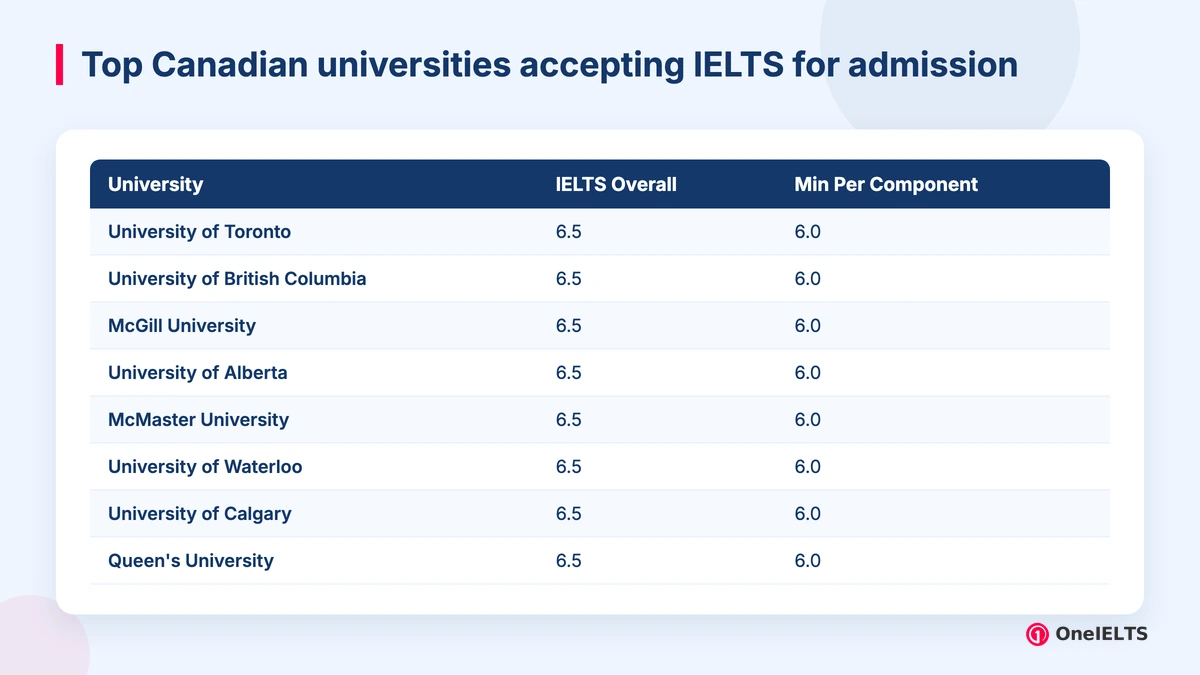
The top universities in Canada that accept IELTS share a common floor, but competitive faculties such as law, medicine, business and engineering often ask for 7.0 or above. The typical minimum is IELTS 6.5 overall with no band below 6.0 on your IELTS Academic result. Always check the specific program, because the overall band score and the minimum per component both vary by course and by undergraduate and postgraduate level.
The table pairs ten well-known institutions with their usual IELTS entry bar.
| University | IELTS Overall | Minimum Per Component |
|---|---|---|
| University of Toronto | 6.5 | 6.0 |
| University of British Columbia | 6.5 | 6.0 |
| McGill University | 6.5 | 6.0 |
| University of Alberta | 6.5 | 6.0 |
| McMaster University | 6.5 | 6.0 |
| University of Waterloo | 6.5 | 6.0 |
| University of Calgary | 6.5 | 6.0 |
| Western University | 6.5 | 6.0 |
| Queen’s University | 6.5 | 6.0 |
| University of Ottawa | 6.5 | 6.0 |
Exact minimums vary by course and rise for graduate programs. Last verified: 30 June 2026.
How Can You Work in Canada with IELTS?
Working in Canada with IELTS means proving your English through IELTS General Training, the version Canadian work and immigration routes recognise. Academic results do not feed work pathways, so for a Canadian work permit, General Training is the test to book.
Five work routes rely on an IELTS General Training result, set out here with where the score bites.
- Post-Graduation Work Permit (PGWP): After you finish a Canadian program, a Post-Graduation Work Permit (PGWP) lets you work for up to three years. The permit itself is study-based, but the Canadian work experience it gives you strengthens an Express Entry profile that does read your General Training scores.
- Express Entry work-based PR routes: Express Entry work-based routes score your IELTS General Training result as a Canadian Language Benchmark, so a higher band lifts your ranking points. Skilled workers with strong English and Canadian job experience clear the cut-off far more often.
- Provincial Nominee Program (PNP) work streams: A Provincial Nominee Program (PNP) stream lets a province nominate you for permanent residence on a local job offer or in-demand occupation. Most streams set their own minimum CLB level that your General Training scores must meet before nomination.
- Professional licensing for regulated occupations: Regulated occupation licensing for nurses, doctors, engineers and teachers often demands IELTS or a sector test, separate from the visa. Even a fluent applicant proves English again to the provincial regulator before practising in that field.
- Employer-specific work permits (often LMIA-based): An employer-specific work permit, frequently backed by a Labour Market Impact Assessment, ties you to one employer. Many such permits skip IELTS, but applying later for permanent residence still pulls you back to a General Training test.
What Is the Canada Visa Process with IELTS?
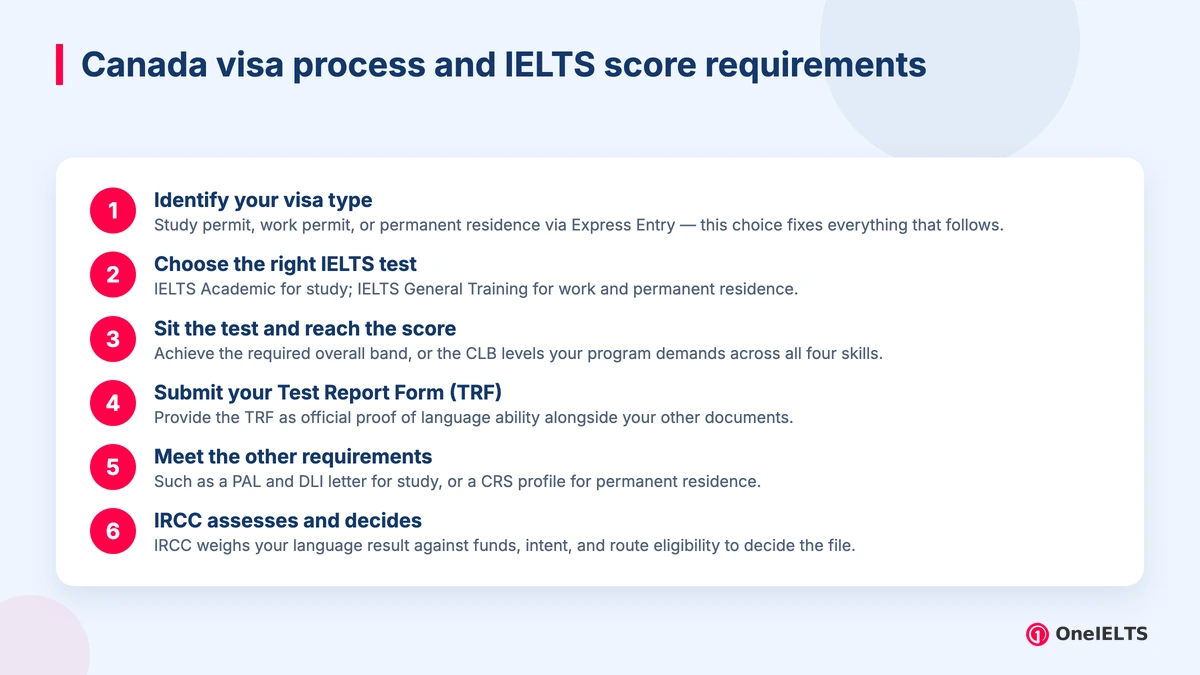
The Canada visa process places your IELTS result early, before the application itself. The three main Canadian visa types are the study permit, the work permit, and Express Entry permanent residence. Each needs a specific IELTS version: Academic for study, General Training for work and PR.
The sequence shows where your IELTS result enters a Canadian application.
- Identify your visa type, whether a study permit, a work permit, or permanent residence through Express Entry, because this choice fixes everything that follows.
- Choose the right IELTS test for that route, IELTS Academic for study and IELTS General Training for work and permanent residence.
- Sit the test and achieve the required overall score, or the CLB levels your chosen program demands across all four skills.
- Submit your IELTS Test Report Form (TRF) as official proof of your language ability alongside the rest of your documents.
- Meet the other requirements, such as a PAL and a DLI letter for study, or a CRS profile for permanent residence.
- IRCC assesses the complete application and decides, weighing your language result against funds, intent, and route eligibility.
How Much Does IELTS Cost in Canada?
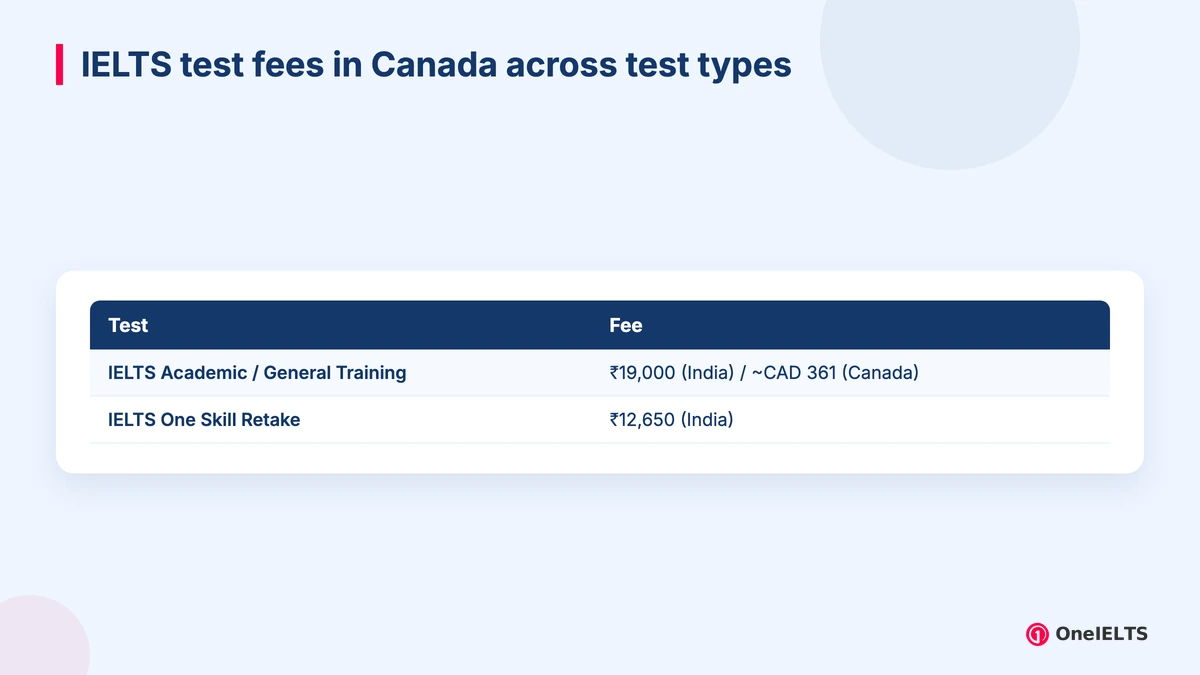
In India, IELTS Academic and IELTS General Training both cost about ₹19,000, while sitting the test in Canada costs roughly around CAD 361 (before tax; varies by centre), a figure you should confirm locally. The fee is identical for the computer-delivered and paper-based formats. The IELTS One Skill Retake is charged separately, on top of the full test fee, at a lower rate you should confirm with IDP or the British Council. The fees come from the official providers, IDP and British Council, and change periodically, so treat these IELTS fees as a guide.
The table sums up the current Canadian-market fees.
| Test | Fee |
|---|---|
| IELTS Academic / General Training | ₹19,000 / around CAD 361 (before tax; varies by centre) (approx.) |
| IELTS One Skill Retake | ₹12,650 (India) |
Last verified: 30 June 2026.
How Can You Get Permanent Residency (PR) in Canada with IELTS?
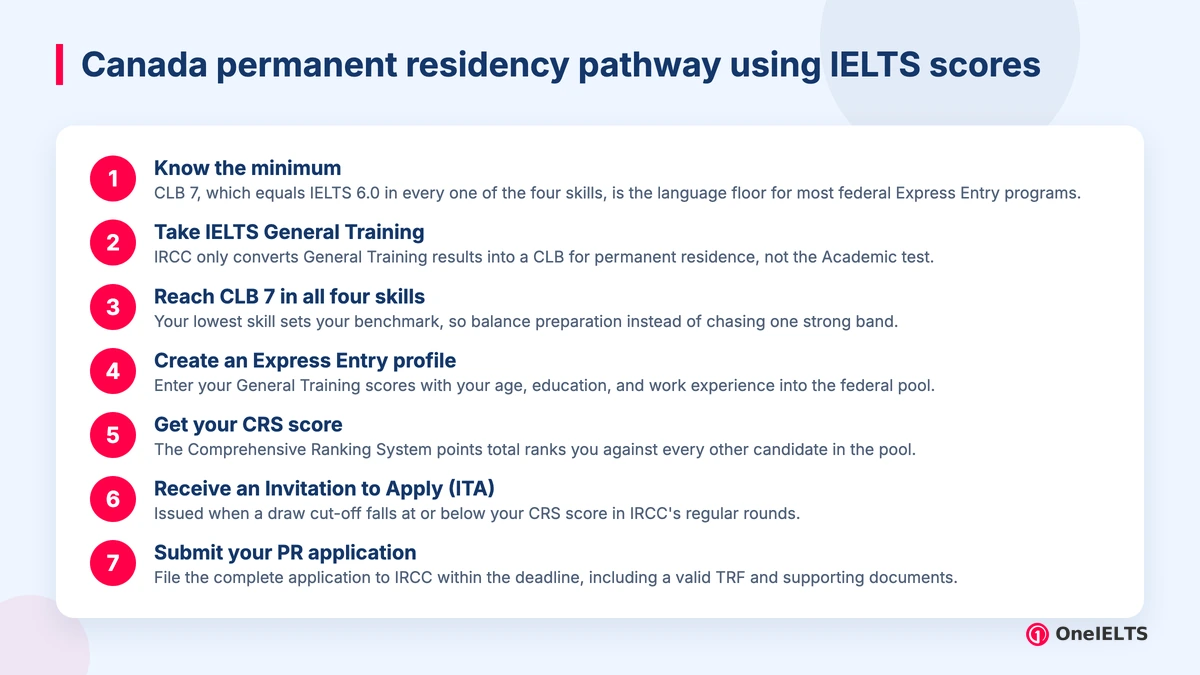
Getting Permanent Residency (PR) in Canada runs through the Express Entry system, and IELTS General Training sits at its core. IRCC converts those scores, not Academic ones, into the Canadian Language Benchmark (CLB) that drives your Comprehensive Ranking System (CRS) total.
The path from test booking to a permanent residence decision follows seven steps.
- Know the minimum: CLB 7, which equals IELTS 6.0 in every one of the four skills, is the language floor for most federal Express Entry programs.
- Take IELTS General Training rather than the Academic test, because IRCC only converts General Training results into a Canadian Language Benchmark for permanent residence.
- Reach at least CLB 7 in all four skills, remembering your lowest skill sets your benchmark, so balance your preparation instead of chasing one strong band.
- Create an Express Entry profile in the federal pool, entering your General Training scores along with your age, education, and work experience.
- Get your Comprehensive Ranking System (CRS) score, the points total that ranks you against every other candidate currently in the Express Entry pool.
- Receive an Invitation to Apply (ITA) when a draw cut-off falls at or below your CRS score, which happens in IRCC’s regular rounds.
- Submit your complete PR application to IRCC within the deadline, including your valid Test Report Form and supporting documents, for the final decision.
What IELTS Band Score Is Required for Canadian Permanent Residency?
Canadian PR requires at least CLB 7, which equals IELTS 6.0 in each of the four skills, and there is no single overall band. IRCC benchmarks each skill on its own, so your lowest skill sets your effective Canadian Language Benchmark.
A higher result, for example CLB 9 at around IELTS 8/7/7/7, maximises your language points under the Comprehensive Ranking System (CRS) for competitive Canada PR draws in the Federal Skilled Worker Program (FSWP). Because of this per-skill conversion, our IELTS band score guide is worth a read before you sit the test.
Is IELTS Academic or General Training Better for Canada PR?
For Canada PR you must take IELTS General Training, because IELTS Academic is not accepted by IRCC for permanent residence. Academic supports study permits and university admission, while General Training is built for work and immigration.
The CLB conversion only applies to General Training scores for Express Entry, so an Academic result, however high, earns you no permanent residence points. If you are weighing the two, our IELTS Academic vs General Training comparison lays out the difference.
When Does Your IELTS Score Expire for Canada Visa and PR Applications?
An IELTS score is valid for two years from the test date for Canadian visa and PR applications. For Express Entry, your result must still be inside that two-year validity period both when you create your Express Entry profile and when you submit the PR application after an invitation.
An expired Test Report Form (TRF) is rejected outright, which can collapse a whole application, so plan your test date around your timeline and IRCC requirements. Our IELTS score validity guide covers the timing for a Canada visa application in detail.
Can IELTS One Skill Retake Help You Reach the Score for Canada PR?
No, IRCC requires one complete IELTS sitting, so an IELTS One Skill Retake result cannot be used for Express Entry PR. One Skill Retake lets you resit a single section within 60 days of a computer-delivered IELTS Academic or General Training test, which can rescue a study or university score.
For permanent residence, though, you must submit one full IELTS General Training test with all four skills from a single complete sitting. Our IELTS One Skill Retake guide explains exactly when the resit counts.
Practice for the Real IELTS Exam
Apply what you’ve learned with free, exam-style practice:
- Take a full IELTS mock test
- Practice by section: Listening, Reading, Writing, Speaking
- Structure your essays with IELTS Writing templates