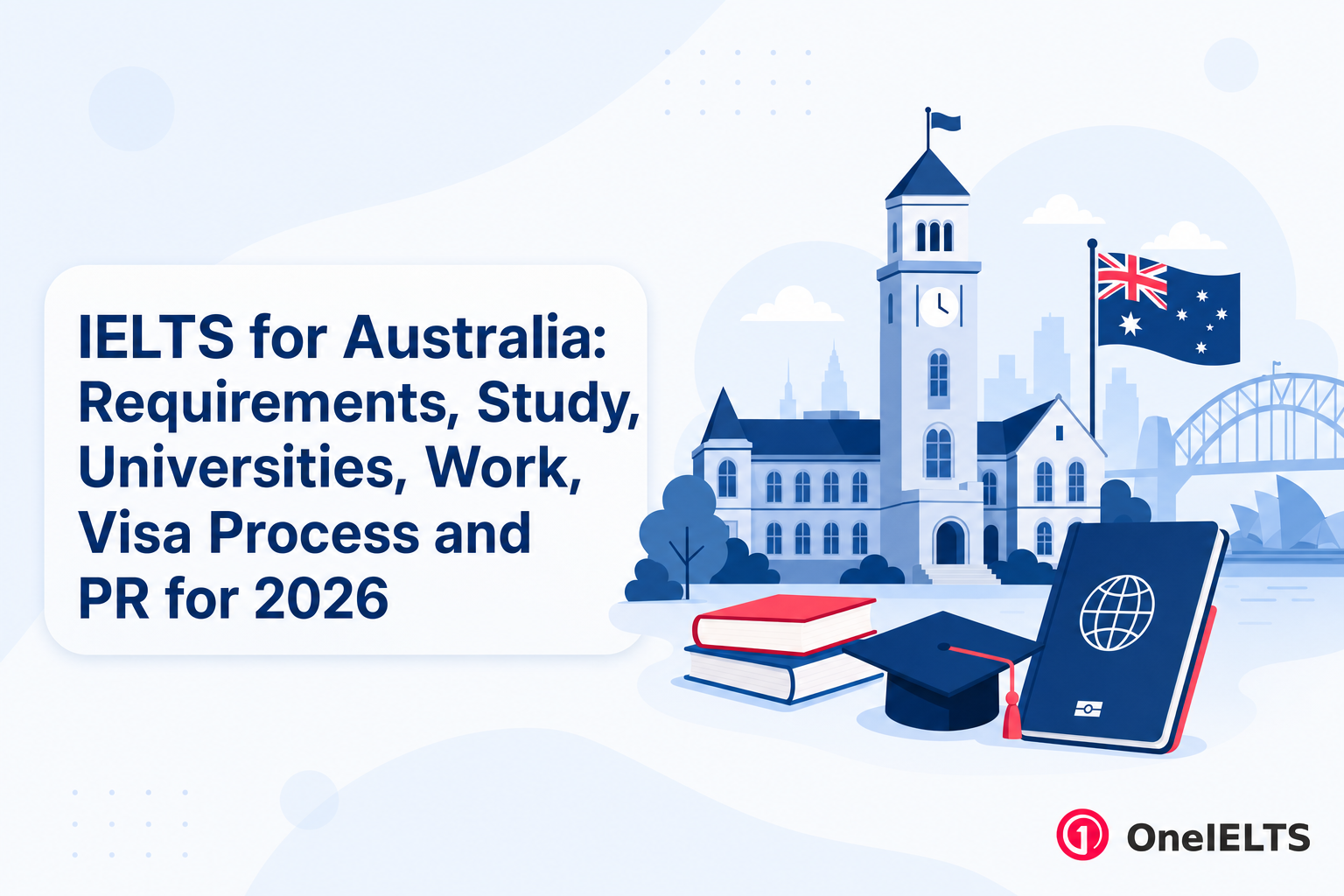
To study, work, or settle in Australia you must prove your English, and for most applicants that proof is IELTS for Australia, taken as either IELTS Academic or IELTS General Training. The International English Language Testing System (IELTS) is recognised by the Department of Home Affairs (DoHA), Australian universities, and employers.
This guide covers which tests Australia accepts, the IELTS requirements by purpose, and how IELTS helps you study. It then maps the top Australian universities and their bands, how you work in Australia with IELTS, the student visa (subclass 500) route, the visa process, the fees, and Australian Permanent Residency (PR). The one rule competitors miss: for skilled migration your bands convert to SkillSelect points, where Competent / Proficient / Superior English buys 0, 10, or 20 points.
Last verified: 30 June 2026
Which IELTS Tests Does Australia Accept?
Australia accepts both IELTS Academic and IELTS General Training, and the Department of Home Affairs (DoHA), universities, and employers all recognise IELTS for Australia. Academic is used for study and professional registration, while either version is accepted for skilled migration. Australia uses the standard IELTS, so there is no separate secure test of the kind the UK runs with IELTS for UKVI.
IELTS works as proof of English proficiency because it scores all four skills on the same nine-band scale that Australian admissions and visa officers already read. If one skill falls short, One Skill Retake (OSR) lets you resit just that section rather than the whole test.
What Are the IELTS Requirements for Australia?
The IELTS requirements for Australia depend on your purpose, because a study place, a work visa, and points-tested PR each set a different bar. Australian universities commonly expect IELTS Academic around 6.5, while the Department of Home Affairs reads your bands as Competent English plus SkillSelect points rather than a single minimum overall IELTS score. The three requirement tiers, each detailed in the sections that follow, are named here.
- The IELTS score you need for an Australian student visa.
- The IELTS score you need for an Australian work visa.
- The IELTS score you need for Australian permanent residence.
1. IELTS Score for an Australian Student Visa
The Australian student visa (subclass 500) lets you study a registered course full-time, and your IELTS Academic score proves you can cope with English-medium teaching. The Department of Home Affairs commonly accepts overall 5.5 to 6.0 for the visa with no band less than 5.0, while most universities ask 6.5 with no band below 6.0 before they issue a Confirmation of Enrolment (CoE).
A packaged ELICOS or foundation course can lower the entry band, since the English class sits before your main degree. Which type of IELTS test should you take for an Australian student visa? You take IELTS Academic, which is the version that meets the university entry requirement.
2. IELTS Score for an Australian Work Visa
The Australian work visa routes run mainly through skilled and employer-sponsored streams, and IELTS proves the English level each one demands. Competent English, meaning 6.0 in each band, is the common minimum for skilled and employer-sponsored visas such as the Temporary Skill Shortage visa (subclass 482).
Some skills assessment bodies and regulated professions, including nursing, teaching, and engineering, require 7.0 in each band or higher. Which type of IELTS test should you take for an Australian work visa? Either Academic or General Training is accepted for most work routes.
3. IELTS Score for Australian Permanent Residence
Australian permanent residence runs through the points-tested skilled visas, the subclass 189 / 190 / 491 group, where English is scored as points rather than a single pass. Competent English (6 each) earns 0 points, Proficient English (7 each) earns 10 points, and Superior English (8 each) earns 20 points.
Your level is set by your lowest of the four bands, so Superior English needs a genuine 8.0 in every skill. Which type of IELTS test should you take for Australian permanent residence? Academic or General Training both count, and you lodge the result with your SkillSelect Expression of Interest (EOI).
How Does IELTS Help You Study in Australia?
IELTS helps you study in Australia by proving you can learn in an English-medium environment, and the Department of Home Affairs accepts the score for the student visa subclass 500. Australian universities read your IELTS Academic result as direct evidence of English language proficiency before they admit you. The specific ways IELTS supports your study plan in Australia are set out below.
- Student Visa (subclass 500) Approval. A qualifying IELTS Academic score satisfies the English condition the Department of Home Affairs attaches to the subclass 500 student visa, clearing one of the main hurdles before you can travel to study in Australia.
- University and College Admission. Australian universities and colleges set IELTS as the standard admission test, so meeting the program minimum makes you eligible for an offer and a Confirmation of Enrolment at the institution you want.
- Competitive Advantage. A band above the minimum strengthens your application for selective courses and scholarships, because admissions teams read a higher IELTS score as stronger readiness for demanding English-medium study in Australia.
- Course and Pathway Choice. A solid IELTS Academic result widens the courses and pathway programs open to you, since competitive degrees in law, health, and engineering set higher English bars than general undergraduate entry.
- Foundation for the Post-Study Work (subclass 485) visa. Studying on a qualifying course builds toward the subclass 485 Graduate visa, and the English proficiency you proved through IELTS underpins your later move into the Australian skilled workforce.
Can You Study in Australia Without IELTS?
Yes, several Australian universities admit international students without IELTS, provided you can prove your English another way. The study in Australia without IELTS route relies on common alternatives: a Medium of Instruction (MOI) letter, prior study in English, or accepted tests such as PTE Academic / TOEFL / Duolingo.
Example institutions that may waive the test include the University of Queensland, University of Southern Queensland, and Swinburne, though you should verify each current policy before you rely on a conditional offer. Note that the subclass 500 visa may still need its own proof of an English requirement even when the university waives the test.
What Are the Top Universities in Australia That Accept IELTS?
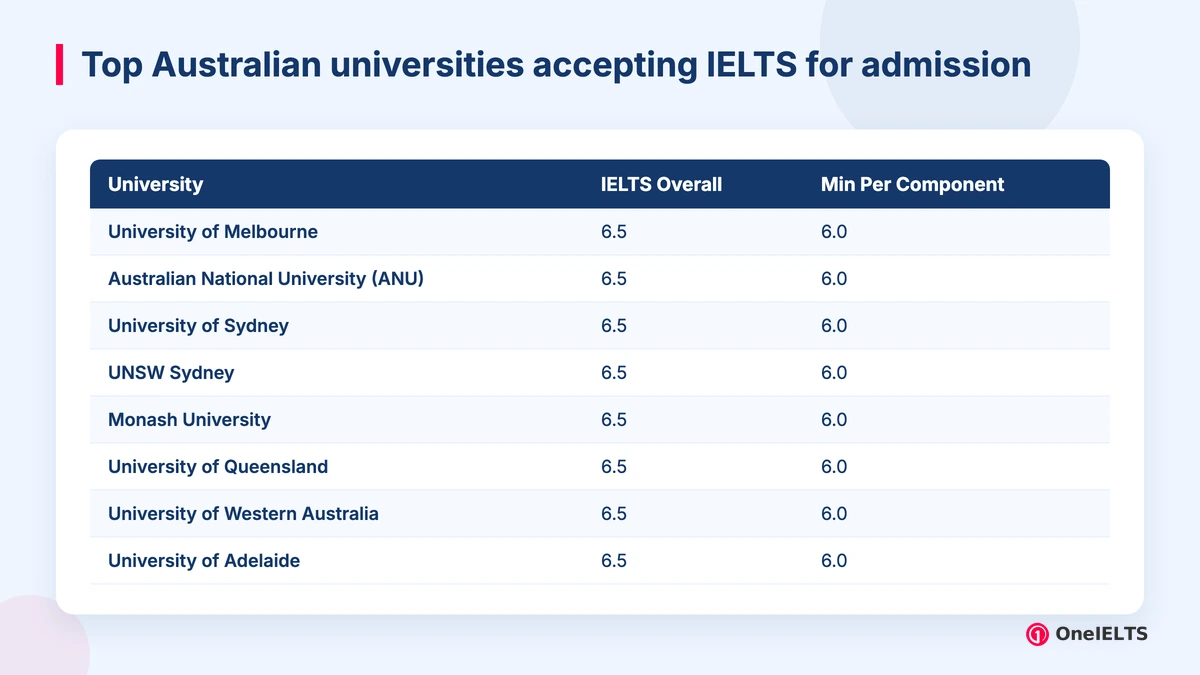
Almost every top university in Australia accepts IELTS, and the top universities in Australia for Indian applicants are mostly the Group of Eight (Go8) research institutions. The typical minimum is IELTS 6.5 overall with no band below 6.0, but competitive courses such as law, medicine, nursing, and teaching often ask 7.0 or more on the overall band score. The IELTS Academic minimums for ten leading universities are set out in the table below, with each minimum per component noted where it applies.
| University | IELTS Overall | Minimum Per Component |
|---|---|---|
| University of Melbourne | 6.5 | 6.0 |
| Australian National University (ANU) | 6.5 | 6.0 |
| University of Sydney | 6.5 | 6.0 |
| UNSW Sydney | 6.5 | 6.0 |
| Monash University | 6.5 | 6.0 |
| University of Queensland | 6.5 | 6.0 |
| University of Western Australia | 6.5 | 6.0 |
| University of Adelaide | 6.5 | 6.0 |
| University of Technology Sydney (UTS) | 6.5 | 6.0 |
| Macquarie University | 6.5 | 6.0 |
Exact minimums vary by course, so confirm the figure for your specific program. Last verified: 30 June 2026.
How Can You Work in Australia with IELTS?
Working in Australia with IELTS means proving Competent English for a skilled or sponsored visa, and either IELTS version is accepted for most work routes. You should take IELTS Academic or General Training, whichever you can score highest in, because the Department of Home Affairs reads the same bands either way. The Australian work visas that rely on an IELTS result are listed below.
- Skilled Independent visa (subclass 189). This points-tested migration visa needs no sponsor, and your IELTS bands feed the points test directly, so reaching Proficient or Superior English can lift your ranking in a SkillSelect invitation round for skilled applicants.
- Skilled Nominated visa (subclass 190). A state or territory nominates you for this points-tested visa, and your IELTS result both meets the Competent English floor and adds the English points that strengthen your nomination and overall score.
- Skilled Work Regional visa (subclass 491). This provisional regional visa within the subclass 189 / 190 / 491 group uses your IELTS bands for points, and stronger English helps you compete for the limited regional invitations the Department of Home Affairs issues.
- Temporary Skill Shortage visa (subclass 482). Employer-sponsored work on the subclass 482 / 485 routes usually needs Competent English at 6.0 in each band, plus a positive skills assessment that often checks your IELTS result against the occupation standard.
- Temporary Graduate visa (subclass 485). Recent graduates use this visa to work after study, and an IELTS score at the required level satisfies the English condition while you build the experience that supports later points-tested migration.
What Is the Australia Visa Process with IELTS?
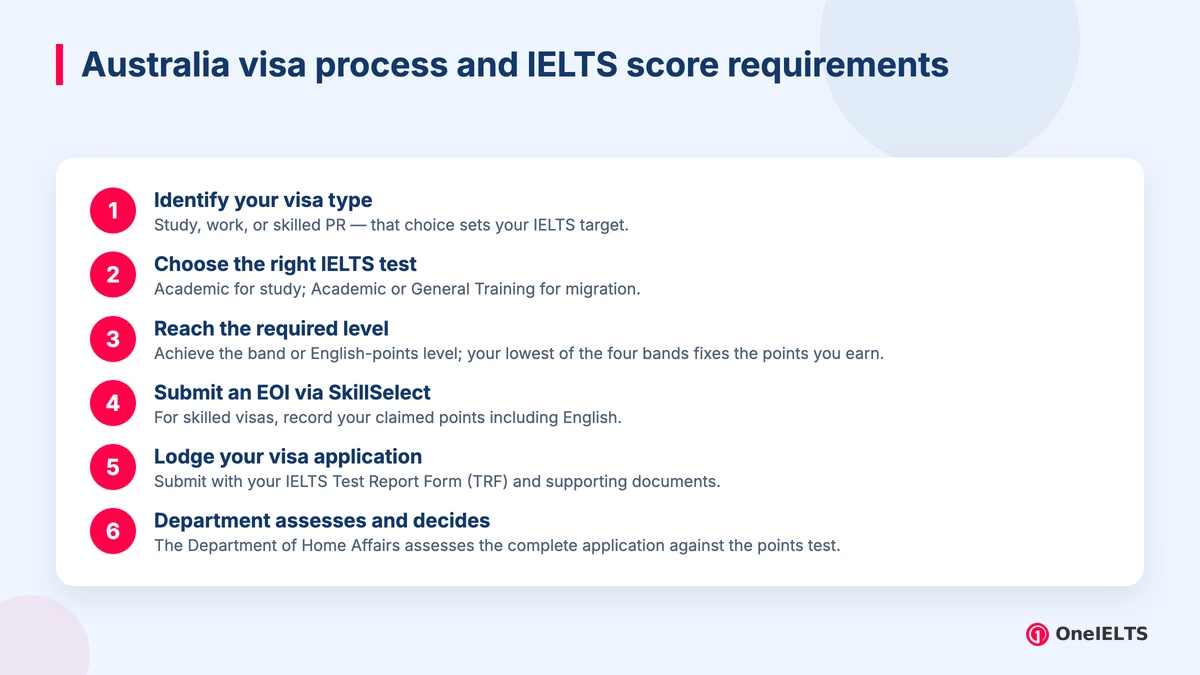
The Australia visa process with IELTS puts your test result early in the timeline, because you cannot lodge most applications until your English is proven. The main visa types are the student subclass 500, the skilled 189/190/491 group, and the graduate 485; study needs IELTS Academic, while migration accepts Academic or General at Competent English or above. The ordered steps of the Australia visa process with IELTS are set out here.
- Identify your visa type, whether you are applying for study, work, or skilled PR, since that choice sets your IELTS target.
- Choose the right IELTS test: Academic for study, and Academic or General Training for migration to Australia.
- Achieve the required band or English-points level, since your lowest of the four bands fixes the points you earn.
- Submit an Expression of Interest (EOI) via SkillSelect for the skilled visas, recording your claimed points including English.
- Lodge your visa application together with your IELTS Test Report Form (TRF) and your supporting documents.
- The Department of Home Affairs assesses the complete application against the points test before it decides the outcome.
How Much Does IELTS Cost in Australia?
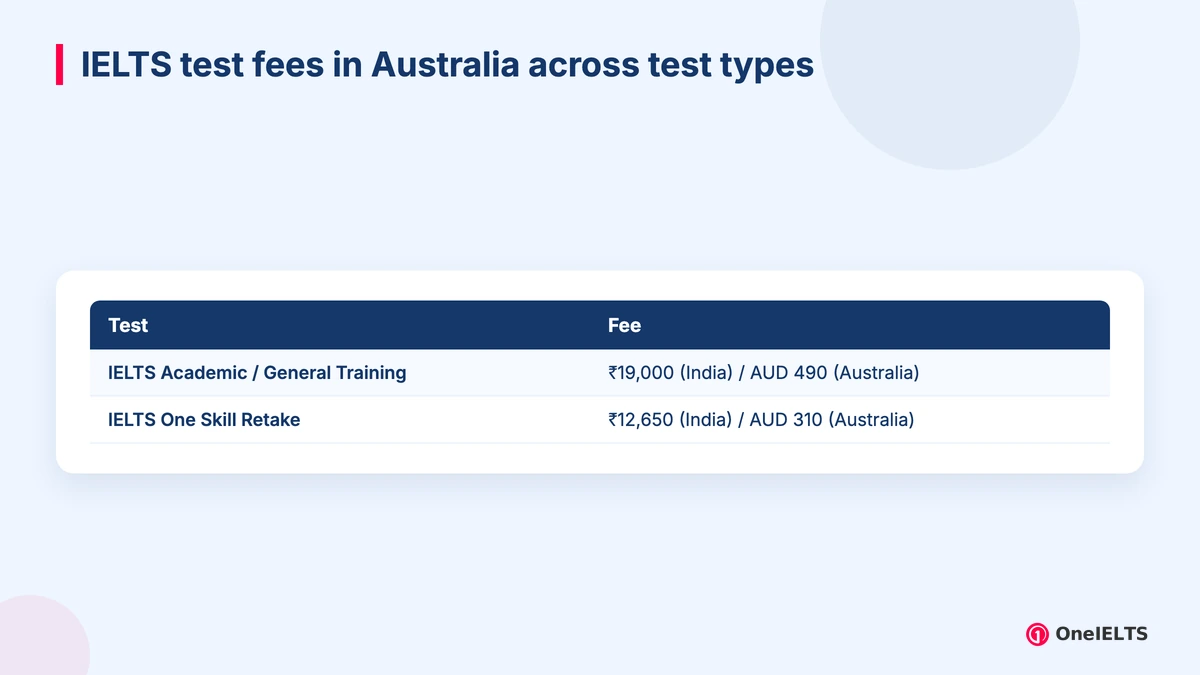
In India, IELTS Academic or IELTS General Training costs about ₹19,000 (the current IDP / British Council India fee); sat in Australia the fee is roughly AUD 490, which you should verify locally. The fee is the same for the computer-delivered and paper-based formats, so the delivery mode does not change what you pay.
The One Skill Retake fee is a separate, lower charge of ₹12,650 in India (AUD 310 in Australia). IDP and the British Council both publish the current figures, and because IELTS fees change you should treat the numbers here as a guide. The current IELTS fees for Australia are set out in the table below. Last verified: 30 June 2026.
| Test | Fee |
|---|---|
| IELTS Academic / General Training | ₹19,000 (India) / AUD 490 (Australia) |
| IELTS One Skill Retake | ₹12,650 (India) / AUD 310 (Australia) |
How Can You Get Permanent Residency (PR) in Australia with IELTS?
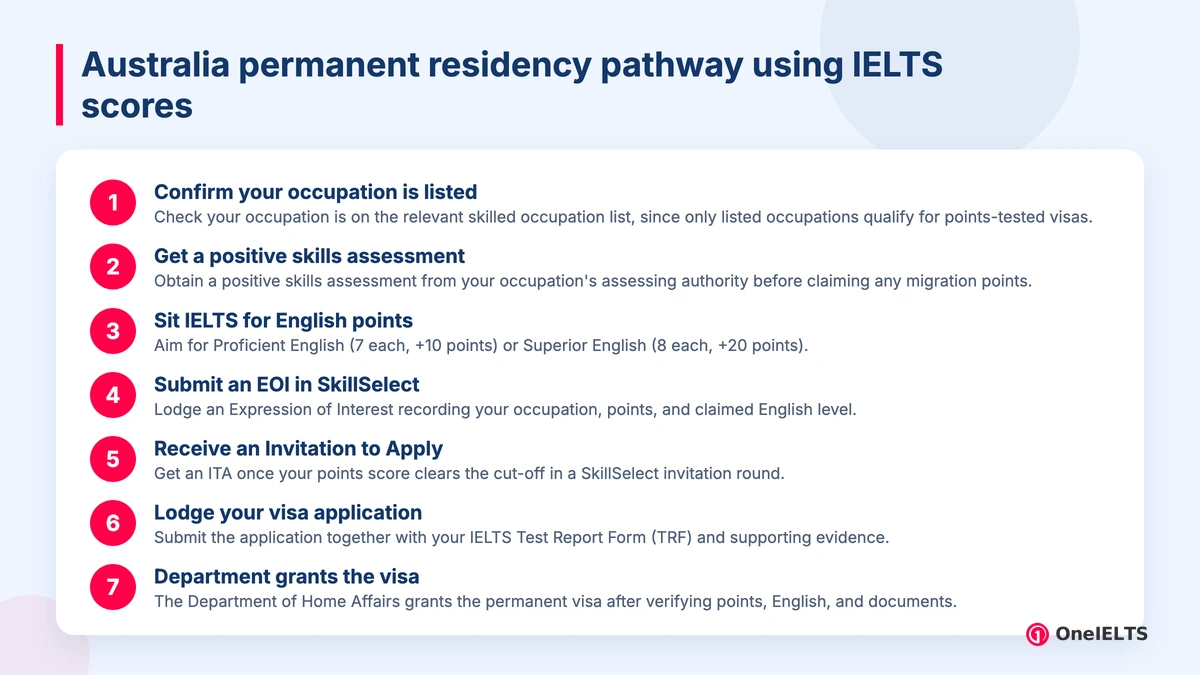
Getting Permanent Residency (PR) in Australia means clearing the points-tested skilled visa with enough SkillSelect points, and your IELTS bands supply the English points that often decide the outcome. The program rewards Proficient / Superior English, so a strong result through the skills assessment and SkillSelect route can lift you above the invitation cut-off. The steps to reach Australian PR with IELTS are numbered here.
- Confirm your occupation is on the relevant skilled occupation list, since only listed occupations qualify for the points-tested visas.
- Get a positive skills assessment from the assessing authority for your occupation before you claim any migration points.
- Sit IELTS and aim for Proficient English (7 each) or Superior English (8 each) to claim the extra 10 or 20 points.
- Submit an Expression of Interest (EOI) in SkillSelect, recording your occupation, your points, and your claimed English level.
- Receive an Invitation to Apply (ITA) once your points score clears the cut-off in a SkillSelect invitation round.
- Lodge your visa application together with your IELTS Test Report Form (TRF) and the rest of your evidence.
- The Department of Home Affairs grants the permanent visa after it verifies your points, your English, and your documents.
What IELTS Band Score Is Required for Australian Permanent Residency?
Australian PR requires at least Competent English, 6.0 in each of the four bands, but most competitive applicants target Proficient (7 each, +10 points) or Superior (8 each, +20 points). On this Competent / Proficient / Superior English ladder your level is set by your lowest band, so every skill must reach the target before the higher SkillSelect points count toward the subclass 189 / 190 streams for Australia PR.
Those extra English points often decide whether you receive an invitation in a SkillSelect round, since two applicants with the same occupation can split on English alone. Our IELTS band score guide explains how each band maps to the nine-band scale.
Is IELTS Academic or General Training Better for Australia PR?
For Australia PR either IELTS Academic or General Training is accepted, so choose the version you can score highest in. Academic is required separately if your skills assessment or professional registration demands it, as it does for nursing and engineering.
IELTS General Training is often easier for the Reading and Writing tasks, which can lift your English points band for the Department of Home Affairs. To weigh the two formats for your occupation, read our IELTS Academic vs General Training comparison.
When Does Your IELTS Score Expire for Australia Visa and PR Applications?
An IELTS result has a two-year validity in general, and the Department of Home Affairs accepts results taken within three years of your skilled visa application in many cases. Verify the rule for your visa. Your IELTS must still be valid when you lodge, not just when you submit your Expression of Interest (EOI), so the lodgement date is the one that counts.
An expired Test Report Form (TRF) is rejected outright, so plan your test date around your invitation timeline. Check the full rules on IELTS score validity in our IELTS score validity guide.
Can IELTS One Skill Retake Help You Reach the Score for Australia PR?
Yes, One Skill Retake lets you resit a single section within 60 days to lift one band, and the Google AI Overview confirms it can help Australia applicants. Confirm with the Department of Home Affairs that the combined result counts for your visa points. One Skill Retake covers computer-delivered IELTS Academic or General Training.
It helps most when one band keeps you from Proficient / Superior English, since a single section can decide between 0 and 10 migration points. See how the resit works in our IELTS One Skill Retake guide.
Practice for the Real IELTS Exam
Apply what you’ve learned with free, exam-style practice:
- Take a full IELTS mock test
- Practice by section: Listening, Reading, Writing, Speaking
- Structure your essays with IELTS Writing templates