You can study abroad without IELTS in 2026 by using an alternative the university already accepts. The usual swaps are an MOI certificate, a Duolingo English Test result, or one of the TOEFL PTE alternatives. This guide ranks eleven countries, then covers the risks, work rules, and the proofs that replace the test.
The eleven countries that admit students without an IELTS requirement are listed below.
- Germany waives IELTS for many English-taught degrees.
- France accepts prior English study and an interview.
- Italy admits students on alternative English proof.
- United Kingdom lets some universities take other evidence.
- Canada offers conditional admission with English pathways.
- Australia accepts a wide range of tests.
- United States sets each requirement by campus.
- Ireland uses pre-sessional English as a route.
- Singapore weighs transcripts and its own check.
- New Zealand takes several equivalent exams.
- United Arab Emirates runs internal English exams.
1. Germany
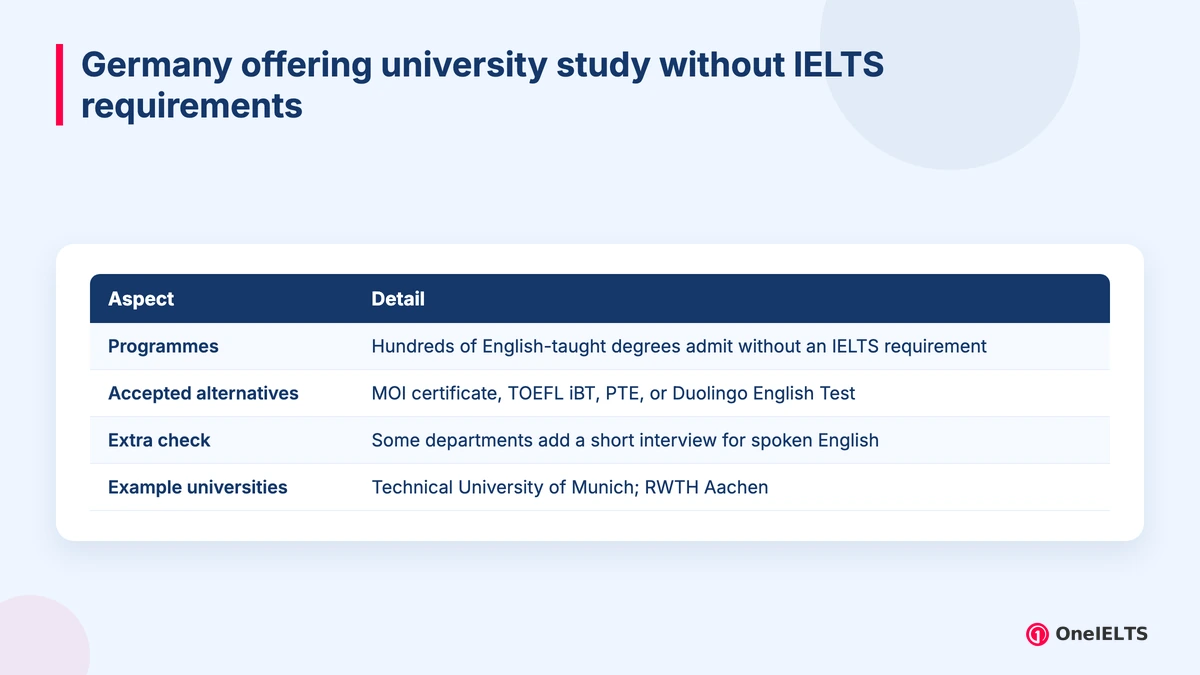
Germany admits students to hundreds of English-taught programmes without an IELTS requirement, which is why it tops most no-IELTS lists. German universities accept proof that your earlier schooling was in English instead.
You can use an MOI certificate, a TOEFL iBT or PTE result, or the Duolingo English Test. Some departments add a short interview to check your spoken English. The Technical University of Munich and RWTH Aachen both admit applicants on these alternatives for designated programmes.
2. France
France lets you study without IELTS at many universities that teach in English, because admissions weigh your full record rather than one score. Sorbonne University and Sciences Po both review applicants without a fixed band for several programmes.
The substitutes are an MOI certificate, a TOEFL / PTE / DET score, or a university interview. A university interview is common at business schools, where the panel judges your fluency directly.
3. Italy
Italy admits students without IELTS at universities that run English-taught degrees and accept other evidence. The University of Bologna and Politecnico di Milano both waive IELTS for eligible applicants.
You can submit an MOI certificate, a TOEFL, PTE or Duolingo score, or sit a departmental interview. Your university acceptance letter then supports your Type D student visa. The consulate checks that university acceptance before it issues the Type D student visa.
4. United Kingdom
The United Kingdom lets some universities admit you without IELTS when they hold their own assessment powers. The University of Greenwich and the University of Bristol accept other evidence for certain courses.
Universities may take Class 12 English scores from an English-medium board, MOI certificates, or SELT alternatives (TOEFL, PTE, Trinity, DET). Where the course needs a Student visa, the university confirms which SELT alternatives the Home Office will accept.
5. Canada
Canada admits students without IELTS through conditional offers, where the university accepts you academically and you prove English separately. The University of Winnipeg and Concordia University both run this model.
The alternatives are an MOI certificate, an Intensive English Program before your degree, or an ESL pathway that bridges you into study. An Intensive English Program runs one or two terms, and finishing it clears the language condition.
6. Australia
Australia lets many universities admit students without IELTS by accepting a wider set of approved tests. Macquarie University and the University of South Australia both list alternatives for direct entry.
You can submit a TOEFL / PTE / CAE / DET result, an MOI certificate, or sit a university interview. Each university publishes its accepted-test table online, so you check the minimum for your course first.
7. United States
The United States sets English rules at the institution level, so many universities admit students without IELTS using their own proof. Arizona State University and the University of Dayton both offer IELTS-optional routes.
The substitutes include an MOI certificate, a Duolingo / PTE score, or an internal English test the campus runs. An internal English test is common on conditional offers, taken during orientation rather than before travel.
8. Ireland
Ireland admits students without IELTS at universities that run pre-sessional English or accept other proof. University College Dublin and the University of Galway both waive the test for eligible applicants.
You can use an MOI certificate, alternative tests such as TOEFL or PTE, or a pre-sessional English course before your degree. A pre-sessional English course of six to twelve weeks clears the language condition on campus.
9. Singapore
Singapore admits students without IELTS at universities that judge English through prior schooling and their own checks. The National University of Singapore and Nanyang Technological University both review English-medium applicants this way.
Admissions teams weigh your academic transcripts, an MOI certificate, or an internal English test. Strong academic transcripts from an English-medium school often satisfy the condition alone, with the internal test kept for borderline cases.
10. New Zealand
New Zealand lets many universities admit students without IELTS by accepting equivalent English qualifications. The University of Auckland and Victoria University of Wellington both list alternatives for entry.
You can submit a PTE / DET / Cambridge result, an MOI certificate, or sit a university interview. Your offer must still clear NZ immigration, so you confirm your proof satisfies the visa officer too.
11. United Arab Emirates
The United Arab Emirates admits students without IELTS at universities in Dubai and Abu Dhabi that run internal English exams. The University of Birmingham Dubai and Amity University Dubai both accept alternatives.
You can prove English with an MOI letter, internal English exams set on campus, or a PTE / Duolingo score. Many UAE campuses run the internal English exams during admission week, so you sit one after arriving.
What Are the Risks of Studying Abroad Without IELTS?
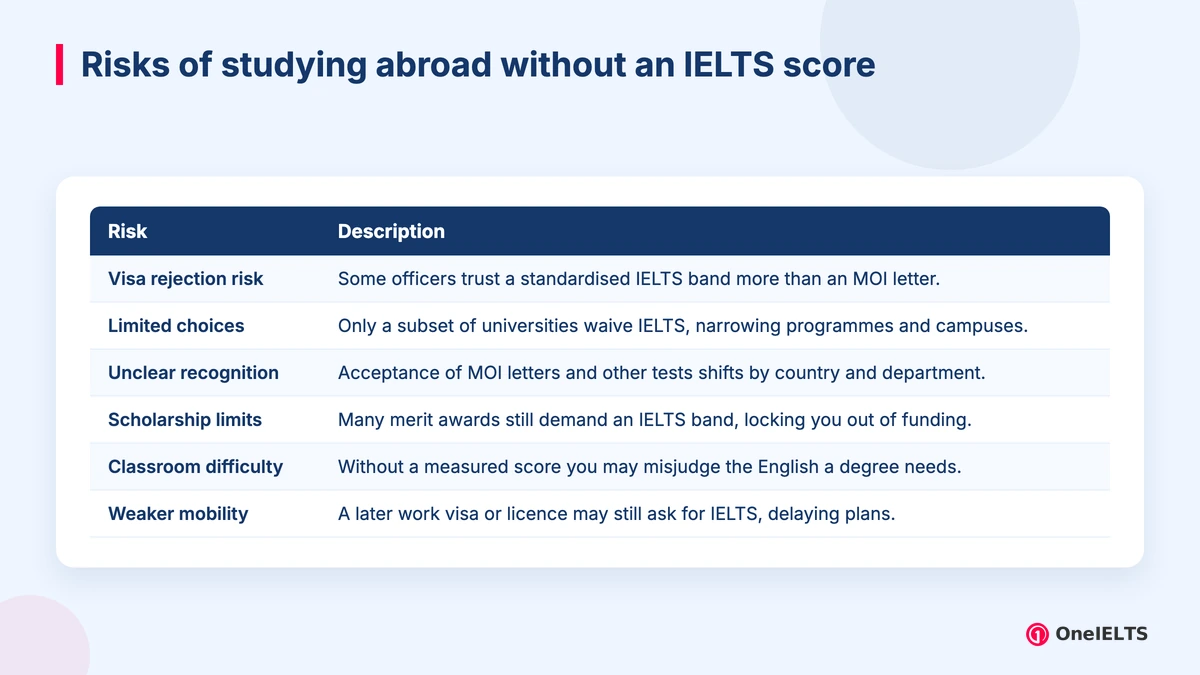
Skipping IELTS narrows your options and adds uncertainty, even though the waiver routes are legitimate. An officer or admissions team may not trust an alternative as readily as an IELTS band, so the path carries real trade-offs.
The main risks of studying abroad without an IELTS score appear in the list that follows.
- Visa rejection risk. Some officers trust a standardised IELTS band more than an MOI letter, so a missing test raises the visa rejection risk on your file.
- Limited choices. Only a subset of universities waive IELTS, so you face limited choices among programmes and campuses you can apply to.
- Unclear recognition. Acceptance of MOI letters and other tests shifts by country and department, leaving you unsure whether your proof qualifies.
- Scholarship limits. Many merit awards still demand an IELTS band, so scholarship limits can lock you out of funding you would otherwise win.
- Classroom difficulty. Without a measured score you may misjudge the English a degree needs, so classroom difficulty grows once lectures begin.
- Weaker mobility. A later work visa or licence may still ask for IELTS, so skipping it now can delay your plans abroad.
Can You Get a Job Abroad Without IELTS?
Yes – some employers accept an MOI, prior English-medium study or another test instead of IELTS, especially for graduate roles taught in English. English-mediated roles in client-facing or regulated fields may still expect formal proof, so check each employer’s policy before you rely on alternative tests.
Is IELTS Still Recommended for Study Abroad in 2026?
Yes – IELTS is still the most widely accepted route and opens the most options across universities, visa systems, and scholarships. A band score gives you more options, while conditional waivers are not offered everywhere. You can compare the test’s reach in our IELTS overview before you decide.
Can You Get Permanent Residency Without IELTS?
Sometimes – a few PR pathways accept alternative language tests or family/investment routes, but most points-based systems still need IELTS to award language points. Family / investment visas often skip a formal English test, while skilled streams rarely do. Check the specific program’s accepted tests on its official immigration page first.
Which English Alternatives Replace IELTS?
The common substitutes are an MOI letter, the Duolingo English Test, TOEFL iBT and PTE Academic, each treated by many universities as equivalent evidence. Acceptance varies by university and country, so one campus takes a Duolingo English Test result while another wants TOEFL iBT or PTE Academic. See which destinations recognise the test in our guide to countries that accept IELTS.
Last verified: 30 June 2026
Practice for the Real IELTS Exam
Apply what you’ve learned with free, exam-style practice:
- Take a full IELTS mock test
- Practice by section: Listening, Reading, Writing, Speaking
- Structure your essays with IELTS Writing templates