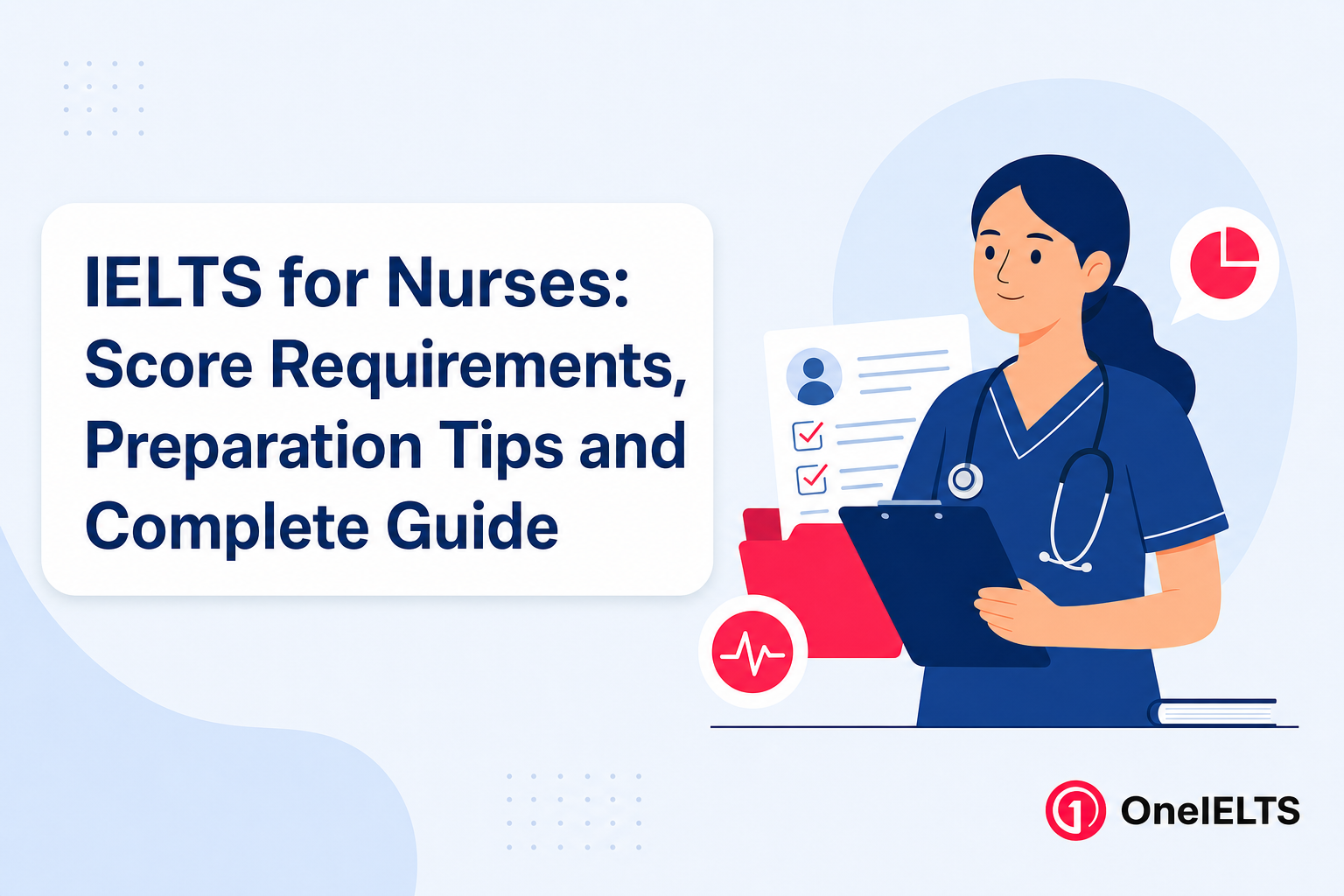
Before an internationally trained nurse can work a single shift abroad, the nursing regulator wants proof of English, and for most that proof is IELTS for nurses. Nurses sit the Academic test to register with bodies like the UK NMC, Australia’s AHPRA, and Ireland’s NMBI, which typically ask for an overall 7.0, often 7.0 each band. Nursing regulators run looser than medical ones. The NMC accepts a 6.5 in Writing, lets you combine two sittings within six months, and accepts OET, so nurses reach the bar by more routes than doctors.
This guide covers why nurses need IELTS and the score requirements by country. It then walks through how to prepare around shifts, the Academic-versus-General question, the exam fees, and the IELTS-or-OET choice. It closes on whether you can combine sittings or use a One Skill Retake. Some nurses also face the NCLEX separately for clinical licensure.
Why Do Nurses Need IELTS?
Nurses need IELTS to register with a nursing council and prove safe English communication with patients. Every major regulator treats English proficiency as a patient safety control, not paperwork. A nurse who misreads a drug chart or misunderstands a handover puts lives at risk.
This registration requirement sits separate from your work visa. Immigration may grant you the right to enter a country, but the nursing council still verifies your English before it adds you to the register and lets you practise.
What IELTS Score Do Nurses Need by Country?
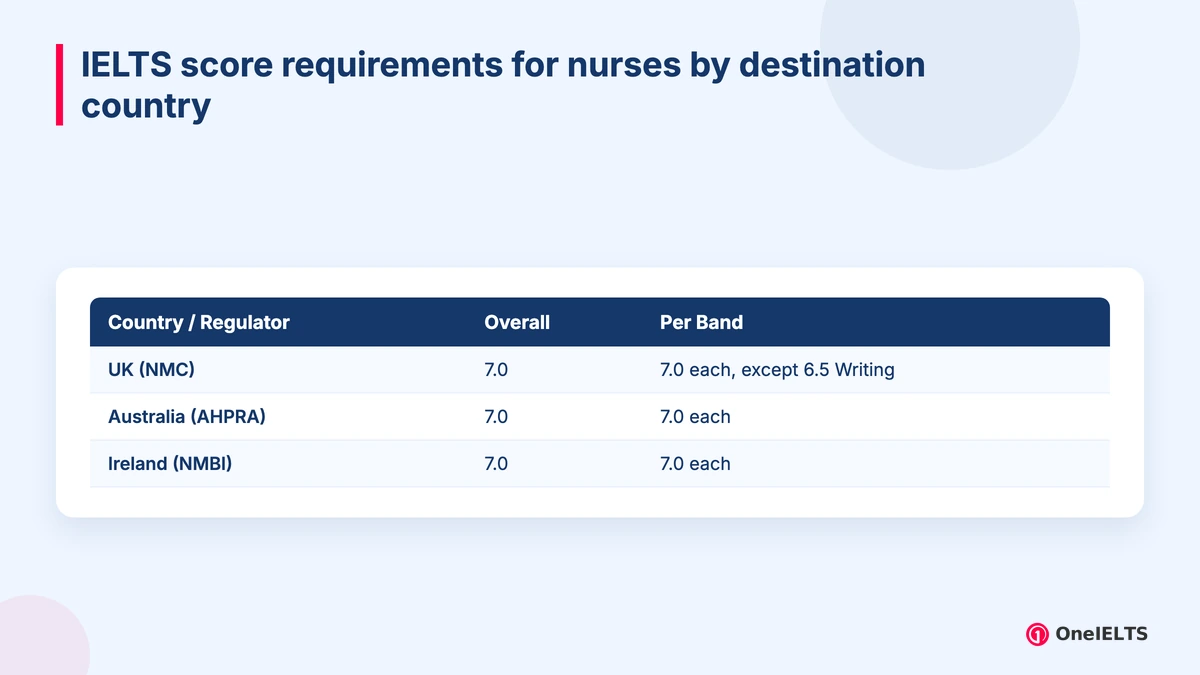
The three big English-speaking nursing registers cluster around an overall 7.0, though the NMC carves out one concession on Writing that the others do not. The table below sets each regulator’s minimum side by side so you can see the per-band detail.
| Country/Regulator | Overall | Per Band |
|---|---|---|
| UK (NMC) | 7.0 | 7.0 each, except 6.5 Writing |
| Australia (AHPRA) | 7.0 | 7.0 each |
| Ireland (NMBI) | 7.0 | 7.0 each |
Last verified: 30 June 2026
The UK NMC is the outlier: it accepts a 6.5 Writing band as long as your other three bands hit 7.0. AHPRA and NMBI hold the line at 7.0 each, with no single-band relief.
How Can Nurses Prepare for IELTS?
Working nurses rarely get clean study weeks, so the prep that works is built around rotating shifts rather than against them. Here are the preparation tips that fit a nurse’s working life.
- Build medical English into daily handovers by noting the formal term beside the ward shorthand you already use.
- Use shift-friendly study blocks of 25 to 40 minutes between or after shifts instead of waiting for a free day.
- Drill Writing Task 2 essay structure on rest days, since most nurses lose marks on argument organisation, not vocabulary.
- Book weekly Speaking practice with a partner or tutor to rehearse fluency under timed pressure.
- Rotate through one full timed listening and reading set each week to build exam stamina.
Do Nurses Need IELTS Academic or General Training?
Nurses need IELTS Academic, not General Training. Regulators such as the UK NMC accept the Academic test, including Academic UKVI where a visa-approved version is required, and they do not accept General Training for registration. The Academic module suits clinical English because its reading passages and Writing Task 1 data descriptions mirror the dense, evidence-based language nurses meet in care plans, research summaries, and patient charts.
What Are the IELTS Exam Fees for Nurses?
Nurses pay the standard IELTS Academic fee, with no separate nurse rate. The test provider charges every Academic candidate the same price, so a nurse and a university applicant booking the same session pay identically. The current standard India fee is ₹19,000; confirm the live figure on the IDP / British Council booking page before publishing.
Last verified: 30 June 2026
Which English Test Is Best for Nurses, IELTS or OET?
OET is healthcare-specific while IELTS is general academic English, so the right test depends on your regulator and where you feel stronger. OET builds its tasks around clinical scenarios like writing a referral letter, whereas IELTS tests broader academic English. Weigh the decision factors below before you book.
- Regulator acceptance: confirm your council takes both, since some accept only one.
- Healthcare English comfort: OET rewards nurses fluent in clinical contexts and tasks.
- General English strength: IELTS suits candidates confident across academic topics.
- Resource availability: IELTS has wider preparation material and more test dates worldwide.
Can Nurses Combine Two IELTS Sittings?
Yes, some regulators such as the UK NMC let nurses combine two IELTS sittings taken within six months. The conditions are strict, and the rule that lets you combine sittings only holds when each sitting clears a 6.5 minimum in every skill. No band can drop below that floor, and both sittings must fall inside the six-month window.
The council then takes your best band from each sitting to build a combined result. Check the exact thresholds in our IELTS band score guide before you book a resit.
Is the One Skill Retake Accepted for Nurse Registration?
Some nursing regulators accept a One Skill Retake, but confirm with your council before relying on it. The One Skill Retake lets you resit just one of the four skills and merge it into your original score for a combined result, which can rescue a single weak band.
Acceptance is not universal, so verify per regulator that they recognise the retake for registration rather than assuming it counts. Read how the process works in our IELTS One Skill Retake guide.
Practice for the Real IELTS Exam
Apply what you’ve learned with free, exam-style practice:
- Take a full IELTS mock test
- Practice by section: Listening, Reading, Writing, Speaking
- Structure your essays with IELTS Writing templates