IELTS, the International English Language Testing System is the test you most likely need if you plan to study or work in abroad. It comes in two forms — IELTS Academic and IELTS General Training — and works as the English language proficiency test that universities and immigration authorities trust. The same band score serves two scoring logics. A university reads your overall band as an admission cut-off, while immigration systems convert each skill separately, so your weakest skill can outweigh your overall band.
This guide covers the full form, the types of IELTS test, and why IELTS matters. It walks through the test format, the band score, preparation, fees, booking, the syllabus, who runs the exam, and what happens on test day. Finally it explains why IELTS opens doors across higher education and migration for the 12,500 organizations that accept it.
Last verified: 30 June 2026
What Is the IELTS Full Form and Meaning?
IELTS is the International English Language Testing System, the world’s most popular English-proficiency exam. It is the standard form of English language testing for people who want to study, work, or migrate in an English-speaking environment. It is accepted by over 12,500 organizations worldwide, including universities, employers and immigration authorities. The test assesses four skills — Listening Reading Writing Speaking — and reports each on a nine-band scale from 1 to 9. You can sit it on computer or paper, and the British Council / IDP jointly deliver it with Cambridge.
Who Conducts the IELTS Exam?
IELTS is jointly owned and run by three partners — the British Council, IDP IELTS Australia, and Cambridge English — who set the questions, train examiners, and protect the standard together. This shared ownership is why your band means the same thing wherever you sit the test.
These three test partners share the standard. You book and take the exam through either the British Council or IDP, and the result is identical whichever partner you choose, so candidates pick on location, dates, and convenience alone. Authorised test centres worldwide deliver the exam on behalf of these partners, running the Listening, Reading, and Writing papers and arranging your face-to-face Speaking interview with a certified examiner.
What Are the Types of IELTS Tests?
IELTS comes in four versions that share the same Listening and Speaking parts but differ in Reading and Writing, so you pick the one your university or visa route requires. The four main IELTS test types are described below.
- IELTS Academic measures whether your English suits university study. It uses academic Reading and Writing tasks, including graph description, and most degree applicants worldwide take this version.
- IELTS General Training suits migration, work, and school applications. Its Reading and Writing differences focus on workplace and everyday texts plus a letter task, rather than academic essays and articles.
- IELTS for UKVI is the same Academic or General Training test run under UK Visas and Immigration security rules, so its result is approved for UK study, work, and visa applications.
- IELTS Life Skills is a speaking-and-listening-only test mapped to CEFR A1/A2/B1 levels, used mainly for UK family, settlement, and citizenship routes that need a spoken English check.
What’s the Difference Between IELTS Academic and General Training?
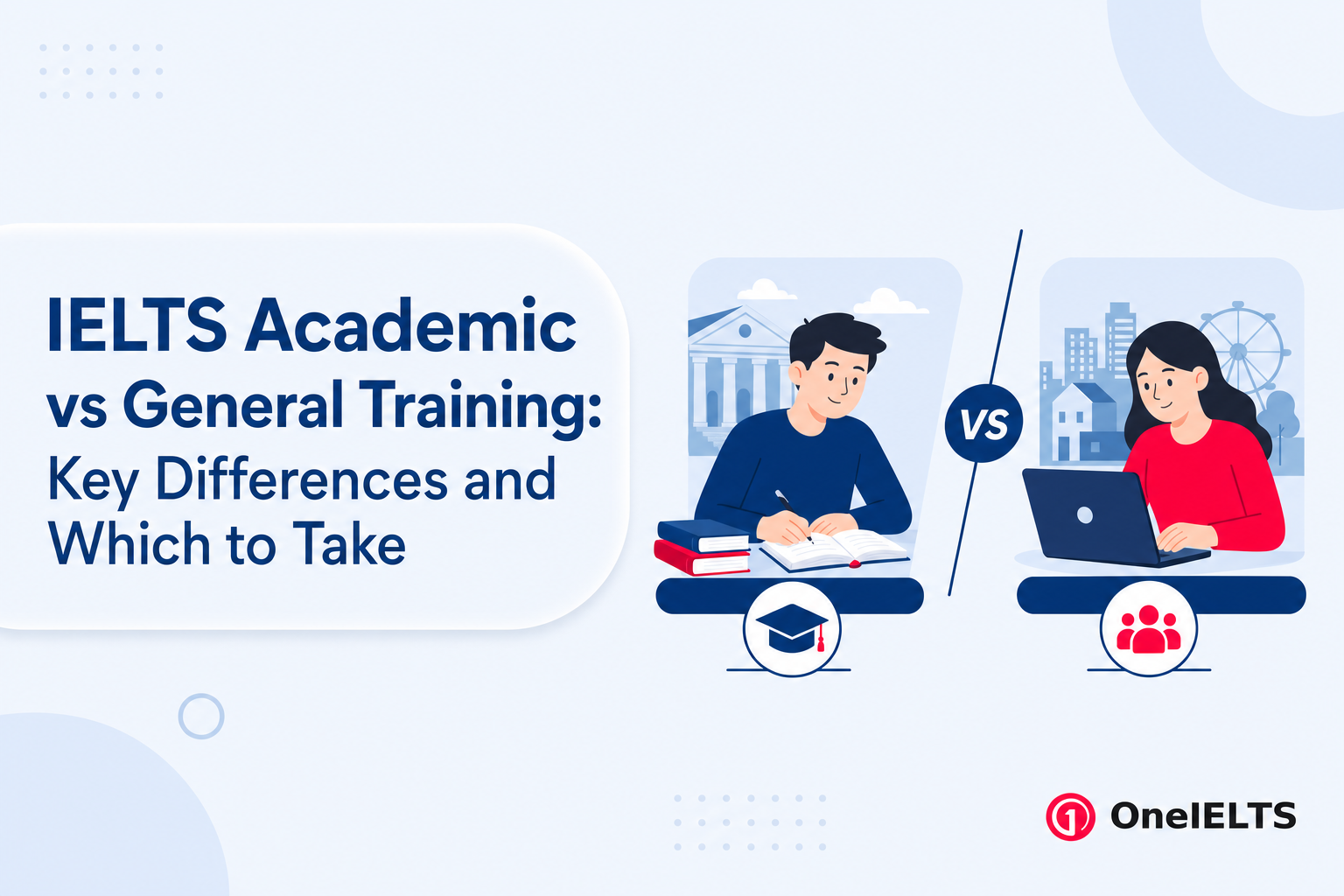
The difference is purpose: IELTS Academic is for university study while IELTS General Training covers migration and work plus school, and only the Reading and Writing sections differ between them. Both versions share the same Listening and Speaking sections, sat on the same day with the same examiner. Academic Reading and Writing use academic texts and a chart-description task, while General Training uses everyday and workplace texts plus a letter task. Compare both side by side in our guide to IELTS Academic vs General Training.
Why Is IELTS Used Around the World?
IELTS gives universities, governments, and employers one trusted measure of English, which is why it spans education, immigration, and professional licensing across more than 140 countries. The main reasons IELTS carries such weight are numbered below.
- Worldwide acceptance for education. University admissions teams across the UK, Canada, Australia, and the US use IELTS bands to confirm applicants can study in English.
- Immigration and visas. Immigration authorities accept IELTS for visa applications, converting your band into points or benchmark levels that decide eligibility.
- Work and licensing opportunities. Professional bodies in nursing, medicine, and engineering require IELTS to register and practise in an English-speaking country.
- A global English standard. IELTS sets a single global English standard, so a band earned in one country means the same thing to institutions in another.
- Flexible, adaptable test formats. With Academic and General Training versions plus computer or paper delivery, IELTS fits study, work, and migration goals through wide employer recognition.
Which Countries Accept the IELTS Exam?
Among the leading study destinations and immigration systems for IELTS — UK Canada Australia USA plus New Zealand Ireland — six countries draw the most candidates, ranked here by demand.
- United Kingdom accepts IELTS for student visas, skilled work, and university entry through UK Visas and Immigration.
- Canada uses IELTS for study permits and Express Entry, mapping bands to its benchmark levels for immigration.
- Australia accepts IELTS for student and skilled visas, with the Department of Home Affairs setting minimum bands.
- USA universities accept IELTS for admissions, and thousands of programmes now treat it as standard.
- Ireland accepts IELTS for university study and work-permit routes across both public and private institutions.
- New Zealand uses IELTS for student visas, residence, and skilled migration under Immigration New Zealand rules.
You can see the full picture in our guide to the countries that accept IELTS.
Why Is IELTS Used for Study and Migration Abroad?
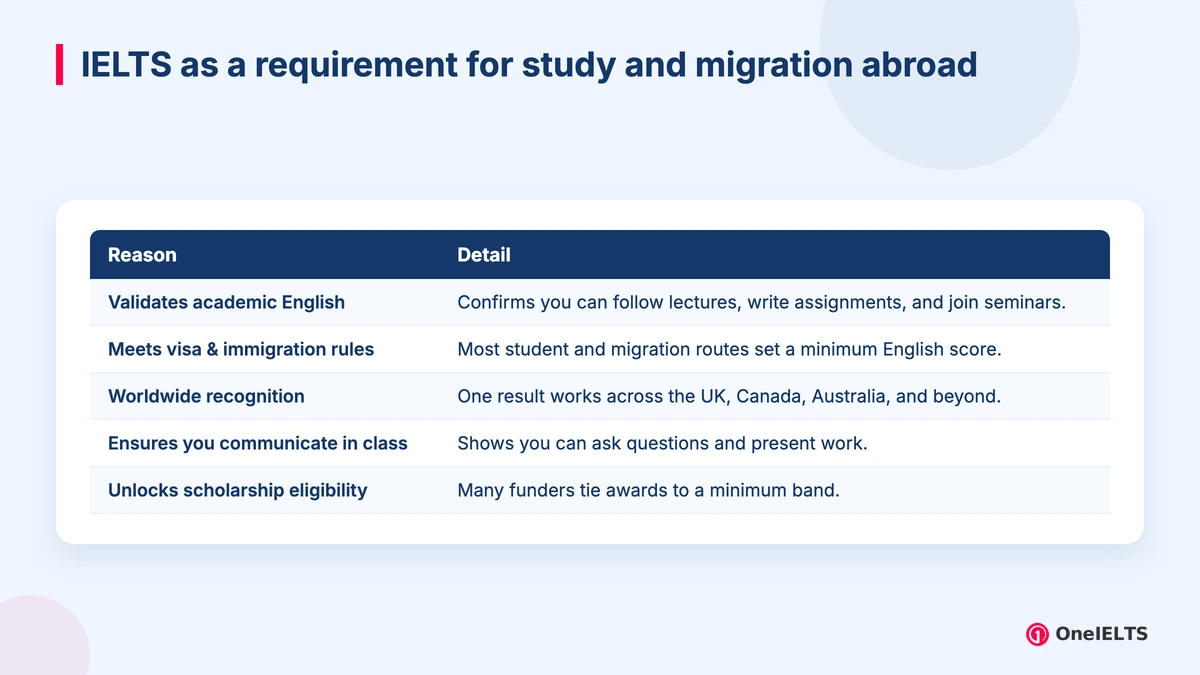
Studying abroad means proving you can learn in English, and IELTS is the evidence universities and visa offices accept, which is why almost every application asks for it. The key reasons IELTS underpins study and migration abroad appear in the following points.
- Validates your academic English ability. IELTS confirms your academic English is strong enough to follow lectures, write assignments, and join seminars from your first week on campus.
- Meets visa and immigration rules. A qualifying IELTS band satisfies visa and immigration rules, since most student and migration routes set a minimum English score before they approve you.
- Carries worldwide recognition. Its worldwide recognition means one IELTS result works across the UK, Canada, Australia, and other destinations, so you rarely need a second English test.
- Ensures you can communicate in class. A solid band shows you can communicate in class, ask questions, and present work, which protects both your grades and your wellbeing abroad.
- Unlocks scholarship eligibility. Many funders tie scholarship opportunities to a minimum band, so a higher IELTS score can directly improve the funding you qualify for.
What Are the Benefits of the IELTS Exam?
The benefits of the IELTS exam include worldwide acceptance, visa and immigration value, and the flexible One Skill Retake that lets you resit just one section. The main benefits are set out below.
- Worldwide acceptance. IELTS is recognised by top universities and 12,500 organizations, so one result opens admissions across dozens of countries.
- Visa and immigration value. Immigration systems accept IELTS bands directly, making it a single test that satisfies both study and migration requirements.
- One Skill Retake flexibility. The One Skill Retake lets you resit one weak section instead of the whole exam, a cost-effective fix for borderline scores.
- Education and career opportunities. A strong band unlocks degree places and international jobs, since many employers and licensing bodies treat IELTS as proof of English.
We cover each one in detail in our guide to the benefits of IELTS.
What Is the IELTS Test Format?
The IELTS test format has four sections taken in one sitting — Listening, Reading, Writing, and Speaking — that total under three hours and measure your full range of English. The four sections and their test timing are set out here.
- Listening (30 minutes) plays four recordings, from a casual conversation to an academic lecture, with 40 questions. Everyone takes the same Listening section regardless of which IELTS version they booked.
- Reading (60 minutes) has 40 questions across three passages. Academic uses journal and report extracts, while General Training draws on notices, adverts, and workplace documents suited to migration and jobs.
- Writing (60 minutes) sets two tasks. Academic asks you to describe a chart then write an essay; General Training asks for a letter then an essay, the core of the Academic vs General Training modules split.
- Speaking (11-14 minutes) is a face-to-face interview with an examiner in three parts: introduction, a long-turn monologue, and a two-way discussion. It is identical across both IELTS versions.
Can You Take IELTS on Computer or Paper?
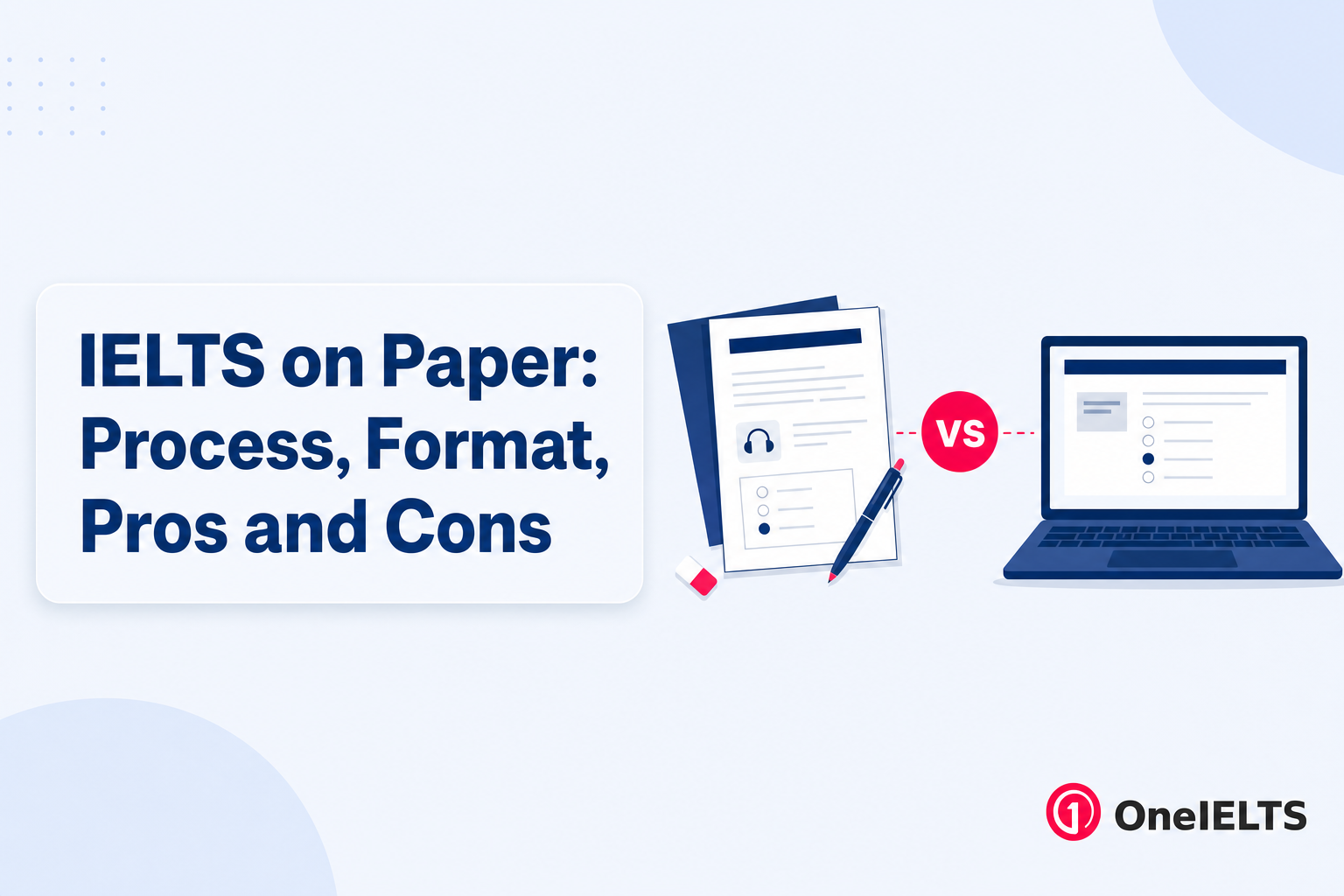
Yes, you can take IELTS on computer or on paper, and computer-delivered IELTS is now the default choice at most test centres. The same questions and scoring apply to both, and the Speaking test stays face-to-face with an examiner whichever mode you pick. Computer-delivered results arrive in 3-5 days against around 13 days for paper-based IELTS, and paper sittings are being phased out at many centres through 2026, so faster results now favour the screen. See how the modes compare in our guide to computer-delivered IELTS.
What Is the IELTS Syllabus and Exam Pattern?
The IELTS syllabus covers the same four skills for every candidate. The IELTS exam pattern — question types, number of questions, and timing — shifts between Academic and General Training in Reading and Writing only. Each skill and its pattern are mapped below.
- Listening syllabus and pattern. One 30-minute section with 40 questions across four recordings, mixing multiple choice, form completion, matching, and map labelling. Listening Reading Writing Speaking all start from this shared Listening paper.
- Reading syllabus and pattern. Sixty minutes and 40 questions over three passages. Academic and General Training differ here: Academic uses journal-style texts, while General Training uses notices, handbooks, and workplace material.
- Writing syllabus and pattern. Two tasks in 60 minutes. Academic pairs a 150-word data-description report with a 250-word essay; General Training swaps the report for a letter, keeping the essay.
- Speaking syllabus and pattern. An 11-14 minute interview in three question types: short personal questions, a long-turn cue card, and a deeper two-way discussion linked to that topic.
How Does the IELTS Band Score Work?
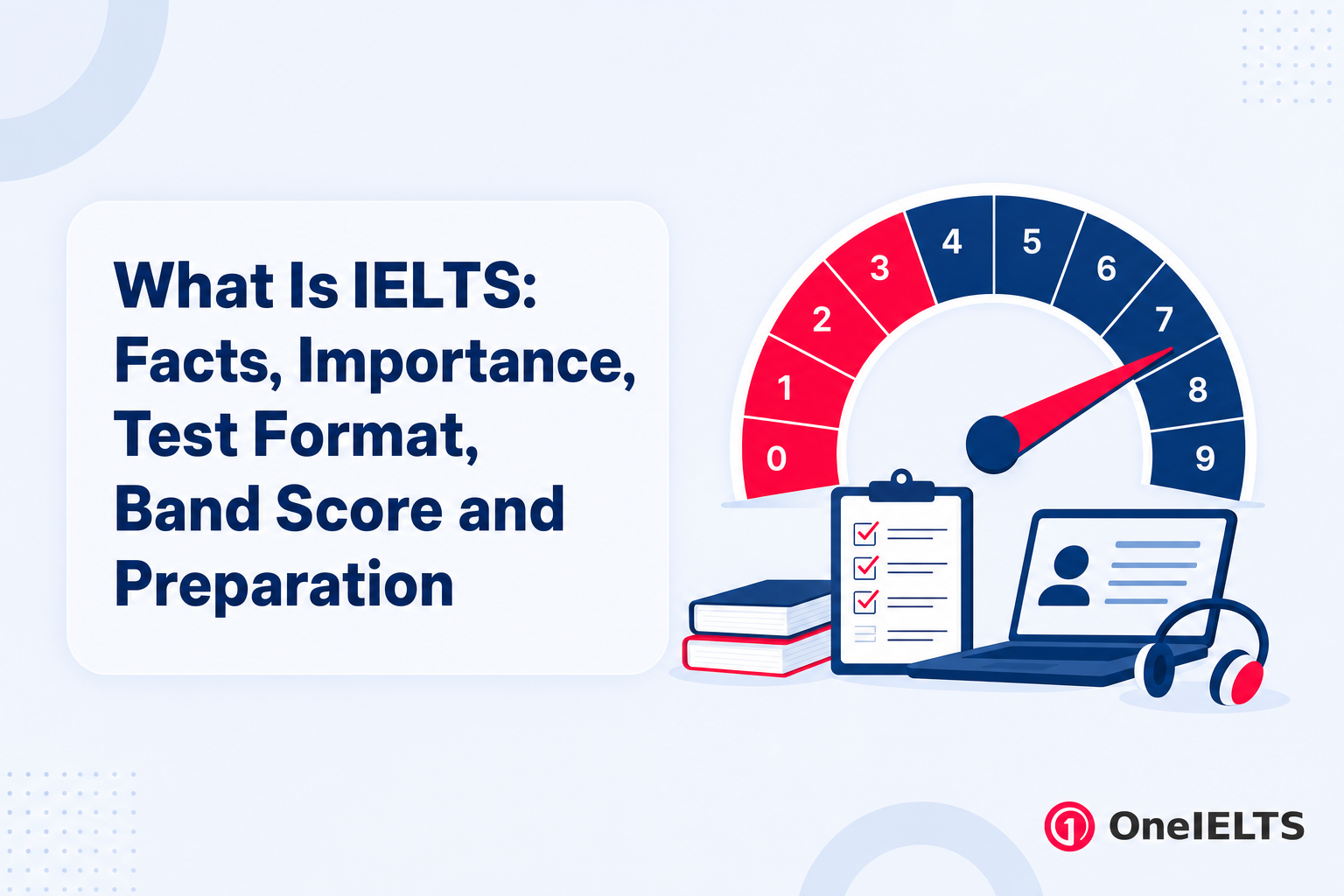
The IELTS band score reports your English on a nine-band scale, and the British Council maps each band to a clear ability level. The band descriptors run from Band 9 to Band 4 and below. Band 9 marks an expert user, Band 7 a good user, Band 6 a competent user, and Band 4 a limited user.
Each of the four sections earns its own section score first. Your overall band is then the average of these four section scores, rounded to the nearest half-band. This half-band rounding turns an average of 6.75 into 7.0 and 6.25 into 6.5. The overall band average is what universities read as a single admission cut-off.
Immigration systems work differently. They read each skill separately and set a minimum on every one, which is why your lowest skill can matter most. A strong overall band still fails a visa rule if one section sits below the required level, so candidates often target their weakest skill rather than the average.
What Is a Good IELTS Band Score?
A good IELTS band score depends on your goal: most universities ask for an overall 6.0 to 7.0, while many skilled migration routes want 6.5 or higher with no skill below the set minimum. There is no universal pass mark, because each university requirement and visa route publishes its own minimum overall band and per-skill minimum. Band 7 counts as a good user and Band 8 as very good, so competitive courses and high-points immigration streams reward the higher bands. Target the highest minimum your destination sets, since the lowest skill band can decide a visa even when the overall band looks strong. See the thresholds in detail in our guide to a good IELTS score.
Who Is Eligible to Take the IELTS Exam?
Almost anyone can take IELTS — there is no minimum qualification, and the main requirement is a valid passport, with a recommended minimum age of 16. The test sets no upper age limit, and you need no prior degree or English certificate to register, which keeps it open to school leavers and working professionals alike. You choose IELTS Academic or General Training based on your study or migration goal, not on any eligibility rule, so the version follows your destination rather than your background. Check the finer points in our guide to IELTS eligibility.
How Do You Register and Book the IELTS Exam?
IELTS registration runs entirely online through IDP or the British Council, and booking takes a few minutes once you know your test type and city. The IELTS exam booking steps follow in order.
- Create an account and log in. Set up a profile on the IDP or British Council portal, then use that IELTS login each time you manage or rebook your test.
- Choose your test type and city. Select IELTS Academic or General Training, pick computer or paper, and find your nearest test centre from the list.
- Pick an available IELTS exam date. Open the calendar, compare sittings against your application deadline, and reserve a slot that leaves time for your result.
- Upload your passport and pay the fee. Enter your passport details exactly as printed, upload the ID page, and pay online to hold your booking.
- Confirm the booking and save your details. Review your test type, date, and centre, confirm, then keep the confirmation email with your candidate number.
How Do You Apply for the IELTS Exam?
Booking IELTS takes a few minutes online once you know your test type and city, and you confirm with a card payment. The IELTS application steps are listed in this order.
- Visit the official IDP or British Council website to start, since both deliver IELTS and run the booking system.
- Choose your test module and format, picking Academic or General Training and deciding between computer or paper delivery.
- Select your location and date from the nearest test centre’s calendar, checking that the date meets your application deadline.
- Create your profile and upload ID, entering passport details exactly as they appear on the document you will bring.
- Pay the fee and confirm the booking, after which you receive your test details and any preparation resources by email.
How Much Does the IELTS Exam Cost?
The IELTS exam fee buys you all four sections in one sitting plus delivery of your Test Report Form, and the exact price depends on your country and test type. The current IELTS fees in India sit at ₹19,000 as of July 2026, so check the live amount on the official IDP or British Council site before you book.
In most centres the fee is the same whether you choose computer-delivered or paper-based IELTS. Two versions can cost more: IELTS for UKVI carries a UK-visa surcharge, and IELTS Life Skills uses a separate, usually lower price because it tests only speaking and listening. One payment covers the test, the marking, and a copy of your Test Report Form sent to your chosen institutions, with extra report copies charged separately.
How Do You Prepare for the IELTS Test?
Good IELTS preparation pairs knowing the test with steady skill-building over several weeks, not last-minute cramming. The preparation strategies that move your band most are listed here.
- Learn the format and band criteria. Study the format and criteria for each section so you know exactly how examiners award marks before you attempt a single practice question.
- Take timed practice tests. Sit full timed practice tests under exam conditions to build stamina, fix your pacing, and remove the time pressure that costs many candidates marks.
- Strengthen each of the four skills. Train all four skills separately, giving extra hours to your weakest one, since immigration rules judge each skill on its own rather than the average.
- Use authentic IELTS materials. Practise with authentic resources from the British Council, IDP, or Cambridge, because unofficial mocks often misjudge real question types and band difficulty.
- Analyse and fix your mistakes. Treat mistake analysis as the core habit: review every wrong answer, find the pattern behind it, and correct that pattern before your next practice test.
Is the IELTS Exam Difficult?
IELTS is not inherently difficult, but its difficulty depends on your English level and preparation rather than on any trick in the test. Most test-takers find the Writing section hardest, especially Task 2, because timed essay writing exposes weak structure and vocabulary faster than the other parts. Targeted practice lowers the IELTS difficulty sharply: when you train against the band criteria and review every mistake, the test becomes predictable. Candidates most often lose half a band in Writing by drifting off the prompt, not by weak grammar. See where the real challenges sit in our guide to whether IELTS is difficult.
How Can You Improve Your IELTS Score?
Raising an IELTS band between attempts comes down to fixing your weakest skill, not redoing everything you already pass. The practical ways to improve your IELTS score are listed here.
- Target your weakest skill first. Diagnose which of the four skills drags your overall band down, then spend most of your study hours there rather than spreading effort evenly.
- Master the band descriptors examiners use. Learn exactly how examiners award marks in Writing and Speaking, so you write and speak to the criteria instead of guessing what scores well.
- Get feedback on Writing and Speaking. Writing and Speaking feedback from a trained teacher lifts your band fastest, since these productive skills improve most when someone shows you the precise band-level fixes.
- Build timed exam stamina. Sit full sections of timed practice under the clock so test-day pacing feels routine, because rushed final answers cost candidates marks they could otherwise earn.
- Use the One Skill Retake for a single section. If one section alone holds you back, book a One Skill Retake rather than re-sitting the entire test to lift just that band.
We break down each tactic in our guide to how to improve your IELTS score.
Where Can You Take a Free IELTS Practice Test?
You can take a free IELTS practice test through the official sample papers that British Council IDP Cambridge publish, which mirror the real format and timing for each of the four skills. Official practice tests carry the same question types and band-level difficulty as the live exam, so they predict your readiness far better than unofficial mocks. Sitting a timed practice test under exam conditions exposes pacing problems and your weakest skill before test day. Review every wrong answer against the band descriptors rather than only checking your raw score, since the pattern behind a mistake matters more than the count. Start with the official-style sets in our guide to the IELTS practice test.
What Happens on IELTS Test Day?
On IELTS test day you check in with your passport, clear an identity check, then sit the on-screen sections before your Speaking interview, and the whole process is tightly timed. The stages of a computer-delivered test day run in this sequence.
- Arrive early and check in with your passport. Reach the test centre at least 30 minutes ahead and present the same valid passport you registered with, since staff match it to your booking before entry.
- Store personal belongings and complete identity checks. Lock phones, watches, and bags in the storage area, then sit for the biometric photo and finger scan that confirm your identity at the test room door.
- Sit the Listening, Reading and Writing sections on computer. Take all three on-screen parts back-to-back in one sitting under exam timing; this Listening Reading Writing block runs without long breaks.
- Attend the face-to-face Speaking interview. Meet a certified examiner for the Speaking test, which may run on the same day or within a few days of your written sections at most centres.
- Leave once the examiner releases you. Collect your stored belongings only after staff confirm your sections are submitted, then leave the test centre and wait for your result online.
How and When Do You Get Your IELTS Result?
You get your IELTS result as a Test Report Form, available 3-5 days after a computer-delivered test and about 13 days after a paper-based one. You can view your result online by logging in to the IDP or British Council portal, and an official Test Report Form goes to the institutions you nominated when booking. The form shows a band for each of the four skills plus your overall band, so admissions and visa officers read both at a glance. Read more in our guide to your IELTS result.
How Long Is an IELTS Score Valid?
An IELTS score is valid for two years from the test date, the standard validity period most universities and immigration authorities accept. Some institutions and visa routes accept an older score or set a shorter window, so confirm the rule for your specific application before you rely on a past result. Once your two-year score validity expires you must retake IELTS, since no body recognises an out-of-date Test Report Form. Check the detail in our guide to IELTS score validity.
Can You Reschedule or Cancel Your IELTS Test?
Yes, you can reschedule or cancel your IELTS test, though an administrative fee usually applies and the refund depends on how much notice you give. You reschedule IELTS or cancel IELTS through the same IDP or British Council account you booked with, before the published deadline for your test date. Cancelling well before the test date earns a partial refund after a deduction, while a late cancellation or no-show forfeits most of the IELTS exam fee. A cancellation more than five weeks before the test is refunded minus a 25% administrative charge; within five weeks there is no refund except on medical grounds, so check the current policy before you change a booking. Read the full policy in our guide to how to reschedule your IELTS test.
What Can You Do If You’re Unhappy With Your IELTS Result?
If you’re unhappy with your IELTS result you can request an Enquiry on Results, a re-mark of one or more sections by a senior examiner. You apply for the Enquiry on Results within six weeks of the test date through the centre that issued your Test Report Form. You pay a re-mark fee that is refunded in full if any band score rises, and you can choose which of the four sections to re-mark. For a borderline single section, a One Skill Retake is often faster than a re-mark, since it gives you a fresh attempt rather than a second marking. Learn the steps in our guide to the Enquiry on Results re-mark.
Can You Take a One Skill Retake in IELTS?
Yes, you can take a One Skill Retake to resit a single section of IELTS without sitting the whole test again. It is available within 60 days of a computer-delivered IELTS test, so you book it once your original result arrives. The retake covers exactly one single section — your choice of Listening, Reading, Writing or Speaking — and your eligibility and validity follow the same rules as your first test. Learn how it works in our guide to the One Skill Retake.
How Does IELTS Compare to TOEFL and PTE?
IELTS, TOEFL and PTE are each an English proficiency test, but they differ in scoring scale, test delivery, and Speaking assessment. IELTS uses a nine-band scale with a face-to-face Speaking interview, TOEFL scores 0-120 with computer-recorded Speaking, and PTE is fully computer-scored. The three tests compare across format and use as set out in the table below.
| Test | Scoring scale | Speaking format | Typical use |
|---|---|---|---|
| IELTS | Nine-band scale (1-9) | Face-to-face with an examiner | Study, work, and migration worldwide |
| TOEFL | 0-120 total score | Computer-recorded responses | Mainly US and Canadian university admission |
| PTE | 10-90 score | Computer-scored, no examiner | Australian study and migration, fast results |
We weigh the trade-offs in full in our guide to IELTS vs TOEFL.
Are There IELTS Scholarships for Studying Abroad?
Yes, a strong band can unlock IELTS scholarships for studying abroad, because many universities and funding bodies set a minimum IELTS score as an eligibility condition for their awards. IELTS itself is not a scholarship, but a qualifying band is often the gatekeeper that lets you apply for a merit-based award or need-based university funding. Higher bands can widen the funding you qualify for, since competitive scholarships rank applicants partly on English proficiency. Check each scholarship’s exact minimum band and accepted test version before you apply, as requirements vary by university and country. See which awards reward a high band in our guide to IELTS scholarships.
Practice for the Real IELTS Exam
Apply what you’ve learned with free, exam-style practice:
- Take a full IELTS mock test
- Practice by section: Listening, Reading, Writing, Speaking
- Structure your essays with IELTS Writing templates