Your IELTS band does more than open a university door. On many merit awards and the British Council’s IELTS Prize, the band itself is scored, so a 7.5 can fund a place a 6.5 only admits. An IELTS scholarship rewards proven English proficiency, and this guide covers whether you can get a scholarship with IELTS, the four scholarship types, the eligibility bands, the top universities behind them, and how to apply. The merit scholarship, the IELTS Prize, exam fee waivers, and the eligibility rules all sit ahead.
Last verified: 30 June 2026
Can You Get a Scholarship With IELTS?
Yes, a strong IELTS band meets the English proficiency threshold for eligibility and lifts your standing in merit scoring. Most funders treat your overall band as a hard eligibility gate first, then a competitive signal. Some weight English proficiency directly, so a higher band moves you up the ranking rather than just clearing the minimum.
Several awards make that weighting explicit. The British Council’s IELTS Prize judges candidates partly on their band, and many university awards put a higher IELTS result into the merit scoring that decides who gets funding. Treating the test as a scoring factor, not a pass-or-fail box, is what separates a funded applicant from an admitted one.
1. Government and Overseas Scholarships
Government and country scholarships are state-funded awards that send international students abroad, such as the UK’s Chevening Scholarships or Australia Awards. They cover tuition, living costs, and travel for a full degree. Chevening requires an unconditional university offer, which in turn sets the English condition you must meet.
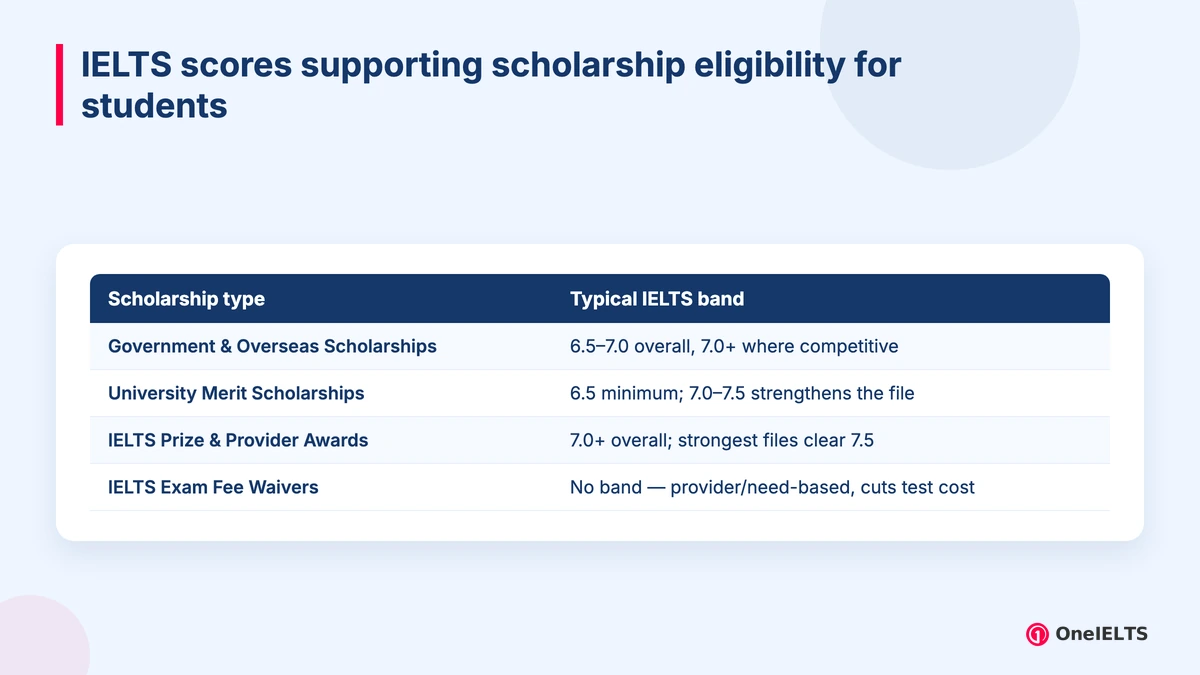
A typical IELTS band here tracks the host university’s own admission rule rather than a separate scholarship figure, so plan for 6.5 to 7.0 overall, and 7.0+ where the course is competitive.
2. University Merit Scholarships
University merit scholarships are tuition discounts a single institution awards from its own funds for academic strength, such as the University of Melbourne International Undergraduate Scholarship or a UK dean’s award. They range from a partial fee reduction to a full waiver and renew if you keep your grades up.
Here your IELTS band is often a scoring factor, not just a gate. Meeting the 6.5 minimum admits you; pushing to 7.0 or 7.5 strengthens a file that competes against every other strong applicant.
3. IELTS Prize and Provider Awards
The IELTS Prize and provider awards are scholarships funded by the test owners themselves for high-scoring candidates. The British Council IELTS Prize, for example, grants up to £40,000 toward tuition at an institution that accepts IELTS. Selection weighs your band, your study plan, and your statement.
These awards reward the top of the scale, so a competitive entry usually needs an IELTS band of 7.0+ overall, and the strongest files clear 7.5. A higher band here is the multiplier, since the prize is scored partly on the result itself.
4. IELTS Exam Fee Waivers
IELTS fee waivers and exam fee discounts cut the cost of sitting the test rather than funding your degree, which makes them distinct from a tuition scholarship. They usually arrive as a provider promotion from the British Council or IDP, or as need-based support routed through a partner or sponsoring body.
To find a current offer, check your test provider’s official booking page and any partner promotion running in your country. These change by season and region rather than staying fixed.
How Do You Apply for an IELTS Scholarship?
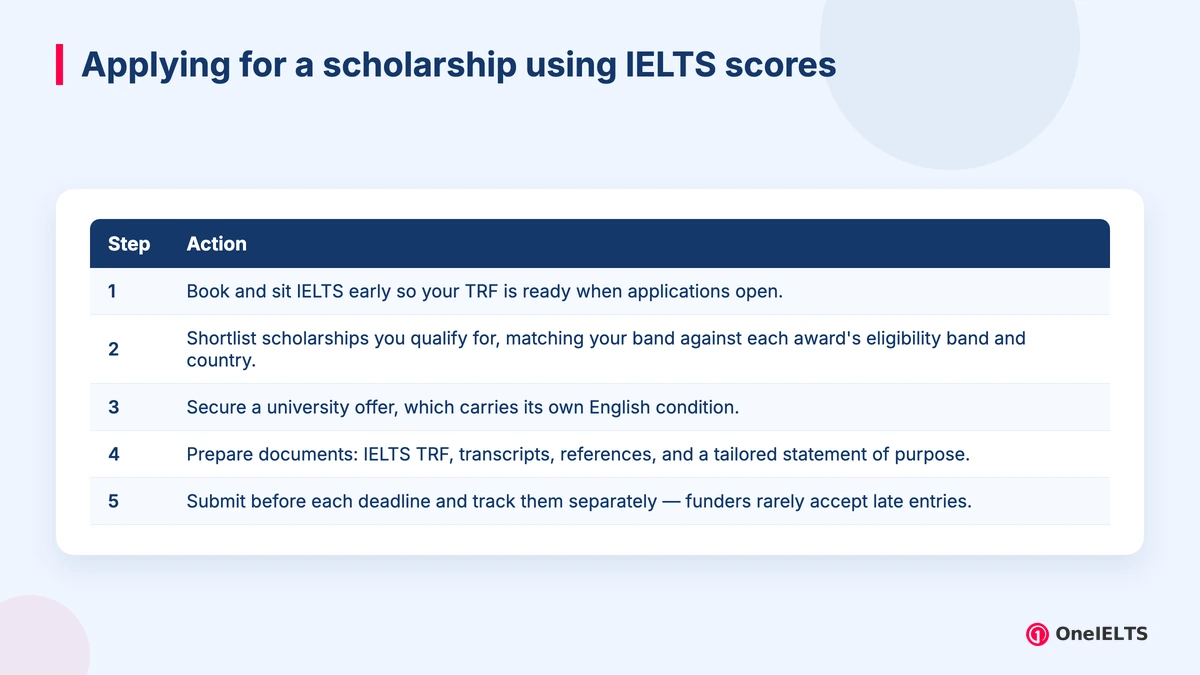
Applying for an IELTS scholarship means lining up your IELTS TRF, a target university offer, and the funder’s documents before each deadline, then submitting them as one package. The route runs from sitting the test to confirming the award. The five steps that take you from booking to a funded place are set out here.
- Book and sit IELTS early. Take the test well before any deadline so your IELTS TRF is ready when applications open.
- Shortlist scholarships you qualify for. Match your overall band against each award’s eligibility band and country.
- Secure a university offer. Most funders need an admission offer, which carries its own English condition.
- Prepare your documents. Gather your IELTS TRF, transcripts, references, and a statement of purpose tailored to each funder.
- Submit before the deadlines. File each application and track its deadlines separately, since funders rarely accept late entries.
What IELTS Score Do You Need for a Scholarship?
Most scholarships expect an IELTS band of 6.5-7.5 overall, with competitive awards favouring 7.0+. The minimum clears eligibility; the higher band wins the funding. Because many merit panels score the result rather than just checking it, raising your overall by even half a band strengthens the whole application. See how the nine-band scale works in our IELTS band score guide before you set a target.
Which Universities Offer IELTS Scholarships?
Many top universities across the UK Canada Australia USA offer IELTS-linked merit scholarships for international students. Named groups recur in each market, from the Russell Group to the Group of Eight, and each sets its own band rule. Always check the university’s own funding page, since amounts and English conditions are revised yearly. Strong university funding favours higher bands; confirm where your score is recognised in our list of countries that accept IELTS.
Practice for the Real IELTS Exam
Apply what you’ve learned with free, exam-style practice:
- Take a full IELTS mock test
- Practice by section: Listening, Reading, Writing, Speaking
- Structure your essays with IELTS Writing templates