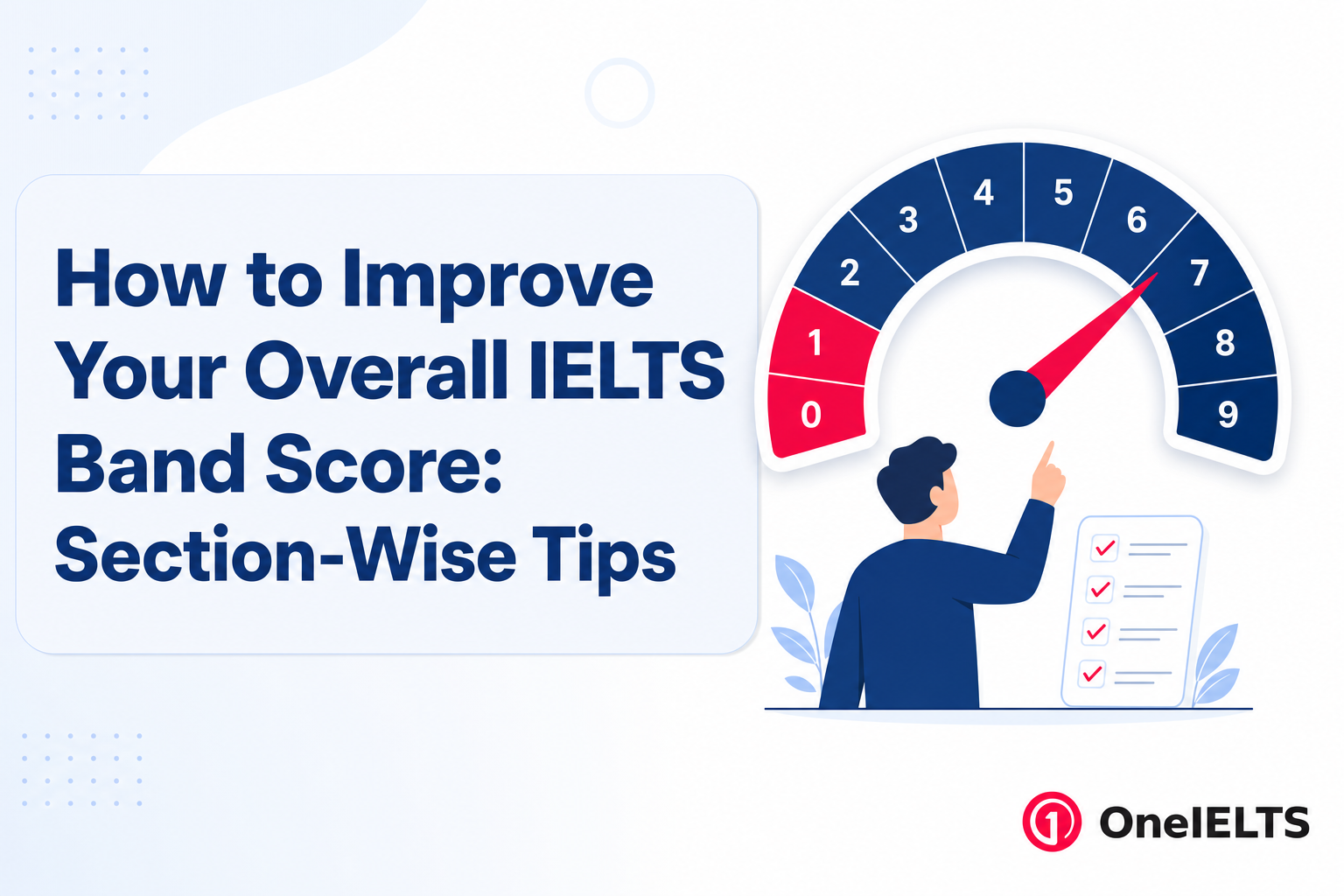
Your overall IELTS band is the average of four sections. The fastest way to raise it is to lift your weakest skill first — moving a 5.5 to 6.5 shifts the overall far more than pushing a 7 to 7.5.
This guide gives examiner-approved, section-wise tips for Listening, Reading, Writing, and Speaking, shows how a single retake can lift one band, and lays out the fastest route to a higher score. The way to improve IELTS score outcomes is to audit where you lose marks, then spend your prep on the band that drags the average down.
What Are the Best IELTS Listening Tips?
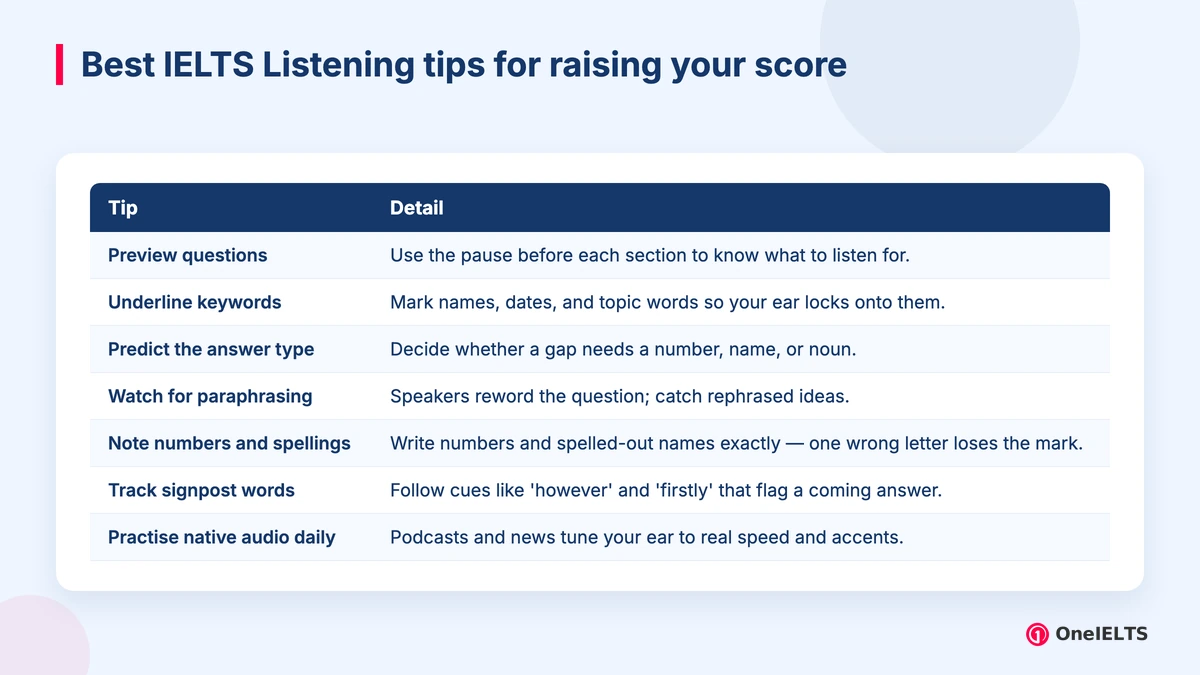
The highest-impact Listening tips are the ones that buy you reading and prediction time before each recording plays, because the audio runs only once. Strong test-takers decide what kind of answer they need before they hear it. Seven Listening habits that lift band scores are set out in order below.
- Preview questions. Use the pause before each section to preview questions, so you know exactly what to listen for when the recording starts.
- Underline keywords. Mark names, dates, and topic words in each question so your ear locks onto them the moment the speaker reaches that point.
- Predict the answer type. Decide whether a gap needs a number, a name, or a noun, which narrows what you are listening for.
- Watch for paraphrasing. Speakers rarely repeat the question wording, so train yourself to catch paraphrasing and rephrased ideas that signal the answer.
- Note numbers and spellings. Write phone numbers, dates, and spelled-out names exactly as you hear them, since one wrong letter loses the whole mark.
- Track signpost words. Follow cues like “however”, “firstly”, and “on the other hand”, because these signpost words tell you when an answer is coming.
- Practise native audio daily. Listen to native audio such as podcasts and news clips every day to tune your ear to real speed and accents.
What Are the Best IELTS Reading Tips?
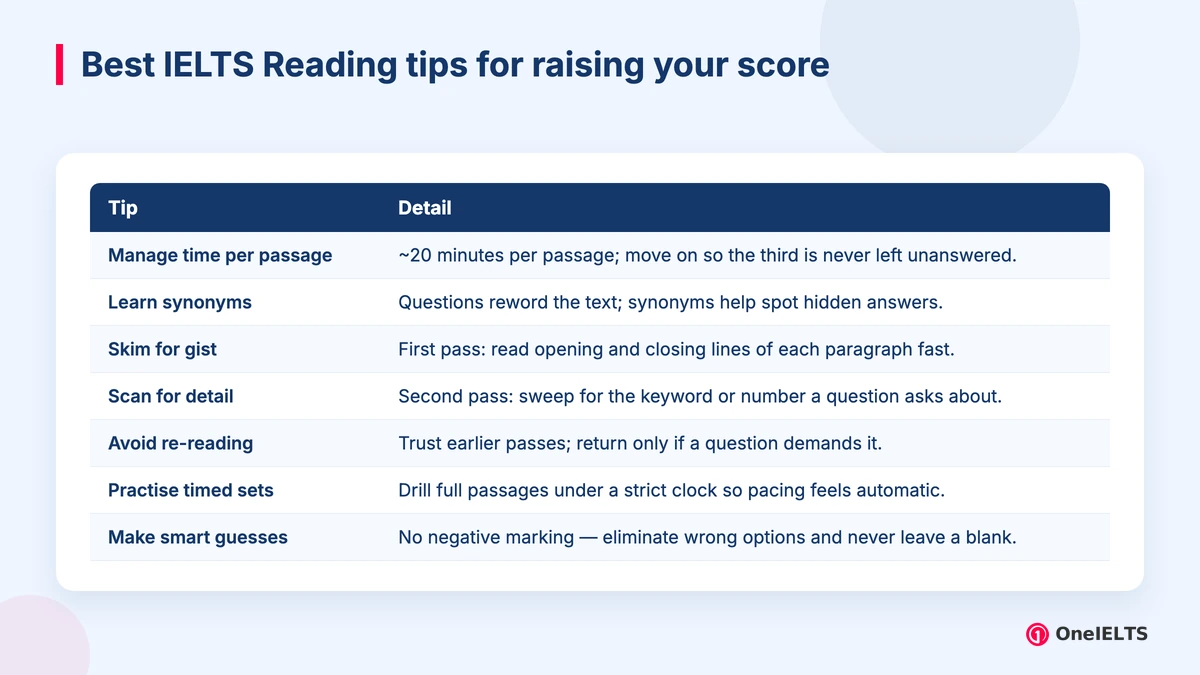
The reading tips that move scores most are about pacing and word-matching, not reading every line, because you have only 60 minutes for three passages and 40 questions. Most candidates lose marks by overspending on one passage. Seven Reading habits worth drilling are listed here.
- Manage time per passage. Give roughly 20 minutes of time per passage and move on when it runs out, so you never leave the third passage unanswered.
- Learn synonyms. Questions reword the text, so building synonyms for common topic words helps you spot answers that hide behind different vocabulary.
- Skim for gist. Skim and scan in two passes: first read the opening and closing lines of each paragraph fast to grasp the gist.
- Scan for detail. On the second pass, scan for detail by sweeping the text for the keyword or number a question asks about.
- Avoid re-reading. Resist reading a passage twice; trust your earlier passes and return only if a specific question demands it.
- Practise timed sets. Drill full passages under a strict clock so test-day pacing feels automatic rather than rushed.
- Make smart guesses. With no negative marking, never leave a blank — eliminate wrong options and commit to your best answer.
What Are the Best IELTS Writing Tips?
The writing tips that lift bands fastest start with knowing how you are marked, because examiners score against fixed criteria rather than a general impression. Candidates most often lose half a band in Task 2 by drifting off the prompt, not by weak grammar. Seven Writing habits that protect your band follow.
- Study the four criteria. Learn the four criteria — task response, coherence, lexical resource, and grammar — so you write toward what the examiner actually rewards.
- Plan before writing. Spend three to five minutes to plan first, mapping each paragraph, which keeps your essay on the prompt from the first line.
- Paraphrase the prompt. Open by rewording the question; a clean paraphrase prompt shows range and avoids copying the task statement.
- Write a clear overview or position. State your position in Task 2 or an overview in Task 1 early, so the reader sees your stance immediately.
- One idea per paragraph. Keep one idea per paragraph, developed with a reason and an example, which keeps coherence high and the argument easy to follow.
- Use a formal register. Write in an academic, formal register without contractions or slang, matching the tone examiners expect in both tasks.
- Proofread for errors. Save two minutes to proofread for spelling, articles, and verb tense, since clean accuracy lifts your grammar score.
What Are the Best IELTS Speaking Tips?
The speaking tips that raise scores most build fluency and natural delivery, because the examiner rates spontaneous speech, not rehearsed lines. The biggest avoidable loss comes from using no memorised scripts. Seven Speaking habits that help you sound natural and fluent are given here.
- Practise daily aloud. Speak English aloud every day on random topics so forming answers under pressure feels routine by test day.
- Avoid memorised scripts. Examiners reward genuine speech and follow a no memorised scripts rule in practice, so answer the actual prompt rather than reciting prepared lines.
- Extend answers with reasons. Extend answers by adding a reason and an example rather than stopping at a short reply, which shows fluency.
- Focus on stress and intonation. Vary your stress and intonation so your speech sounds natural, since flat monotone delivery lowers the pronunciation score.
- Use topic vocabulary. Bring in precise topic vocabulary for common themes like work, travel, and technology to show lexical range.
- Keep going past small mistakes. If you slip, keep going rather than stopping to correct yourself, because hesitation costs more than a minor error.
- Structure Part 3 arguments. In Part 3, structure arguments with a clear point, reason, and example to handle the abstract discussion questions.
How Can You Improve One Skill With a Retake?
The IELTS One Skill Retake lets you re-sit a single section — Listening, Reading, Writing, or Speaking — and lift just that band instead of taking the whole test again. The British Council and IDP offer it after a computer-delivered test. It saves you from retaking the whole test and helps you save time. The new band for that single section replaces the old one on a fresh TRF, while your other three scores stay as they were.
What Is the Fastest Way to Improve Your IELTS Score?
The fastest way to a higher score is to spend your prep where it pays back most: fix your lowest skill first, use a targeted retake, and review every error from timed practice. These four moves give the biggest overall gain for the least study time, and each one is explained below.
- Audit and target your lowest skill first. Find the section dragging your average down and put most of your study there, since that is where the overall band moves most.
- Use One Skill Retake instead of resitting everything. Re-sit only the weak section through One Skill Retake rather than rebooking the full test, saving money and your already-strong bands.
- Take timed mock tests and review every error. Sit full mock tests under exam timing, then make mock test review a habit so the same mistake never costs you a mark twice.
- Get feedback on Writing and Speaking. Get feedback on productive skills, because Writing and Speaking are hardest to self-mark and where guided correction lifts bands quickly.
How Can You Find Your Weakest IELTS Skill?
Take a full timed mock and compare the four section bands — your lowest band is where prep pays off most. After focused practice on that section, re-test the weak skill with another timed mock to confirm it has actually risen before you move your attention elsewhere. The nine-band scale, and how each section feeds your overall, is explained in our IELTS band score guide.
Is It Possible to Improve Your IELTS Score in a Month?
Yes — a focused month can lift one or two skills, though large jumps usually need longer than four weeks. Realistic gains in one month depend on your starting level: a candidate at 5.5 can often reach 6.0 or 6.5 with daily targeted work, while a much bigger leap typically needs a longer, structured study plan.
How Do You Set a Target IELTS Band Score?
Set your target band from the requirement of your course or visa, then work backwards to the lowest skill that must clear it. Many universities and visa bodies set a per-section minimum, not just an overall — so let the course or visa requirement fix both numbers before you plan. See what counts as a strong result in our good IELTS score guide.
Last verified: 30 June 2026
Practice for the Real IELTS Exam
Apply what you’ve learned with free, exam-style practice:
- Take a full IELTS mock test
- Practice by section: Listening, Reading, Writing, Speaking
- Structure your essays with IELTS Writing templates