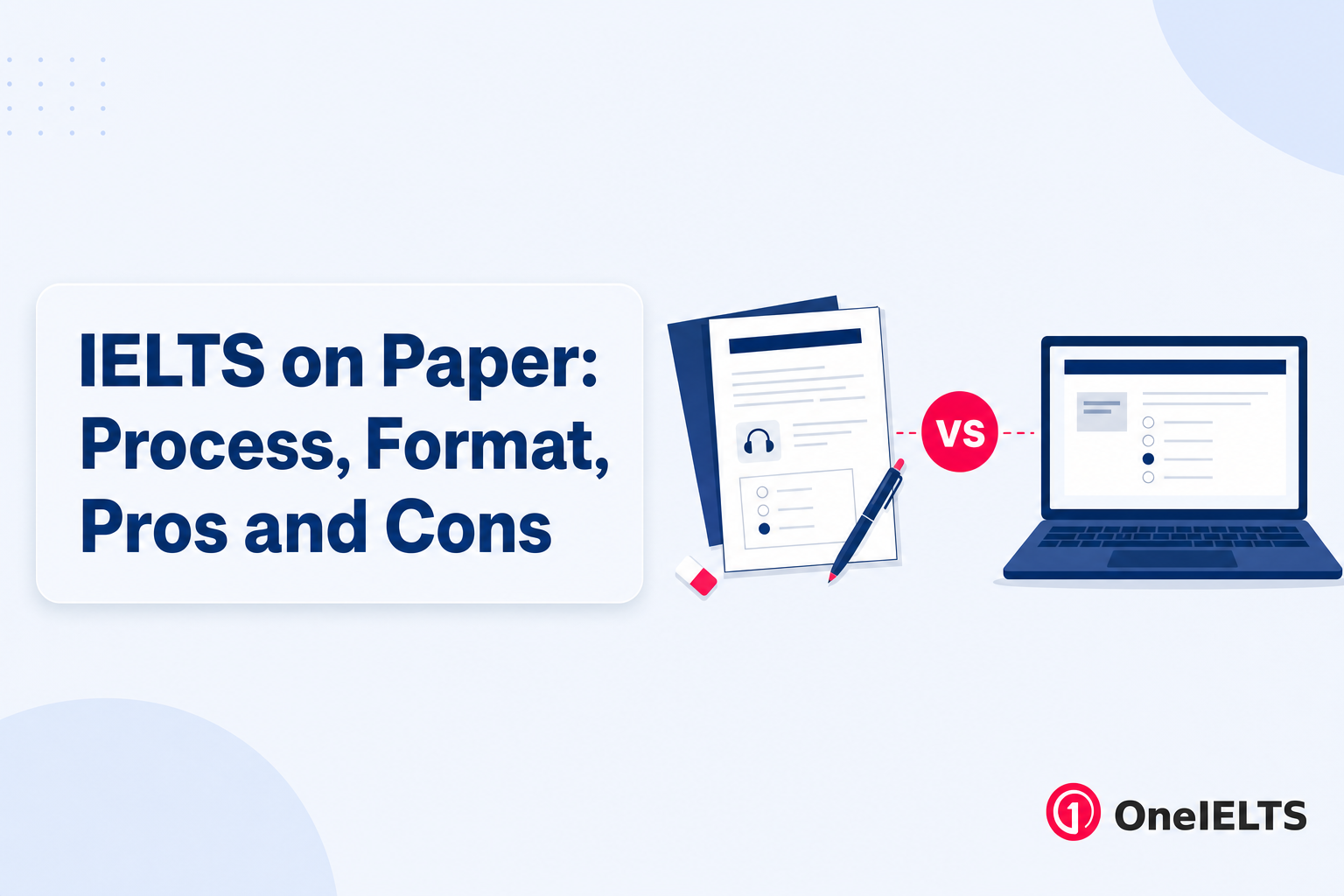
IELTS on Paper has been discontinued. All IELTS tests now run on computer, and in India the last paper-based dates were in August 2026. If you prefer to handwrite, the replacement is IELTS Writing on Paper: you take Listening and Reading on computer, write your Writing answers by hand on an answer sheet with the pen provided, and do Speaking face-to-face with an examiner. The content, the band scale and the way results are recognised stay exactly the same.
This guide explains what the paper format was, when it ended, how the new Writing on Paper option works, and what a paper result you already hold still means. One point shapes the decision today: handwriting now applies to the Writing section only, and results arrive on the computer timeline of a few days.
Last verified: 8 October 2026
What Was the Paper-Based IELTS?
The paper-based IELTS was the standard IELTS test taken with pen and paper instead of a keyboard, sat in person at an authorised test centre. Candidates read printed question booklets and recorded their responses on physical answer sheets.
It covered the same four sections as every IELTS format: Listening, Reading, Writing, and Speaking, reported on the same nine-band scale. A paper result you already hold means exactly what a computer result means, and universities and immigration authorities keep accepting it for its normal two-year validity.
Has the Paper-Based IELTS Been Discontinued?
Yes, the paper-based IELTS has been discontinued. ielts.org announced on 5 March 2026 that IELTS would no longer be offered on paper from mid-2026, with timelines varying by market, and IDP IELTS India now states that IELTS on Paper has been discontinued. In its place, selected markets, including India, offer IELTS Writing on Paper inside the computer test.
Every IELTS test now runs on computer at a test centre, with the Writing on Paper option available for the Writing section only. Because availability of that option varies by country and centre, confirm it with your test centre when you book.
Last verified: 8 October 2026
How Does IELTS Writing on Paper Work?
With IELTS Writing on Paper, the Writing questions appear on screen, but you receive an IELTS Writing Answer Sheet and a pen and write both tasks by hand. Listening and Reading are completed on computer, and Speaking stays face-to-face with an examiner.
Because Listening is on computer, there is no 10-minute transfer time any more; you type answers as you listen and get a short review at the end. Task types, timing and scoring match the computer test, and the option is not available for IELTS for UKVI.
What Are the Pros of IELTS Writing on Paper?
Writing on Paper keeps the main advantage of the old paper test for the section where it mattered most. Three practical advantages stand out.
- You plan, draft and edit your essays by hand, so slow or hesitant typists are not penalised in Writing.
- Results arrive on the computer timeline, not the old two-week paper wait.
- You still get the on-screen tools in Listening and Reading, such as highlighting.
What Are the Cons of IELTS Writing on Paper?
Handwriting your Writing answers carries a few trade-offs that typing avoids.
- There is no automatic word counter, so you count words yourself.
- Handwriting legibility matters, because examiners must read your script to score it fairly.
- If you later book a One Skill Retake for Writing, you must retake it in the same mode, on paper.
Who Should Choose IELTS Writing on Paper?
Choose Writing on Paper if you think and edit better with a pen. Choose fully on-computer IELTS if you type quickly and want the word counter and cut-and-paste in Writing. Both give the same scores and are accepted on the same terms.
- Slow typists who lose time or accuracy composing Writing answers on a keyboard.
- Paper thinkers who plan, draft, and edit more clearly by hand than on a screen.
- Candidates who practised essays by hand and want test day to feel the same.
How Long Do Writing on Paper Results Take?
Writing on Paper results arrive within five days according to ielts.org, and IDP IELTS India lists 1 to 2 days. The old paper-based test took about 13 days (around 7 in India).
That puts both current options on the same fast timeline, so results speed is no longer a reason to choose one over the other. Read more about computer-delivered IELTS to compare the two options.
Is Writing on Paper Easier Than Typing?
Neither is easier, because the content and scoring are identical across both options and only the way you write differs. The questions, the Speaking interview, and the nine-band marking are the same whether you write by hand or type.
Which one feels easier comes down to personal comfort: some candidates focus better on paper, others move faster on screen. Our guide on paper versus computer IELTS breaks down how to pick the option that fits you.
Practice for the Real IELTS Exam
Apply what you’ve learned with free, exam-style practice:
- Take a full IELTS mock test
- Practice by section: Listening, Reading, Writing, Speaking
- Structure your essays with IELTS Writing templates