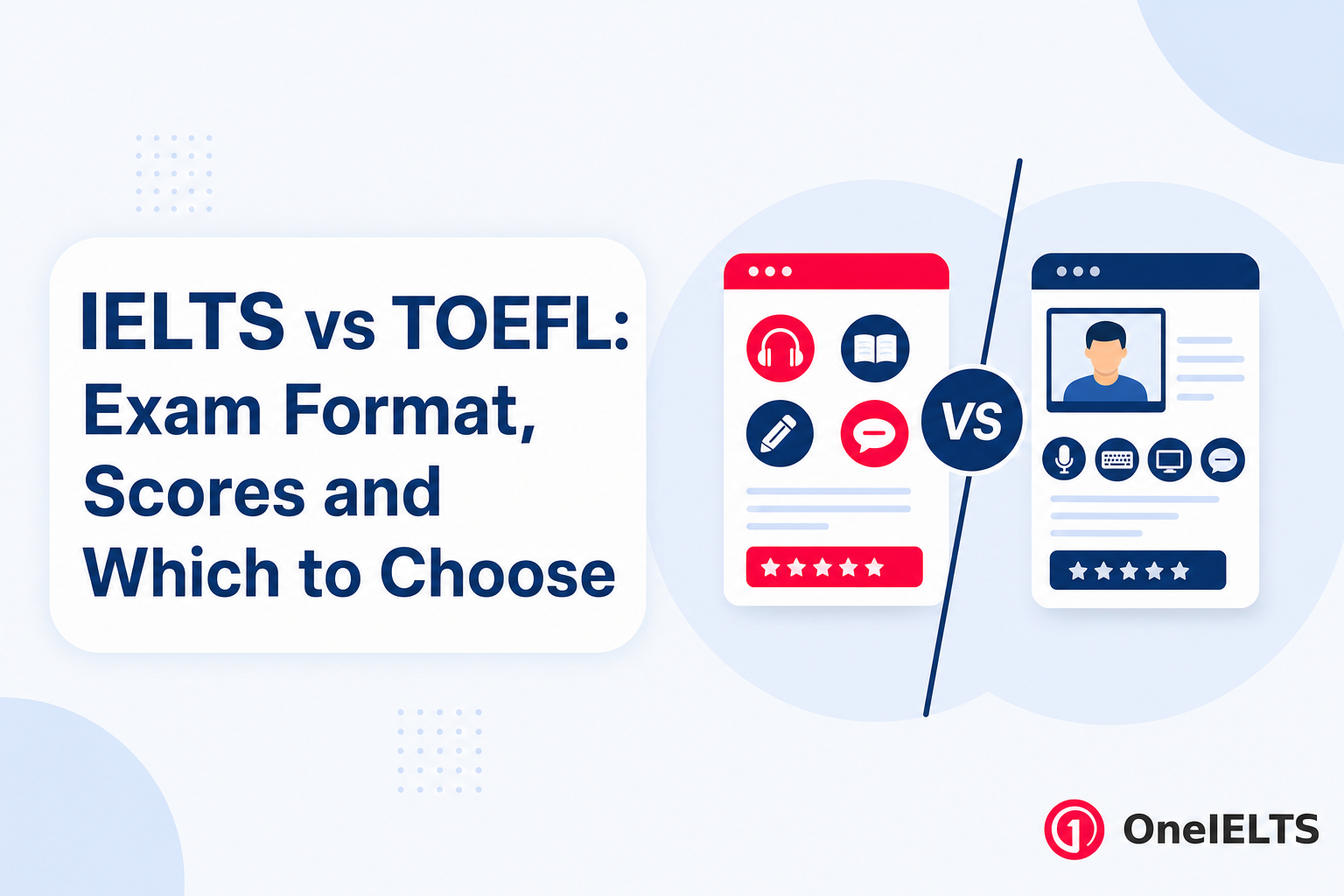
Picking between IELTS and TOEFL comes down to where you’re applying and which test format suits you. The exam that’s “harder” doesn’t decide it. The IELTS vs TOEFL choice is really one of American vs UK English and destination choice. IELTS tests the same four skills favoured across the UK, Australia and Canada, with paper or computer delivery and a face-to-face Speaking test. TOEFL is the American academic English test, fully computer-based and reported on a 0-120 scale.
This guide covers what each test is, how IELTS differs from TOEFL, whether TOEFL is harder, the TOEFL-to-IELTS score equivalent, and how to choose by destination choice and format.
What Is IELTS and How Does It Differ From TOEFL?
IELTS measures your English across four skills — Listening, Reading, Writing and Speaking — and reports each on a 1-9 band. It is the test most institutions across the UK Australia Canada region and beyond ask for, and you sit it as either a paper or computer exam. Its defining difference from TOEFL is the Speaking test. IELTS runs a face-to-face speaking interview with a certified examiner, whereas TOEFL records your answers to a computer.
What Is TOEFL?
TOEFL, the Test of English as a Foreign Language, certifies academic English for study at English-medium universities. It is rooted in American academic English, runs fully computer-based from start to finish, and is scored 0 to 120 across its four sections. US universities have long treated it as a default. ETS designed its tasks around the reading, lecture and discussion work students meet on American campuses.
Last verified: 30 June 2026
What Are the Key Differences Between IELTS and TOEFL?
Four contrasts separate the two tests, and each one matters more than the headline question of difficulty. They span format delivery, the scoring scale, speaking style and country acceptance. The four differences that decide between IELTS and TOEFL are set out below.
- Test format and delivery. TOEFL is computer only, while IELTS gives you a choice of paper or computer delivery options, so you match the sitting to how you work best.
- Scoring systems. The two tests use a different scoring scale: IELTS reports a 1-9 band, whereas TOEFL builds section totals into one 0-120 score.
- Speaking and Writing style. The speaking style differs sharply: IELTS uses a face-to-face interview, while TOEFL records speaking and sets integrated reading-to-writing tasks.
- Acceptance by country. Country acceptance splits by region: the US still prefers TOEFL, the UK, Australia and Canada lean toward IELTS, and most universities accept both.
1. Test Format and Delivery
The computer only TOEFL runs every section, including Speaking, on a screen at a test centre or, where offered, at home. The paper or computer IELTS keeps both delivery options open: you take the traditional paper exam or the computer version, with the same content and scoring either way. That choice lets handwriting-comfortable candidates avoid typing under time pressure, which the screen-based format does not allow.
2. Scoring Systems
IELTS scores run on a 1 to 9 band scale, awarded in half-bands for each skill and then averaged into an overall band. The IELTS 1 to 9 scale contrasts with TOEFL 0 to 120, which adds four section totals of 0-30 for Reading, Listening, Speaking and Writing. Because the two systems count in different units, you read across them with an official concordance table rather than converting one figure into the other.
3. Speaking and Writing Style
IELTS Speaking is a face-to-face interview: you talk to a real examiner across three parts, and the conversation can adapt to your answers. TOEFL takes the opposite approach with recorded speaking, where you speak into a microphone and a mix of human and automated scoring rates the file later. TOEFL also leans on integrated tasks that ask you to read a passage, hear a lecture and then write or speak a response. IELTS keeps its writing tasks separate.
4. Acceptance by Country
The US prefers TOEFL as its long-standing academic standard, and many American programmes quote TOEFL scores first. The UK Australia Canada IELTS pattern is the mirror image: those countries built their immigration and university requirements around IELTS. Even so, the two exams are now both widely accepted on either side, so the safer move is to confirm what your specific institution wants before you book.
Is TOEFL Harder Than IELTS?
Neither test is inherently harder — TOEFL suits candidates strong in academic American English, while IELTS suits those comfortable with a face-to-face Speaking test. Because it is not inherently harder either way, difficulty depends on your own strengths and your speaking comfort. If talking to a person settles your nerves, IELTS feels easier; if you’d rather record an answer and read American-style passages, TOEFL does. The exam that fits your habits is the one you’ll score higher on.
What Is the TOEFL to IELTS Score Equivalent?
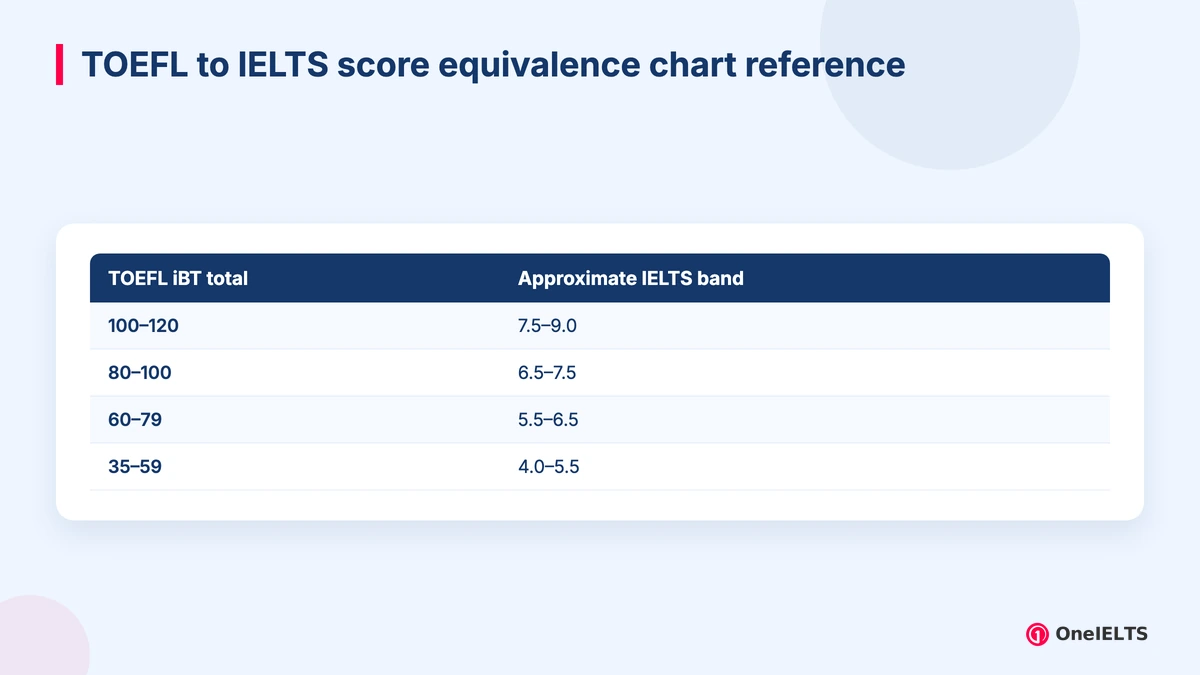
There is no exact formula, but published concordance tables map a TOEFL iBT total to an approx IELTS band so admissions teams can compare applicants. For instance, TOEFL 80-100 ~ 6.5-7.5 on the IELTS scale. The rough TOEFL-to-IELTS equivalents, based on the published iBT-to-band mapping, are shown in the table below.
| TOEFL iBT total | Approximate IELTS band |
|---|---|
| 100-120 | 7.5-9.0 |
| 80-100 | 6.5-7.5 |
| 60-79 | 5.5-6.5 |
| 35-59 | 4.0-5.5 |
A 2026 scale note: ETS replaced the 0–120 TOEFL iBT total with a new 1–6 scale in January 2026. During a two-year transition, score reports still show a comparable 0–120 total alongside the new 1–6 bands and a CEFR level, so the 0–120 concordance above remains usable for reports issued in that window. For the current official mapping, check ETS’s TOEFL–IELTS score comparison table.
Should You Take IELTS or TOEFL?
Your destination and the test format drive this decision far more than any difficulty ranking — pick the test your target country prefers and the delivery that matches your strengths. The decision rules that point you to the right test are listed here.
- Choose TOEFL for US-focused applications. American universities treat TOEFL as their default, so US-focused TOEFL candidates avoid friction by sitting the test admissions teams expect of them.
- Choose IELTS for the UK, Australia, Canada and global options. The UK Australia Canada IELTS rule holds because these countries built visa and admission criteria around IELTS, and it travels well elsewhere too.
- Prefer IELTS if you want a human Speaking test. Its face-to-face human speaking interview suits candidates who think better talking to a person than recording answers into a microphone under a timer.
- Match the format to your strengths. Pick computer delivery if you type fast and read well on screen, or choose IELTS on paper if handwriting and a printed page keep you calmer during the exam.
- Confirm what your institution accepts. Check the exact university or visa requirement first, because institution acceptance, not reputation, decides which score actually counts for your application.
How Do IELTS and TOEFL Scores Convert?
ETS publishes an official ETS concordance — for example, IELTS 6.5 ~ TOEFL 79-93 — so you read scores across the two tests rather than calculating them. Always use the official table, not a do-it-yourself formula, because the relationship between an IELTS band and a TOEFL total isn’t linear. Our IELTS band score guide explains what each band means before you compare it to a TOEFL figure.
Which Test Do US and UK Universities Prefer?
US universities lean toward TOEFL, while UK, Australian and Canadian institutions prefer IELTS — the preference follows the country, not the quality of the test. The US prefers TOEFL and the UK prefers IELTS, yet most top universities now have both accepted side by side.
The deciding factor is usually your destination plus whatever minimum the programme sets. Because both are accepted so widely, check the threshold that counts as a good IELTS score for your course before you commit.
Practice for the Real IELTS Exam
Apply what you’ve learned with free, exam-style practice:
- Take a full IELTS mock test
- Practice by section: Listening, Reading, Writing, Speaking
- Structure your essays with IELTS Writing templates