Your IELTS result arrives as a Test Report Form (TRF) that records a band for each skill and one overall band, read off the same nine-band scale by every university and visa office.
This guide covers the Test Report Form and the result release time, plus the day-count gap between computer and paper. It shows how to log in, check or preview the result online, the IDP versus British Council split, and downloading the TRF or eTRF. It then covers what the scores mean, validity and expiry, sending results, and verification. It closes on what counts as a good result and the re-mark, retake and re-sit routes.
Computer scores post in a day or two while paper takes about thirteen, and an Enquiry on Results can re-date a deadline-critical score. The fastest way to check IELTS result figures is the official portal.
What Is the IELTS Test Report Form (TRF)?
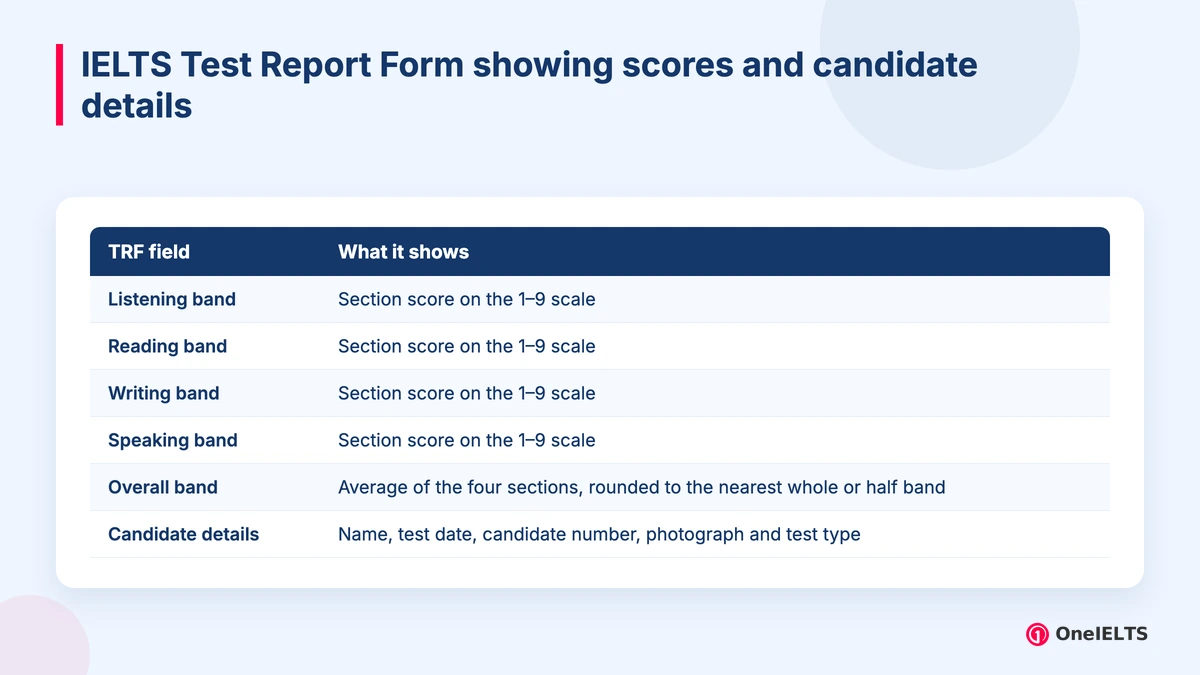
The IELTS Test Report Form (TRF) is your official result document, showing a band for each of the four sections plus an overall band. It is issued as a paper TRF for the paper test or a digital eTRF for the computer test, so the format depends on how you sat the exam. The TRF and eTRF carry the same four section bands and the same overall band, and a receiving body reads them identically.
This document is the only official proof of your score; the online preview that appears earlier is provisional and carries no weight with an admissions office. A single TRF also records your test date, candidate number, photograph and test type, which is why universities treat it as a tamper-resistant record rather than a printout. Keep the original safe, because centres charge a fee for extra copies and issue only a limited number.
The TRF you hold is the same record an admissions officer or visa caseworker reads, so its details have to match your passport exactly. A mismatched name or date can stall an application while the centre reissues a corrected form, which takes time you may not have near a deadline. Check your name spelling and date of birth on the booking before the test, since the TRF prints exactly what the registration holds.
How Long Does It Take to Get Your IELTS Result?
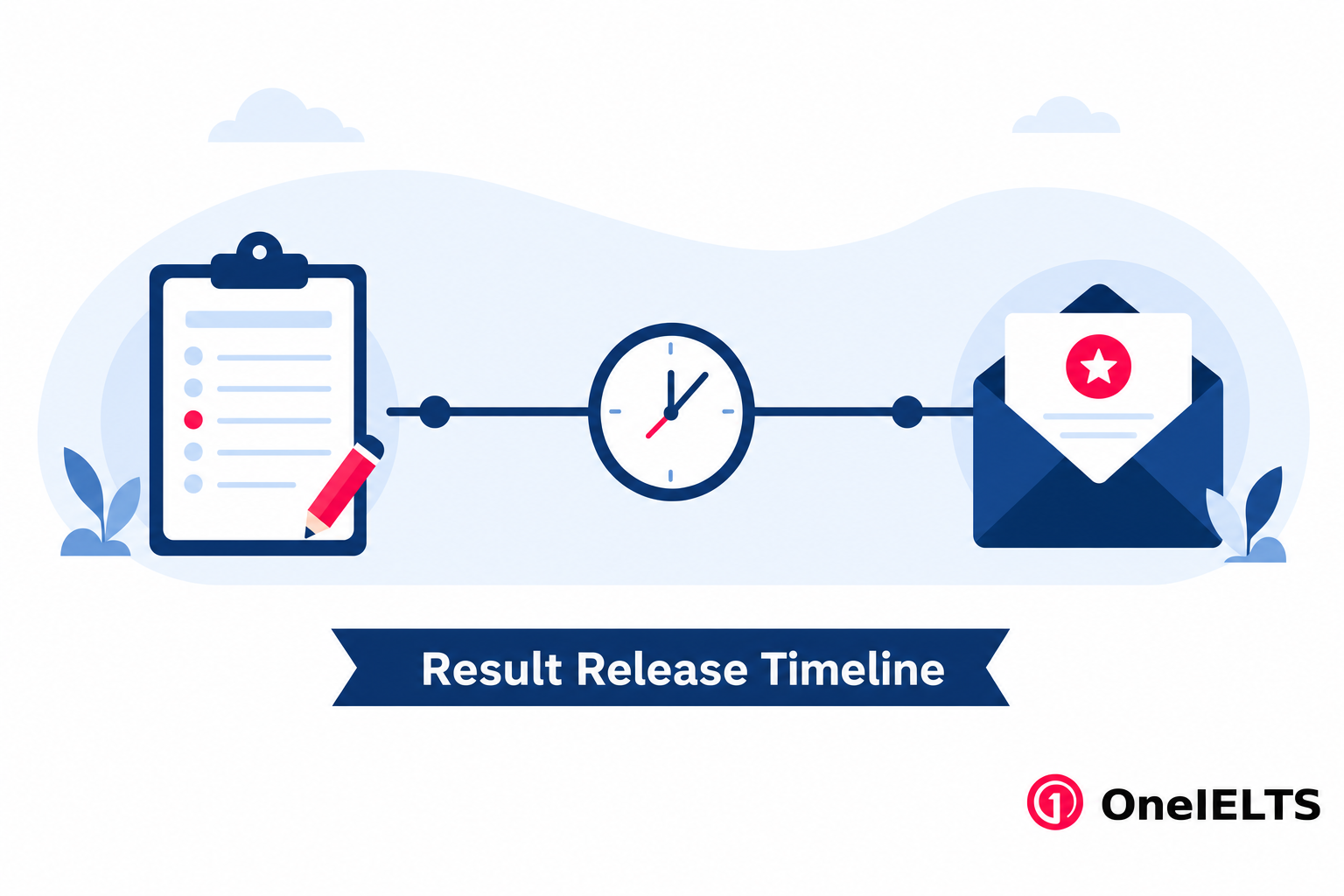
The result release time depends on your test type: IELTS on computer results post in about 1 to 2 days, IELTS on paper in about 13 days (7 days in India), and IELTS Online in 6 to 8 days. The British Council and IDP set these windows, and India runs a shorter paper cycle than most markets. The table below maps each test type to the time you should expect before the result issues.
| Test type | Result release time |
|---|---|
| IELTS on Computer | 1 to 2 days |
| IELTS on Paper | ~13 days (~7 in India) |
| IELTS Online | 6 to 8 days |
| IELTS for UKVI / Life Skills | up to 13 days |
Last verified: 30 June 2026
The clock starts on your test date, not the day you booked. The Speaking test sometimes sits a few days either side of the written papers without changing the release window. If a public holiday falls inside a paper-marking cycle, the centre can add a day or two, so build a small buffer into any application deadline that depends on the result.
Different test routes also sit on slightly different schedules. IELTS for UKVI and Life Skills can take up to 13 days, similar to the standard paper window, because the same marking and reporting steps apply. IELTS Online lands in 6 to 8 days, between the computer and paper figures, since it is remotely invigilated yet still examiner-marked for Writing and Speaking. Plan around the slowest test you might sit, not the fastest, when a hard deadline is in play.
Can You Preview Provisional IELTS Results Online?
Yes – you can preview provisional results online about 1 day after a computer test or 13 days after a paper test, using your passport or ID number to log in. The preview stays available for about 28 days and is not official confirmation, so treat it as an early indication only.
The full release time for each test type sits in our IDP IELTS results overview. Once the official TRF or eTRF issues, the preview is replaced by the confirmed record, and that confirmed copy is the one any institution will check.
How Many Days Does the IELTS Result Take (Computer vs Paper)?
A computer IELTS result takes about 1 to 2 days, while a paper result takes about 13 days (7 days in India). The gap exists because computer Listening and Reading are auto-scored the moment you finish, and computer Writing is routed to a central marking pool that turns scripts around fast.
Paper scripts follow a slower path. They are collected, shipped to a marking centre, scanned, and hand-marked by trained examiners, and each handover adds days. “IELTS result in how many days” is the single most-asked timing question candidates raise, and the count runs from the test date, not the booking date.
India runs a roughly 7 days paper cycle that beats the global norm, because high-volume regional marking centres there process scripts in larger, faster batches. That India 7 days figure is why a paper test in Delhi or Mumbai clears faster than one in many other markets.
The practical lesson is to match your test format to your deadline rather than your comfort. A candidate who needs a result inside a week should book the computer test, where the 1 to 2 days window leaves room to react.
Someone with months in hand can take paper without the day-count mattering. Either way, count from the test date and add a buffer, because a re-mark or a re-sit eats far more time than the gap between the two formats. If your deadline is tight, that day-counting difference is reason enough to pick the computer format. The full format comparison sits in our IELTS computer vs paper guide.
How Can You Check Your IELTS Result Online?
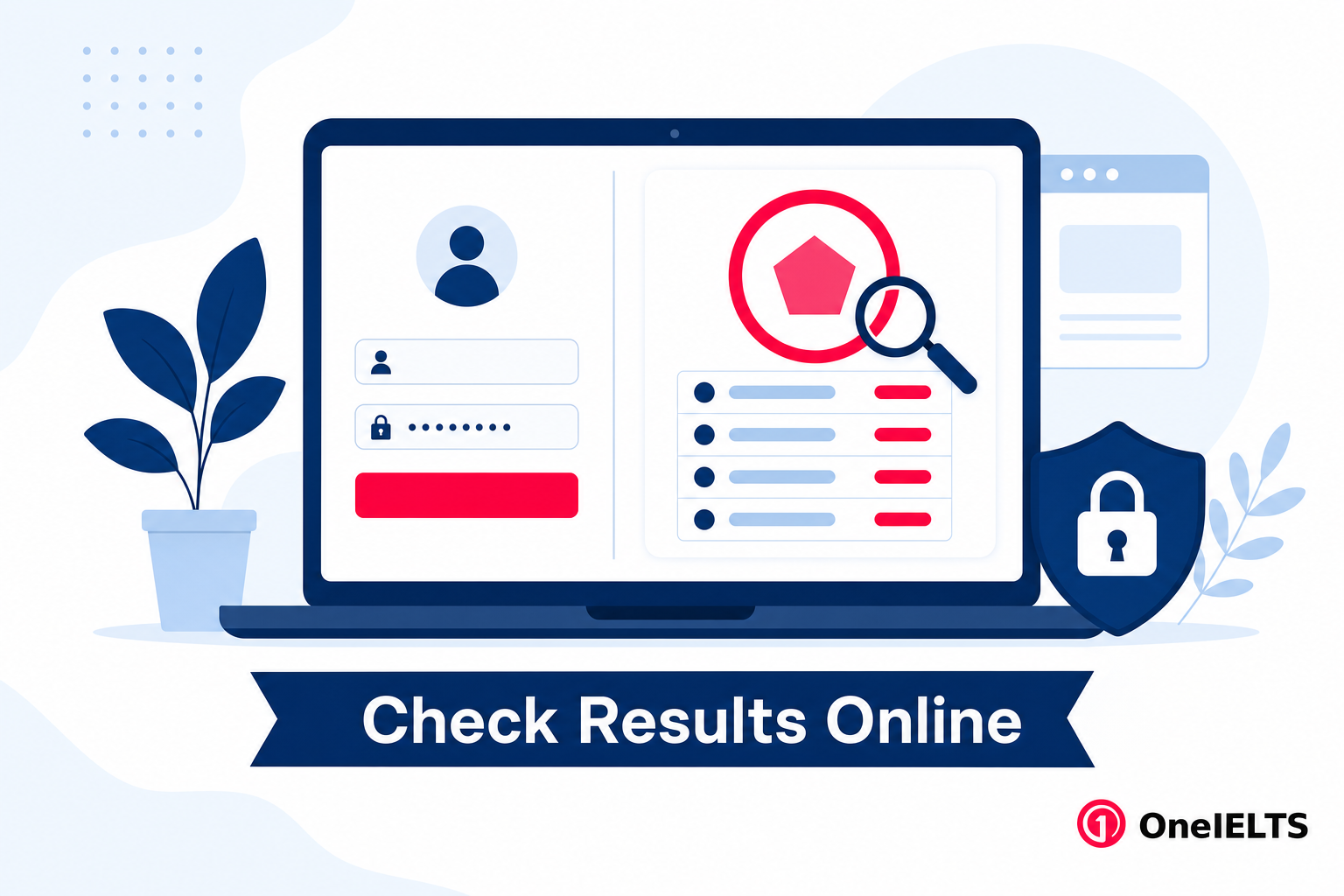
A candidate can reach the result through several channels, most of them digital and tied to the centre that ran the test. The routes below set out the main ways you can see your bands once the result is published.
- Official Test Taker portal. Sign in to the IDP or British Council IELTS result login to view and download your bands once the result releases.
- Email notification. The centre sends an email notification with a secure view link the moment your result is published online.
- eTRF download. Open your booking profile to do an eTRF download of the digital report once it appears.
- SMS alert. Some centres send an SMS alert telling you the result is ready, prompting you to log in and check.
- Paper TRF. For paper tests you collect the printed TRF in person or receive it by post from the centre.
Most candidates now use the portal and the email link, since both surface the result the moment it is published. The SMS alert and the posted paper TRF lag behind, so treat them as backups rather than your first check. Whichever channel reaches you first, the bands you see online and the bands on the issued TRF are identical.
How Do You Log In to Check Your IELTS Result Online?
Logging in to check your result is a short, fixed sequence on the same portal you used to book. The numbered steps below walk through the IELTS result login from opening the portal to viewing your eTRF.
- Open the test taker portal of the centre that ran your test, choosing the IDP or British Council site to match your booking.
- Enter your registered email or candidate number, the same identifier you used when you registered for the exam.
- Enter your password or the one-time code sent to your phone or email if the portal asks you to verify.
- Open the results tab, where published scores appear once the release window has passed for your test type.
- View or download the eTRF, saving the PDF copy for your own records once the bands are showing.
A failed login is almost always a wrong email rather than a held result. If the results tab is empty, the release window has not closed yet, so check the date math before you contact the centre.
Keep your candidate number and registered email together somewhere you can find them, because both are needed to sign in. If you booked months earlier, the password may have expired, in which case the one-time code route gets you in without a reset. The portal session is short-lived, so download the eTRF in the same visit rather than relying on the page staying open.
How Do You Check Your IDP vs British Council IELTS Result?
You check an IDP result on the IDP test taker portal and a British Council result on the British Council results page – the body that took your booking is the one that publishes your result. You cannot see an IDP result on the British Council site or the reverse, so the login URL follows whichever booking organisation processed your registration.
Both portals show the same bands and overall band on the same release timeline; only the portal and its sign-in screen differ. If you forget which one you used, the confirmation email from your booking names the organisation. Our IDP IELTS overview explains how the two portals differ in practice.
How Do You Download Your IELTS TRF or eTRF?
You download your eTRF as a PDF from the results tab of the test taker portal once the result is published; a paper TRF cannot be downloaded and is posted or collected instead. The eTRF download is a view copy for your own records, useful for tracking your bands, but institutions receive a verified copy through the portal rather than the PDF you save.
A TRF download is searched often near deadlines, so save the eTRF PDF early once the score appears. Still, rely on the Notify Institution route for any official delivery, because a self-saved PDF speeds up your own reference but does not replace the verified record a university or visa office reads.
Save the eTRF PDF in more than one place the day it appears. The portal keeps the result available for a limited period, and once that window passes you may need to request a copy rather than download one freely. A locally stored PDF is fine for filling in forms and tracking your bands, even though the verified copy is the only version an institution acts on.
What Is the Difference Between a TRF and an eTRF?
An eTRF is simply the digital version of the paper Test Report Form, marked and weighted identically. It is, in effect, a digital Test Report Form rendered as a secure online record. The eTRF is issued for the computer test at eligible centres and is accessed through the portal rather than printed at home.
You cannot self-print one that counts as proof. Only the centre-issued copy carries the official authenticity it needs to satisfy a university or visa office. The portal copy and the database behind it matter more than any file you save yourself.
What Do the Scores on Your IELTS Result Mean?
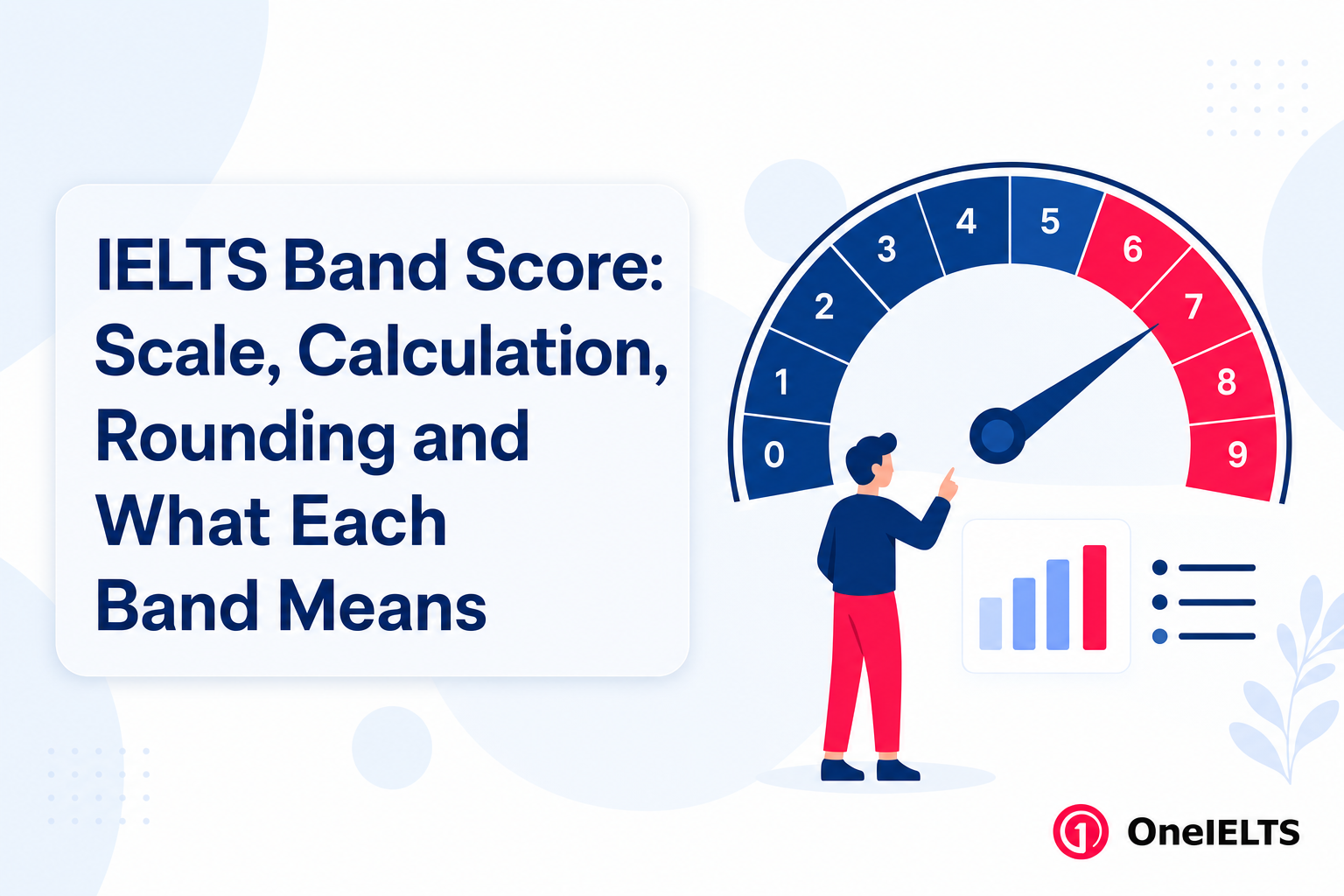
Your result reports a band from 1 to 9 for each of Listening, Reading, Writing and Speaking, plus an overall band that sums up your performance. The same nine-band scale measures both Academic and General Training, so the four section bands and the overall band are read the same way across formats.
Each band describes a level of English proficiency, not pass/fail. This is a proficiency not pass-fail system, so there is no failing mark – only the level you reached, which an institution weighs against its own threshold. Half bands appear at every step, so a result of 6.5 or 7.5 is normal rather than a rounding quirk. A band 7 means the same thing to a university in one country as it does to a visa office in another.
Reading the four section bands together tells you more than the overall figure alone. A profile of 7, 7, 6, 6.5 and a profile of 6, 6.5, 7.5, 7 can both average to the same overall band, yet they point to very different strengths. An institution that sets a per-skill floor cares about the lowest number, not the average, so always read your weakest band first against the requirement you are chasing.
How Is Your Overall IELTS Result Calculated?
Your overall band is the average of the four section bands, rounded to the nearest whole or half band. Because it is an average of four bands, the rounding rule is precise: a .25 average rounds up to the next half band, and a .75 average rounds up to the next whole band.
So a 6.25 average becomes 6.5 once the score is rounded to nearest half, and a 6.75 average becomes 7.0. This averaging is why a single weak skill drags the overall down, and why fixing one section can lift the whole result. The full mechanics sit in our IELTS band score guide.
How Long Is an IELTS Result Valid?
An IELTS result is normally valid for two years from the test date. Some institutions and visa routes set a shorter institutional window, accepting scores only six to twelve months old, so the two years validity is a ceiling rather than a guarantee.
There is no extension; once the result lapses you must re-sit the test to produce a fresh score. The validity runs from the date you sat the exam, not the date the result issued, so the two-year clock is already a few days in when you first see your bands.
Plan your test date around when you will actually use the score, not when you study. A result taken too early can lapse before a delayed intake or a slow visa decision, forcing an avoidable re-sit. If your course or visa timeline is uncertain, sitting the test closer to the application window protects the most usable validity.
What Happens When Your IELTS Result Expires?
Once it passes two years, an expired result is no longer accepted for admissions or most visas, and you must take a fresh test. Check each institution policy for its exact validity rule before you rely on an older score, because a body that allows two-year results may still reject one near the edge of that window.
The validity rules and how destinations vary sit in our IELTS score validity guide. There is no grace period and no renewal, so a result that lapses mid-application can force a fresh test at the worst possible moment.
Diarise the expiry date the day you receive your result. If you are applying in stages, confirm the score will still be valid on the date the institution actually checks it, not the date you submit. A few destinations accept a result that was valid at submission even if it lapses during processing, but most do not, so never assume that leniency.
How Do You Send IELTS Results to Institutions?
You can nominate institutions to receive your official result, sent by post as a paper TRF or electronically through the eTRF notify channel. The portal lets you name up to five free institutions when you book, and it routes each copy through its Notify Institution option.
Confirm each receiver’s preferred delivery method and address first, because a university that requires an electronic copy may reject a posted paper TRF. Beyond the five free nominations, additional copies usually carry a per-institution fee and a short processing time, so list your real shortlist at booking rather than later.
Timing the nomination matters as much as the count. If you name institutions at booking, the centre can dispatch the result as soon as it issues, which shaves days off an application. If you add them afterwards, the request joins a processing queue and may arrive after a verified portal check would have. For a tight deadline, the electronic eTRF notify route reaches a receiving body faster than a posted paper TRF.
How Do Organisations Verify an IELTS Result?
Organisations confirm a result’s authenticity through the IELTS Results Verification Service, querying the secure database directly rather than trusting the candidate’s own copy. This authenticity check is why a self-printed or edited document fails as proof; a not self-printed, centre-issued record is what they accept.
Candidates send results through the portal so the receiving body can verify online against the source record. Because verification runs against the database rather than the paper, even a perfect photocopy carries no standing on its own. The receiving organisation always reads the score from the source it can trust.
This is also why you never need to courier a paper TRF to most modern receivers. The verification service lets an institution confirm your bands in seconds against the database, provided you have sent the result through the portal. For candidates, the takeaway is simple: route the result officially, and let the receiver verify it rather than trying to prove authenticity yourself.
What Counts as a Good IELTS Result?
A good IELTS result is the band your target university or visa route asks for, which for most courses and immigration streams sits between 6.0 and 7.0 overall. There is no universal pass mark on the nine-band scale, so a good result is defined by the institution’s published target requirement, not by the test itself.
Common reference points help. A 6.5 overall suits many undergraduate courses, 7.0 covers many postgraduate and professional registrations, and some visa routes accept 6.0 or set a per-skill minimum instead. Read your result against the exact target requirement before you decide to re-mark or re-sit, because a band that is good for one destination can fall short for another.
A good result is therefore relative, not absolute. The same 6.5 overall that comfortably clears one undergraduate course can miss a postgraduate programme that asks for 7.0, or a registration body that wants 7.0 in every skill. Start from the published requirement of your real target, then work backwards to the band and per-skill floor you actually need. That keeps you from chasing a higher number than your destination ever asked for.
What Is a Good Result for Each Skill?
A good per-skill result is one that clears the minimum your destination sets for each skill. Many courses and visas demand a floor in every band, not just the overall, so a strong overall band can still fail an application if one skill falls short.
That weak skill is most often the Writing band, where candidates lose ground against the per-skill minimum. Nursing and other professional registration bodies frequently require 7.0 in each skill, which is stricter than the overall figure alone. Our IELTS good band score guide breaks down the common thresholds, so check whether your destination sets an overall figure, a per-skill floor, or both.
How Does Your Result Map to Band Descriptors?
Each band on your result maps to a published band descriptor that names the level of English it represents, from band 5 modest user to band 8 very good user. The descriptors let you read what a number means in plain terms, so you can see which skills to target before a re-sit rather than guessing.
They are set by the test partners and apply identically to Academic and General Training, so a band 7 describes the same level of English whichever format you took. The full wording for each level sits in our IELTS band descriptors guide.
What Can You Do If You Are Unhappy With Your Result?
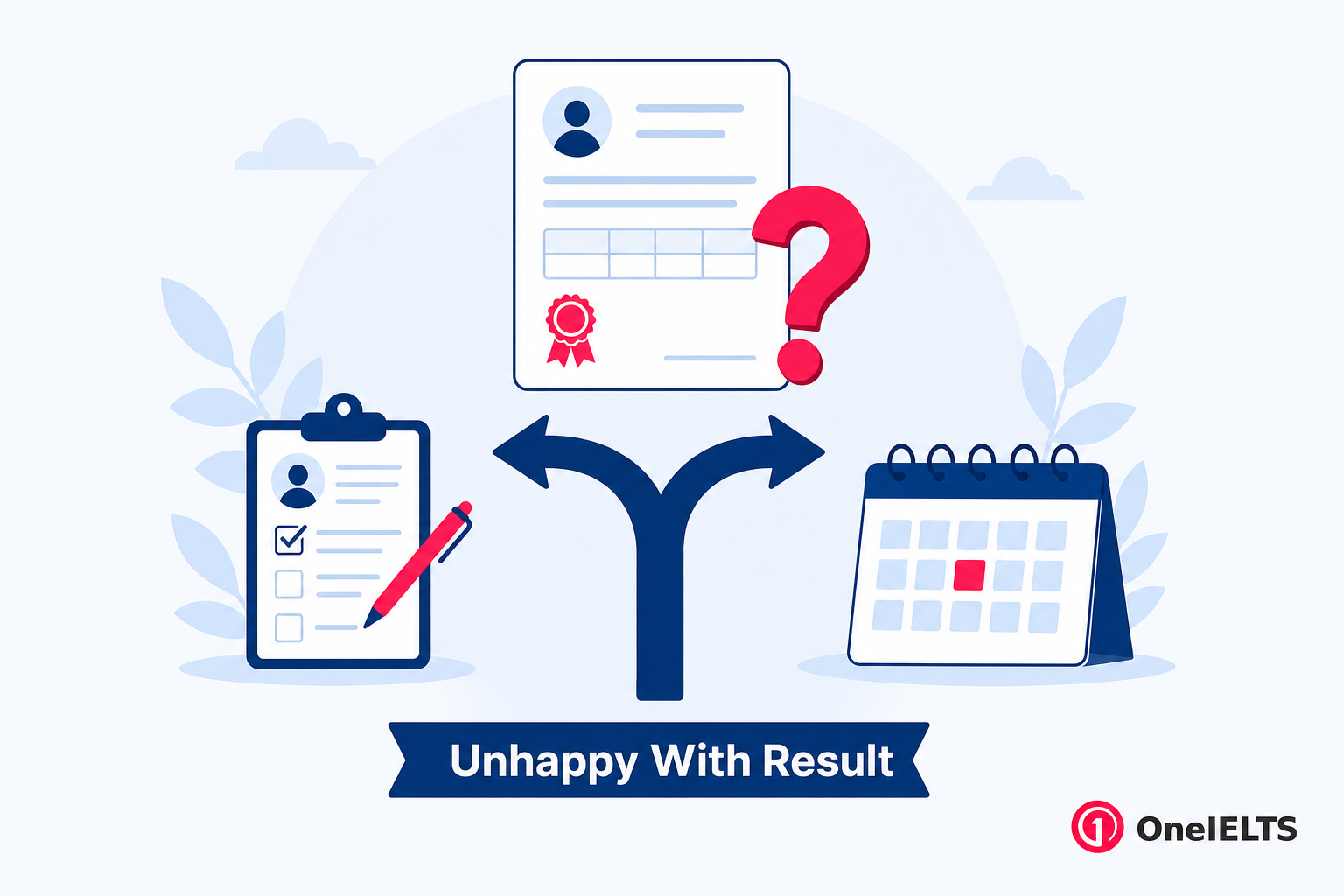
A disappointing result leaves you three practical routes, and the right one depends on how close your score sits to the band you need. The options below let you choose by situation, from a re-mark to a focused retake to a full re-sit.
- Request an Enquiry on Results. Ask for a senior-examiner re-mark when you believe a band was marked too low and sits within reach of your target.
- Take a One Skill Retake. Re-sit only the weakest of the four skills if you tested on computer and one section alone dropped your overall band.
- Re-sit the test. Book the full four-skill exam again when several sections fell short and a single re-mark or retake would not close the gap.
How Does the IELTS Enquiry on Results (EOR) Re-mark Work?
An Enquiry on Results is a senior examiner re-mark you can request within six weeks of the test. The fee is fully refunded if any band rises, so the fee refunded if band rises rule protects a genuine query rather than penalising it.
It takes anywhere from 2 hours to 21 days, a new TRF is issued if the score changes, and a band can rise, stay the same, or rarely fall. Candidates most often query Writing or Speaking, the two examiner-marked papers, where a half-band swing is most likely to move an application across a threshold.
Weigh the cost and the clock before you lodge an enquiry. The fee is real money up front, refunded only if a band actually rises, and the re-mark can take up to 21 days that a tight deadline may not allow. If you are one half-band short on a single examiner-marked paper, an Enquiry on Results is usually the better bet than a full re-sit. If you are short across several papers, fresh preparation and a new test will move you faster. Our IELTS EOR guide covers the request steps.
What Should You Do If Your Result Is Lower Than Expected?
If your result is lower than expected, first compare each band against your target, then choose a re-mark for a borderline single skill or a re-sit when several bands fell short. A calm gap analysis beats an instant rebooking.
A half-band shortfall on a borderline band points to an Enquiry on Results, while a broad miss across two or more skills points to fresh preparation and a new sitting. You have a six-week window to lodge an Enquiry on Results, so act before that closes if a re-mark is the better bet. Our IELTS EOR guide sets out when a re-mark is worth the fee.
Can You Retake Just One Skill Instead of All Four?
Yes – if you sat IELTS on computer at an eligible centre you can take a One Skill Retake within 60 days of the original test. You apply for any EOR first and resolve it before booking a One Skill Retake, not after, because a re-mark and a retake cannot run on the same score at once.
The retake produces a fresh TRF for that skill, which you then pair with your existing bands, so a single weak section need not cost you the whole exam fee again.
The 60-day window and the computer-only rule are the two limits that catch candidates out. You cannot take a One Skill Retake on a paper sitting, and you cannot start one until any Enquiry on Results on the same score has finished. Decide quickly, because the window counts from your original test date and does not reset. Read the eligibility rules in our IELTS One Skill Retake guide.
How Many Times Can You Sit IELTS to Improve Your Result?
There is no limit on how many times you can re-sit IELTS, so the no re-sit limit rule gives you room to keep going until you hit your target. You should prepare before rebooking and target your weakest skill rather than repeating the same result with the same gaps.
A One Skill Retake is often cheaper and faster than a full re-sit when only one section holds you back. The full re-sit vs retake decision and a study plan sit in our improve IELTS band guide. Candidates who treat each sitting as a fresh attempt without changing their preparation tend to plateau, so a focused plan beats raw repetition.
Before you rebook, look at which skill cost you the band and why. A Writing band that stalls usually reflects task response rather than grammar, while a Reading band often turns on timing and skimming technique. Fix the specific cause, then choose the cheapest route that addresses it: a One Skill Retake for one weak skill, a full re-sit when two or more need work.
Practice for the Real IELTS Exam
Apply what you’ve learned with free, exam-style practice:
- Take a full IELTS mock test
- Practice by section: Listening, Reading, Writing, Speaking
- Structure your essays with IELTS Writing templates