Most IELTS writing mistakes advice arrives as a flat list. Nine pages were read for this guide, five of them IELTS-partner properties, and not one mistake appears on three of the four test-owner assets. There is no agreed list to hand you.
So this page sorts every mistake by criterion cost: what it takes off Task Response, Coherence and Cohesion, Lexical Resource, or Grammatical Range and Accuracy. Real error pairs, quoted and attributed. The four band ceiling claims the whole search result contains, and no fifth. The six places the guides give conflicting guidance, with both sides named.
What Are the Most Common Mistakes in IELTS Writing?
Nine pages were read for this article, and there is no agreed list. Counting IDP’s global and India grammar pages as the single asset they demonstrably are, not one mistake appears on three of the four test-owner assets. In the independent set, only two mistakes reach three of four.
That finding sets the method. A mistake asks for your attention in proportion to what it costs, and what it costs is a band in one of four criteria. This page files every mistake under the criterion it damages, and mistake cost decides the order inside each section.
Credit where it is due on criterion filing. Google’s AI Overview on this exact search does the same thing, with three sub-heads: Task Response and Structure, Coherence and Cohesion, and Vocabulary and Grammar. Exactly one captured page of nine organises itself that way. The other eight publish flat lists, and only three of the nine mention band descriptors at all.
The page runs in that order. Four criterion sections come first, with the grammar section carrying comma and word-order detail. Spelling follows, since the one reusable word list on this search result sits there. Then the two tasks separately, because a mistake in Task 1 is not a mistake in Task 2. Then the four band ceilings, the six places the guides disagree, and how to check your own work.
Which Mistakes Cost You Task Response Marks?
Answering a different question is the most expensive mistake in IELTS Writing. The AI Overview names it in one line.
“Missing parts of the prompt: Forgetting to answer a sub-question or giving a one-sided argument when asked to discuss both views.”
ELT School gives the shape: a question asks “Do you agree or disagree, and what are your reasons?” and the writer supplies the reasons without ever stating a position.
The cost is the sharpest band claim in the whole capture. My IELTS Classroom, writing as a serving IELTS marker, puts it this way.
“making this mistake means that before you have written one word, your score for Task Response can now be NO MORE THAN 5.0.”
An off-topic answer caps one of your four criteria before the examiner has read a sentence.
Not covering every part is the same error at smaller scale. IDP Australia publishes three checks against it.
- “Read the question carefully and decide how many parts must be addressed”
- “Look for plurals – For example, problems – more than one problem must be presented”
- “Look for and – For example, the individual and the society”
Unanswered parts are easy to create and easy to prevent, because the plural and the word and both sit in plain sight in the prompt.
Undeveloped ideas cost marks even when every part gets an answer. My IELTS Classroom is blunt: “Never have a one sentence argument (even if the sentence is a long one!)” Its ratio rule is worth copying. A discuss-both-sides essay takes two ideas per paragraph with two or three extension sentences each; a to-what-extent essay takes one idea per paragraph with four to six sentences.
Invented evidence is the mistake candidates think they are getting away with. “If you are using fake statistics in your essays – STOP!” writes My IELTS Classroom. IDP Australia explains why it fails: “Examiners cannot check if your research and survey examples are real”. Its own bad example reads “A recent research in Harvard shows that 89% of all wild animals die in cages.”
Over-generalisation is the fifth and the cheapest to repair. My IELTS Classroom’s pair runs “People who eat fast food are obese” into “People who eat fast food TEND TO BE obese”. The British Council offers the hedging phrases: “As it seems that…”, “It might well be that..”, “It could be…”
Which Position Mistakes Cost Task Response Marks?
An implied position is scored as no position at all. The examiner needs a held position, written down, rather than a stance you assume a reader will infer. ELT School’s pair shows the repair: “In conclusion, some people think X while others think Y. Both viewpoints have merit.” becomes “In conclusion, although X has merit, I firmly believe that Y is the better approach.”
Three sources price this one. The British Council calls it “A common and costly mistake in Writing Task 2”. My IELTS Classroom calls it “probably the biggest and most common mistake I see as an IELTS marker”. ELT School says the both-sides hedge “is a classic reason for being stuck at Band 6.”
IDP Australia supplies the practical test.
“If you discuss what some people think and what other people think, you have not yet expressed your opinion. Make sure the examiner knows what you think.”
On position placement the guides split, and the split is real. My IELTS Classroom says the introduction is “not actually that important” as long as “you should make your opinion known in the body AND conclusion”. ELT School requires it “from the very beginning”.
State it in the introduction and hold it through the body and conclusion. That version satisfies both sides, and the AI Overview points the same way when it treats waiting until the conclusion as the error. Writing the opening that carries it belongs to the IELTS Writing Task 2 introduction page.
Which Memorised Phrases Are Common Mistakes?
Memorised openers are the phrases examiners recognise fastest. IDP Australia publishes the only named phrase blacklist in the capture.
- “Controversial topic/hot topic”
- “Two-edged sword/double-edged sword/2 sides/faces of a coin”
- “In a nutshell”
- “I pen down by saying”
- “There are pros and cons”
- “This essay will discuss”
- “Reasons why I hold this view”
- “This is a highly controversial/is a highly debated issue”
It adds one more line: “Avoid proverbs and clichés – old is gold”. ELT School’s pair turns “This essay will discuss both sides and give an opinion at the end.” into “Although online learning has certain benefits, I believe traditional classroom interaction is more significant because…”
The cost is not a deduction. ELT School explains what happens instead.
“Examiners can spot these immediately, deem them mechanical, and may exclude them from the assessment (they might not even count towards your word count).”
The AI Overview says the same in fewer words: “Rote templates: Using obvious, memorized introduction phrases that examiners penalize or ignore entirely.” Mechanical language is skipped, and skipped words cannot earn you marks.
One published typo needs flagging, because a candidate reading it alone would take the opposite lesson. IDP Australia’s page as published reads “The examiner is looking for memorised language, phrases and clichés.” The surrounding text makes “looking out for” the obvious intent. Rewriting the prompt in your own words belongs to the how to paraphrase for IELTS page.
Which Coherence and Cohesion Mistakes Cost Marks?
Paragraphing is the one mistake on this search result with a band-by-band descriptor attached. IDP Australia publishes the mapping, and it is the only descriptor table anywhere in the capture.
| Band | Paragraphing descriptor, quoted from IDP Australia |
|---|---|
| 8 | “Paragraphing is used sufficiently and appropriately” |
| 7 | “Paragraphing is generally used effectively to support overall coherence, and the sequencing of ideas within a paragraph is generally logical” |
| 6 | “Paragraphing may not always be logical and/or the central topic may not always be clear” |
| 5 | “Paragraphing may be inadequate or missing” |
IDP then marks its own sample essay against those paragraphing descriptors, calling it a match for band 5. The AI Overview names the two failure shapes.
“Poor paragraphing: Writing single-sentence paragraphs or one massive block of text.”
Single-sentence paragraphs and one unbroken block sit at the same band.
A linking word in every sentence is the second mistake. ELT School’s pair replaces “Firstly, the entertainment industry is lucrative. Secondly, it is popular. Furthermore,…” with “First of all, the entertainment industry is lucrative. Another significant reason is its popularity…” The AI Overview calls it “Overusing transition signals: Dropping words like furthermore, moreover, or consequently into every sentence instead of letting ideas flow naturally.”
The wrong essay format is the third, and IDP Australia states it in one line: “You should not use sub-headings, bullet points or numbers.”
The guides disagree here. One captured page treats linking words as something candidates use too little of, warning that “poor use of linking words can hurt your score”, while ELT School treats overuse as the fault.
Mechanical connectors at the start of every sentence are the actual error, not the devices themselves. The fix is variety, which means pronouns and referring phrases carrying some of the load. Which connector to choose belongs to the connectors for IELTS page.
Which Vocabulary Mistakes Cost Lexical Resource Marks?
A wrong collocation costs more than a small vocabulary does. ELT School supplies two pairs.
- “He did a crime.” becomes “He committed a crime.”
- “We must do an effort.” becomes “We must make an effort.”
The British Council adds “to give a distraction”, which should read “to provide a distraction”, along with the drill for it.
“Develop your awareness of common collocations by underlining them in IELTS reading texts and checking possible verb-noun collocations in a dictionary.”
Informal register is the second. ELT School turns “Kids nowadays can easily get info from the internet. The results were so-so.” into “Children nowadays can easily obtain information from the internet. The results were mediocre.” Its substitution list runs Kids to Children, Guys to People, Get to Obtain or Receive, and So-so to Average or Mediocre.
Contractions belong with it. ELT School turns “It’s clear that we can’t solve this issue quickly.” into “It is clear that we cannot solve this issue quickly.”
Its band note is firm: “it’s crucial to follow it strictly if you are aiming for Band 7 or higher.”
Forced vocabulary is the fourth and the most self-inflicted. The AI Overview calls it “Forcing complex words: Using rare, inappropriate words incorrectly rather than natural collocations.”
The British Council extends it to idioms: “If you are unsure about using idioms, it is better not to use them at all. You can still get a high score without using a lot of idioms.”
Word repetition is the fifth, and Grade Online supplies the only Task 1 vocabulary pair on the search result.
“The number of cyclists went up a bit, then went down a bit again and was the same until the end of the period.”
That becomes the following.
“The number of cyclists first increased insignificantly, then there was a slight decline in figures, followed by a period of stability until the end of the period.”
Two sources pull against each other here. Grade Online says “The more varied your language is, the higher band you can achieve”; ELT School says “You don’t need to use difficult words. What’s vital is using the right combinations of words (collocations) and accurate grammar.” Accuracy comes first and range second, because a rare word placed wrongly costs more than a common word placed right.
Which Grammar Mistakes Cost Marks in IELTS Writing?
Subject-verb agreement is the error both grammar sources name first. ELT School’s pair: “The government need to take action.” becomes “The government needs to take action.” The AI Overview names the identical one, “Forgetting third-person singular -s (e.g., the government need)”. IDP’s rule is one line: “When the subject is singular, the verb must also be singular. When plural, both subject and verb must be plural.”
The comma splice is the second. ELT School turns “Cigarettes affect smokers’ health, they also affect bystanders.” into “Cigarettes affect smokers’ health. They also affect bystanders.” IDP defines it: “A comma splice happens when two independent clauses are joined together by just a comma. Instead, we should separate two independent clauses with a full stop.”
Sentence fragments are the third, and IDP prints three pairs.
- “is a good place to live.” becomes “It is a good place to live.”
- “The athlete his trophy.” becomes “The athlete was displaying his trophy.”
- “After I start university.” becomes “I’ll come home less often after I start university.”
Conditional forms are the fourth. IDP sets them out as a table, and its mixed row is honest about the limit.
| Conditional | Form |
|---|---|
| Zero | If + present simple, present simple |
| First | If + present simple, will + infinitive |
| Second | If + past simple, would + infinitive |
| Third | If + past perfect, would have + past participle |
| Mixed | “Various depending on meaning – see examples.” |
The two test owners disagree about that last row. The British Council files “Incorrect use of mixed conditionals” under mistakes made by advanced learners, while IDP teaches them as a target structure. Its advice is conditional on competence: “If you want to use a mixed conditional, make sure you know how to use them correctly”. Reach for one only when you can already build it without thinking.
Tense inconsistency is the fifth, and the IELTS Writing Task 1 tenses page owns it in full.
Error frequency is what actually separates the bands, and IDP states it more usefully than any other page in the capture.
“At the top bands from 7 to 9, a speaker or writer should only make a few, occasional or rare errors. In the middle bands like from 4 to 6, grammar mistakes are more frequent, but the difference with band 6 is that the mistakes do not impact on the writer’s or speaker’s message from coming through.”
Which Comma Mistakes Appear in IELTS Writing?
Four comma rules cover almost everything, and IDP supplies all four with worked examples.
Comma overuse comes first.
“When there is an independent clause followed by a dependent clause in the same sentence, you don’t need a comma.”
Its example: “The house plant died because I didn’t water it.”
The missing opener comma is the reverse.
“There needs to be a comma after discourse markers, prepositional phrases or dependent clauses.”
Its three examples:
- “Unfortunately, it didn’t work out.”
- “On the other hand, social media has some benefits.”
- “Once the timer has finished, please put down your pencil.”
The compound sentence needs one.
“Commas are necessary when separating two independent clauses in a compound sentence.”
Its example: “They wanted to play football in the park, but it was raining.” Joining two independent clauses with only a comma gives you the splice from the section above.
One measurement earns this section its place. Punctuation returns non-zero on three of the nine captured pages, and comma rules with worked examples appear on exactly one asset. When a complex sentence is worth building at all belongs to the how to use complex sentences page.
Which Word Order Mistakes Appear in IELTS Writing?
Three word order patterns account for most of what goes wrong, and IDP gives each a pair and a formula.
Object before time phrase. “I have played for six years basketball.” becomes “I have played basketball for six years.” The formula is “Subject + Auxiliary Verb + Verb + Object”, which fixes the verb object order.
Adverb placement. “I go often to the park.” becomes “I often go to the park.” The formula is “Subject + Adverb of Frequency + Verb + Object”.
Question shape in a statement. “You have played basketball?” becomes “Have you played basketball?” The formula is “Auxiliary Verb + Subject + Verb + Object”.
That adverb of frequency rule appears on IDP’s global page and is absent from the India version of the same article. This page is in a position to notice it because it read both. Tense choice sits next door to word order, and the IELTS Writing Task 1 tenses page covers it.
Which Spelling Mistakes Do Candidates Make?
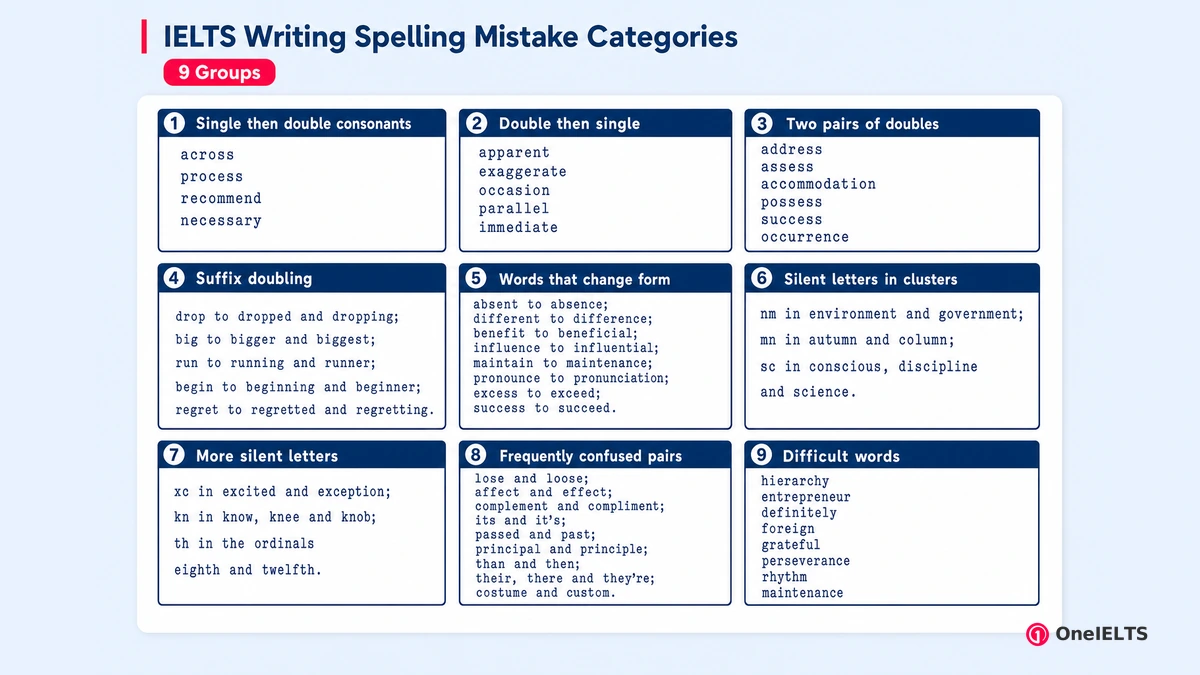
Spelling has one reusable word list on this entire search result, and IDP publishes it. Only one page of nine carries anything like it, sorted into categories rather than dumped as a single column.
- Single then double consonants: across, process, recommend, necessary.
- Double then single: apparent, exaggerate, occasion, parallel, immediate.
- Two pairs of doubles: address, assess, accommodation, possess, success, occurrence.
- Suffix doubling: drop to dropped and dropping; big to bigger and biggest; run to running and runner; begin to beginning and beginner; regret to regretted and regretting.
- Words that change form: absent to absence; different to difference; benefit to beneficial; influence to influential; maintain to maintenance; pronounce to pronunciation; excess to exceed; success to succeed.
- Silent letters in clusters: nm in environment and government; mn in autumn and column; sc in conscious, discipline and science.
- More silent letters: xc in excited and exception; kn in know, knee and knob; th in the ordinals eighth and twelfth.
- Frequently confused pairs: lose and loose; affect and effect; complement and compliment; its and it’s; passed and past; principal and principle; than and then; their, there and they’re; costume and custom.
- Difficult words: hierarchy, entrepreneur, definitely, foreign, grateful, perseverance, rhythm, maintenance.
ELT School adds the three its author sees most: Enviroment for Environment, Goverment for Government, and Beleive for Believe.
Two rules govern the rest. On spelling consistency, IDP is explicit: “Both British and American spellings are accepted in IELTS. However, it is important that you remain consistent and stick to one or the other.”
The second rule matters more than it looks. IDP Australia: “Remember that computer-delivered IELTS does not have spell-check. A typo is considered a spelling error.” Its typo errors are the ones your fingers make, not your memory: teh for the, adn for and, tehm for them, thier for their. Its drill is to turn spell-check off on your own device while you practise, then turn it back on afterwards.
The consequence differs by paper, and IDP says how.
“words with spelling mistakes in the Reading and Listening tests will be marked as incorrect, while spelling errors in the Writing test may make it difficult for the examiner to understand and follow your message.”
Which Mistakes Are Specific to IELTS Writing Task 1?
One of the nine captured pages is about Task 1 mistakes. The top result, the British Council’s page and the two most detailed independent pages are all Task 2 or sentence-level grammar. The People-also-search-for chips still ask for “Common mistakes in ielts writing task 1” by name. Grade Online is the one page that covers them, and every one of the task one errors below is attributed to it.
Writing an opinion at all heads the list, which is the exact reverse of Task 2.
“You might get a penalty if you write about: reasons why changes happened; your opinion about the situation; predict the future of the situation.”
That opinion penalty is task-dependent, and the disagreement section below settles it properly.
No overview is the second, and it has its own section underneath this one.
Describing every figure instead of grouping is the third. Grade Online sets out the data grouping alternative.
“if you group your trends by similarities and differences, which is a good strategy, you will:
paraphrase the task in paragraph 1 + overview of main trends; write about similar trend in paragraph 2; write about different trends in paragraph 3.”
Starting to write immediately is the fourth. Grade Online asks for pre-writing analysis, telling candidates to “spend 3 – 5 minutes” on the axes, measurements, column names, dates and trends before a word goes down.
Vague quantity language is the fifth, and the cyclists pair quoted in the vocabulary section is the example.
Not checking is the sixth, and Grade Online calls it the biggest.
“This is one of the biggest mistakes candidates commit in the real exam… it is worth spending 1 or 2 minutes at the end to check your writing. Pay attention to: spelling; punctuation; articles; subject and verb agreement; the mistakes you know you often make.”
That final check earns its minutes. Chart-type structure and the vocabulary each visual needs belong to the Task 1 pages.
Why Do Missing Overviews Count as Writing Mistakes?
A missing overview is a Task 1 answer that lists figures without ever saying what the data does as a whole. Grade Online supplies the only Task 1 descriptor citation in the capture.
“If you want to receive band 6+, follow the criteria, which say that you need “to present an overview with information appropriately selected”. Unlike band 5, where the candidates simply “recount details mechanically with no clear overview”.”
The AI Overview states the same mistake in plainer words.
“No overview (Task 1): Failing to include a summary paragraph highlighting the main trends or features in the data.”
A mechanical recount of every figure is what band 5 looks like.
The repair takes two sentences. Write a summary sentence or two naming the largest movement, the highest and lowest points, or the overall direction, place it after the paraphrased introduction, and keep every figure out of it. That is the band six threshold in practice.
One measurement justifies giving this its own section. The word overview is non-zero on one captured competitor page of nine, and on two others it appears only in navigation. The highest-cost Task 1 error is almost unpublished on this search result, which the IELTS Writing Task 1 hub covers in full.
Which Mistakes Are Specific to IELTS Writing Task 2?
Too few paragraphs is the Task 2 mistake with a worked demonstration behind it. IDP Australia prints a two-paragraph zoos essay, re-paragraphs the same essay into four, and marks the original against the band 5 descriptor. Its fix is two sentences: “Use paragraphs for each idea. Leave a space between each paragraph.” Paragraph count is visible from across a room, which is why it is the first thing a marker sees.
An essay that is not an essay is the second. IDP Australia rules out three things by name, and the essay format it describes has no sub-headings, no bullet points and no numbers.
Conclusion faults come in two shapes. A conclusion that introduces something new leaves the new idea undeveloped, and a conclusion that adds nothing wastes the last thing the examiner reads. Both are fixed by restating the position you set out in the introduction, which the position section above covers.
Ending a paragraph on the example is the fourth, and it appears on no other captured page. My IELTS Classroom is direct about it.
“never end a paragraph with an example – you need to show the examiner how your example ties back to the question.”
Example placement is a one-sentence fix and it is nearly free.
An under-length answer is the fifth. One captured page of nine states the penalty: “Writing fewer than the required words will result in a penalty. Aim for at least 150 words in Task 1 and 250 words in Task 2.” The counting mechanics live on the how to count words in IELTS Writing page. Essay types and full structures belong to the IELTS Writing Task 2 hub.
Which IELTS Writing Mistakes Cap Your Band Score?
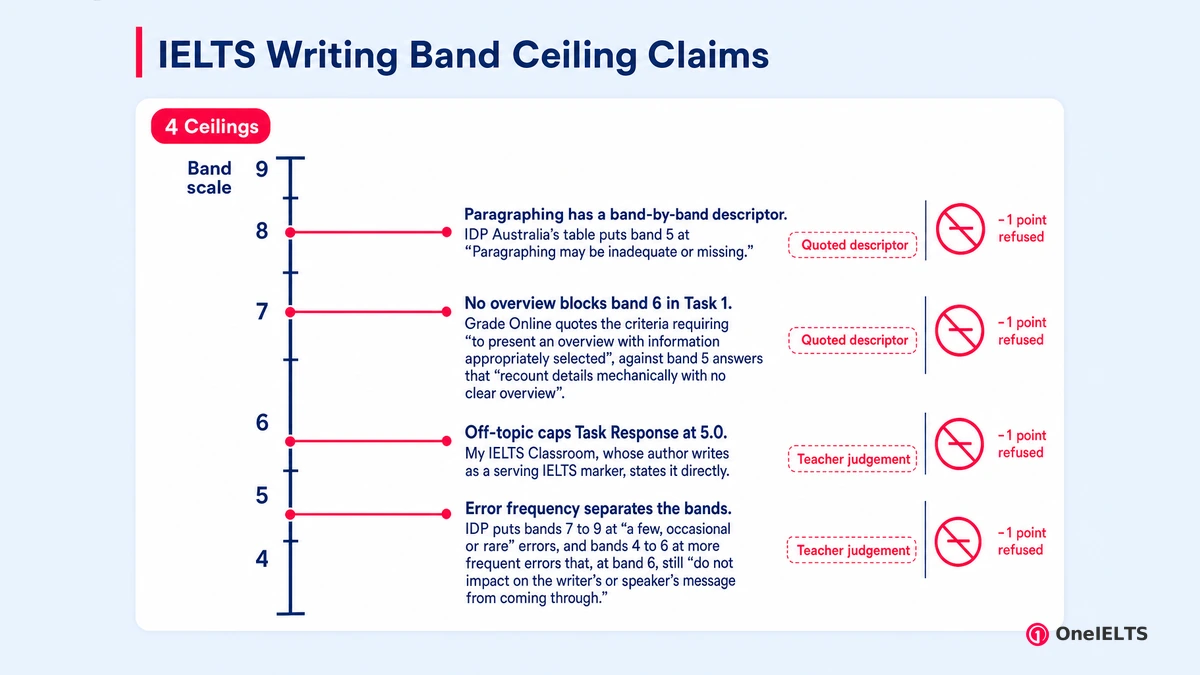
Four band ceiling claims exist across the nine captured pages, and here they all are. Two are quoted descriptor wording and two are a teacher’s judgement, and this page tells you which is which.
Off-topic caps Task Response at 5.0. My IELTS Classroom, whose author writes as a serving IELTS marker, states it directly.
“your score for Task Response can now be NO MORE THAN 5.0. Yes, even if your grammar and vocabulary is perfect, your chance to achieving a 7.0 or even 6.5 is now very slim.”
No overview blocks band 6 in Task 1. Grade Online quotes the criteria requiring “to present an overview with information appropriately selected”, against band 5 answers that “recount details mechanically with no clear overview”.
Paragraphing has a band-by-band descriptor. IDP Australia’s table, given in full above, puts band 5 at “Paragraphing may be inadequate or missing.”
Error frequency separates the bands. IDP puts bands 7 to 9 at “a few, occasional or rare” errors, and bands 4 to 6 at more frequent errors that, at band 6, still “do not impact on the writer’s or speaker’s message from coming through.”
Now the honest limits on claim sourcing. Those four are the only band claims in nine pages, and three of the nine mention band descriptors at all. Anyone offering you a fifth ceiling is not reading it off a published descriptor.
This page also refuses one claim outright. A captured page asserts the following.
“IELTS uses a positive marking system, it also has a deductive aspect where points are readily subtracted for inappropriate expressions or rule violations.”
No other captured page supports it, and it contradicts the descriptor matching that two other pages describe. IELTS Writing is marked by matching your answer to a band descriptor, not by subtracting points, so the deduction myth gets it wrong in a way that changes behaviour. A mistake costs you by moving which descriptor fits your answer.
Ceilings only show up on a full answer written under the clock, which is what a timed IELTS Writing mock is for.
Which IELTS Writing Mistakes Do the Guides Disagree About?
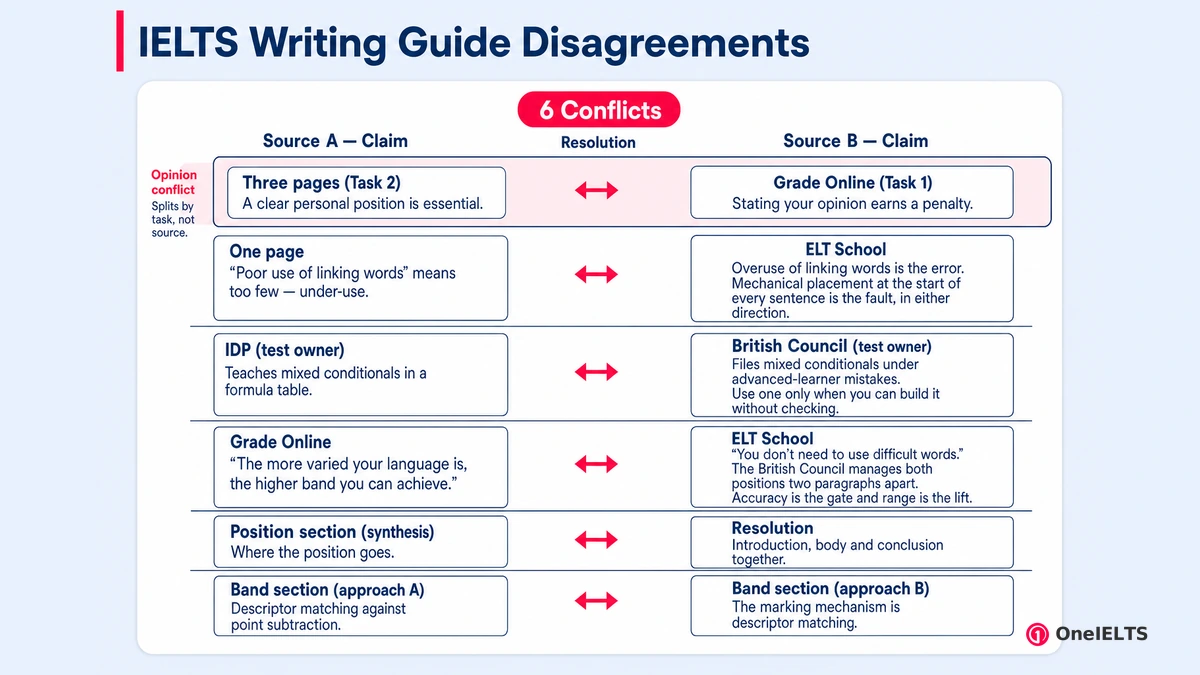
Six conflicts were measured across the nine pages, two of them between test owners. Both sides are quoted, then resolved.
Whether an opinion is required or penalised is the sharpest, and it is pure task dependency. Three pages insist a clear personal position is essential; Grade Online says stating your opinion earns a penalty. All four are right, because the first three are writing about Task 2 and Grade Online is writing about Task 1. Not one page on this search result says so. Task 2 requires your position; Academic Task 1 forbids it.
Linking words, too few or too many is the connector dispute. One page treats “poor use of linking words” as under-use while ELT School treats overuse as the error. Mechanical placement at the start of every sentence is the fault, in either direction.
Mixed conditionals, target or liability is the conditional dispute, and it runs between two test owners. IDP teaches them in a formula table; the British Council files them under advanced-learner mistakes. Use one only when you can build it without checking.
Range versus accuracy is the fourth. Grade Online: “The more varied your language is, the higher band you can achieve.” ELT School: “You don’t need to use difficult words.” The British Council manages both positions two paragraphs apart. Accuracy is the gate and range is the lift.
Where the position goes is the fifth, resolved in the position section above: introduction, body and conclusion together.
How the marking works is the sixth. Descriptor matching against point subtraction, handled in the band section, and the marking mechanism is descriptor matching.
One finding frames all six. On a query about common mistakes, no mistake appears on three of the four test-owner assets. Pages presenting their own list as settled are the reason candidates receive contradictory advice.
How Do You Check for Mistakes in IELTS Writing?
Two sources agree that not checking is itself one of the biggest mistakes. Grade Online calls it exactly that and blames the clock, since candidates “do not have enough time to check their writing, especially if they are not trained to do so”.
ELT School fixes the checking time: “High-scoring candidates always dedicate the final three minutes to reviewing their work.”
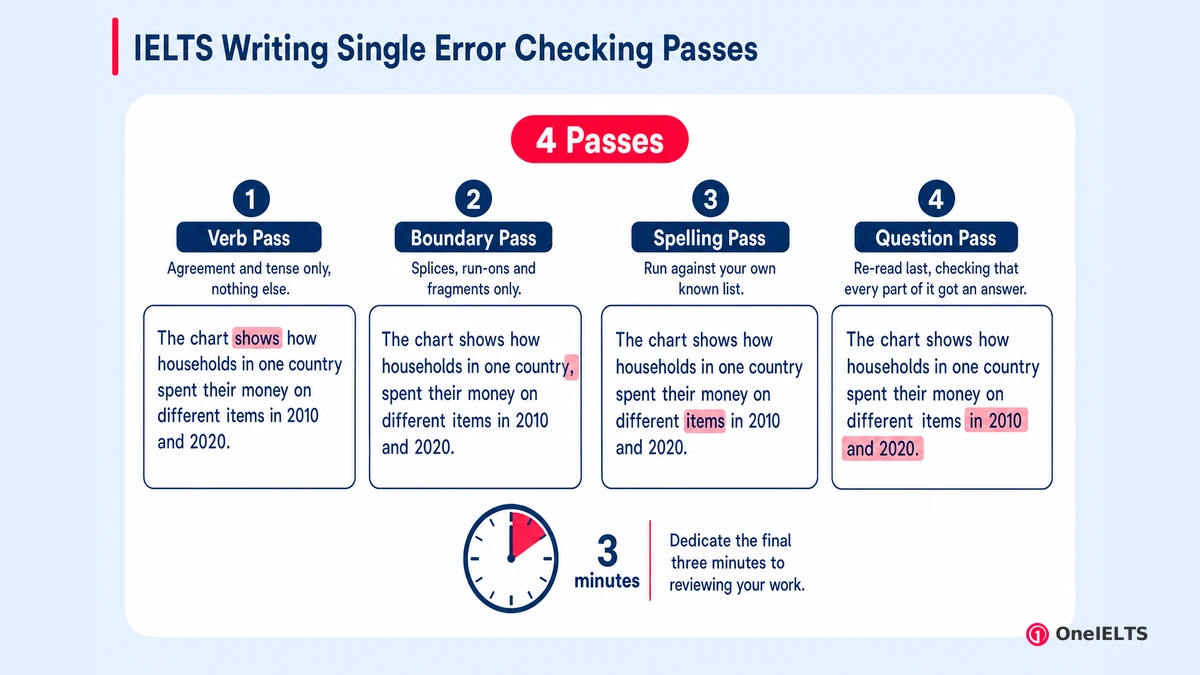
The method matters more than the minutes. Read for one error type per pass, because reading for meaning hides every one of them. Four single-error passes cover the ground.
- The verb pass. Agreement and tense only, nothing else.
- The boundary pass. Splices, run-ons and fragments only.
- The spelling pass, run against your own known list rather than a general one.
- The question, re-read last, checking that every part of it got an answer.
ELT School’s checklist is a compact version of the same thing: “Task Achievement: Have I answered every part of the prompt? Style: Have I avoided contractions and informal language? Grammar: Is my subject-verb agreement, tense, and punctuation (especially commas) correct? Spelling: Are common words like Environment spelled correctly?”
Grade Online gives the Task 1 version: “spelling; punctuation; articles; subject and verb agreement; the mistakes you know you often make. Read your response a few times. Each time you read focus on a different aspect.”
The British Council supplies the sentence that makes all of this work: “check your common mistakes and practise writing model answers before the test. That way, you’ll have the chance to catch habitual errors before the exam.” Your personal error list is not the list on this page. It is the errors you repeat. The wider process of planning, timing and getting marked belongs to the IELTS writing tips page.
How Do You Proofread for IELTS Writing Mistakes?
Proofreading is four mechanical moves plus one condition nobody else names.
Finish early enough to check, which ELT School prices at the final minutes: dedicate the last three. Read for verbs, then for full stops, then for spelling, one single-purpose pass each and never all three together. Apply the breath test to your longest sentence by reading it in your head as if aloud, because a sentence you cannot get through in one breath is usually a splice or a run-on. Re-read the question last, not first.
The condition changes how you should practise. IDP Australia is explicit that computer-delivered IELTS has no spell-check, and that a typo counts as a spelling error. Its drill follows from that: turn spell-check off while you practise and back on afterwards, so you find out which words you actually get wrong. The full exam-hour budget belongs to the IELTS writing tips page.
How Do You Practise Avoiding IELTS Writing Mistakes?
Build your personal error list before you drill anything. Take three answers you have already written, mark every error in them, and file each one under its criterion using this page’s four sections. The list that matters is short, and it is yours.
Then drill the repeat errors, the two or three that keep coming back, rather than the twenty that appear once. Use the wrong-and-right pairs on this page as the model: see the error, write the correction, then write a fresh sentence with the same structure so the repair survives contact with new content.
Then write one timed answer with spell-check off and run the four single-purpose passes on it. Criterion filing works here too, because an error you cannot file is usually an error you have not understood.
Why this order rather than a list of twenty? Nine published pages could not agree on which mistakes are common, so the only reliable list is the one your own writing produces. IELTS Writing practice is where the timed answers happen. Practising needs a free OneIELTS account.
A mistake matters exactly as much as the criterion it costs you, and no more.
Written by Jamil Ahmed, reviewed 14 August 2026.
Last verified: 14 August 2026
Practice for the Real IELTS Exam
Apply what you’ve learned with free, exam-style practice:
- Take a free IELTS mock test — all four skills, real exam timing, AI band scoring
- Sit a Writing section mock — Task 1 and Task 2 in one timed hour with a band estimate
- Practise by question type — self-paced Writing sets with model answers