Nine pages were read for these IELTS writing tips and between them they publish over 150. Six appear on four pages or more, which means the commodity advice is settled and restating it changes nothing.
What is not settled is more useful. Where the exam hour actually goes. The six places the published sources give conflicting advice, two of them test owners against each other. Which popular Reddit advice is wrong. And how to find the weak criterion holding your band down, which is the question the peer threads on this search are actually asking.
This page covers the hour, planning, Task 1, Task 2, vocabulary, what costs you marks, the disagreements, the wrong peer tips, diagnosing a plateau, getting marked feedback, and practice.
Which IELTS Writing Tips Actually Change Your Score?
Six agreed tips appear on four captured pages or more. Every source shares them, so this page provides them once in a block rather than spreading them across ten sections.
- Read the question and answer every part of it.
- Stay on the topic you were given.
- One central idea per paragraph, explained rather than named.
- A clear introduction, body and conclusion.
- Do not repeat the same words throughout.
- Mix simple and complex sentences accurately.
Now the thing this search result does not say. Those six are the entry price rather than the differentiator. A candidate stuck at 6.5 is usually already doing all six, which is exactly why two Reddit threads rank on page one of this query.
The plateau problem is what the rest of this page is for. Where the hour goes, with real numbers. Where the published advice conflicts, with both sides quoted.
Then which popular tips are wrong, how to find your own weak criterion, and how to get an answer marked by somebody who can name it.
Read the disagreements section and the diagnosis section first if you have already read three tips lists. They are the two that a seventh tips list cannot give you.
Which IELTS Writing Tips Reach Band 9?
Nobody publishes one. The sources agree on band 8 and stop there, so here is what they actually claim.
IDP builds its whole guide on the descriptors: “Using the band descriptors as a guide we are going to go through the 8 steps”. It sets the band 8 threshold for uncommon lexis in its own words.
“You will see in the band descriptors that a band 8 writer skillfully uses uncommon lexical items.”
E2Language grants the most useful concession on the whole search result, and no other captured page grants it.
“A Band 8 essay does not need to be completely error-free, but they should be rare and not interfere with understanding.”
The British Council reaches the same band-8 threshold from vocabulary, saying you would need to display skilful use of uncommon lexical items.
One caveat closes it. People-also-search-for on this query asks for band 9 tips, and not one captured page publishes a band 9 answer with the descriptors mapped onto it. What the sources do agree on is narrower than the query implies: accuracy at the top is about error rate, not about vocabulary size. The IELTS writing Task 1 band 9 page goes further on those descriptor claims.
How Long Should You Spend on Each Writing Task?
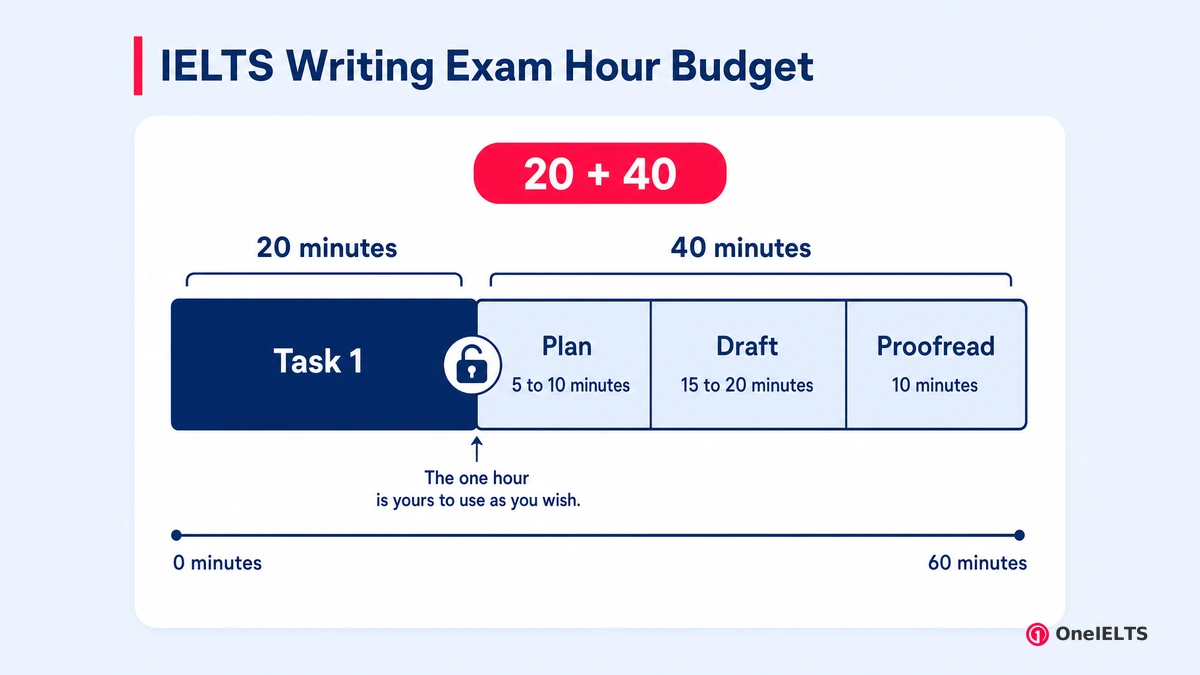
Twenty minutes on Task 1 and forty on Task 2, with the essay’s forty split three ways. The exam board publishes the only complete budget in the capture.
“Plan to spend around 20 minutes on your first task, and 40 minutes on your essay task.”
Inside the essay it goes further, giving 5 to 10 minutes reading the question and planning the answer, 15 to 20 minutes on the draft window, and a 10-minute checking window for proofreading and editing.
The AI Overview publishes a tighter reading of the same hour: three to five minutes to analyse the prompt, and three minutes saved at the end to proofread. Treat those as two readings of one hour rather than as a contradiction, because the task split is identical in both.
IELTS Liz adds the point no other captured page makes, and it changes how the hour gets used.
“You can manage your own time in the writing test. The one hour is yours to use as you wish. If you want to do task 2 first, you can.”
She pairs it with the weighting: Task 1 counts for about 33 per cent of your Writing marks. Task order follows from those two facts together rather than from either alone.
One measurement puts the coverage in perspective. Only two of the nine captured competitors give any time figures at all, on a query about writing tips. A budget is only real under exam conditions, which is what a timed IELTS Writing mock supplies.
How Do You Plan an IELTS Writing Answer?
Three to five minutes, before you write a sentence. The finding that justifies saying so is startling: the top result on this search is a 2,492-word guide to reaching band 8, and the words plan and planning appear in it zero times.
Only one captured article gives a planning window at all. E2Language: “Take the first 3-5 minutes of the test to outline what you are going to write.”
The procedure below comes from the British Council’s brainstorming section, which is the fullest treatment in the capture.
- Read the question more than once and highlight the key words. Identify how many question parts it has, which the British Council says to do “at the very beginning”.
- Idea generation next, for a few minutes, writing down anything that comes to mind “even if they seem unrelated at first”.
- Group the related ideas into categories.
- Handle idea selection next, taking the strongest and most relevant, and checking each one directly addresses the question.
- Outline first, covering the introduction, the body paragraphs and the conclusion, before writing a sentence.
The reason to bother is counter-intuitive and only one page states it. The British Council writes that “planning also enables you to write faster”, which inverts the instinct that planning costs you drafting time.
The Reddit thread ranking on this search offers a candidate’s own version.
“Make a 2-minute outline – Just write Main idea 1 with a small example, then Main idea 2 with a small example.”
That is a candidate’s method rather than a publisher’s, and it is the only tip in that thread that survives comparison with the published advice.
How Do You Proofread Your IELTS Writing?
Proofread, then edit, then proofread again. Those are the exam board’s own steps eight, nine and ten, and it separates the proofread pass from the edit pass while asking for the first one twice.
E2Language names what to look for: “Spelling errors and typos / Grammar inconsistencies / Word repetition / Poor transitions or logical gaps”.
One technique appears on exactly one captured page and it is worth the space.
“Take the extra time to read your writing out loud (mentally) and catch for anything that does not sound right. Too often, mistakes are more audible than visible.”
Audible errors need a gap to be caught in, which is why the same page adds “Make a habit of completing your writing a few minutes early”. An early finish is the precondition, not a bonus.
The word proofread returns zero on seven of the nine captured competitors, including both Reddit threads. The catalogue of specific errors belongs to the common IELTS writing mistakes page.
Which Writing Tips Suit Task 1?
Five, and they are scarce on this search result. The top result and the British Council’s page are both Task 2 only, on a query with no task in it. Only three of the nine captured competitors address Task 1 at all, while People-also-search-for asks for Task 1 tips by name.
It is a report not essay. IELTS Liz: “Task 1 is a report and not an essay. This is important to know because you can learn strategies for report writing more easily that for essay writing.”
Select, do not list. E2Language says Task Achievement in Task 1 “is choosing appropriate information, not just describing all the details”, and asks you to “identify key trends or comparisons and group related information logically”. Data selection is the skill being marked.
No opinions. E2Language again: “In Academic Task 1, do not put your assumptions or opinions in. Your task is to summarise and describe data, not explain or discuss why patterns are there.”
Clear the minimum length. IELTS Liz reads the rubric literally: “The instructions say ‘Write at least 150 words’. This means you need to write over 150 words.”
Build speed second. Her sequencing is worth copying. Start with spending time developing your techniques and awareness, then build up your speed so you can complete a task within the recommended 20 minutes. Speed building comes after accuracy, not alongside it.
Which structure each chart type needs belongs to the Task 1 pages.
Which Tips Suit a General Training Letter?
Aim for 170 to 190 words. That letter length is the only General Training figure in the whole capture, and IELTS Liz supplies it: “On average, you should aim for your letter to be between 170 and 190 words. A shorter letter does not allow enough detail for a high score.”
Tone matching is the second. E2Language: “For General Training Task 1, tone matters just as much. A letter to a friend must be informal and friendly, whereas a complaint letter to an organisation must be polite and formal.”
The criteria work slightly differently too. IELTS Liz notes that Task Achievement is about completing the letter and fulfilling the letter aims, and that Coherence and Cohesion covers the structure, organisation and linking of information inside it.
GT coverage across this search result is thin. The phrase general training returns zero on the top result and on the British Council’s page, and three of nine captured competitors mention it at all. The IELTS writing Task 1 letter page carries the types and the sign-offs.
Which Writing Tips Suit Task 2?
Answer every part, hold your position, and go deep rather than wide. Five tips, each attributed, and the Task 2 hub owns the depth behind them.
Count the question parts. IDP: “Read the question carefully and decide how many parts are in it” and “You must answer all parts of the question to reach a band 6 or higher.” Two checks make it concrete. Watch for plurals, because a prompt asking for advantages requires a minimum of two. Watch for the word and, because it usually adds a second element to comment on.
Hold your position. IDP asks you to present your opinion and support it throughout the whole essay. For a discuss-both-views prompt it gives the sequence: state your opinion at the beginning, present both views, come back to it, then conclude. A held position appears three times, not once.
Choose idea depth over breadth. E2Language: “Top-scoring IELTS essays elaborate on fewer ideas.”
Respect the paragraph minimum. IDP: “Make sure each paragraph contains a clear and developed topic with a minimum of two sentences.” Its PEEL device names the moves: Point, Example, Explain, Link.
Use effective examples. The British Council: “For an example to be effective, it should be relevant, specific and clearly highlight the point you are trying to make.”
Essay types, question analysis and full structures belong to the Task 2 hub.
Which Vocabulary Tips Should You Follow in IELTS Writing?
Precision over rarity. The British Council gives the cleanest formulation in the capture: “the golden rule: if you’re unsure how to use an uncommon term, find a simpler equivalent you can use in its place.”
E2Language says the same from the other side. Range “does not mean using obscure or really difficult words; it means using the suitable words in the suitable context.”
The AI Overview adds that you should choose words you are confident using rather than memorising complex fancy phrases incorrectly.
Collocation is the most useful specific here, and two pages raise it. The British Council notes that “A sound understanding of collocations is also expected”, and E2Language supplies examples: take responsibility, make a decision, pose a threat.
Two disagreements sit inside this topic. The first is about synonym restraint. IDP warns against “Overuse synonyms, one is enough”; the British Council recommends synonyms to avoid repetition; E2Language says study and practise them. A synonym is worth using when it is accurate and the repetition is real, so IDP’s warning lands against synonym-chasing rather than against synonyms.
The second is sharper and it is about lexical ambition. Three captured pages build their advice on using less common vocabulary. IELTS-UP argues the opposite outright: “they stuff their essays with uncommon vocabulary, overuse complicated grammar or write too many words. But are these means really necessary? The answer is NO.” It adds that “Even simple but accurately expressed ideas score better than too complicated ones.”
The adverb settles it. The descriptor language IDP itself quotes says a band 8 writer skilfully uses uncommon lexical items, and skilfully is doing all the work in that sentence.
IDP’s own prohibitions close the section: no imprecise words like stuff or thing, no slang like gonna, no contractions, no old-fashioned language, and spelling consistency between American and British forms. Word lists belong to the vocabulary pages.
Which Sentence Structures Should You Vary?
Alternate simple, compound and complex sentences throughout. E2Language asks you to attempt relative clauses, conditional sentences and the passive where the meaning needs them, which is what a genuine sentence mix looks like.
IDP supplies the clarity limit that stops this becoming bad advice.
“It is important to use a mix of complex and simple sentences. But remember, your complex sentences should not be long and complicated.”
E2Language puts the same brake on differently, warning against lengthy and muddled sentences written just to appear intelligent, because clarity must always be the priority.
Comma accuracy ties the two together, and IDP is the only page connecting punctuation to complex sentences. It asks for accurate capitalisation, commas and full stops, and its checklist item reads “Did you use commas in your complex sentences, where needed?”
Punctuation returns non-zero on only three of the nine captured competitors. When a complex sentence is worth the risk belongs to the how to use complex sentences page.
Which IELTS Writing Tips Cost You Marks?
Six prohibitions are specific, checkable and agreed. The top result publishes thirty in one article and IELTS Liz’s top-three page publishes none, so this section carries only the handful worth memorising.
Memorised language. IDP: “Don’t use any memorised language, phrases or examples throughout your essay. They are easy for examiners to spot and don’t demonstrate your ability to write fluently.” The AI Overview agrees that examiners spot pre-learned essays easily.
Invented evidence. IDP prohibits presenting recent research or statistics of the “At least 41% of all men” kind. The British Council says do not invent figures such as a percentage or a number and add them to examples.
Connector overuse. The exam board warns you not to fall into the trap of trying to put a linking word in every sentence. IDP warns against overusing basic linkers like firstly, and E2Language notes that overuse makes writing feel mechanical.
Topic drift. IELTS-UP: “If you wander from the subject, you’ll get a much lower score even for a well-styled answer.”
Vague generalisation. E2Language: “Refrain from broad generalisations such as ‘All people think…’ or ‘Technology is bad.'”
Essay formatting that does not belong. IDP is the only captured page carrying any of these: no headings or subheadings, no underlining, no numbers, symbols or abbreviations, no contractions, and no one-sentence paragraphs.
The full error catalogue with fixes belongs to the mistakes page, and reproducing it here would only make this list harder to remember.
Which Memorised Templates Do Examiners Spot?
Memorised openers, and the proverbs. E2Language: “Examiners can spot when you are reusing opening lines like ‘In today’s modern society…’ or copying whole memorised paragraphs.”
IDP adds the named cliches, listing overused phrases, idioms and proverbs such as “The grass is always greener on the other side” and “Old is gold”. Its checklist asks whether you avoided memorised language, clichés and proverbs.
It also publishes a phrase substitution table no other page carries. Nowadays becomes In recent times, firstly becomes The primary reason why, in a nutshell becomes In conclusion, and e.g. becomes For example.
One peer counter-view is worth naming as such. A commenter on the Reddit thread ranking on this very search writes “From my experience, some sentences must be memorized to help you build your essay”. Another candidate in the same thread pushes back: “memorized statements might be a red flag for some evaluators. Since they evaluate IELTS writing for a living, they would know or recognize ‘template sentences’.”
Every published source sits on the second side, unanimously. The first view persists for an understandable reason, which is that a memorised sentence feels like insurance under time pressure.
IELTS-UP names the replacement: “spend some time learning to adopt advanced vocabulary to make it fit into your answer.”
Rewriting the question in your own words belongs to the how to paraphrase for IELTS page.
Where Do the IELTS Writing Tips Disagree?
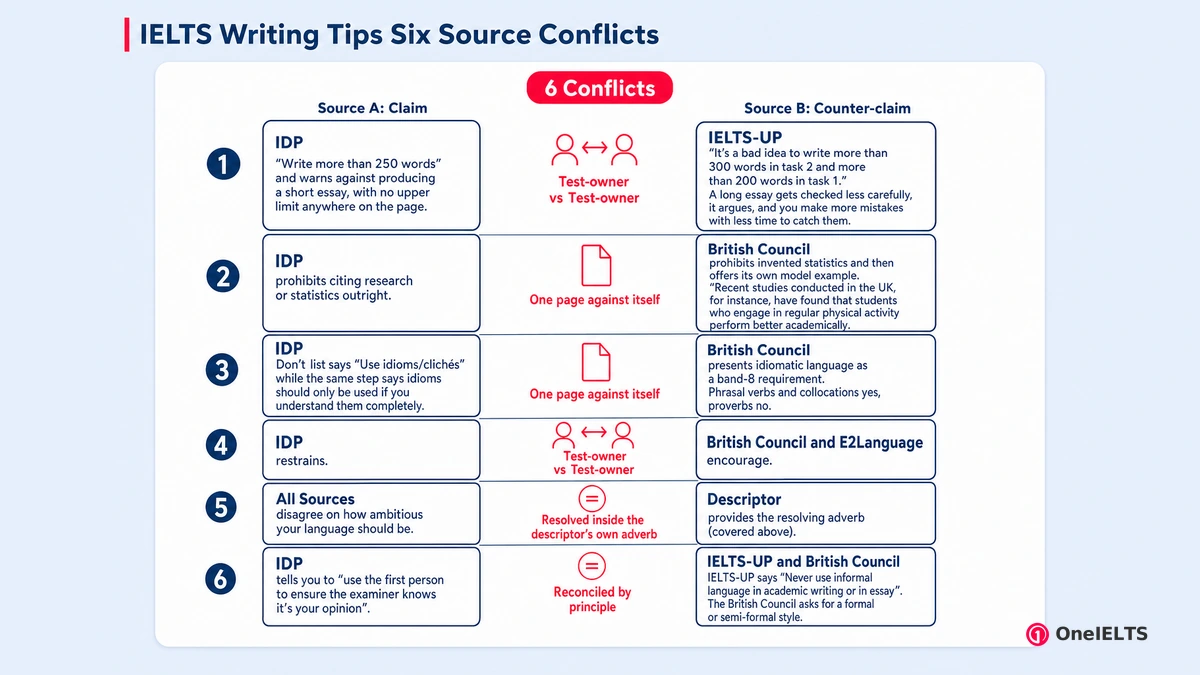
Six measured conflicts across nine sources, including two test owners disagreeing with each other and one page contradicting itself inside a single section. Conflicting advice is worth more to you than another agreed tip, because it tells you where the judgement is yours.
1. How long the essay should be. IDP says “Write more than 250 words” and warns against producing a short essay, with no upper limit anywhere on the page.
IELTS-UP disagrees, and the length dispute comes with a reason attached.
“It’s a bad idea to write more than 300 words in task 2 and more than 200 words in task 1.”
A long essay gets checked less carefully, it argues, and you make more mistakes with less time to catch them. Clear the minimum, and treat everything above it as a trade against your own checking time.
2. Statistics in examples. IDP prohibits citing research or statistics outright. The British Council prohibits invented statistics and then offers its own model example.
“Recent studies conducted in the UK, for instance, have found that students who engage in regular physical activity perform better academically.”
An unattributed appeal to recent studies is the same move, so that is one page against itself. Use an example from your own experience or general knowledge, with no numbers on it.
3. Idioms. The idiom dispute runs inside one page as well as between two. IDP’s own Don’t list says “Use idioms/clichés” while the same step says idioms should only be used if you understand them completely. The British Council presents idiomatic language as a band-8 requirement. Phrasal verbs and collocations yes, proverbs no.
4. Synonyms. Covered above: IDP restrains, the British Council and E2Language encourage.
5. How ambitious your language should be. Also covered above, and the descriptor’s own adverb resolves it.
6. Whether to write “I think”. IDP tells you to “use the first person to ensure the examiner knows it’s your opinion”. IELTS-UP says “Never use informal language in academic writing or in essay”, and the British Council asks for a formal or semi-formal style. The first person is not informality, and a stated position is worth more than a stylistic preference.
Which IELTS Writing Tips on Reddit Are Wrong?
Three claims, and the rest of those threads is sound. Two Reddit threads rank on page one of this search and People-also-search-for suggests “IELTS writing tips reddit”, so reading them is reasonable.
Wrong: that a prompt cannot ask for both views and your opinion. The thread says “if it asks about the two views then you should not mention your opinion” and, asked directly, “No it would either that or the other”.
A both views prompt asking for your own opinion is a standard Task 2 shape, and IDP publishes the sequence: state your opinion at the beginning, present both views, return to your opinion, conclude. This peer misinformation contradicts the same thread’s own opening tip, and nobody in it corrected them.
Wrong: that invented examples are fine. The claim is “Examples don’t need to be real or detailed.” Both test owners disagree, with IDP prohibiting invented research or statistics and the British Council saying do not invent figures. The tip is reaching for something true, so be precise about the line. A general or personal example needs no citation and no numbers. A fabricated statistic is a different thing entirely.
Contested rather than settled: memorised sentences. The claim that some sentences must be memorised is quoted in full in the section above, along with the candidate who pushed back in the same thread. Every published source is against it.
One counterweight, because this must not read as a publisher defending publishers. The peer threads get one big thing right that the publisher pages get wrong, and the next two sections are about exactly that.
One note on the numbers. Every band score quoted from those threads consists of unverified self-reports, including the one crediting a single YouTube channel for a 7.5.
How Do You Find Out Why Your Writing Score Is Stuck?
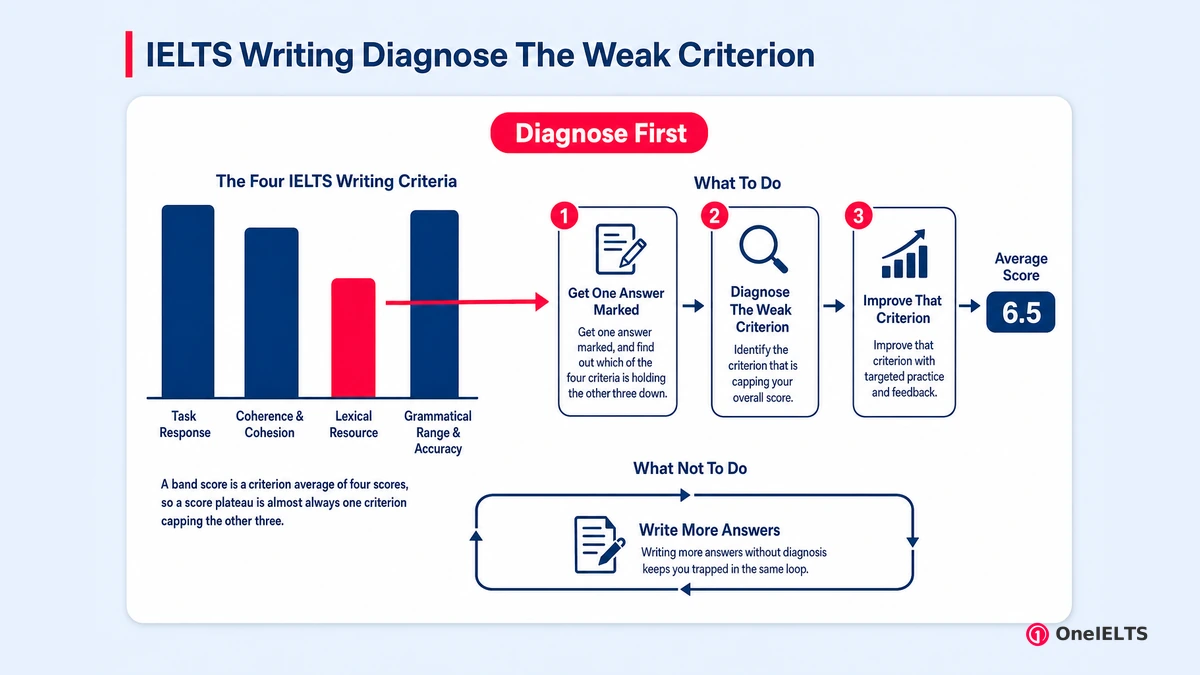
Get one answer marked, and find out which of the four criteria is holding the other three down. One exchange on the Reddit thread ranking on this search makes the whole case.
“I keep getting 6.5 in Writing (academic)… I’ve watched the YouTube videos of Cris from IELTS Advantage, IELTS Simon and even read Liz’s website.. I don’t know what else I can do to improve?”
Another user asks how the writing was graded. The answer: “Never got it graded, I got 6.5 in the exam.”
A commenter in the same thread supplies the diagnosis, and no captured publisher page says it.
“You need to know why you’re getting 6.5. Usually those who are stuck on this score but have done plenty of IELTS study are falling down on their grammar/lexis. Those sites you mention will no doubt be good for improving Task Response and CC, but they are not grammar tuition sites for writing.”
The general form of the point is this page’s own. A band score is a criterion average of four scores, so a score plateau is almost always one criterion capping the other three. A tips page is a broadcast and cannot tell you which one is yours.
One captured source is organised by the reader’s current score rather than by topic. IDP India’s band-level errors table splits typical mistakes and fixes across bands 5 to 5.5, 6 to 6.5, 7 to 7.5 and 8 to 9, with a How to improve block under each. Read the band you are actually on rather than the one you want.
Self-assessment fills the gap between marked answers. E2Language asks you to analyse your writing after each practice session using the band descriptors, or to ask a teacher for detailed feedback. The British Council puts it as using the IELTS scoring criteria to evaluate your own essays.
How Do You Get Your IELTS Writing Marked?
Four marking routes exist and none of them is free and reliable at once. The word feedback returns 11 times on the British Council’s page, once on E2Language’s, and zero on the other three captured articles including the top result. In the Reddit threads it is the central answer.
Peer review. The British Council: “Exchange essays with other students or study groups to get different opinions.” Free, unreliable on grammar, and genuinely useful on whether your position is clear. Each of the four carries route limits worth knowing before you pick one.
A qualified teacher. “Consider hiring a professional IELTS tutor who can give you expert and detailed feedback.” Tutor feedback is the only route that covers all four criteria. The British Council names its own paid service at this point, which is fair enough and worth knowing.
Online forums. The British Council suggests joining online IELTS communities where you can share essays and receive forum feedback. One route limit shows up in the Reddit finding: that channel is moderated against promotion, which is a trust signal and also means fewer expert answers.
Self-assessment against the criteria. The weakest of the four, for exactly the reason the Reddit exchange shows. It is worth doing anyway, because it forces you to read your own answer as four separate things rather than as one impression.
The peer argument for why this matters more than more tips is better put than any publisher manages.
“Trying to improve writing by watching videos is like learning how to swim by watching the Olympic swimmers. Yes, you’ll see how to do it, but when you actually do it, is your style the same as theirs?”
How Do You Use Feedback to Improve Your Writing?
Sort the corrections by criterion, then fix one thing at a time. Four steps turn a marked answer into a band.
- Start with correction sorting by criterion rather than by page order. Four criteria, four piles, and the biggest pile is the one to work on.
- Set a single goal per session. The British Council recommends “Setting goals for each practice session – such as focusing on complex sentence structures or improving coherence.”
- Rewrite the same answer rather than writing a new one. That rewrite loop is this page’s own recommendation, and the reason is that a new answer hides whether the correction landed.
- Read a model in the same shape. E2Language: “do not merely practice writing. Read well-written writing as well. Study model Band 8 and 9 essays. Notice the way arguments are built… Make notes. Imitate. Re-shape. Adapt.”
Model reading works best straight after step 3, while you still remember what your own version did. The criterion wording itself belongs to the IELTS writing band descriptors page.
How Do You Practise IELTS Writing Tips?
Three rules, and an ordering that matters more than the rules. Each comes from the capture rather than from habit.
- Timed practice at the real length. The British Council: “Get used to real test time conditions by writing essays in no more than 40 minutes.”
- Topic variety rather than repetition. The British Council again: “Practise writing essays on different topics to be more flexible.”
- One single goal attempt at a time, taken from the feedback section above.
The ordering is the page’s argument in one move. Writing more answers with nobody reading them is precisely what the Reddit candidate had already done at 6.5. Get one marked, fix the criterion it names, then write more.
A marked answer first, then volume. IELTS Writing practice supplies the prompts for the volume half. Practising needs a free OneIELTS account.
The tips are not the hard part. Finding out which of your four scores is holding you down is.
Written by Jamil Ahmed, reviewed 14 August 2026.
Last verified: 14 August 2026
Practice for the Real IELTS Exam
Apply what you’ve learned with free, exam-style practice:
- Take a free IELTS mock test — all four skills, real exam timing, AI band scoring
- Sit a Writing section mock — Task 1 and Task 2 in one timed hour with a band estimate
- Practise by question type — self-paced Writing sets with model answers