Eight pages teach you how to change words in a source sentence. Not one publishes a list of the words you must not change.
That gap is expensive, because over-paraphrasing is the failure that keeps candidates at band 6. Word substitution applied to every word produces poor choices and shifted meaning, and both cost more than a repeated word would have. Meaning preservation is the actual instruction, and a kept word is often the right answer.
This page covers what paraphrasing is, why it is marked, the four techniques, synonyms, word forms, the passive, sentence structure, the words to keep, over-paraphrasing, both Writing tasks, and how to practise.
What Is IELTS Paraphrasing?
IELTS paraphrasing is rewriting a sentence in your own words while keeping its meaning exactly. In IELTS the sentence you are rewriting is almost always the question itself.
The test owner defines it as rewriting a phrase or sentence using your own words and expressions while retaining the original meaning. Retained meaning is the whole constraint. It shows the examiner you understood the source well enough to restate it, which is why question rewriting is marked at all.
Two things have to change together, and the AI Overview on this search says so directly. The vocabulary change and the structure change go as a pair. Swapping single words and leaving the sentence shape alone is not paraphrasing, and it is the commonest thing candidates submit as one.
You use the skill in the first sentence of Task 1 and the first sentence of Task 2. You use it in reverse every time you read a Reading question, where somebody else has already done the rewriting and your job is to spot it. That reversal is the subject of the section below.
Why Does Paraphrasing Affect Your Band Score?
Copied words are not counted and substituted words are marked, so paraphrasing touches your word count and your vocabulary score at the same time.
The uncounted words point is concrete and appears on one page in eight. IELTSPodcast puts it plainly: never copy all the words from the question, because the examiner will not count those words. Write 260 words with 30 lifted from the prompt and you have written 230.
The criterion link is thinner than you would expect. Only one captured page names it, saying paraphrasing is a vital part of the Lexical Resource criterion. Only one other attaches a figure, with IELTS Liz’s “vocabulary counts for 25 per cent of your writing marks”.
Her two-axis picture is worth having, and it is her reading of the descriptors rather than a quotation from them. The criterion measures a range axis and an error axis together. The error axis runs from frequent errors that cause meaning problems at the bottom to most sentences error free at the top.
That pairing produces the score movement rule for this whole page. A wider range with more errors in it does not move you up. One measured absence sharpens the point: band descriptor returns zero in body text on all eight captured pages, so almost nobody teaching this technique connects it to the thing that marks it.
Does Paraphrasing Help in Reading and Listening?
More than it helps in Writing. In Reading and Listening the paraphrase is done for you, so the answer sits in the passage under different wording and finding it is the entire task.
IELTS Liz makes the only published statement of this. Her page is about essays, she notes, but it also helps you understand paraphrasing in Reading and Listening, and it matters less in Speaking because speaking tolerance for repeated words is higher.
Six of the eight captured pages never mention Listening at all, while Google’s People-also-ask block on this query returns a video titled “Understanding Paraphrasing in IELTS Reading”. The demand is visible and the coverage is not.
The recognition direction is what changes. In Writing you produce the paraphrase. In Reading and Listening you recognise one, and finding the matching answer is harder because you never got to choose the substitutions. The handoff for question types is the IELTS Reading guide.
What Are the Paraphrasing Techniques?
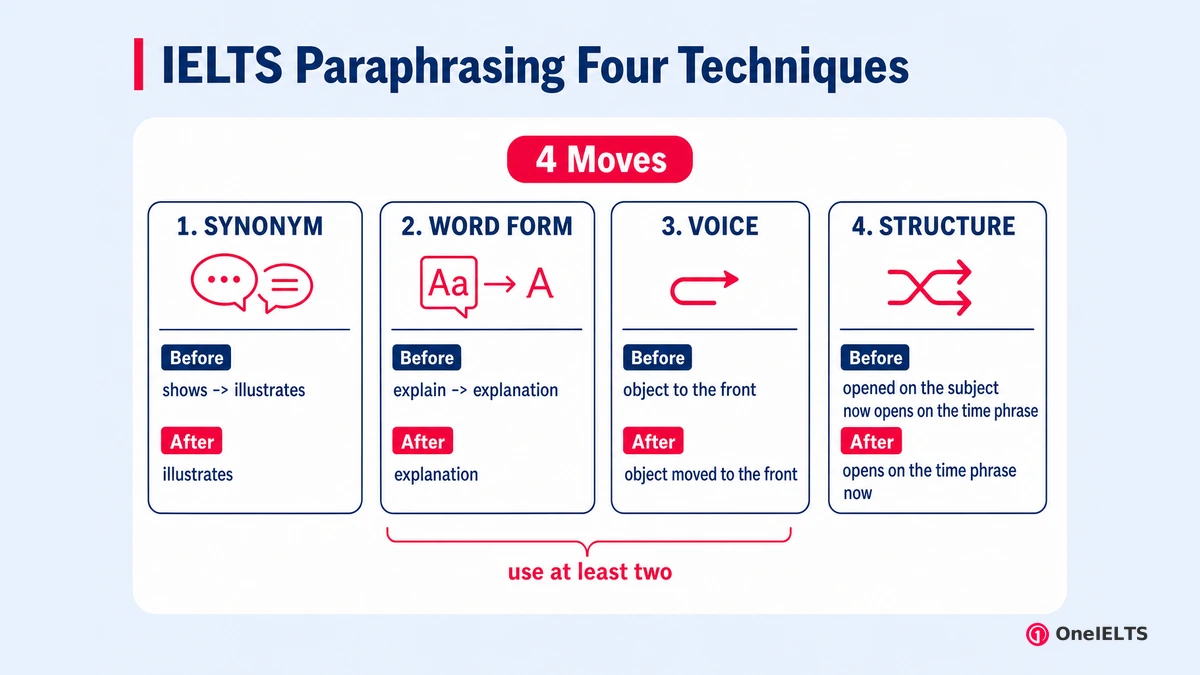
Four moves cover it: a synonym, a change of word form, a change of voice, and a change of sentence structure. The useful skill is stacking two of them rather than collecting more.
A synonym replaces a word with one that means the same thing, as in shows becoming illustrates. A word-form change keeps the word and changes its job, so explain becomes explanation. A voice change moves the object to the front. A structure change reorders the clauses, so a sentence that opened on the subject now opens on the time phrase.
The fifth thing is not a technique and it decides the result: how many of the four you apply to one sentence.
Only one source gives guidance on stacking techniques, and where it sits is itself the finding. The British Council says relying on one technique is doable but stressful and not very effective, and advises using at least two or three. That page has zero article headings, with all five of its techniques tagged as h4s, so the one piece of stacking advice on the search result is also the hardest to find.
The technique count varies wildly. The eight captured pages name 1, 3, 4, 5, 5, 6, 6 and 6 techniques, plus one page that names none and gives four process steps instead. Two of the sixes count “practise on sample tests” as a technique.
Two moves nobody teaches are the most reliable ones there are. The words opposite and negative return zero on all eight pages, so no page teaches the negation rewrite. It is often the cleanest one available: “few countries have succeeded” for “most countries have failed”. Part of speech also returns zero on all eight, because every page says word form instead.
One construction comes only from a test owner, and it is the dummy subject “it”, as in “it is argued that” replacing a named subject.
What Are the 5 Steps to Paraphrasing?
Read it, cover the original, say it aloud in simple words, write what you said, then compare. Five steps, and the middle one is the one candidates skip.
Where the method comes from is a finding in itself. Google’s AI Overview publishes a three-step version, namely read carefully, look away and say the concept aloud, then write and check. That form appears on no captured IELTS page. The nearest published step list is a four-step one on a university academic-skills page that never mentions IELTS at all.
The cover-it step does the work. With the original in front of you, you substitute words one at a time. With it covered, your spoken restatement carries the idea not words, which is what the criterion measures. The comparison check at the end tells you what you kept.
The handoff for where that first sentence sits in an essay is the IELTS Writing Task 2 introduction page.
How Do You Use Synonyms Safely?
Only when you are certain of the collocation, never one-for-one across a whole sentence, and never with a word you have not used before.
IELTS Liz states the thing most synonym lists imply is untrue.
“Synonyms are NOT words with 100% the same meaning and the same usage. This is why so many people make mistakes with them.”
Fastrack demonstrates the failure rather than describing it. It replaces Top with Leading, Ten with Dozen and Countries with Nations, producing “The bar graph illustrates the leading dozen of nations”, and then says “Do not do this”. Its reason is the useful part: you will not find synonyms with the same meaning for every word, and precise language matters more than variety.
Three rules follow, and they are short enough to hold in an exam.
- Substitute only from your owned vocabulary, meaning words you have written in your own sentences before.
- Keep the certain collocation intact. If you cannot hear the new word next to its neighbours, it is wrong.
- Apply the five-second rule. If no natural substitute arrives in five seconds, keep the original word and move on.
The test owner’s version of rule one is shorter still: use only words you are entirely sure about.
One measured absence explains why this keeps going wrong. Collocation returns zero in body text on all eight captured pages, so the mechanism behind one-for-one substitution failure has no name anywhere a candidate would look.
Which Paraphrasing Words Are Worth Learning?
The small set that recurs in task statements, meaning the reporting verbs, the chart nouns and the time expressions. Almost none of the topic words.
A general synonym list is the wrong asset for two reasons. It gives you words you do not own, and using a word you do not own is the exact failure described above. The recurring question words are worth learning because they appear in the question every time, while the topic words change with every prompt.
Three groups cover it. Reporting verbs: shows, illustrates. Chart nouns: figure, proportion. Time expressions: between 2000 and 2015, over the period. Learn an owned word in each group and you have covered the sentence that repeats.
The demand is real and this page is arguing against it: “IELTS paraphrasing words list” is one of the eight live related searches on this query. The handoff for word sets is the IELTS vocabulary list page.
How Do You Change the Word Form?
Keep the word and change its job. Verb to noun, adjective to adverb. The word job changes and the word itself stays, which lets you reuse a word you are already sure of instead of gambling on a synonym.
The AI Overview gives the cleanest example: the verb explain becomes the noun explanation.
IELTS Liz explains why the technique is underrated. Do not get stuck always hunting for synonyms, she writes, because you can just change the word form and still get a high score. The reason is the whole argument of this page in miniature. An owned word carries no collocation risk, so the danger that killed the synonym has gone.
Four shifts cover most of it. Verb to noun, as in increase becoming an increase. Noun to verb, as in a reduction becoming to reduce. Adjective to noun, as in efficient becoming efficiency. Adjective to adverb, as in rapid becoming rapidly.
Changing the form changes the surrounding grammar, so the sentence usually has to be rebuilt around it. That is the structure technique doing double duty, and it is why word-form changes often produce a better rewrite than a synonym does.
One naming note is worth matching. Every captured page calls this word form and none says part of speech, so a word family search will find you less than a word form search will.
How Do You Change from Active to Passive Voice?
Move the object to the front and the doer to the back or out entirely. Object fronting rewrites the sentence without touching a single content word.
One pair shows it. Active: “The government introduced a new recycling scheme in 2015.” Passive: “A new recycling scheme was introduced in 2015.” Doer removal took four words out and changed nothing else.
That zero vocabulary change makes it the safest technique on this page, because it tests no word you do not already use. It is also the wrong choice in one clear misuse case: whenever the doer is the point of the sentence, fronting the object buries the only fact that mattered.
Four of the eight captured pages name it as a technique, and it is the one the AI Overview names in its opening sentence.
When Does Paraphrasing Need the Passive Voice?
When the doer is unknown, unimportant or obvious. In IELTS that means most of a process description and very little of an essay.
Task 1 takes it naturally, because a process description has an unknown agent by design and nobody needs to be told who operates the machine. Task 2 mostly does not, because an over-passive essay produces a hidden position and the position is what Task Response is looking for.
The risk is worth naming once. Used as a paraphrasing trick on every sentence, the passive produces flattened writing and costs the clarity the rewrite was meant to buy. The handoff for the form itself is the passive voice in IELTS writing page.
How Do You Rewrite the Sentence Structure?
Change the order before you change the words. Move the time phrase, split one long sentence into two, or turn a clause into a phrase. Structural change is what makes a rewrite count as one.
The AI Overview frames it as flipping the clause order or switching active to passive, and warns that changing vocabulary alone is not paraphrasing at all.
Three moves cover almost every task statement.
- A fronted time phrase. “Sales rose sharply between 2010 and 2015” becomes “Between 2010 and 2015, sales rose sharply.”
- A sentence split. One sentence carrying two ideas becomes two sentences carrying one each.
- A reduced clause. “The countries that were surveyed” becomes “the surveyed countries”.
The university page states the standard most clearly, and it is stricter than most IELTS pages. Ensure you are changing the sentence structure as well as most of the words, because a rewrite that keeps the original shape gets flagged for structural similarity even when the vocabulary differs.
This technique costs something the others do not. Restructuring introduces grammar risk that a synonym never does, so it belongs on sentences you can rebuild confidently. Clause types belong to the complex-sentences page.
Which Words Should You Not Paraphrase?
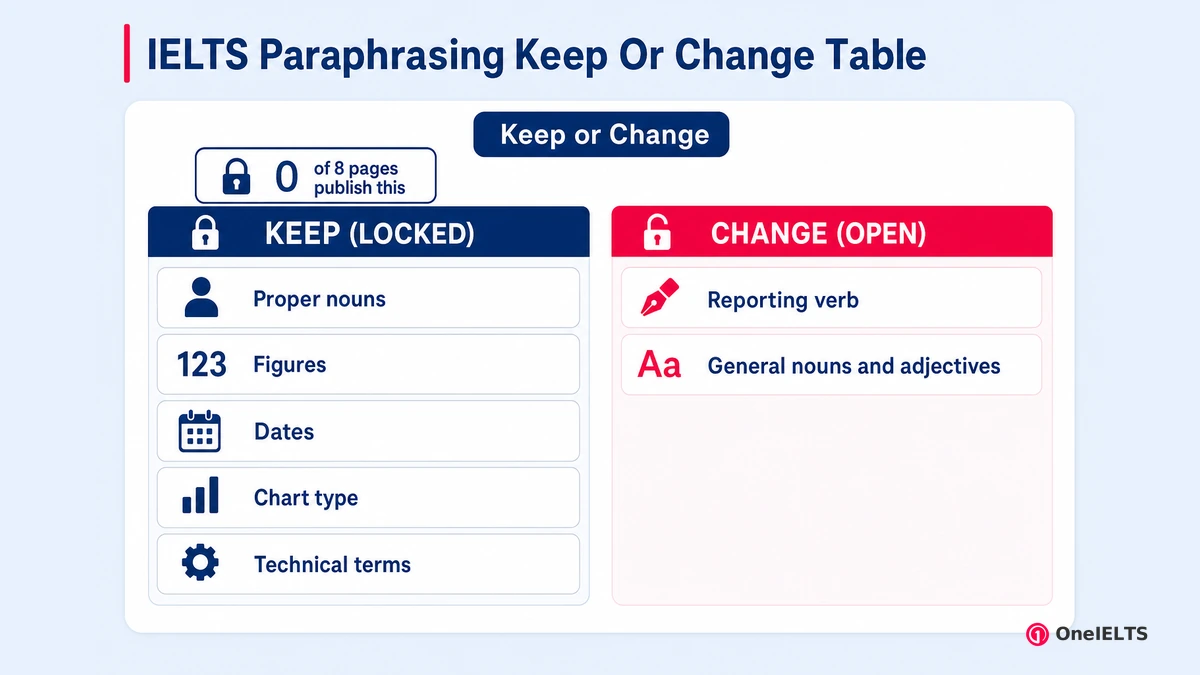
Proper nouns, figures, dates, the chart type, and any technical term with no natural equivalent. Leave them exactly as they are, and note that nobody on this search result tells you that.
| Word type | Keep or change | Why |
|---|---|---|
| Proper nouns and place names | Keep | There is no synonym for Canada, and inventing one changes the fact. |
| Figure and date values | Keep | A rewritten number is a wrong number, and a shifted year is a shifted claim. |
| The chart or diagram type | Keep | Bar chart and diagram have no natural equivalents. |
| Technical or subject-specific terms | Keep | No equivalent exists, and an approximation reads as a misunderstanding. |
| The reporting verb | Change | Shows, illustrates and compares are interchangeable and expected to vary. |
| General nouns and adjectives | Change if you own the substitute | This is where range is demonstrated, and where the five-second rule applies. |
The measurement justifies the whole section. Proper noun returns zero on all eight captured pages. Technical term returns zero on seven of eight. The phrase cannot be changed returns zero on all eight. Both test-owner technique pages say nothing about it whatsoever.
Three sources come close and none turns it into a category. Fastrack asks what to do with a diagram and answers that you can use the word diagram because there is no synonym, adding that you should not worry about repeating keywords. The university page tells you to highlight the key words you must keep, because those words are essential to the meaning. IELTSPodcast notes that some common or technical words cannot easily be replaced.
Most readers will not believe this section without permission from somebody senior, so here is IELTS Liz giving it: even a band 9 can keep some words the same.
One boundary stops that becoming an excuse. Keeping individual words is fine. A copied phrase lifted whole from the task is not, and the examiner treats those words as uncounted.
Can You Over-Paraphrase?
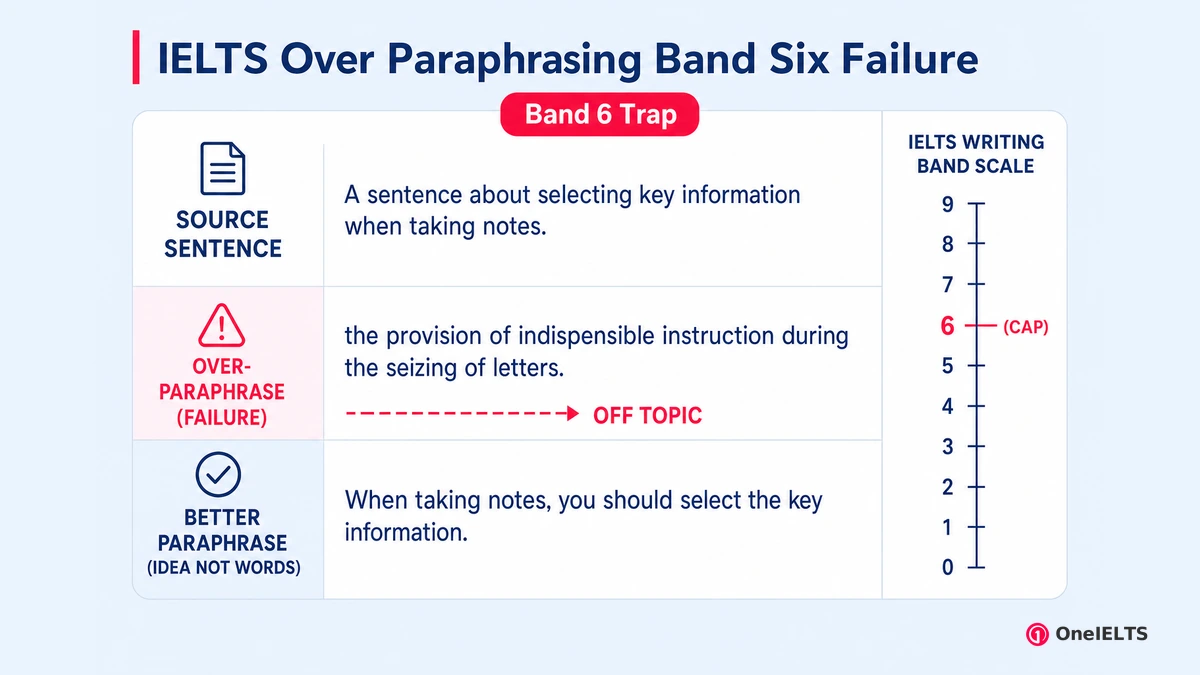
Yes, and it is the specific failure that keeps candidates below band 7. Changing too many words produces poor word choice and shifted meaning, and both cost more than repetition would have.
IELTS Liz gives the only quantified diagnosis on the search result.
“People stuck at band 6 and below, often over-paraphrase. They try to change too many words too often which results in 1) poor word choices 2) changing the meaning and going off topic. Both problems will lower your score below band 7.”
The university page supplies the second worked failure. A sentence about selecting key information when taking notes comes back as “the provision of indispensible instruction during the seizing of letters”. Its diagnosis is exact: the writer went looking for a synonym for every word instead of restating the point. Its remedy is to use simple language rather than reaching for complex words.
Both failures share one mechanism. Paraphrase the idea not words, because word-by-word substitution is what produced the leading dozen of nations and the seizing of letters alike. That is precisely what the cover-it step in the five-step method prevents, and it is why the step exists.
The failure has no name on this search result. Overuse and unnatural both return zero in body text on all eight captured pages, which is part of why it goes undiagnosed. Going off topic through a mistranslated topic noun costs you under Lexical Resource and Task Response together. That shows up across a whole marked paper rather than inside one rewritten sentence, which is what a timed Writing mock test is for.
Should You Use a Paraphrasing Tool?
Not for producing your answer, and not for learning either. A tool rewrites words, and the exam is testing whether you can restate an idea.
The search result is split and the reader deserves to know it is contested advice. IELTSPodcast recommends taking assistance from a paraphrasing tool. The university page lists using one as a cause of failure and advises avoiding them, because tool output often changes the meaning completely. That same university page is the one that names Turnitin.
The measurement is stark. Quillbot, ChatGPT and generator return zero on all eight captured pages, and word-boundary “ai” returns zero on all eight. The question a candidate in 2026 will certainly ask is answered by nobody in the exam vertical.
One honest checking use exists. Run a rewrite you have already produced through a tool to see whether the meaning drift you suspect is real, and never let it generate one for you. The handoff is the IELTS writing mistakes page.
How Do You Paraphrase in Writing Task 1?
Rewrite the task statement into your opening sentence. Change the reporting verb and the time expression, and leave every figure, place name and chart type exactly as it is.
IELTSPodcast states the rule: in Task 1 the first sentence must always be a paraphrased version of the question. That makes this the one sentence in the whole paper where paraphrasing is compulsory rather than useful.
Four moves do the work.
- Change the reporting verb. Shows becomes illustrates, or gives information about becomes compares.
- Change the word form of the data noun. The number of visitors becomes visitor numbers.
- Front or reword the time expression. From 2000 to 2015 becomes over a fifteen-year period.
- Name the categories where the task said “three countries”. A named category is a specificity gain rather than a substitution.
The keep list bites hardest here. The chart type, the units, the years and the place names all stay, and every retained figure stays to the digit. Fastrack’s line is the one to carry: you can use the word diagram, there is no synonym.
One honest note about the sources. Only one captured page separates Task 1 from Task 2 with actual instruction, and a test owner’s Task 1 article uses two Task 2 essay sentences as its worked examples.
How Do You Paraphrase in Writing Task 2?
Rewrite the statement, not the instruction. Change fewer words than you think, because a Task 2 prompt’s key nouns name the topic and the topic is what you have to stay on.
No captured page makes the split that matters. A Task 2 prompt has a statement half and an instruction half. The statement gets paraphrased into your first sentence. The instruction, meaning agree or disagree or discuss both views, needs no rewriting at all because it is not part of your sentence.
Three moves cover the statement.
- Change the general nouns and the main verb, which is where your range gets demonstrated without risking the subject.
- Keep the topic noun that names the subject, because that word is what the examiner checks your essay against.
- Restructure the clause order so the sentence is yours rather than the prompt’s with words swapped.
IELTS Liz names the risk in move two. Over-changing the topic words is how a candidate ends up writing about an adjacent subject and losing Task Response on an essay that reads perfectly well.
The paraphrase is the first sentence of your introduction, and the introduction page owns everything else about that paragraph.
How Do You Practise Paraphrasing?
Practise with the original covered. Every drill below hides the covered source, because looking at it is what turns paraphrasing into word-swapping. Five steps make a session.
- Open a real task statement and read it three times. Then cover it completely, with the screen off or the page turned over.
- Say the idea out loud in the simplest words you have. Do not try to sound academic, because this spoken version is testing understanding rather than vocabulary.
- Write down what you just said. This is your paraphrase, and it will be shorter than you expected it to be.
- Uncover the original and compare. Underline every kept word, because those are your keep list and most should be nouns, figures and names.
- Now check every changed word. Any word you could not confidently use in a second sentence of your own goes back to the original.
Step 5 is the unusual instruction and it earns its place. Confident reuse is the only test that separates a word you own from a word you found. A synonym you cannot reuse will collocate wrongly under timing, and that is the poor-word-choice half of the band 6 diagnosis this page is built on.
The cover-it move is not this page’s invention. Google’s AI Overview publishes a three-step version of it, and the nearest published step list belongs to a university academic-skills page with zero IELTS mentions. That tells you the method is a writing method rather than an exam trick.
Step 1 needs real statements. IELTS Writing practice is the unfiltered hub, which suits this drill because it works on a Task 1 chart statement and a Task 2 prompt equally well. Practising needs a free OneIELTS account.
Written by Jamil Ahmed, reviewed 14 August 2026.
Last verified: 14 August 2026
Practice for the Real IELTS Exam
Apply what you’ve learned with free, exam-style practice:
- Take a free IELTS mock test — all four skills, real exam timing, AI band scoring
- Sit a Writing section mock — Task 1 and Task 2 in one timed hour with a band estimate
- Practise by question type — self-paced Writing sets with model answers