


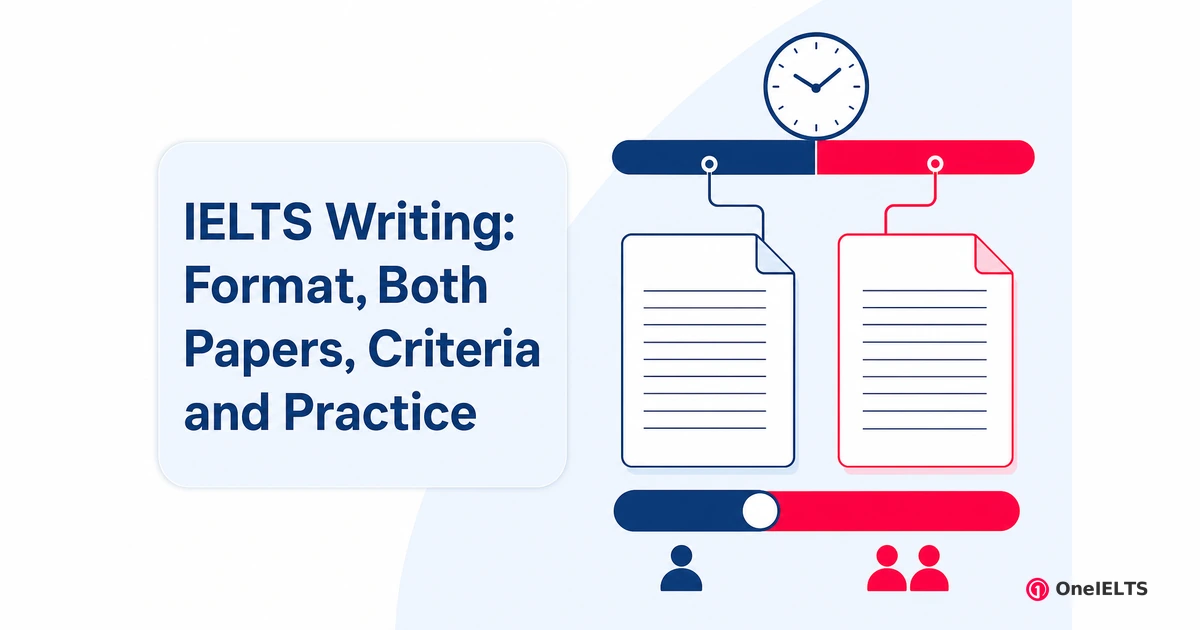
The 60-minute Writing test sets two compulsory tasks, and both are answered in full connected sentences. Task 1 takes at least 150 words in a recommended 20 minutes. Task 2 takes at least 250 words in a recommended 40.
One number should govern how you spend that hour, and the ranking pages barely carry it. Task 2 is worth roughly two thirds of the Writing band, which leaves Task 1 a one-third Writing share.
This page covers the format and how the Academic paper and the General Training paper differ. Then the skills assessed, the four marking criteria, the six shared steps, how hard the section really is, how to start, what band 8.5 takes, the mistakes, and where to practise.
What Is the IELTS Writing Test?
The IELTS Writing test is the 60-minute section made up of two compulsory tasks. They are marked together to produce a single Writing band from 0 to 9.
Candidates do ask whether one task can be skipped, so the test owner answers it plainly: “There are two Writing tasks and BOTH must be completed.”
One formatting rule is a published penalty rather than advice, and the owner states it in the same register.
“You must write your answers using full sentences. You must not write your answers as notes or bullet points.”
One detail almost no page carries changes how you use the paper. Question-paper notes are allowed and the examiner never sees them, so planning costs you nothing but minutes. The sections below take the format, the two papers, the marking and the shared method in that order.
What Is the Format of the IELTS Writing Test?
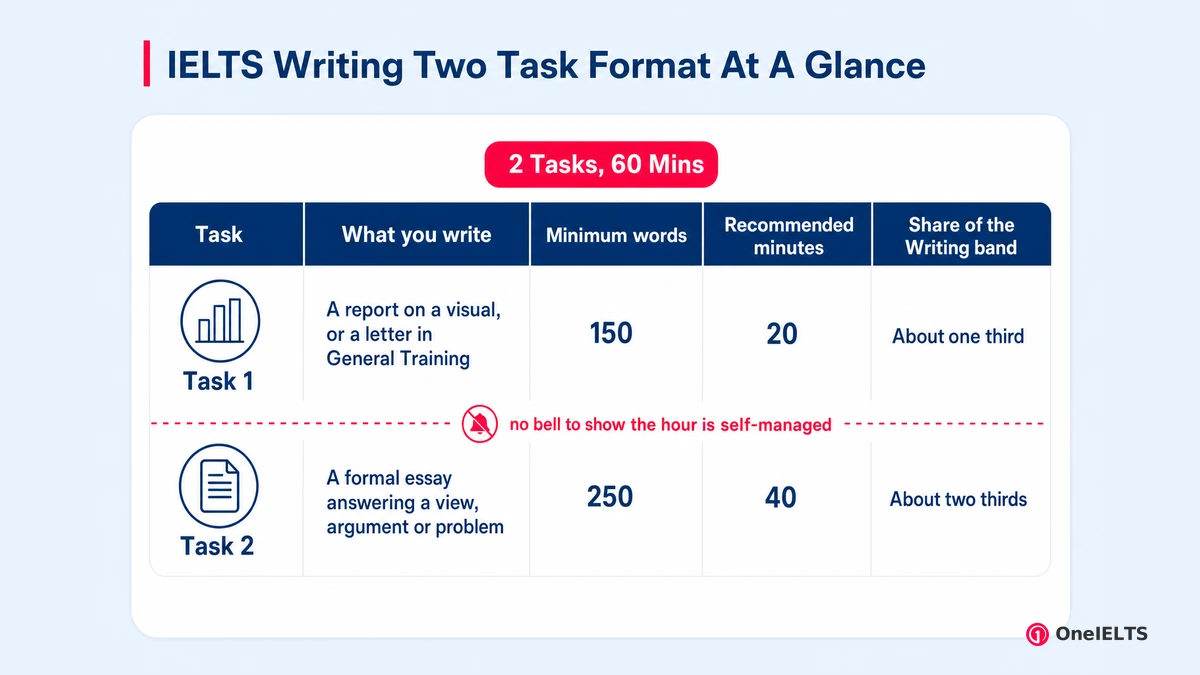
Two tasks in 60 self-managed minutes. Task 1 at 150-plus words in a recommended 20 minutes, Task 2 at 250-plus words in a recommended 40. The at-a-glance format sits in one table.
| Task | What you write | Minimum words | Recommended minutes | Share of the Writing band |
|---|---|---|---|---|
| Task 1 | A report on a visual, or a letter in General Training | 150 | 20 | About one third |
| Task 2 | A formal essay answering a view, argument or problem | 250 | 40 | About two thirds |
The self-managed hour is the part most ranking pages leave out. There is no bell between the tasks, the two figures are recommended timing rather than rules, and the only fixed number is the hour itself. Task weighting is what should decide how you divide it.
IELTS Writing Task 1 asks you to report information you have been given, in your own words, without adding an opinion. In the Academic paper that means a chart, graph, table, map or process diagram. In General Training it means a letter answering a situation. The minimum word count is 150 either way, and the task is compulsory.
IELTS Writing Task 2 asks you to answer a point of view, an argument or a problem in a formal essay of at least 250 words. It is the same task in both papers, which makes it the half of the test every candidate shares. It carries twice the marks of Task 1.
Seeing the two-task shape is one thing and sitting it is another, which is what a full IELTS mock test is for.
How Does IELTS Writing Differ in the Academic and General Training Papers?
Only Task 1 differs. Academic Task 1 is a report task on a visual, the General Training paper sets a letter instead, and Task 2 is a shared essay task in both. Four combinations exist and here is what each asks for.
- Academic Task 1. A 150-word report describing a chart, graph, table, map or process diagram, with no opinion in it.
- Academic Task 2. A 250-word formal essay answering a point of view, an argument or a problem you are given.
- General Training Task 1. A 150-word letter responding to a described situation, covering the three bullet points supplied.
- General Training Task 2. The same 250-word essay task as the Academic paper, marked against the same criteria.
Register is the part that genuinely differs. The letter register moves with the reader, running formal to a stranger, semi-formal to a named contact and informal to a friend. Academic Task 1 takes one academic or semi-formal neutral style throughout and never changes.
This fork needs resolving early because Google’s own AI summary on this query ends by asking the reader which paper they are sitting. The General Training letter page covers openings, purposes and sign-offs.
What Skills Does the IELTS Writing Test Assess?
Whether you can report information accurately, argue a position clearly, organise both in paragraphs, and control the vocabulary and grammar while doing it. Five assessed skills, drawn from what the owner publishes per task.
- Organising, presenting and comparing data, and describing the stages of a process. The Academic Task 1 skills.
- Writing a letter in the register the situation calls for. The General Training Task 1 skill.
- Writing a clear, relevant, well-organised argument with evidence or examples. The Task 2 skill for argument development.
- Producing connected paragraphs rather than notes, in both tasks and without exception.
- Controlling vocabulary and sentence structures accurately enough that meaning is never in doubt.
Notice what is missing from that list. Reporting data and building an argument are both there, and topic knowledge is not. The test does not assess what you know about the subject or whether your opinions are good ones.
It assesses accuracy of expression. A candidate with a thin argument expressed precisely outscores a candidate with a rich argument expressed loosely, which is the opposite of what most preparation assumes.
What Are the IELTS Writing Marking Criteria?
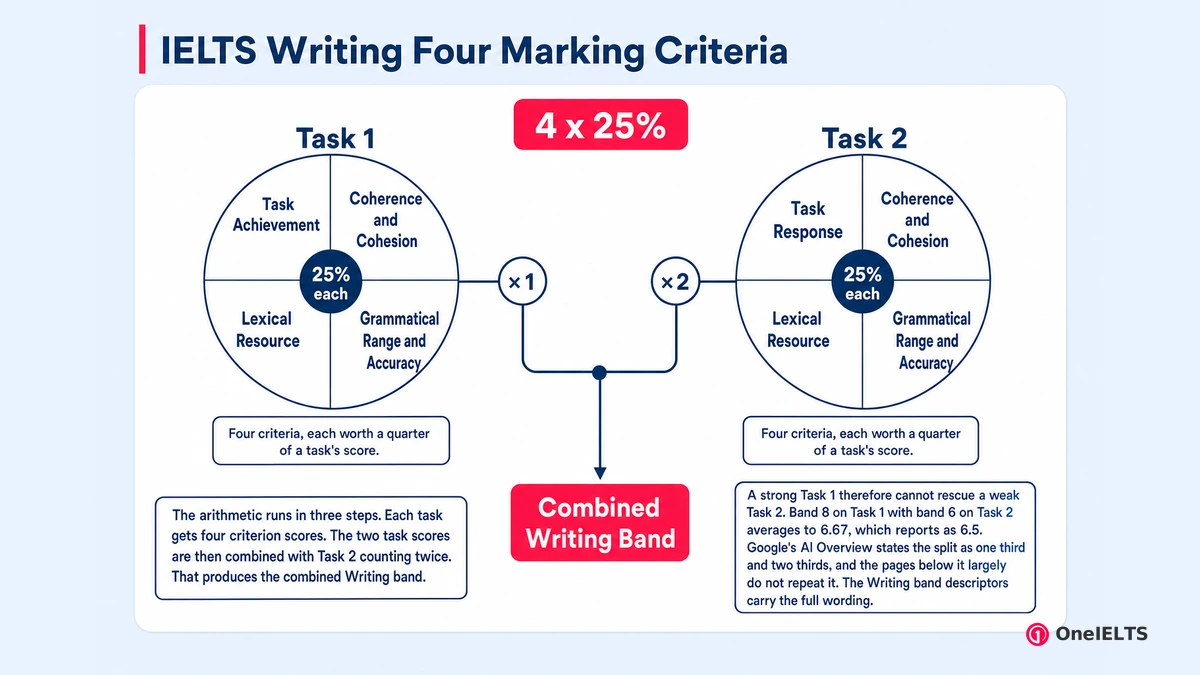
Four criteria, each worth a quarter of a task’s score. Task Achievement or Task Response, Coherence and Cohesion, Lexical Resource, and Grammatical Range and Accuracy. Each behaves slightly differently across the two tasks.
| Criterion | What it measures | How it differs between Task 1 and Task 2 |
|---|---|---|
| Task Achievement / Task Response | Whether the answer covers what the task asked, at the required length. | Task 1 rewards selection of key features; Task 2 rewards a held position and developed ideas. |
| Coherence and Cohesion | Paragraphing, the order of information, and the links between sentences. | Task 1 wants four predictable paragraphs; Task 2 wants one idea per paragraph. |
| Lexical Resource | Range and accuracy of the vocabulary you choose, including collocation. | Task 1 leans on trend and quantity language; Task 2 on topic and argument language. |
| Grammatical Range and Accuracy | Sentence variety and control, including tense, articles, plurals and agreement. | Task 1 turns on tense choice; Task 2 on complex sentences that stay accurate. |
Get the first name right, because this page can fix it across the cluster. It is Task Achievement in Task 1 and Task Response in Task 2. The owner sets both out together.
“Task achievement (in Task 1) and Task response (in Task 2) assess how accurately, appropriately and relevantly your response covers the task requirements.”
The arithmetic runs in three steps. Each task gets four criterion scores. The two task scores are then combined with Task 2 counting twice. That produces the combined Writing band.
A strong Task 1 therefore cannot rescue a weak Task 2. Band 8 on Task 1 with band 6 on Task 2 averages to 6.67, which reports as 6.5. Google’s AI Overview states the split as one third and two thirds, and the pages below it largely do not repeat it. The Writing band descriptors carry the full wording.
How Should You Approach the IELTS Writing Test?
Six steps, the same whichever task you are on. Understand it, plan it, open it, develop it, close it, check it. The shared approach ends with what you should have on the page.
- Understand the task. Read the prompt twice and count how many separate things it actually asks you for.
- Plan the response. Decide the shape and the content before you write a single sentence of it.
- Write a clear opening. Paraphrase the prompt so the reader can see task comprehension without hunting for it.
- Develop well-organised body paragraphs. One idea or one data group per paragraph, and never two.
- Write a closing. An overview in Task 1, a conclusion in Task 2, and nothing new in either of them.
- Review your work. Tense, articles, plurals, spelling, and whether you answered the question asked.
The six diverge in exactly one place. Step 5 is an overview near the top in Task 1 and a conclusion at the bottom in Task 2, and that overview versus conclusion difference is the only structural fork in the whole method.
The planning step and the review step are worth defending. Steps 1, 2 and 6 cost about ten minutes of the hour between them, and they are the three candidates cut first when time runs short. They are also the three that decide Task Achievement.
Is IELTS Writing Easy, or Is It the Hardest Section?
For most candidates Writing is the lowest of the four band scores, and the reason is structural rather than linguistic. It is the only section where you produce the language instead of recognising it.
Three things make it behave differently from the other three sections. There is no answer key, so partial credit does not exist the way it does in Listening and Reading. Criterion-based marking means a candidate can write fluently and still be capped by one criterion. And both tasks run under a shared clock, so a mistake in one costs the other.
That lowest band section pattern is widely reported by teachers rather than published as a figure, and no source in this capture puts a number on it. Weigh it accordingly.
The reframe is more useful than reassurance. Produced language sounds like an unfixable problem, and it is not, because the criteria are published. Unlike a general “write better English” problem, this one comes with a published checklist. A candidate who fixes structure and task response usually moves a band before their English changes at all.
How Do You Start an IELTS Writing Answer?
Paraphrase the prompt in your own words in the first sentence, and never copy it.
The exam board does not count copied prompt wording towards your minimum, so a copied opening costs you words as well as marks. Those uncounted words are the reason a paraphrased opening is a rule rather than a preference. Four sentences do the opening work across the two tasks.
- Task 1, sentence one. Say what the visual shows, with its units and its time span, in different words from the prompt.
- Task 1, sentence two. The overview sentence, giving the main pattern with no figures in it at all.
- Task 2, sentence one. Paraphrase the statement or question you have been given, keeping every idea in it.
- Task 2, sentence two. A position statement saying what the essay will argue, in words a reader could disagree with.
Two openings waste the first thirty seconds. Copying the prompt, which costs you counted words. And a general observation about how the modern world is changing, which answers nothing and is marked as nothing. A first sentence proves you read the question, and nothing else it does matters as much.
How Can You Score 8.5 in IELTS Writing?
Band 8.5 means both tasks land at band 8 or better on all four criteria, and because Task 2 counts twice it is Task 2 that decides whether you get there.
The weighted average does the work and no ranking page shows it, so here it is. Band 8 on Task 1 with band 9 on Task 2 averages to 8.67, which reports as 8.5 after half-band rounding. Band 9 on Task 1 with band 8 on Task 2 averages to 8.33, which also reports as 8.5. But band 9 on Task 1 with band 7 on Task 2 averages to 7.67, which reports as 7.5.
Criterion consistency at band 8 looks like this across the four.
- Task Achievement or Task Response. Every part answered, features selected rather than listed, position held from first line to last.
- Coherence and Cohesion. Information sequenced so well that the linking stops being noticeable to a reader.
- Lexical Resource. Precise word choice including collocation, with errors rare enough not to register.
- Grammatical Range and Accuracy. A wide range used flexibly, with errors appearing as slips rather than as patterns.
One caveat rather than a sales pitch. Band 8.5 in Writing is a rare score, and most candidates who need an overall 8 reach it with 7.5 in Writing and higher scores elsewhere. Optimise the section where a half band is actually available to you.
Which IELTS Writing Mistakes Should You Fix First?
The ones that apply whichever task you are on. Not answering the question asked, writing under the minimum, using notes instead of prose, and running out of time. Six cross-task mistakes, in cost order.
- Answering a question the prompt did not ask. The fastest cap on Task Achievement and Task Response alike.
- Writing under the minimum word count. A published penalty in both tasks, at 150 words and 250 words.
- Using notes or bullet points. A published penalty, because the answer must be a whole piece of connected text.
- An off-topic answer that drifts from the subject you were given. A published penalty in both tasks.
- Copying wording from the prompt. Those words are not counted towards your minimum at all.
- Letting one task eat the other’s minutes. The shared hour is fixed and nothing else about the split is.
One distinction makes that list usable. Items 2, 3 and 4 are penalties the test owner publishes. The other three cost marks through the criteria instead, which means they are judgements rather than rules.
Mistakes also change with level, and one page on this search result organises them that way. The errors capping a band 5 answer and a band 8 answer are different problems entirely, so look at the band you are on rather than at a generic list. The IELTS Writing mistakes page carries the catalogue.
Where Can You Practise IELTS Writing?
Practise both tasks in one 60-minute sitting rather than separately. The transfer of time between them is the failure most timed practice never rehearses. Five steps make a whole-test practice routine.
- Practise each task separately while you are still learning its shape and its language.
- Once the shape is stable, switch to full sixty-minute sittings with both tasks in one go.
- Write Task 1 and Task 2 in whichever order you have decided on, and hold to that order.
- Start self-marking against the four criteria before you read any model answer at all.
- Give weighted correction time to the harder half, running roughly two to one towards Task 2.
Free material is plentiful and partial. Three of the top ten results on this query are practice inventories, and they all supply the same thing: prompts. What they do not supply is a clock, a band estimate, or feedback on whether you answered the question that was asked.
OneIELTS’s timed Writing mock is where the whole-hour routine runs, with both tasks in one sitting. IELTS Writing practice covers the per-task sets in step 1. Practising needs a free OneIELTS account.
How Should You Split Your Task 1 Practice?
Task 1 practice goes type by type, because every visual uses the shared structure and the type-specific language is not shared at all. Bar-chart language will not carry you through a process diagram.
Two clauses hold the routine. Three answers on one visual type before you move to the next, and an untimed first attempt so the shape settles before the clock does. The overview check is the one worth running every time: is it there, and does it contain figures it should not?
The IELTS Writing Task 1 hub carries the per-type pages.
How Should You Split Your Task 2 Practice?
Task 2 practice goes essay type by essay type, and one check belongs on every attempt: is the position in the conclusion the position in the introduction?
Three essays on one type before switching, and forty minutes from the second timed attempt onward. Position consistency is what that check measures, and it is the commonest single failure at band 6.
One trap is worth naming, because volume feels like progress. Writing twenty essays without a feedback loop trains the same errors twenty times over. The IELTS Writing Task 2 hub covers the types.
Which Grammar and Vocabulary Do You Need for IELTS Writing?
Lexical Resource and Grammatical Range are two of the four criteria, so half your Writing band comes from vocabulary and grammar. The range that earns marks is narrower than most candidates assume.
Two things move those criteria. Accurate collocation in the words you already own, and sentence variety meaning a genuine mix of simple and complex sentences rather than complexity everywhere.
The false economy is swapping in unusual words you cannot place. A rare word in the wrong slot costs more under Lexical Resource than the simpler word it replaced. The IELTS vocabulary page carries the sets.
How Can You Improve Your IELTS Writing Score?
A structural change moves a Writing band faster than a linguistic one. Answering every part of the prompt, giving each paragraph one idea, and finishing the task.
Each has a reason attached. Answering every part covers the criterion that caps fluent essays. Paragraph discipline gives Coherence and Cohesion something to reward. A finished task stops the answer losing marks in its last thirty seconds, which is where a missing conclusion costs twice.
Effort allocation follows from the weighting. Correction time should run roughly two to one towards Task 2. The IELTS writing tips page carries the rest.
Written by Jamil Ahmed, reviewed 14 August 2026.
Last verified: 14 August 2026
Practice for the Real IELTS Exam
Apply what you’ve learned with free, exam-style practice:
- Take a free IELTS mock test — all four skills, real exam timing, AI band scoring
- Sit a Writing section mock — Task 1 and Task 2 in one timed hour with a band estimate
- Practise by question type — self-paced Writing sets with model answers