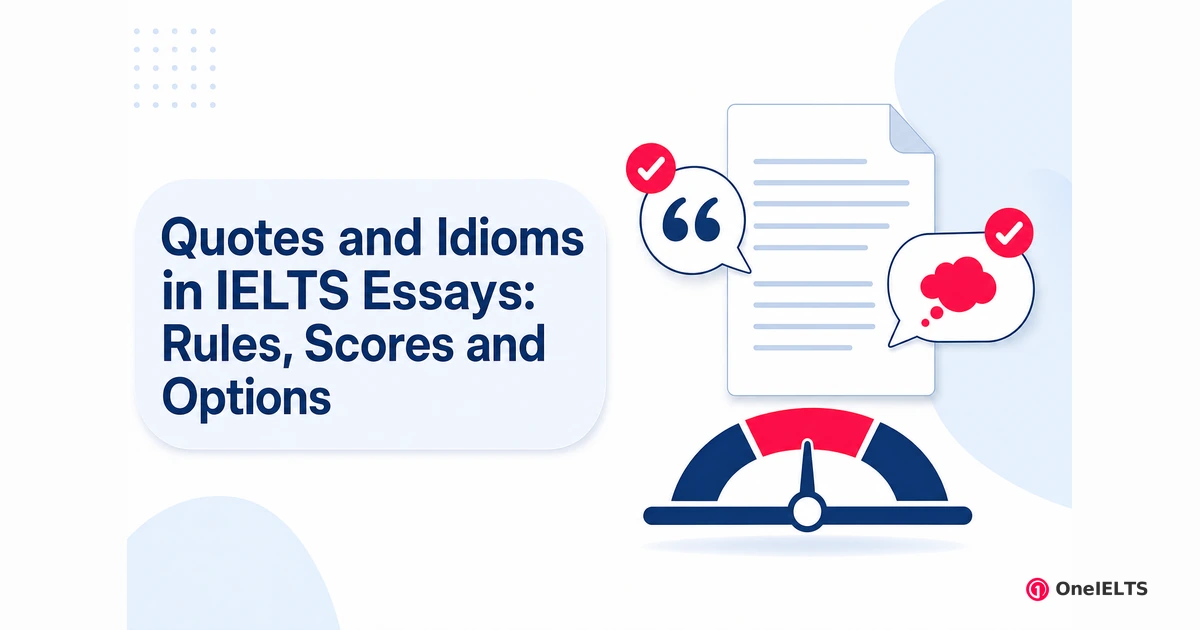
Your IELTS Writing Task 2 essay earns its band from your own argument and your own words, so a borrowed quotation or proverb adds length without adding proof of either. Quotes and idioms aren’t banned, but no criterion rewards them, most idioms break the academic register, and a misused one lowers your band. The band descriptors show why: Writing’s Lexical Resource line treats idiomatic items as optional, while Speaking band 9 asks for idiomatic language throughout.
This page covers quotes in a Task 2 essay, idioms and proverbs, band impact, Task 1 and letters, common mistakes, usage rules, quotation marks, and three safer options. It ends with Speaking, where the answer flips; Speaking idiom lists stay on their own page.
Can You Use Quotes in an IELTS Writing Task 2 Essay?
Yes, a quote is allowed, but it earns no marks. Nothing in the IELTS rules forbids one, yet the examiner assesses your own language and reasoning, and a famous quote is neither. Task Response wants a developed position backed by relevant ideas, while a quote only states someone else’s position. Lexical Resource assesses vocabulary you produced, so quoted words prove nothing about your range.
You can’t check a line or its source in the exam room, so a half-remembered quote risks being wrong. Used as an essay hook, it usually replaces the paraphrase of the question your introduction needs. You still owe at least 250 words of your own writing around it. One short, widely known line can work once in a body paragraph, followed by your own explanation.
Can You Use Idioms or Proverbs in IELTS Writing?
You can, but rarely should. Most idioms and proverbs are informal, conversational or clichéd, and Task 2 asks for a formal register, so either is likelier to cost a mark for style than to earn one.
Informal idioms such as “a piece of cake”, “once in a blue moon” and “hit the nail on the head” signal spoken English and break the essay’s academic style. Fixed expressions like “a double-edged sword”, “in the long run” and “play a key role” read naturally in academic prose. Teachers often call this second group formal idioms, and it’s safe only when the meaning and the collocation are exact.
A proverb or a translated saying rarely passes that test. A high-band essay can contain zero idioms, and their absence never lowers a score.
Will Quotes or Idioms Get You a Higher IELTS Writing Band?
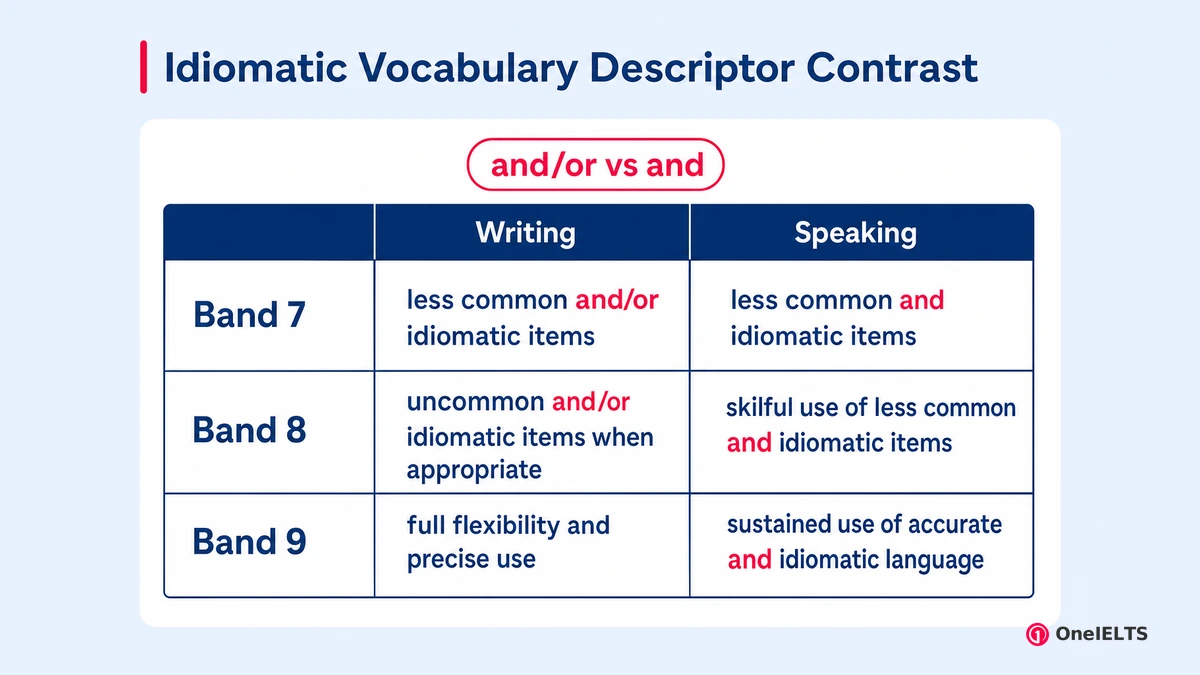
No, the Writing band descriptors give no marks for a quote or an idiom as such. The public band descriptors for Writing list idiomatic items only as an option, “uncommon and/or idiomatic items”, and only “when appropriate”. The Speaking descriptors join the two with “and”, and the band 9 Writing line drops idioms entirely.
In Writing, less common lexical items means precise topic words and collocations. A wrong-register idiom counts against style and collocation, and a memorized quote shows no Lexical Resource range. None of the top-ranking guides we checked quotes this wording.
The May 2023 grids split on idiomatic vocabulary at bands 7 to 9 (checked on 7 October 2026).
| Band | Writing Lexical Resource (key phrase) | Speaking Lexical Resource (key phrase) | What it means for idioms |
|---|---|---|---|
| Band 7 | “Some ability to use less common and/or idiomatic items”, with “an awareness of style and collocation” | “Some ability to use less common and idiomatic items” plus an awareness of style and collocation | Writing accepts precise less common words alone; Speaking expects some idioms beside them. |
| Band 8 | “Skilful use of uncommon and/or idiomatic items when appropriate” | “Skilful use of less common and idiomatic items” despite occasional inaccuracies | An essay idiom earns credit only when the register suits it; Speaking expects idioms here. |
| Band 9 | “Full flexibility and precise use are widely evident” | “Sustained use of accurate and idiomatic language” | Band 9 Writing names no idioms at all, while band 9 Speaking requires them throughout. |
Can You Use Idioms in Writing Task 1 or a Letter?
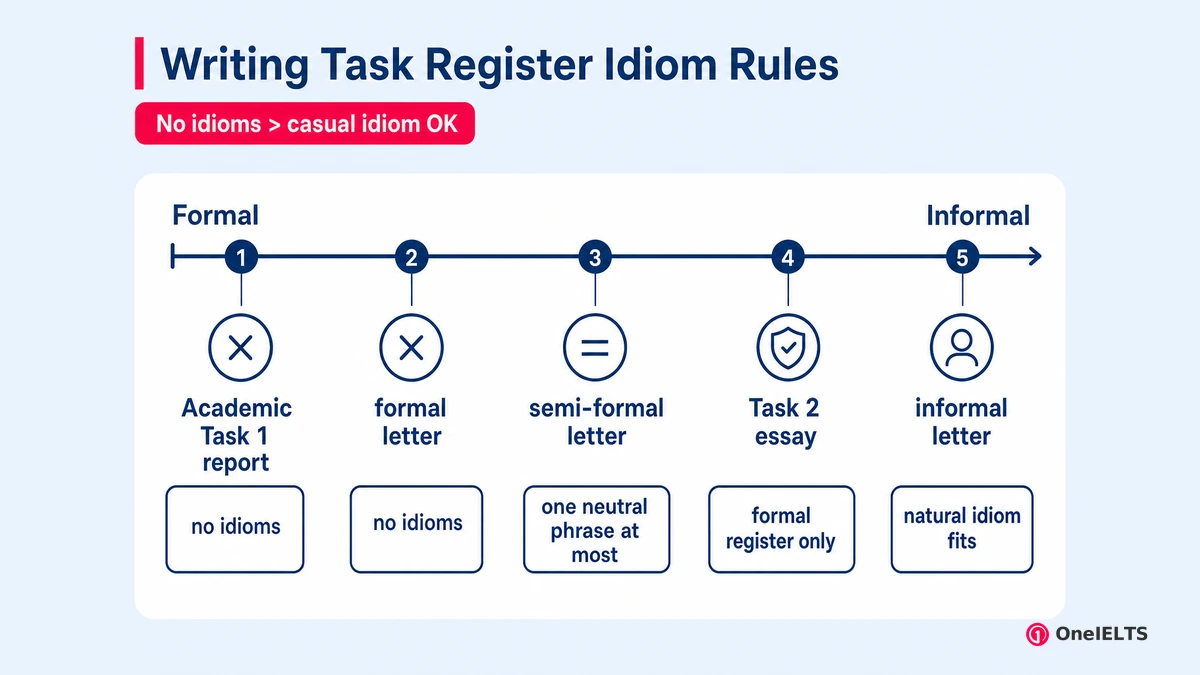
Never in Academic Task 1, almost never in a formal or semi-formal letter, and sparingly in an informal letter to a friend, the only Writing task where a casual idiom fits the register. Each task sets its own letter tone or report style, and that decides whether an idiom belongs.
A General Training letter follows its prompt: the person you write to sets the register, so a formal letter and an informal letter take opposite rules. Here is how the idiom rule shifts from one Writing task to the next.
- Academic Writing Task 1 (report on a chart, map or process): no idioms at all, because the report calls for factual, objective language only.
- General Training Task 1 formal letter: no idioms; a complaint or job application needs polite, standard phrasing that any reader follows easily.
- General Training Task 1 semi-formal letter: avoid idioms, and keep to one neutral fixed phrase such as “in the long run” at most.
- General Training Task 1 informal letter: a natural idiom fits the friendly tone, such as telling a friend the course was “a piece of cake”.
- Task 2 essay (Academic and General Training): both versions demand a formal register, so the essay rules in the idioms section above apply.
What Mistakes Do Idioms Cause in IELTS Writing?
Idioms lower Writing scores in four predictable ways: wrong register, wrong meaning, wrong form, and forced placement, plus two habits that make each one worse. Under Lexical Resource, an idiom with the wrong meaning or fixed form counts as an error in word choice, and an inappropriate register counts against style. Under Task Response, a forced idiom takes space your own ideas needed.
Each of the six mistakes below comes with a wrong version and a fix.
- Using an idiom you don’t fully understand: “Housing costs are the tip of the iceberg” misuses the phrase; “Housing costs have reached a record high” says what you meant.
- Changing the fixed form of an idiom: “on a long run” breaks the fixed form, while only “in the long run” is correct, and examiners notice the wrong article.
- Choosing a casual idiom in a formal essay: “Online learning is a piece of cake” sounds chatty; “Online learning is accessible to most students” keeps the essay formal and precise.
- Forcing an idiom where a plain word is clearer: “Governments must bite the bullet on fuel taxes” adds nothing over “Governments must accept the cost of higher fuel taxes.”
- Overusing idioms or stacking several in one paragraph: “At the end of the day, it’s a double-edged sword” sounds rehearsed; one idiom per essay, at most, reads naturally.
- Spending exam time thinking about which idiom to insert: IELTS suggests 40 minutes for Task 2, and every minute hunting for an idiom comes out of planning and checking.
How Should You Use a Quote or Idiom in a Task 2 Essay?
Use it once, keep it short and formal, tie it to your point, and explain it in your own words straight after. That covers a candidate who still wants a quote or a formal idiom after weighing the risks above.
Six rules keep a single quote or idiom from costing you marks.
- Use it sparingly and purposefully: one quote or formal idiom per essay at most, placed where it strengthens a specific argument.
- Keep it formal enough for an academic register: “a double-edged sword” passes the test, but “a piece of cake” never does.
- Make sure it supports the paragraph’s point: the line must back that paragraph’s supporting point, not the essay topic in general.
- Avoid misquoting: paraphrase the idea instead if you’re unsure of the exact words or the speaker, because misquoting looks careless.
- Follow it with your own explanation and example: add two sentences showing how the line applies to the question you’re answering.
- Never let it replace the paraphrase of the question in the introduction: your opening sentence restates the task in your own words.
Can You Use Quotation Marks in IELTS Writing?
Yes, quotation marks are correct punctuation in IELTS Writing for a direct quote, a title, or a term you’re discussing, but using them to mark irony reads as informal.
- Direct quote: The descriptors ask for “an awareness of style and collocation.”
- Title: The OECD report “Education at a Glance” compares school spending.
- Term: “Gig economy” means short-term task work.
- Avoid scare quotes: The “experts” were wrong.
American English puts a period or comma inside the closing mark, while British English often puts it outside; either is accepted when used consistently. Quotation marks never make borrowed words your own vocabulary. See our punctuation rules page for more.
How Do You Give Examples in IELTS Writing Task 2 Instead of Quotes?
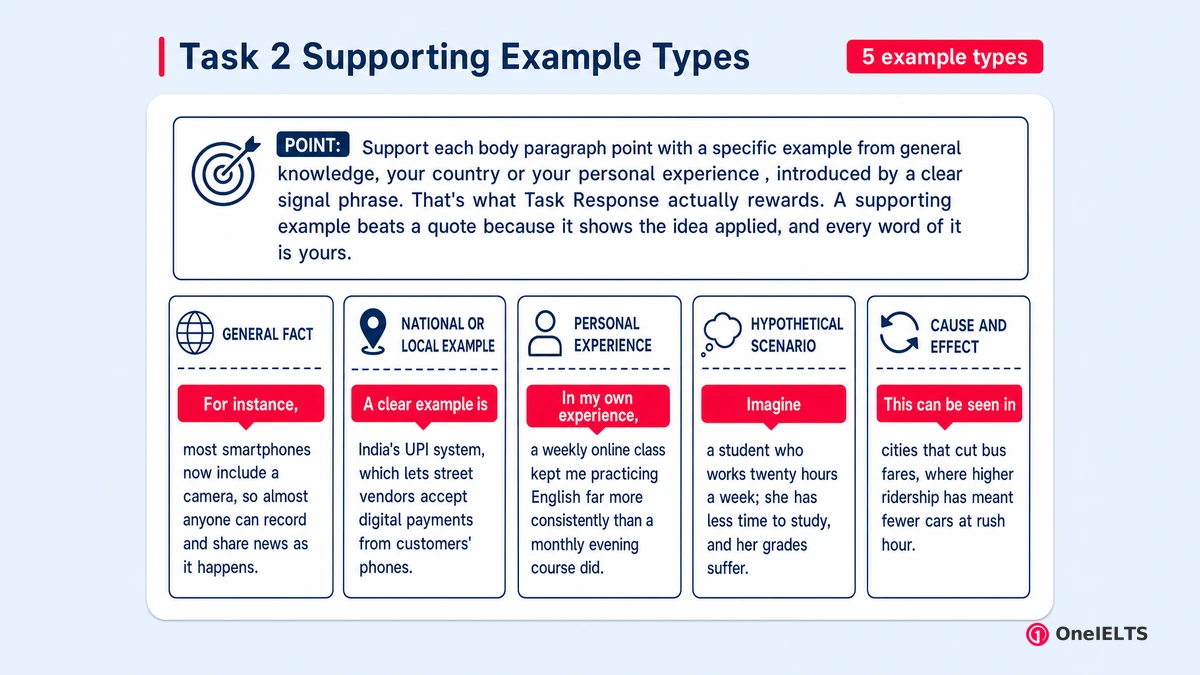
Support each body paragraph point with a specific example from general knowledge, your country or your personal experience, introduced by a clear signal phrase. That’s what Task Response actually rewards. A supporting example beats a quote because it shows the idea applied, and every word of it is yours.
Signal phrases such as “For instance”, “A clear example is” and “This can be seen in” introduce an example formally. Five types of example work on common Task 2 topics, each shown with a model sentence.
- A general fact most readers accept: “For instance, most smartphones now include a camera, so almost anyone can record and share news as it happens.”
- A national or local example: “A clear example is India’s UPI system, which lets street vendors accept digital payments from customers’ phones.”
- A personal or observed experience: “In my own experience, a weekly online class kept me practicing English far more consistently than a monthly evening course did.”
- A hypothetical scenario: “Imagine a student who works twenty hours a week; she has less time to study, and her grades suffer.”
- A cause-and-effect illustration: “This can be seen in cities that cut bus fares, where higher ridership has meant fewer cars at rush hour.”
Write a full essay with examples like these in IELTS Writing practice and get feedback on each body paragraph.
Can You Make Up Examples in IELTS Writing?
Yes, invented or hypothetical examples are acceptable, because the examiner judges how well an example supports your point, not whether it’s true. Don’t invent precise statistics or put words in a real person’s mouth.
A hypothetical example such as “Imagine a student who…” is fair. “A 2023 Harvard study proved that 87%…” is fabricated authority, and invented statistics weaken your credibility the moment they sound too neat. A fabricated quote credited to a famous person is the riskiest choice of all. Examiners penalize nothing about an honest hypothetical, and vague phrasing such as “research suggests” beats a fake number.
Which IELTS Writing Words Can You Use Instead of Idioms?
Replace each casual idiom with a precise formal word or collocation that carries the same meaning. That’s what less common lexical items with “an awareness of style and collocation” look like in practice.
A formal alternative also shows the precise vocabulary examiners credit. Two idioms, “a double-edged sword” and “in the long run”, are formal enough to keep, and “on the other hand” is a standard linker. For topic word lists and useful phrases, see Task 2 vocabulary.
These seven swaps turn casual idioms into academic vocabulary.
| Casual idiom | Meaning | Formal alternative | Example sentence |
|---|---|---|---|
| a piece of cake | something very easy to do | straightforward / effortless (replace) | The online application process is straightforward for most users. |
| in the long run | over a long period of time | in the long term (either is acceptable as-is) | Renewable energy reduces household costs in the long term. |
| a double-edged sword | something with good and bad effects | has both advantages and drawbacks (idiom acceptable as-is) | Social media has both advantages and drawbacks for teenagers. |
| the tip of the iceberg | the visible part of a bigger issue | a small part of a larger problem (replace) | Reported cases are only a small part of a larger problem. |
| hit the nail on the head | describe something exactly right | identify the core issue precisely (replace) | The report identifies the core issue precisely: housing supply. |
| cost an arm and a leg | be very expensive to buy | prohibitively expensive (replace) | Private healthcare is prohibitively expensive for many families. |
| on the other hand | introducing an opposite point or view | conversely / by contrast (linker acceptable as-is) | By contrast, rural schools struggle to recruit teachers. |
Can You Use Quotes, Idioms or Proverbs in the IELTS Speaking Test?
Yes, in IELTS Speaking, natural idioms are part of the Lexical Resource descriptor from band 7 upward. A short quote or proverb can also work in Speaking Part 3 when you discuss an abstract idea, provided you explain it.
Speaking is a conversation, so the conversational register that hurts an essay suits an interview. Idiomatic language earns credit here when it’s accurate. The Speaking grid still penalizes an idiom used wrongly or forced in. Quotes stay low value even in Speaking: the examiner wants your opinion, and memorized answers or lines don’t show it.
Which Commonly Used Idioms From Daily Life Work in IELTS Speaking?
The idioms that work in IELTS Speaking are the common, everyday ones you already use naturally, not rare expressions memorized from a list. Common idioms such as “over the moon”, “once in a blue moon” and “a piece of cake” fit Speaking Part 1 questions about your life. Your test for everyday idioms: natural use in a sentence about yourself. See English idioms for IELTS Speaking for the full list.
Does Overusing Idioms in the Speaking Test Lower Your Band?
Yes, overusing idioms can lower your Speaking band. The descriptors reward idiomatic vocabulary only when it’s accurate and natural, and an answer packed with idioms sounds rehearsed. Speaking band 7 asks for “some ability to use less common and idiomatic items”, so one or two natural idioms across the test suffice. Forced idioms also hurt Fluency and Coherence, since you pause to fit them in. See IELTS Speaking band 7.
Is It Okay to Use Slang in IELTS Speaking?
No, avoid slang in IELTS Speaking; informal is fine, but slang is regional, can be misunderstood, and isn’t the idiomatic vocabulary the descriptors reward. Informal language such as phrasal verbs (“figure out”, “catch up”) and common idioms is acceptable. The examiner treats slang and swear words as errors of register. Build your Speaking vocabulary with our IELTS Speaking vocabulary guide.
Is Thinking About Idioms Too Much a Mistake in IELTS Speaking?
Yes, thinking about idioms too much is a mistake, because planning where to insert one slows your answer and breaks fluency. Skip long idiom lists. Learning in context works better: pick a few common idioms, use them in Speaking practice until they come out naturally, and remember that examiners spot memorized phrases quickly. More fixes sit in our IELTS Speaking tips.
Written by Jamil Ahmed, reviewed 7 October 2026.
Last verified: 7 October 2026
Practice for the Real IELTS Exam
Apply what you’ve learned with free, exam-style practice:
- Take a free IELTS mock test — all four skills, real exam timing, AI band scoring
- Sit a Writing section mock — Task 1 and Task 2 in one timed hour with a band estimate
- Practice by question type — self-paced Writing sets with model answers