


At least 150 words for Task 1 and at least 250 for Task 2, with no maximum at all. Those are the only word count numbers the exam board publishes. Its own page ranks second for this search and publishes zero counting rules — hyphenated, compound, contraction and date all return zero across its 975 words.
So every rule here carries its source. This guide covers the official minimum and the missing maximum, which words count as one, numbers and dates, and copied prompt words. Then counting in the exam by line calibration, the on-screen counter, what under-length costs, the limits candidates invent, and the target worth aiming at.
How Does IELTS Count Words in Writing?
Every word you write on the answer sheet counts, including a, an and the. Hyphenated words and figures count as one. The minimums are 150 words for Task 1 and 250 for Task 2.
IELTS Liz sets the all words count rule out in her comment thread, writing that every word is counted regardless of how small it is. Google’s AI Overview supplies the other half verbatim, saying that hyphenated words such as well-being, along with numbers and dates, count as a single word.
Now the finding that justifies this page. The exam board’s own format page ranks second for this search and publishes no counting rules at all. It gives the official minimums, states that you will be penalised if your answer is too short, and says nothing about how a word is counted.
That absence is why every rule further down carries a named source, and why the unsourced rules are labelled as unsourced rather than blended in with the rest. What follows is the numbers, the counting rules, how to count under exam conditions, and what actually happens if you fall short.
How Many Words Must You Write?
At least 150 words in Task 1 and at least 250 in Task 2. The exam board’s official wording is worth reading exactly as it stands, because the phrasing is the whole point.
You must write at least 150 words and will be penalised if your answer is too short.
You must write at least 250 words and will be penalised if your answer is too short.
It restates both as a minimum of 150 words and you must write a minimum of 250 words.
The board says at least and a minimum of. It never says over and it never says about. The top-ranking result on this search opens by saying IELTS have set a task of writing over 150 words, then four lines later quotes the board correctly as at least 150 words.
Over 150 and at least 150 differ by one word, at exactly the boundary this page is about. Read it as a wording slip rather than an error of substance.
The vocabulary problem that follows is measurable. The related searches on this query carry “IELTS Writing Task 1 word limit”, and across three ranking Reddit threads the phrase word limit appears four times against minimum three times. The limit misnomer is the root of most of the confusion here, because 150 and 250 are a minimum floor rather than a ceiling.
The criterion link is the board’s own, and it names where the minimum is assessed.
Task achievement (in Task 1) and Task response (in Task 2) assess how accurately, appropriately and relevantly your response covers the task requirements, using the minimum of 150 words for Task 1 and 250 words for Task 2.
Is There a Maximum Word Count?
No. The board says so twice, and each time it attaches a different reason.
While you will not be penalised for writing more than 150 words, you should remember that a longer Task 1 answer may mean that you have less time to spend on Task 2.
The sentence ends by naming the task two weighting: Task 2 contributes twice as much to your Writing band score.
While you will not be penalised for writing more than 250 words, if you write a very long answer you may not have time for checking and correcting at the end.
It adds two more costs in the same breath. Some ideas may not be directly relevant to the question, and you may also produce handwriting which is unclear.
No other captured page makes the double-weighting argument, and none connects over-writing to unclear handwriting. Checking time is the Task 2 half of the board’s case, and most candidates never budget for it.
Two teachers corroborate the no upper limit rule. IELTS Liz writes that there is no upper word limit, but that a long essay is not therefore a good idea, and that writing too many words does not mean a better mark. Her padding risk warning is blunt: people often like to add padding to their essays and this only lowers your score. Magoosh agrees there is no penalty for writing too many words, while not encouraging you to overwrite.
The best answer on this topic comes from a Reddit thread that ranks on this search, because it answers the fear rather than the rule. One user worries that an examiner may not read the full answer. Two replies correct him.
Examiners must read the full essay whether they like it or not. It’s the standard procedure for marking.
It’s their job to read any essay in full. Not reading the full essay is a misconduct that could result in a penalty.
A flaired teacher adds the concession no publisher page makes, saying examiners must read it all and remain objective even though they dislike such long tasks. That examiner obligation is what the anxiety is actually about.
Whether writing more helps your score at all is the concise writing page’s argument.
Which Words Count as One Word?
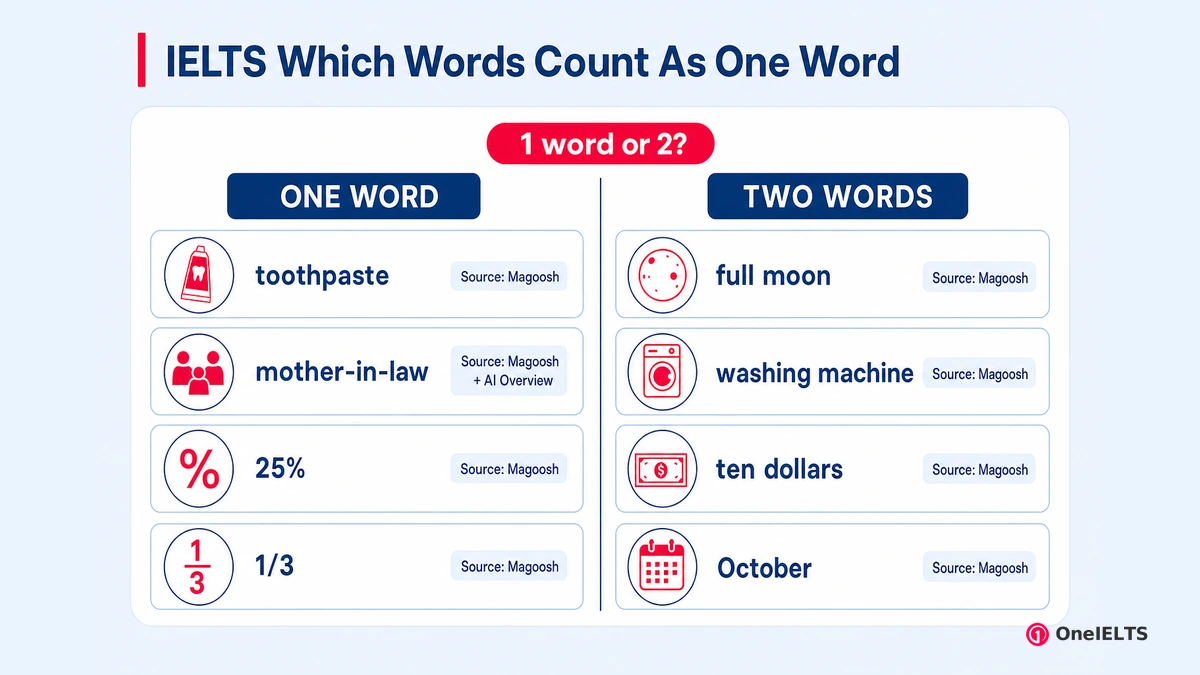
These rules are not published by the exam board. They come from one detailed commercial page last updated in 2021, one tool page, and Google’s AI Overview, and where two of those disagree this page says which it follows.
| Rule | How it counts | Source |
|---|---|---|
| Closed compounds | One word: toothpaste, sunrise, dishwasher | Magoosh |
| Open compounds | Two words: full moon, washing machine, even when they carry one idea | Magoosh |
| Hyphenated words | One word: mother-in-law, up-to-date | Magoosh, corroborated by the AI Overview and the tool page |
| Fractions | One word: 1/3, two-fifths | Magoosh |
| Attached symbols | One word: $10.00, 25%. Written out they are two: ten dollars, twenty-five percent | Magoosh |
| URLs | One word | Magoosh |
| Words in parentheses | Counted normally: one word in brackets is one, two are two | Magoosh |
| Articles and prepositions | Every one counts, every time | Magoosh, the tool page, and IELTS Liz |
Magoosh’s own worked example makes the small words rule concrete: The dog ran around the block while the dog walker chased it is twelve words. The tool page states the same thing, that IELTS counts all words including small ones like a, an and the.
One disagreement needs naming. The tool page states flatly that compound words, hyphenated words, numbers and dates are all counted as one, which contradicts the open compounds rule above, and it illustrates “compound” with a hyphenated example.
This page follows the open compound distinction, because it is the more careful of the two and because full moon is visibly two words on the page.
How Are Hyphenated Words Counted?
As one word each. Magoosh states the hyphen rule plainly and provides its own examples: all hyphenated words count as one, so mother-in-law is one word and up-to-date is one word. The AI Overview corroborates it with well-being.
The consequence is this page’s own point. A hyphen is the cheapest word you can lose, and a candidate who writes well-being, long-term, so-called and up-to-date across one essay is four words shorter than they think.
That hidden shortfall is a reason to check your count, not a reason to avoid the compound modifier. Three of the six captured articles say nothing about hyphenation at all, and one of the three is the exam board.
Do Contractions Count as One Word?
Yes. Magoosh offers the contraction rule with its own examples: contractions are always counted as one word even though they represent two, so it’s is one word and we’re is one word.
The point that matters more than the rule is register. The captured mistakes guidance treats a contraction as a formal register error in an academic answer, whatever its count. Writing it is rather than it’s fixes the register and delivers a word gain at once.
Register errors more generally belong to the common IELTS writing mistakes page.
Do Numbers and Dates Count as One Word?
As digits, yes. Written out, no. The split is where Task 1 candidates lose their count.
Magoosh states the figures as digits rule with its examples: numbers, dates and times are almost always counted as one word, so 500 is one word, 7:15am is one word and 10/24/1982 is one word. The AI Overview and the tool page both corroborate it.
The same source sets the written-out rule directly against it. Numbers written out count as two words or more, so ten thousand is two and 3 million is two. Date formats behave the same way, with October 24th counting as two words and August 24th, 2021 counting as three.
The Task 1 consequence is this page’s own observation. A chart answer is full of figures, and a candidate who writes 25% twelve times has written twelve words where twenty-five percent would have been twenty-four.
That chart arithmetic means the same answer can sit over or under the minimum on a formatting choice that has nothing to do with quality. Write figures because they read more clearly in a data description, and do not lean on them to reach the minimum.
Which figures to select in the first place belongs to the IELTS Writing Task 1 pages.
Do Copied Question Words Count?
One page on this search says they do not, and it is the single highest-stakes unsourced claim in the capture. IELTS Liz, verbatim:
If you copy the information given by IELTS for your introduction, the examiner will not count those words. This means you might be under the word count. So, always paraphrase your introductions.
Now the measurement, stated plainly. No other page on this search states this, and that includes the exam board. The claim is unsourced, and it is uncontradicted only because nobody else addresses it.
What the board does publish is adjacent and different, and it covers external sources rather than the prompt in front of you. Its plagiarism rule states that you will be severely penalised if your writing is plagiarised, meaning copied from another source.
The resolution does not depend on settling it. Paraphrase regardless. If the claim is right, copying the prompt costs you words you thought you had. If it is wrong, a copied prompt still costs you Lexical Resource, because a copied introduction demonstrates nothing.
The advice is identical either way, which is exactly why nobody has bothered to settle the question. How to rewrite the prompt is the how to paraphrase for IELTS page’s subject.
Does a Title Count Towards Your Word Count?
Not one of the six captured articles addresses this, and the exam board is among the six. The title question meets an unpublished rule: nothing anywhere covers a title or heading you write yourself.
The advice does not need the rule. The board requires your answer to be written as a whole piece of connected text, meaning you must not use notes or bullet points. IDP Australia states the no subheadings version in the mistakes capture, telling candidates not to use sub-headings, bullet points or numbers.
So it resolves itself. Do not write a title, and the counting question never arises. Saying the rule is unpublished is more useful here than guessing at it.
How Do You Count Your Words in the Exam?
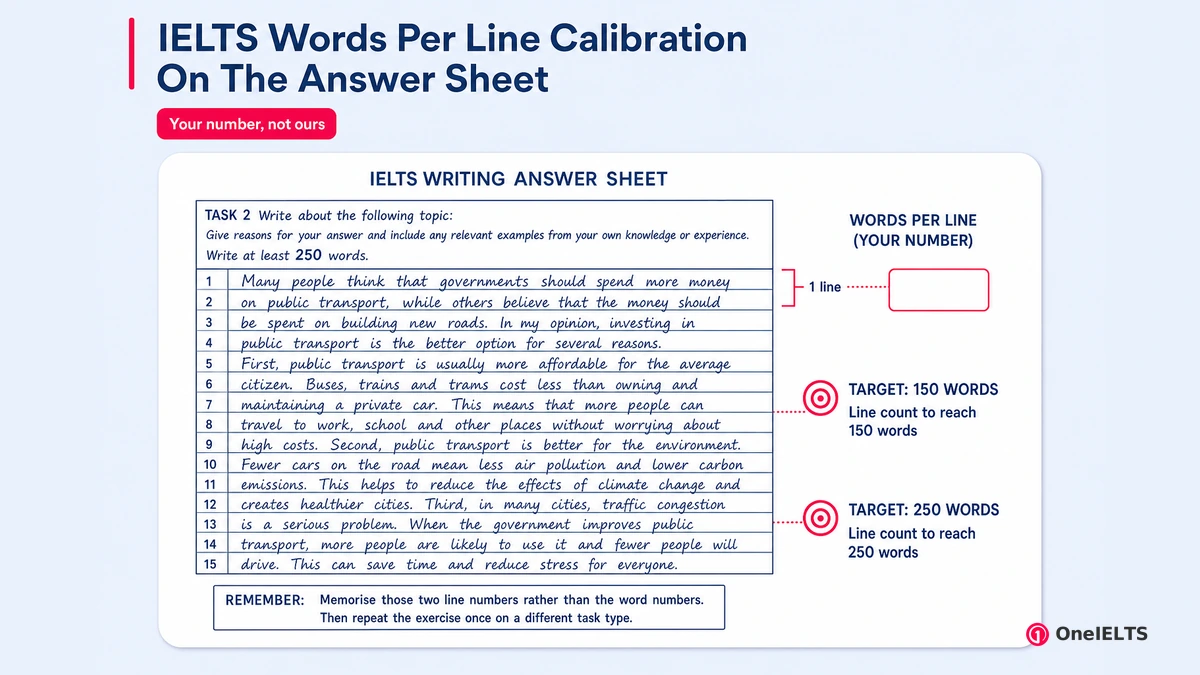
By counting lines, not words. Line counting is what all three sources that address it recommend, which is worth saying out loud on a page where the sources agree about very little.
IELTS Liz writes that you do not have time to count each word you have written, so you should count the lines instead. Magoosh calls word-by-word counting probably not worth it, since your time is better spent drafting a well-written essay. E2Language goes further, saying that on test day you should not need to count your words to know how close you are.
IELTS Liz adds one practical note: you do not need to write the word count at the bottom of your essay.
Then the gap, and it is the most concrete unmet need on this search. Three pages tell you to count lines and not one says how many words a line holds. The reason is handwriting variance, which is also why the unpublished figure has to be yours and can be produced in a single sitting.
E2Language frames the answer sheet calibration case best.
If you prepare for the paper-delivered test by typing or by handwriting onto your notebook or scrap paper, you won’t know what 150 or 250 words look like on test day.
you might be used to writing 1 full A4 page but when you write on the official test paper, this could become 2.5 pages.
The section below turns that into a method you run once.
How Do You Count Words by Counting Lines?
Nobody can hand you a words per line figure, because it depends on the size of your handwriting. You make your own, once, and remember it.
- Print the official IELTS answer sheet, which is E2Language’s own instruction.
- Write one full timed answer on it, by hand, at your normal exam speed.
- Count the words once, properly, using the rules from this page, then divide by the number of lines you used. That is your personal figure.
- Work out the two line counts that matter: 150 divided by your figure, and 250 divided by your figure.
Memorise those two line numbers rather than the word numbers. Then repeat the exercise once on a different task type, because a Task 1 data description and a Task 2 essay do not produce the same task density on the page.
IELTS Liz names the failure mode this line target replaces. Never count all words, word by word. Count lines instead and multiply by the average number of words on a line, as a quick estimate.
How the rest of the exam hour gets budgeted belongs to the IELTS writing tips page.
Does the Computer Count Words for You?
Yes on the computer-delivered test. Magoosh is the one captured page that states it in an article, writing that if you are taking the IELTS exam on a computer then the computer will count your words for you.
The sourcing gap around that answer is worth recording. The related searches on this very query ask “Is there a word count in IELTS writing computer based” by name, and the exam board’s own Writing format page says nothing about it. IELTS Liz confirms the on-screen counter only in a comment reply rather than in either of her two ranking articles.
One article page in six answers a question Google itself is suggesting.
On the computer delivered test, the counter removes the arithmetic and not the judgement. Magoosh attaches the caveat itself, recommending you still practise these tasks so you get a feel for each essay length.
On the paper delivered test there is no counter at all, which is the whole reason the line-calibration method above exists. The board adds one paper-specific warning that appears nowhere else, noting that a very long answer means you may also produce handwriting which is unclear.
This page states what the captured sources state, and on this particular point the exam board is not among them.
What Happens If You Write Under the Word Count?
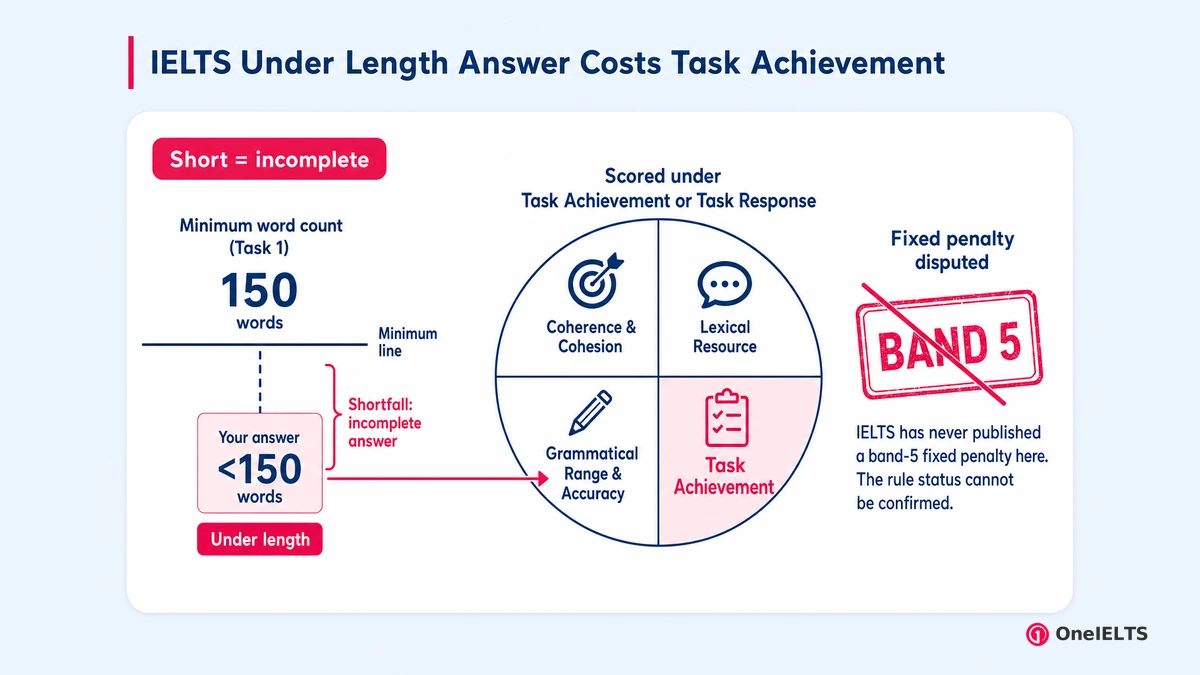
You are penalised, and the board is unambiguous about the direction if not the amount. Its wording is the same for both tasks: you must write at least 150 words and will be penalised if your answer is too short.
Read the grammar of that carefully. The board uses the verb penalised eight times across the page and the noun penalty never, and it attaches the criterion consequence to a criterion rather than to a band.
Task achievement (in Task 1) and Task response (in Task 2) assess how accurately, appropriately and relevantly your response covers the task requirements, using the minimum of 150 words for Task 1 and 250 words for Task 2.
Two ranking pages then argue about a rule the board has never published here. IELTS Liz writes that there used to be a fixed penalty of band 5 in Task Response for going under, and that this rule has now been removed. She qualifies it herself, writing that you will get no fixed penalty but that a short essay under 250 words will definitely impact your score, and not in a good way.
Magoosh takes the opposite side. It writes that IELTS has not announced they will eliminate the word count penalty. Some teachers say you can write slightly under without being penalised, it adds, and it does not believe that is worth the risk.
The resolution is available because the board is on the page. Neither source cites anything, the board has never published a band-5 fixed penalty here, and what it does publish makes the argument beside the point. An under length answer is an incomplete answer, and incompleteness is scored under Task Achievement or Task Response whether or not a fixed floor exists.
The development ladder IELTS Liz quotes shows the mechanism at work. Band 5 ideas are limited and not sufficiently developed, and band 6 ideas might be inadequately developed. Band 7 extends main ideas, band 8 presents a well-developed response with extended ideas, and band 9 fully extends them.
Under-length is a timing failure before it is a rules failure, and a timed Writing mock test is where you find out which one you have.
Did IELTS Remove the Band 5 Word Count Penalty?
One widely-read page says yes and another says no, and the exam board has not published the rule on the page that ranks for this question. The rule status cannot be confirmed from the sources on this search.
What can be confirmed comes from the board itself. You will be penalised if your answer is too short, and the assessment of task coverage sits inside Task Achievement and Task Response. Those two confirmable facts are the whole of the published record here.
The practical consequence needs neither side to win. Whether the mechanism is a fixed floor or a descriptor match, the same action follows: clear the minimum. The published descriptor wording sits on the IELTS writing band descriptors page.
Which Word Count Limits Do Candidates Invent?
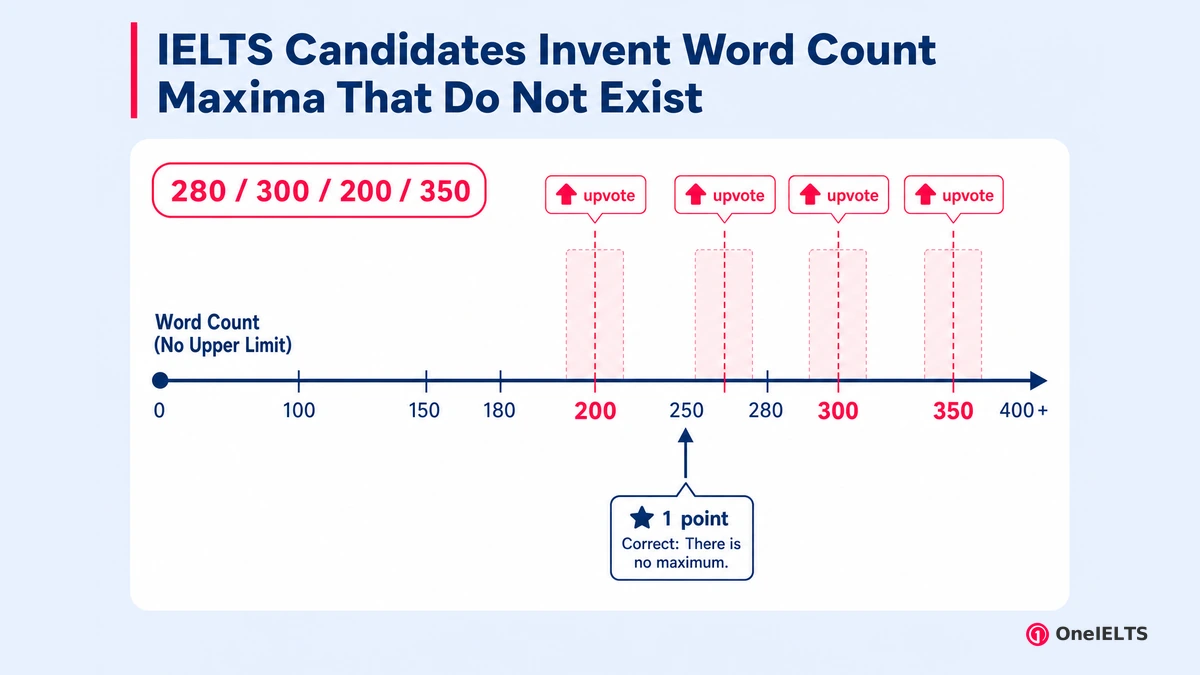
Four maxima that do not exist: 280, 300, 200 and 350. Three r/IELTS threads rank on page one for this query, and between them candidates and even a paid instructor assert all four. The exam board says there is no maximum.
- You are advised to write at least 250 words and not more than 280 words, sitting at plus two and never rebutted inside its own thread.
- An IELTS instructor of mine has a rule, that is you should never exceed 20% of the 250 word limit for task 2, which the poster reports from a paid instructor as meaning every essay stays under 300 words.
- Task 1: Ideally 180, Max 200. Task 2: Ideally 300, Max 350 — the top comment of its thread, posted by an unflaired account. Two sentences later the same account writes that if it takes you 400 words to drive your point then go for it, and that he wrote 400 words himself.
- The recommended 150-180 words for Task 1, which converts the board’s floor into a band with an implied ceiling.
The root cause is a vocabulary error rather than a knowledge error. Across those threads the limit vocabulary wins: word limit appears four times against minimum three. Calling a floor a limit produces a ceiling that was never there.
Then the upvote inversion, which is the sharpest single observation in the capture. The two answers in those threads that match the board exactly both came from flaired teachers and both sit at one point, while the invented maxima are the top comments.
One of the correct ones reads: there is no upper word count, and you will not be penalised for writing more than the required number of words. Correct and boring loses to specific and wrong, which is why a candidate reading those threads comes away believing in a ceiling.
Be fair to the threads, though, because their instinct is sound. A long answer does carry more error surface and leaves less checking time, which is precisely what the board itself says. What they got wrong was the mechanism, not the caution.
Which Word Count Advice on Reddit Is Wrong?
Two claims, and one piece of peer advice worth keeping.
Wrong: that an examiner might not read a long answer. The same thread corrected it twice. One reply states that examiners must read the full essay whether they like it or not, and another that not reading the full essay is a misconduct which could result in a penalty. That examiner obligation claim was downvoted to minus six, so the community correction here polices mechanism claims hard.
Wrong: the invented maxima covered in the section above, all four of them.
Worth keeping, and it is the most original idea in the whole capture. One commenter separates typed versus load-bearing words, writing that a lot of essays he reads run to about 360 words while their real word count is around 265 to 270 because of lengthy language. He pairs Children can benefit from computer-based games against a wordier version of the same idea.
That comment scored zero points and appears on no publisher page on this search.
One note on the numbers in those threads. Every band score there is among the unverified self-reports, including one candidate’s account of writing 250 and 350 words and scoring 8 overall. His Writing band was 7.0, the lowest of his four, and nobody in the thread remarked on it.
Which Word Count Should You Actually Target?
The exam board publishes no target at all. Every figure here belongs to a teacher or a vendor, and each one is named rather than blended into a range.
For Task 1, IELTS Liz recommends aiming for between 170 and 190 words, trying not to go over 200, with a maximum of 210 for complicated charts. Magoosh says to target 175 words. The AI Overview says to aim for 160 to 180.
For Task 2, IELTS Liz recommends between 270 and 290 words, trying not to go over 300, and repeats it on her second page as around 270 to 290. The AI Overview says 270 to 320. A word-counter tool says high scoring essays usually have 270 to 320 words, and gives no source at all, which is what the unattributed figures problem looks like in practice.
Magoosh contradicts itself here and it is worth flagging. It states that you should target 175 words for Task 1 and 250 words for Task 2, then later on the same page says the Task 2 count you should aim for is 275. Its first figure is the bare minimum its own advice tells you not to write to.
The reading this page offers is that the recommended targets converge more than they look. Every Task 1 recommendation sits between 160 and 190. Every Task 2 recommendation starts at 270.
The disagreement is entirely about the ceiling, which is the one part nobody has authority over because no ceiling exists. Converging ranges at the bottom and noise at the top is the actual shape of the published advice.
IELTS Liz supplies the only paragraph budget in the capture, and it is what a target means in practice. The introduction runs about 40 to 50 words. Two body paragraphs come to about 95 words each, or about 65 words each if you write three. The conclusion takes about 30 to 40 words.
How Do You Practise Hitting the Word Count?
Three moves, and only the first produces a number no article can give you.
Move one is the line calibration drill. Run it once on the official answer sheet and write your two line numbers somewhere you will actually find them again.
Move two is the blind count. Write one full timed answer without counting anything, then count it properly using the rules above. The gap between what you thought you wrote and what you wrote is the thing worth knowing.
Move three depends on your test mode. On computer, build the counter habit of practising with it visible so you learn to ignore it until the end. On paper, practise on the official answer sheet rather than on notebook paper, because the line width is not the same.
The order is deliberate. The counting rules matter far less than knowing what your own 250 words look like, and only one of those two can be read off a page.
Real prompts to run all three on are at IELTS Writing practice. Practising needs a free OneIELTS account. The grid is browsable when you are logged out, and opening a set is what requires signing in.
The minimum is a floor you have to clear, and everything above it is a decision about time rather than about rules.
Written by Jamil Ahmed, reviewed 14 August 2026.
Last verified: 14 August 2026
Practice for the Real IELTS Exam
Apply what you’ve learned with free, exam-style practice:
- Take a free IELTS mock test — all four skills, real exam timing, AI band scoring
- Sit a Writing section mock — Task 1 and Task 2 in one timed hour with a band estimate
- Practise by question type — self-paced Writing sets with model answers