


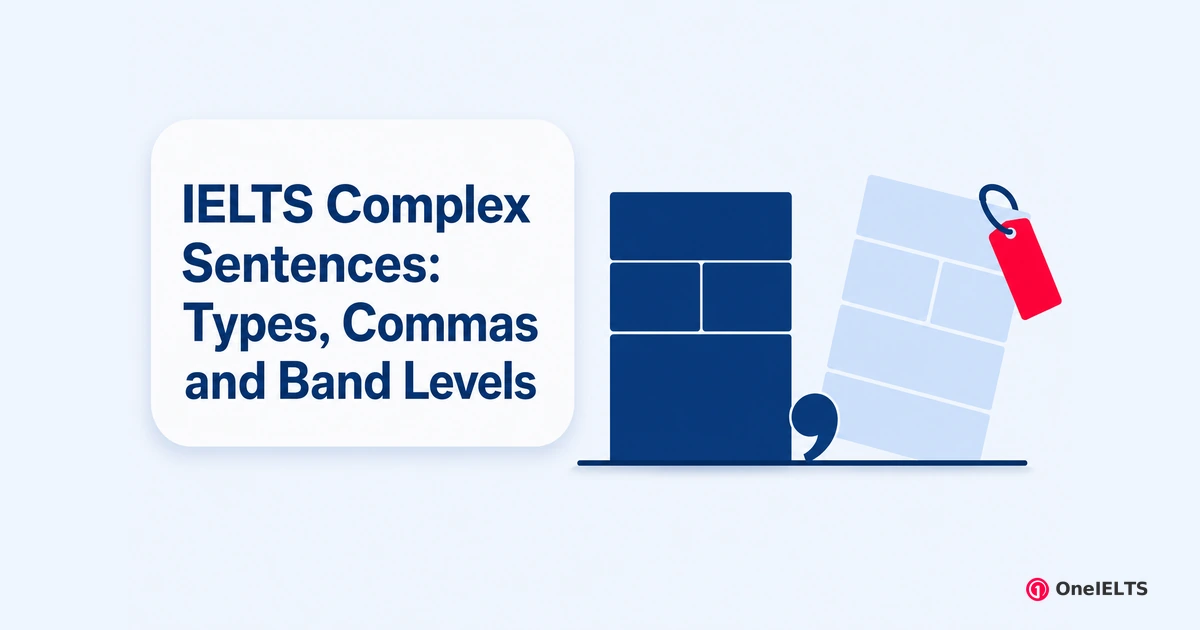
Most advice on this search sells length. The band descriptors reward accuracy, and two pages in nine say so out loud. A complex sentence is one independent clause plus a subordinate clause, and that clause structure decides a quarter of your Writing mark.
This guide covers the definition, the compound sentence it gets confused with, and how to build one. Then the four shapes, ten examples, comma placement, the band ladder, and whether every sentence needs to be complex. It closes on Task 1, Task 2, Speaking and practice, with the accuracy cost of a long wrong sentence named at every step.
What Is a Complex Sentence?
A complex sentence is one independent clause joined to at least one dependent clause — one idea that could stand alone as a sentence, attached to one that could not.
The test owner draws the line at the dependent half. A dependent clause contains a subject and a verb but does not make sense on its own. IDP adds the condition most grammar summaries leave out: the two clauses need a related meaning. Joining two unconnected facts with although produces a sentence that is grammatical and confusing at the same time.
Now the belief the rest of this page argues against. Complex does not mean long. IELTS Jonathan puts it plainly: complex sentences required for a higher band score do not need to be long and complicated, because they are simply two or more clauses. A short example proves it, since Because rents rose, students moved out runs to six words, carries two clauses, and is complex.
The length myth costs candidates more marks than any structure they never learned. What follows is the shapes those clauses take, where the comma goes, what each band actually asks for, and when not to use one at all.
What Is a Clause?
A clause is a group of words built around one verb that has its own subject. Count the verbs carrying subjects and you have counted the clauses.
IELTSdeal supplies the only diagnostic in the nine pages captured for this topic: if there are three clauses in a sentence, there are three subjects and three finite verbs. That subject pairing is the whole test. Run it over your own writing and the clause count stops being a guess.
One distinction decides everything after this. A clause capable of standing alone is independent, a clause that cannot is dependent, and a subordinator such as because, although, if or which is what makes it dependent. The handoff for the rest of the Writing test is the IELTS Writing pillar.
What Is a Compound Sentence?
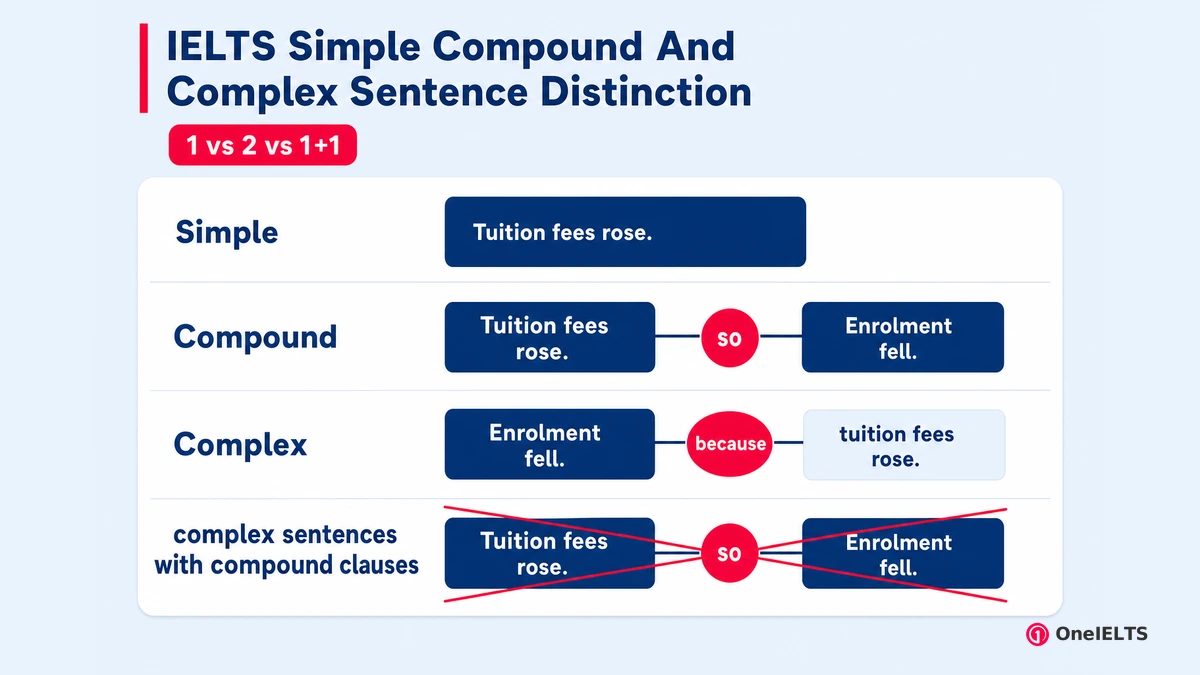
A compound sentence joins two independent clauses with and, but, or, so, for, nor or yet, and it is not a complex sentence whatever some pages on this topic tell you.
The three-way distinction is short enough to memorise. A simple sentence has one clause: Tuition fees rose. A compound sentence has two independent clauses and a coordinating conjunction between them: Tuition fees rose, so enrolment fell. A complex sentence pairs an independent clause with a dependent one: Enrolment fell because tuition fees rose.
Two test-owner pages in this capture get that wrong. Both list “complex sentences with compound clauses” as a type of complex sentence and then describe two independent clauses joined by a coordinating conjunction. The two articles are byte-identical, so the same published error sits on two domains. A candidate who follows that list writes compound sentences believing they are complex, and the band descriptors treat the two differently.
The band consequence is stated on one page only. IELTS Jonathan is blunt about the floor: an essay built entirely from simple sentences lands at band 5 or 6, and compound sentences do not lift it on their own.
IELTSdeal adds a mnemonic worth keeping, in its own idiosyncratic spelling. A subordinate clause never starts with one of the FANBOYES coordinating conjunctions.
How Do You Make a Complex Sentence?
Write the two ideas as two short sentences first, then decide which one is the point. The other one takes the subordinator. Four steps turn any pair of simple sentences into one controlled complex sentence.
- Write both ideas as two short sentences with no conjunction between them, so you can see exactly what each clause is claiming.
- Decide which of the two carries your main point, because that idea stays independent and everything else in the sentence bends around it.
- Choose the relationship between them, which will be reason, contrast, condition or time, and pick one subordinator that carries that exact relationship.
- Attach the subordinator to the supporting idea, never to the main point, then join the two clauses and check the comma against clause order.
Step 4 is where marks are won and lost. The clause carrying the subordinator becomes background information, so subordinator attachment on the wrong idea quietly reverses your emphasis.
Although the scheme cut emissions, it cost too much argues against the scheme. Although it cost too much, the scheme cut emissions argues for it. Same two facts, opposite position, and no captured source on this SERP states the rule.
IDP publishes the drill that trains it. Practise sentence combining by taking simple sentences you have already written and joining them with a conjunction. Notice what that is. It is a rewriting drill rather than a composing drill, which is why it survives exam pressure, because you edit sentences that already exist instead of inventing a structure at speed.
One error from the same test owner’s quiz deserves naming. Too many conjunctions in one sentence is an error, so if although is already showing the contrast, but has to go.
Which Conjunctions Join Two Clauses?
Subordinating conjunctions build complex sentences and coordinating conjunctions build compound ones, and that choice decides the sentence type rather than the meaning.
IDP sorts the subordinating set by relationship group, and four groups cover almost everything IELTS asks of you. Reason takes because and since. Contrast takes although and whereas. Condition takes if and unless. Time takes when and until.
One grammar point belongs here rather than on the word list. The following structure is fixed by the conjunction, so although takes a clause while despite takes a noun or an -ing form, which makes the choice grammatical before it is stylistic. The handoff for the full function-by-function list is the linking words for IELTS page.
What Are the Types of Complex Sentence?
Four shapes are worth learning: adverbial, relative, noun-clause and conditional. This search will offer you at least three incompatible lists instead.
An adverbial clause answers why, when or in spite of what: Because the data covers only two years, the trend is weak. A relative clause adds information about a noun using who, which or that: Students who work part-time report more stress. A noun clause does the job of a subject or an object: What the chart shows is a steady decline. A conditional clause sets a condition with if: If fees keep rising, applications will fall.
The same test owner publishes two incompatible taxonomy sets. Its global article classifies by meaning, giving cause and effect, contrast, condition and time. Its Australia and India articles classify by structure, giving subordinate, relative, compound and fusion. A reader who checks two IDP pages gets two answers, and the overlap between the two lists is close to nothing.
The blind spots are identical across all nine captured pages. Participle clauses appear on none of them, comma splices on none, run-on sentences on none, and compound-complex sentences only as a “Next:” link. The participle clause is the one a candidate actually needs, because it is the shortest way to add a second idea to a sentence.
IELTS Buddy names the failure this narrowness produces. Candidates focus heavily on adverbial clauses, and examiners want a variety of complex structures rather than one shape repeated.
What Are Relative Clauses?
A relative clause adds information about a noun and opens with who, which or that. The comma decides whether that information is essential or extra.
A defining clause identifies which one you mean and takes no commas, because it carries essential information: The countries that introduced the levy saw emissions fall. A non-defining clause adds detail about something already identified and sits inside commas: The northern region, which introduced the levy first, saw emissions fall. IDP sets the rule the same way, with commas when the information is non-essential and none when it identifies which one you mean.
There is a shortening move no captured source makes. A relative clause can often drop its relative pronoun and its verb to become a participle phrase, and the passive participle is the commonest form of that in Task 1. The handoff for the form itself is the passive voice in IELTS writing page.
What Are 10 Examples of Complex Sentences?
Here are ten, two for each of the five relationships that recur in IELTS answers. Ten patterns matter more than ten sentences.
The demand for this is unusually explicit. Google’s live People-also-ask asks for ten examples. Two of its related searches ask for ten and for twenty, and the second-rung queries ask for ten and for five. The nine captured pages name between zero and six types between them. Each item marks its comma position, because that is the half of the pattern most lists leave out.
- Reason, comma: Because the new rail line opened, commuting times in the northern suburbs fell sharply.
- Reason, no comma: Enrolment in evening courses rose since employers began paying the tuition fees themselves.
- Contrast, comma: Although the scheme reduced traffic, it cost far more than the council had planned.
- Contrast, no comma: Recycling rates improved steadily whereas landfill use stayed almost flat across the same decade.
- Condition, comma: If governments subsidise public transport, car ownership in large cities usually falls within five years.
- Condition, no comma: Air quality will not improve unless older diesel vehicles are removed from city centres.
- Time, comma: When the survey period ended, participation had already dropped for three consecutive years.
- Time, no comma: Household water use kept climbing until the metering scheme reached every district in the region.
- Relative, defining, no commas: Students who complete a placement year report higher starting salaries than their classmates do.
- Relative, non-defining, commas: The northern region, which introduced the levy first, saw its emissions fall over the decade.
Each one is a short example on an IELTS-plausible subject, kept deliberately under twenty words. Do not memorise the sentences. Memorise the five shapes underneath them, because a memorised sentence is detectable in an exam script and a shape is not.
The rule for this list is shape not sentence, which is IELTS Jonathan’s point in substance when he tells candidates not to take structures from the internet and drop them into essays. Across the nine pages captured here the same handful of example sentences recur almost word for word, and that is precisely why a memorised structure gets noticed.
Where Does the Comma Go in a Complex Sentence?
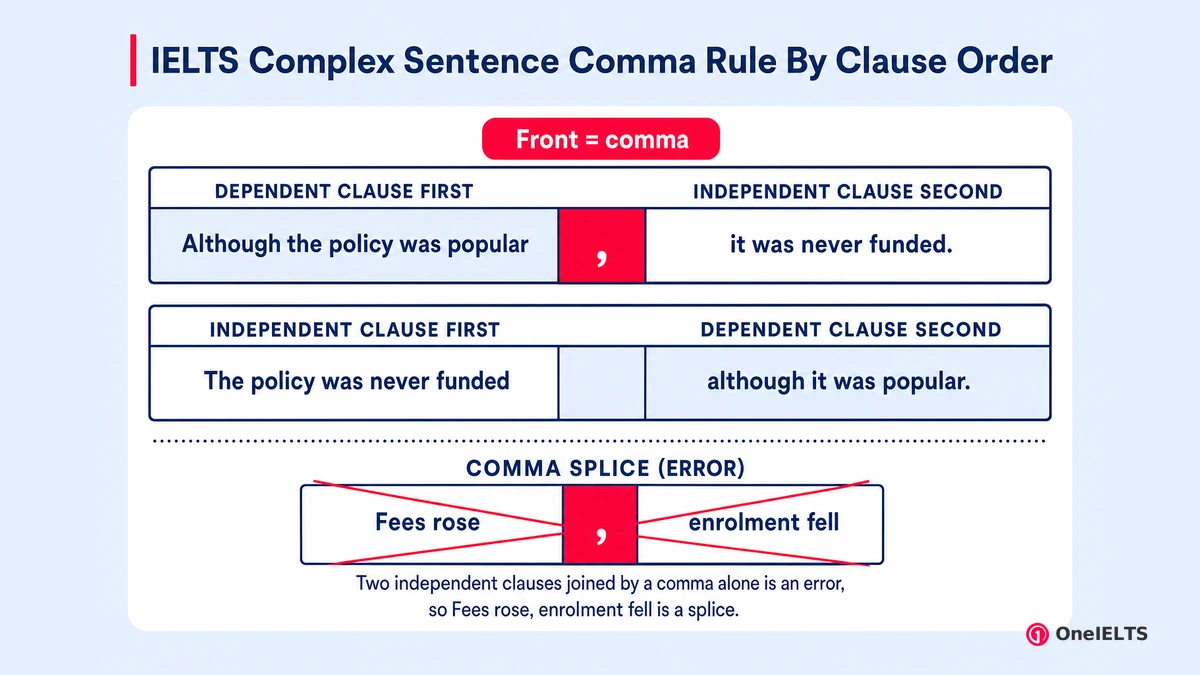
Use a comma when the dependent clause comes first, and no comma when it comes second. That one rule about clause order covers most complex sentences you will write in the test.
Two mirrored examples show it. A leading clause takes the comma: Although the policy was popular, it was never funded. A trailing clause takes none: The policy was never funded although it was popular. Same content, order swapped, comma present and then absent. IDP’s global article and IELTS Online Tests both state the rule, and they are the only two of the nine captured pages that do.
The second rule covers relative clauses. Commas go in when the clause carries non-essential information and stay out when it identifies which one you mean. Compare My university, which opened in the 1960s, has three campuses with The university that opened in the 1960s has three campuses.
The gap here is measurable. Only two of nine captured pages give the core rule, and they are the two shortest pages in the capture. Four pages give no punctuation guidance at all. The string “comma” returns zero on four of nine, on pages that use commas correctly in every one of their own examples and never say why.
Nobody in the capture covers the comma splice, and it is the punctuation error this topic produces most. Two independent clauses joined by a comma alone is an error, so Fees rose, enrolment fell is a splice. The fix is a full stop, a semicolon, or a conjunction that earns its place. “Comma splice” and “run-on” return zero on all nine pages.
Which Band Needs Complex Sentences?
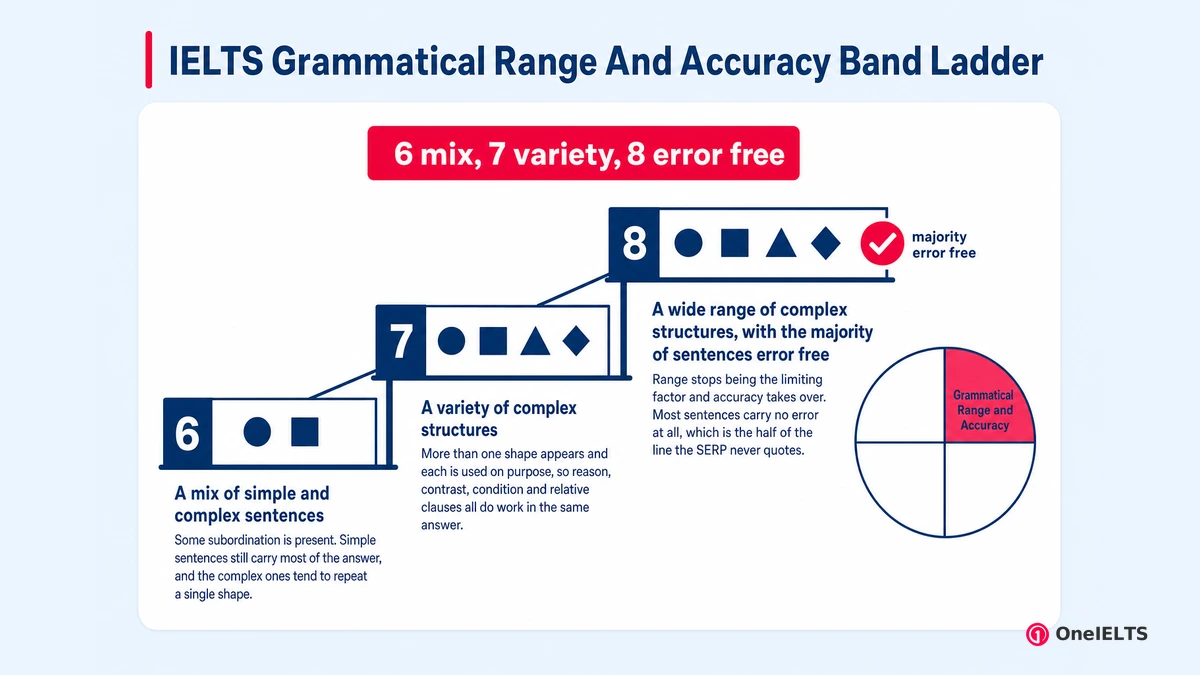
Band 6 needs a mix, band 7 needs variety, and band 8 needs a wide range plus most of your sentences error free. That last clause is the one nobody quotes.
IELTS Jonathan is the only source in the capture who publishes the ladder, and the table sets each rung against what it asks of a real script.
| Band | What the criterion asks for | What that means in practice |
|---|---|---|
| 6 | A mix of simple and complex sentences | Some subordination is present. Simple sentences still carry most of the answer, and the complex ones tend to repeat a single shape. |
| 7 | A variety of complex structures | More than one shape appears and each is used on purpose, so reason, contrast, condition and relative clauses all do work in the same answer. |
| 8 | A wide range of complex structures, with the majority of sentences error free | Range stops being the limiting factor and accuracy takes over. Most sentences carry no error at all, which is the half of the line the SERP never quotes. |
This band ladder appears on exactly one of the nine captured pages. The strings “error-free” and “error free” return zero on eight of nine, and “grammatical range” returns zero on seven of nine. The string “25%” returns zero on all nine, so not one page tells a reader that this criterion decides a quarter of the Writing mark. That criterion weighting is the context every band claim on this topic is missing.
Speaking runs the same ladder. Keith Speaking Academy quotes the descriptor directly, and a band 7 speaker uses a range of complex structures with some flexibility.
Structural variety is easy to prove in one paragraph. The error-free half of the band 8 line is not, because it can only be measured across a whole paper written to time. That is what a timed Writing mock test gives you.
Should Every Sentence Be Complex?
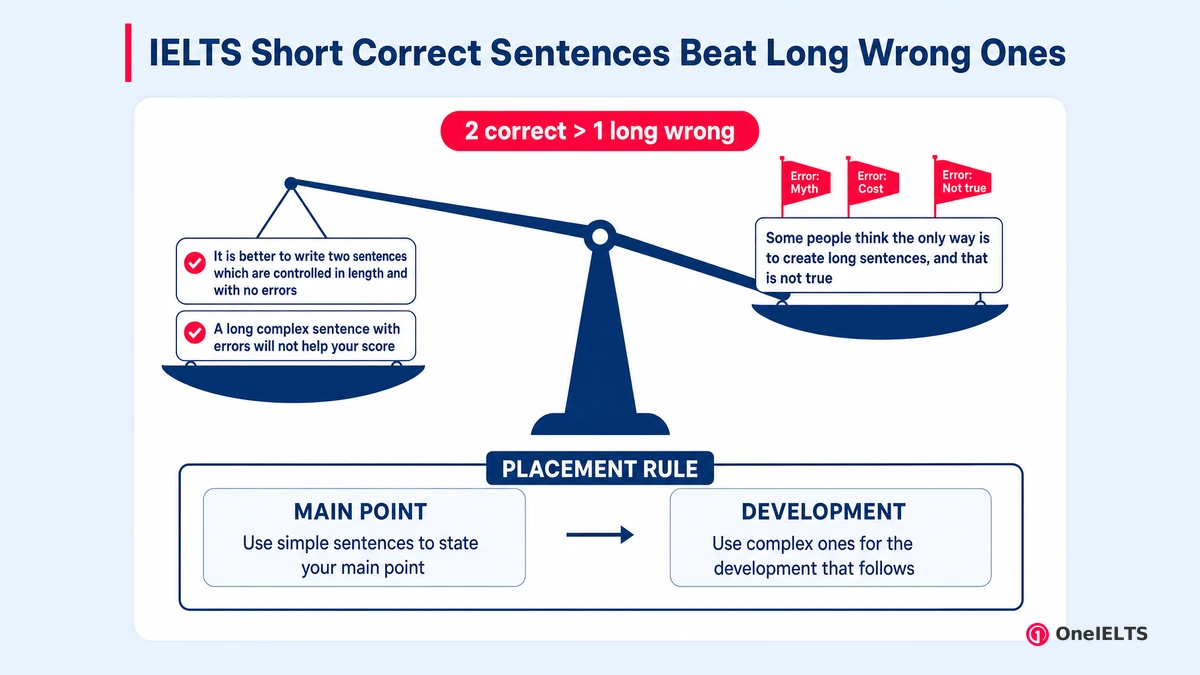
No — and the strongest published statement on this search says the opposite of what the search sells. Two short correct sentences beat one long sentence with errors.
IELTS Liz carries the section, and her wording is worth reading twice.
The more errors your sentences contain, the lower your score will be. It is better to write two sentences which are controlled in length and with no errors than one long sentence with errors.
A long complex sentence with errors will not help your score.
She names the myth as well. Some people think the only way is to create long sentences, and that is not true. The error cost is the whole argument, and controlled length is her fix for it.
IELTS Jonathan reaches the same place from the descriptors. Not all sentences need to be complex, and a good band 8 answer mixes simple and complex sentences accurately, so a confident structure you already control beats an ambitious one you do not. He also reports what he sees in student work, which is very long, grammatically weak sentences that have to be reread before they make sense.
Then the count. Only two of the nine captured pages make this argument at all. Three test-owner pages soften it to “avoid overusing them”. Four say nothing.
The uncomfortable part is checkable in ten seconds. Google’s own AI Overview on this exact search states it flatly, telling readers that short, correct sentences are better than long sentences with grammar mistakes. It assembled that from a corpus in which almost no page says it.
The practical rule is a placement rule rather than a ratio. Use simple sentences to state your main point and complex ones for the development that follows, which is IELTS Jonathan’s own division. No page publishes a ratio, because none exists.
How Do You Reduce Errors in Your Sentences?
Check the joins. Most damage in a complex sentence is a seam error, sitting at the conjunction, the comma, or the agreement across the two clauses.
IDP publishes the three checks, which are punctuation, conjunctions and subject-verb agreement. Run the agreement check last, on the verb furthest from its subject, because distance is where agreement fails. The same page tells you to leave at least five minutes of review time at the end of the Writing test, on the grounds that complex sentences are harder to construct correctly.
Clause errors belong to this page. Articles, plurals, prepositions and gerunds are four of IELTS Liz’s six error areas and they belong elsewhere. The handoff for those is the IELTS writing mistakes page.
Which Complex Sentences Suit Writing Task 1?
Time and comparison shapes fit Task 1: when, while, whereas and which, because Task 1 reports what changed and how two things differ, and it argues nothing.
Four constructions carry almost every Task 1 sentence, and each does a job the visual actually asks for.
- Time subordination for a trend across years, so one clause fixes the period while the other reports what the figure did inside it.
- Whereas and while for a contrast between two data sets, which lets one sentence carry both halves of the comparison instead of two.
- A relative clause to hold an attached figure next to the category it belongs to, which stops the number drifting away from its label.
- A participle phrase to add a second observation without a second sentence, which is the cheapest way to raise range inside a tight word count.
The set differs from Task 2’s for one reason. Task 1 gives you no position to defend, so concession and condition have almost no work to do in it. Only one of the nine captured pages has any task-level depth at all, and it is the page that never defines a complex sentence.
Which Complex Sentences Suit Writing Task 2?
Concession and condition fit Task 2: although, while, if and unless, because a Task 2 essay has to acknowledge the other side and hold its own position anyway.
Four constructions do most of the work in an argument, and each maps onto a move the essay has to make.
- A concession clause to acknowledge the opposing view inside your own sentence, so the essay answers it without surrendering a paragraph to it.
- A conditional solution with if or unless, which lets you propose a measure and state its consequence in one controlled sentence rather than two loose ones.
- A reason clause to keep attached evidence in the same sentence as the claim it supports, which is what an examiner reads as development.
- A noun clause to state what you believe without opening a new sentence, which keeps your position visible inside the argument rather than beside it.
Position placement is the rule this task makes visible. Put the concession in the dependent clause and your own position in the independent one, because the independent clause is what the reader takes away. Reversing the two concedes the argument you meant to win.
One construction, two criteria. The same sentence satisfies the range requirement under Grammatical Range and Accuracy and shows a clear position under Task Response.
Do Complex Sentences Work the Same in IELTS Speaking?
The requirement is the same and the delivery is not. In Speaking the working unit is the clause, and pauses do the job commas do in writing.
Keith Speaking Academy is the only page in nine that answers this, and its framing is worth taking literally. We do not always speak in sentences. When we speak we break speech into smaller units that are easier to use and remember, and those units are clauses.
Its instruction contradicts every other page on this search, deliberately. Do not focus on perfect writing and punctuation in Speaking, and focus on building up clauses, using pauses and intonation instead. The clause unit replaces the sentence, and pause and intonation replace the comma.
Its demonstration takes one written sentence and delivers it again as four separate spoken chunks — same content, four breaths, no punctuation involved.
The band requirement does not move. The same requirement appears in the Speaking descriptors quoted on that page, where a band 7 speaker uses a range of complex structures with some flexibility. Different delivery, identical criterion.
Two test-owner pages promise to cover Speaking and then never come back to it.
How Do You Practise Complex Sentences?
Practise joining, not inventing. Take sentences you have already written and combine them, because the pairs you produce are the only ones you will write accurately under timing.
The routine that follows is a splitting drill first and a joining drill second, which is why it works on writing you already have rather than on sentences you must invent. Five steps, run over one paragraph at a time.
- Take a paragraph you have already written and split every sentence into the shortest simple sentences it will make. Number them.
- Join them back in pairs. Each pair gets ONE relationship (reason, contrast, condition, time or relative) and one subordinator.
- Check the comma on each, since a leading dependent clause takes one and a trailing one does not. Fix any join where two conjunctions do the same work.
- Read the paragraph back. Any sentence you had to reread is wrong even if the grammar is right, and it goes back to two sentences.
- Do it again on a second paragraph, but this time write the pairs the first time and skip step 1.
Step 4 is the unusual instruction and it earns its place. The reread test catches what a grammar checker passes, because rereading is the reader’s symptom of exactly the error the band 8 line penalises. It is also the failure IELTS Jonathan reports seeing in student work, where very long and grammatically weak sentences have to be reread before they make sense.
Pair joining is deliberately a production drill rather than a recognition one. IDP runs a five-question quiz with published answers, the only interactive assessment on this search. A quiz measures whether you can spot a correct sentence, not whether you can write one under pressure.
The paragraphs for steps 1 and 5 have to come from somewhere. Your own IELTS Writing practice answers are the right source, because this drill works on Task 1 and Task 2 answers equally. Practising needs a free OneIELTS account. The grid is browsable when you are logged out, and opening a set is what requires signing in.
Written by Jamil Ahmed, reviewed 14 August 2026.
Last verified: 14 August 2026
Practice for the Real IELTS Exam
Apply what you’ve learned with free, exam-style practice:
- Take a free IELTS mock test — all four skills, real exam timing, AI band scoring
- Sit a Writing section mock — Task 1 and Task 2 in one timed hour with a band estimate
- Practise by question type — self-paced Writing sets with model answers