The dates on the chart choose your IELTS writing tenses. That is the date rule, and it settles Task 1 before you write a word. Past dates take the past simple, future dates take a future form, and a chart with no dates takes the present simple.
No test owner has ever published a tense rule. Across 2,163 words of ielts.org and British Council Academic Writing copy, the word tense appears zero times, so every verb form rule below is attributed to the teacher or site that actually published it.
This page gives the governing rule, then works each case: undated charts, projected data, processes and maps, Task 2, General Training letters, band 9 answers, whether variety raises your band, the errors, tense consistency, and practice. Source attribution is on every rule.
What Tense Should You Use in IELTS Writing?
In Task 1 the dates on the chart decide the tense, and in Task 2 the present simple carries almost everything. Google’s AI Overview is the only source in the capture that states this as a rule: the time markers on your graph, chart or map, whether years, dates or labels, dictate your choice of tense. That date-driven choice is the whole of the Task 1 decision.
Each case gets its own section below, and here is the one-line version of each.
- Dates in the past take the past simple.
- Dates in the future take a future form, usually with a passive reporting verb.
- Dates spanning both take both, switched at a paragraph break.
- No dates at all take the present simple, which is the present simple default.
- A process takes the present simple, often in the passive.
- A map takes the past simple for two labelled years, or a mix of voices.
- A Task 2 essay takes the present simple with four exceptions.
- A General Training letter takes whatever the narrative needs.
One honesty statement governs the whole page. None of those rules comes from the exam board, because the word tense does not appear once across ielts.org’s and the British Council’s Academic Writing pages. Unattributed rules are the norm on this topic, so every rule below carries the name of whoever published it.
Which Tenses Do You Actually Need for Task 1?
Three: present simple, past simple, and a future form. The present perfect and the past perfect are available and rarely needed. Those three core tenses are the working tense set, and they carry any Task 1 chart you are handed.
IELTS Master makes the claim in as many words. Getting a band 9 on Task 1 usually only requires two or three different verb tenses, and even high-level writing uses very simple tenses with simple rules. Its permission line matters as much as its band 9 claim: can you use other tenses? Of course you can, but you don’t have to.
EduBenchmark arrives at the same place from the opposite direction. It teaches all twelve tenses and then tells the reader they will likely not need half of them and can still get a high score. A page that spends two thousand words on twelve forms and then says you need fewer than six is worth reading for the second half.
The demand runs the other way, and it is worth measuring rather than dismissing. One of the four live People-also-ask questions on this search asks for the twelve tenses, and People-also-search-for asks twice for a tenses PDF. So the twelve-tense demand is real and the evidence points to three.
The section below gives the twelve for anyone who wants them, as a reference grid rather than an argument. Nothing in it changes the working set.
What Are the 12 Tenses in Grammar?
Twelve tenses come from four aspects across three times. Simple, continuous, perfect and perfect continuous each run in the past, the present and the future, and the tense grid below is drawn from EduBenchmark and IDP India, both of which publish all twelve.
| Aspect | Past | Present | Future |
|---|---|---|---|
| Simple aspect | A completed action at a past time | A habit, a general fact or a state | An action expected at a later time |
| Continuous aspect | An action in progress at a past moment | An action in progress right now | An action in progress at a future moment |
| Perfect aspect | An action completed before another past action | A past action with present relevance | An action completed before a future point |
| Perfect continuous | Duration up to a past point | Duration up to now | Duration up to a future point |
A grammar example is not a chart sentence, and the difference matters more than it sounds. IDP India’s twelve examples are all about swimming, and EduBenchmark’s are about buying a car and reading a book. None of them shows you what a Task 1 sentence looks like.
These three do, one per tense that actually carries a report. The simple aspect in the past: sales rose sharply between 2010 and 2015. The simple aspect in the present: the chart compares four countries by household income. The future: the figure is forecast to reach 40,000 by 2040.
How each tense is formed belongs to the grammar for IELTS page. This page only tells you which of them a Writing answer needs.
How Do Dates Decide Tenses in IELTS Writing?
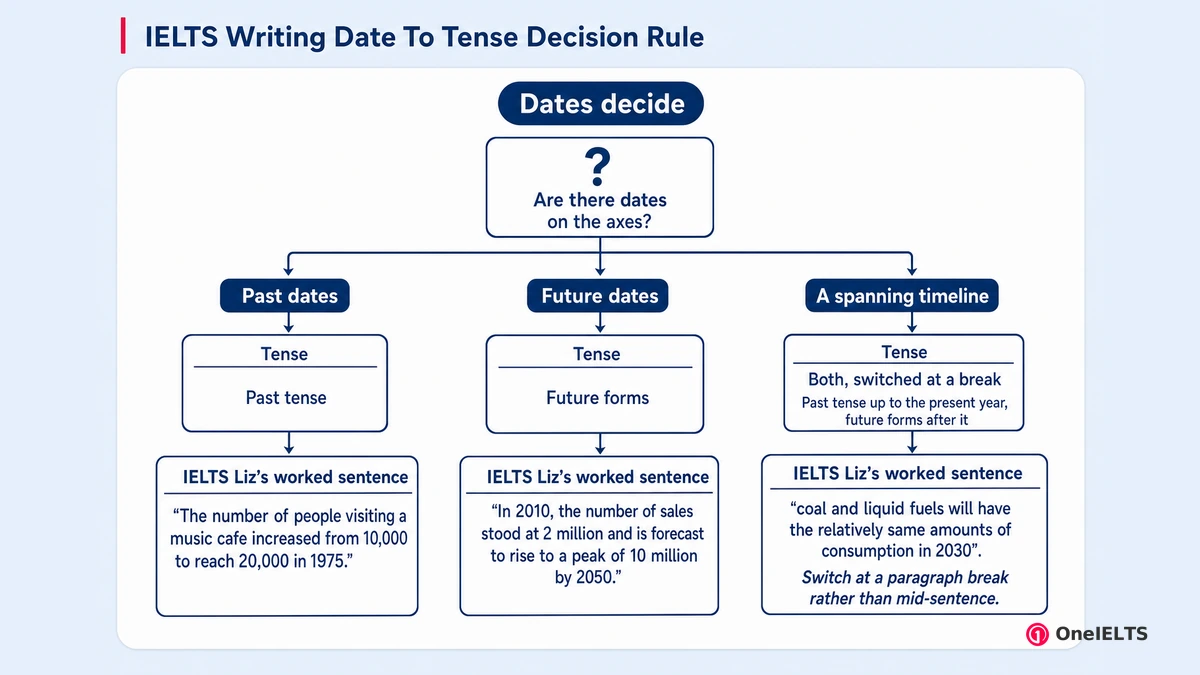
Read the axis dates first, then pick the tense. IELTS Podcast gives the procedure: look at the title and the x and y axes to see whether dates are used, and if they are, the dates tell you the tense. Three cases follow, and IELTS Liz supplies a worked sentence for each.
| What the chart shows | Tense | IELTS Liz’s worked sentence |
|---|---|---|
| Past dates | Past tense | “The number of people visiting a music cafe increased from 10,000 to reach 20,000 in 1975.” |
| Future dates | Future forms | “In 2010, the number of sales stood at 2 million and is forecast to rise to a peak of 10 million by 2050.” |
| A spanning timeline | Both, switched at a break | Past tense up to the present year, future forms after it |
IELTS Podcast phrases the cutoff differently, and the difference is useful. If the year is before the present year use the past tense, and if after, the future tense. That converts a judgement about whether a period has ended into a comparison against this year’s number.
The two sources part company on the spanning case. IELTS Liz says use both tenses and switch between them. IELTS Podcast escalates to the future perfect, which it concedes is “one of the less usual tense in English”. Its worked example: “coal and liquid fuels will have the relatively same amounts of consumption in 2030”.
This page follows IELTS Liz. Switching between two tenses you already control costs nothing, and an unfamiliar form put in for effect risks the accuracy half of the grammar criterion for no gain in meaning.
Which Tenses Does a Task 1 Overview Need?
Two, and the split is deliberate. The introduction sentence and the data sentences are not in the same tense, because they are about different things.
The chart description takes the present simple, since it describes what the chart does rather than what happened. IELTS Master’s Rule 1 says to use the present simple to write about the graphic in the introduction. Its model reads “The line graph compares three companies in terms of their waste output between the years 2000 and 2015.”
The data sentences take whatever the dates dictate. IELTS Master’s own band 9 example puts both in adjacent sentences and labels which rule each one follows, which is the clearest demonstration of the split in the capture.
Candidates trip here because a deliberate switch from present simple to past simple between the introduction and the body looks like an inconsistency. It is not one, and nothing in the marking treats it as one.
What an overview has to contain belongs to the IELTS Writing Task 1 page.
Which Writing Tenses Fit a Chart With No Dates?
Present simple. The present simple default holds on an undated chart, three sources agree on it, and this is the one case where the answer is close to settled.
IELTS Liz: “If there is no date given on your IELTS chart, graph table etc, then you will use the present tense”. IELTS Podcast: “if there is no year, use the present simple tense”. EduBenchmark reaches for “the present tense if there are no dates”. The AI Overview adds its own version, naming the present simple when there is no timeline or date.
There is one present perfect dissent, and it is worth understanding rather than dismissing. Magenta Language prescribes the present perfect for the undated case. Its grounds are that the tense is ideal for describing changes that have happened up to the present moment, especially when no specific date is mentioned. The distinction it reaches for is real: a chart showing change over an unlabelled period is not the same object as a static snapshot.
The finding that makes this case unusual is that the top-ranking page contradicts itself. IELTS Liz gives the present tense as a rule in her article. In her own comment thread on the same page she softens it. When no date is given you should use the present tense, she writes, but choosing the past tense and sticking to it throughout the whole report will be fine. The problem is mixing them.
The comment is the more useful ruling, because consistency over choice is what gets marked. This page follows it: present simple for a static snapshot, present perfect only if the chart genuinely shows change up to now, and whichever you pick, do not switch.
Two otherwise thorough pages never address the case at all. Canam and English Wise skip it, and English Wise says the tense depends on the time frame without ever naming the no-time-frame case.
Which Tenses Describe Projected Data in IELTS Writing?
A passive reporting verb plus a future form. Charts routinely project past the present year, and the sources split hard on what that requires, which makes this the sharpest tense disagreement in the capture.
The first answer is a future form. IELTS Liz gives “Dates in the Future = Future Forms” with “is forecast to rise to a peak of 10 million by 2050” and “By 2030, this number is predicted to hit 34,000”. IELTS Podcast says to use the future tense if the year is after the present year, with “by 2020 the population owning mobile phones will exceed the number with electricity by 1%”. English Wise adds “The number of online shoppers is expected to rise significantly by 2030”.
The second answer is the passive, with no future tense at all. IELTS Master’s Rule 3 says to use the passive voice often to write about processes, predictions and sometimes maps, with “The number of people that own cars is predicted to increase…”. The measurement is what makes this a real disagreement rather than a difference of emphasis: the words future and will appear zero times in that article’s body.
Both camps are describing the same sentence and naming different halves of it. Look at the quotations again. “Is forecast to rise”, “is predicted to hit” and “is expected to rise” are all passive constructions, and each one is a passive reporting verb carrying an infinitive that points forward.
So the practical rule is short. Name the projected data with a passive construction, and let the infinitive or will carry the future. That single pattern covers forecast language on every chart that crosses the present year.
The gap in the capture is worth naming. Magenta places future forms under Task 2 only and never says what to do with a forward-projecting Task 1 chart, and Canam gives the case one clause.
Which Tenses Fit Processes and Maps in IELTS Writing?
Present simple for a process, and past simple for a map with two labelled years. Both often need the passive, and the source that covers processes most closely never reconciles its own two rules.
The AI Overview states the process rule completely, and it is Google’s synthesis rather than any page’s. Always use the present simple tense, often with the passive voice, to describe steps in a mechanical or natural process, as in “Water is heated…”. Process stages take one sentence each, and no captured page puts both halves of that rule together.
IELTS Master asserts both sides in the same article without saying they fit. Rule 1 says to use present simple for processes and to use the same tense for process diagrams. Rule 3 says passives are very useful for processes because we often do not know or care who or what causes the action. Both are right. Present simple is the tense, the passive is the voice, and a present simple process sentence usually carries both at once.
Maps take mixed voice. IELTS Liz says that if you get a diagram or a map they are often a combination of passive and active voice, and her model shows it working.
“Rain is collected as it falls on the roof tops of houses. This water then passes through the drains and is eventually transferred to a water filter.”
That three-clause example contains two passives and one active, which is the actual answer rather than a rule about which to prefer.
A map comparison across two labelled years is a different case again. Both states take the past simple, with the past perfect available for the earlier one, and a reader comment on IELTS Master names exactly that as the article’s gap.
Coverage is thin. Of the ten captured competitor articles, only two mention maps at all and only one mentions processes.
Is the Passive Voice One of the Writing Tenses?
No. Voice versus tense is the whole distinction here. The passive is a voice, and every tense has an active and a passive form, which is why “is collected”, “was collected” and “will be collected” are all passive and all different tenses.
The correction is needed because one captured page gets it wrong in print. Canam publishes a list titled “Common English Tenses for IELTS” that contains the passive form and three conditionals alongside four actual tenses. Four of its eight tenses are not tenses, and that miscategorised list is the reason candidates arrive thinking the passive is something you switch into.
Whether the passive helps is the sharpest disagreement in the capture. IELTS Master makes it one of only three rules. IELTS Liz debunks it directly. Candidates have been told by some teachers that they will get a high score if they use the passive voice, she writes, and this is not true. No tense is more valuable than another, and the majority of bar charts, line graphs, tables and pie charts will unlikely use the passive voice.
They agree more than they look. IELTS Master assigns the passive to processes, predictions and maps, and those are exactly the cases IELTS Liz concedes. A forced passive on a bar chart is the thing she is warning about.
When the passive is correct, how it is formed and how to avoid overusing it belong to the IELTS writing passive voice page.
Which Tenses Work in Writing Task 2?
The present simple carries almost the whole essay. An argument is a general claim, and general claims are present simple, which makes this the present simple default in its purest form.
The AI Overview states it: present simple is the main tense for stating your opinion, general facts and universal truths, as in “Many people believe…” and “education plays a key role”.
Two competitors corroborate. Canam notes that it is very common to use the present simple tense because the candidate is instructed to write general facts and truths and give their opinions. English Wise lists “Present Simple (Most Common Tense)” for general facts and opinions, with “Technology plays an important role in modern education”.
Four exceptions carry the rest of the essay.
- Present continuous for a current trend happening now. “Cities are growing rapidly” from the AI Overview, and “Many countries are investing in renewable energy to combat climate change” from Magenta.
- Present perfect for a past development still shaping the present. “Technology has transformed communication”, and English Wise’s “In recent years, air pollution has increased significantly due to industrialization”.
- Past simple for a genuine historical example only. “In the 19th century, industrialization changed…”, and “In the 20th century, women gained voting rights in many countries”.
- Future forms for a predicted consequence. English Wise gives “If governments invest in renewable energy, pollution levels will decrease”.
Coverage on this case is thinner than it should be. EduBenchmark is the only captured page that gives a Task 2 tense rule inside a tense-focused article, and IELTS Liz’s own Task 2 page, which ranks on this very search, gives none at all.
Which Tenses Support an Opinion in Writing Task 2?
Modals and conditionals, neither of which any competitor page names. The word modal returns zero across all eleven captured competitor pages, and the only source naming modals and conditionals for Task 2 is Google’s AI Overview, which advises using them to propose hypothetical solutions or outcomes.
Modal certainty is the first tool. May, might and could mark a possible effect; should and must mark a recommendation form. One modal replaces a whole hedging clause, which is why they matter in an essay with a word budget.
The first conditional handles a real and likely consequence. English Wise: “If governments invest in renewable energy, pollution levels will decrease.”
The second conditional handles a hypothetical solution. Magenta: “If people were more aware of environmental issues, they might reduce their plastic usage.”
One caveat keeps the categories straight. Conditionals are not tenses either, and Canam lists three of them inside a list titled “Common English Tenses for IELTS”. How to state and hold a position belongs to the IELTS Writing Task 2 page.
Which Tenses Fit a General Training Letter in IELTS Writing?
As many as the story needs. General Training Task 1 is a letter rather than a report, and letter narration moves through time in a way a chart never does.
IELTS Liz supplies the only worked General Training tense list in the whole capture, with her own labels attached to the tagged examples.
- “I am writing to….” (present continuous)
- “I visited your store…” (past simple)
- “…the poor service I have received” (present perfect)
- “I hope the problem will be resolved…” (future form and future passive)
- “I had hoped that…” (past perfect)
Five different tenses in five consecutive lines of one letter is the exact opposite of the Task 1 advice, and the reason is structural rather than stylistic. A letter narrates, so it has to move.
English Wise splits it by register. The formal letter set is present simple, present perfect and past simple. The informal letter set is a mix of present, past and future, with “I have been living in Sydney for five years now, but I will be moving to Melbourne next month.”
Canam gives the loosest version, and the range of advice is itself informative. It says it is unusual to use one specific tense during letter writing, so keep moving around different tenses. That is advice with no rule attached to it.
On grammar marking, IELTS Liz notes that for the General Training test you are also marked on grammar, and that the marking is the same as Academic Task 1 except for Task Achievement. Letter structure and tone belong to the letter pages.
Which Tenses Appear in a Band 9 Writing Answer?
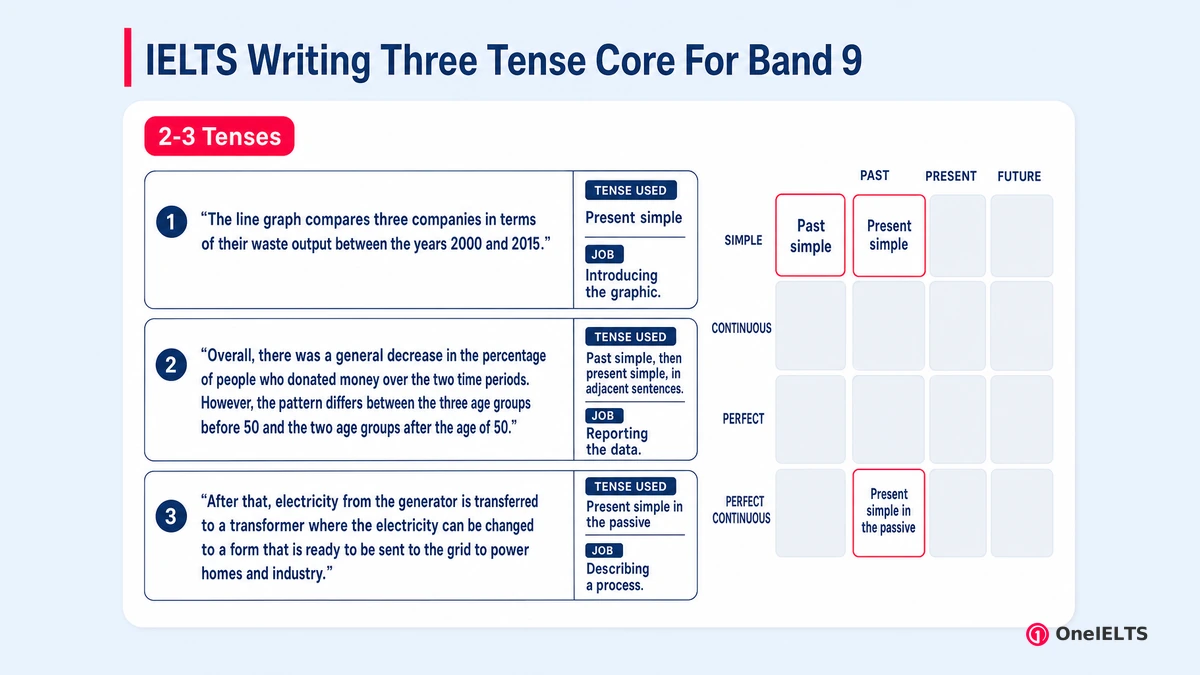
Two or three, according to the only page that puts a number on it. IELTS Master says getting a band 9 on Task 1 usually only requires two or three different verb tenses, and its worked models are the useful part of that claim.
It attributes the band 9 models to IELTS Simon and IELTS Advantage, and labels the rule each one follows.
“The line graph compares three companies in terms of their waste output between the years 2000 and 2015.”
Present simple, introducing the graphic.
“Overall, there was a general decrease in the percentage of people who donated money over the two time periods. However, the pattern differs between the three age groups before 50 and the two age groups after the age of 50.”
Past simple, then present simple, in adjacent sentences.
“After that, electricity from the generator is transferred to a transformer where the electricity can be changed to a form that is ready to be sent to the grid to power homes and industry.”
Present simple in the passive, for a process.
The model sentence limits need saying plainly. They are three sentences from an eight-year-old page, they are not published band 9 scripts from the exam board, and no page in this capture quotes a band descriptor at all. What the tense count does show is that high-scoring answers are built out of ordinary tenses used accurately, and that is as far as the evidence goes.
Does Using More Tenses Raise Your Band Score?
Not by itself. A tense you use correctly because the data required it helps you. A tense you insert to show range is a risk taken for no reason.
One source in the entire capture ties tense to the marking with a number, and it is IELTS Liz.
“Grammar counts for 25% of your marks in IELTS writing task 1 and that includes the correct use of tenses based on the information given in the task.”
She also writes that using the right tense is important in IELTS Writing Task 1 because it falls into the marking criterion of Grammar. Her Grammar criterion is described as sentence structures, tenses, grammatical range and accuracy, so tense accuracy sits inside the grammar criterion rather than being the criterion.
Her Task 2 page is the only place variety is framed as a score-raiser, saying your score will increase if you use different grammar tenses including conditionals, perfect tenses, passive voice, past and future. No example sentence is attached to that bullet, which is worth knowing before you act on it.
Four more pages make the claim with no support at all, and a reader arriving from a band-score question deserves the measurement.
IDP India says a variety of verb tenses results in a high score and names no criterion, no examiner and no descriptor anywhere on the page. Canam says a strong command of tenses is necessary for high band scores. English Wise says incorrect tenses lead to a lower band score. EduBenchmark says correct tenses are crucial to a core grammar score.
The descriptor silence closes it. The words band descriptor and band descriptors return zero on every captured page, and 25% is non-zero on exactly two, both of them IELTS Liz’s.
Those unsupported score claims are range versus risk arguments with nothing underneath them. A timed IELTS Writing mock is the only place a tense choice actually costs or earns you anything.
What Does the Exam Board Say About Writing Tenses?
Nothing. Neither ielts.org nor the British Council has published a tense rule for IELTS Writing, and the test owner silence here is measured rather than assumed.
Across 2,163 words of the two owners’ own Academic Writing pages, the word tense appears zero times. So do past simple, present simple, present perfect, past perfect, verb form, passive, modal and conditional. Those pages were fetched as absence probes precisely because neither of them ranks on this search.
One sentence is the whole of what either owner offers on the subject.
“Grammatical range and accuracy assesses the range of grammar you use and how accurately and appropriately you use it.”
That grammatical range definition never decomposes into a tense, a verb form or any named structure. Two supporting facts sharpen that measured absence. The ielts.org page names a diagram of an object, device, process or event as a Task 1 type, and attaches no tense or voice instruction to it. The British Council page names no assessment criteria at all.
What follows is not cynicism. Every tense rule on this page, including the ones this page recommends, comes from a teacher or a site rather than from the exam board. That is a reason to prefer rules that explain themselves over unattributed authority, not a reason to ignore them. The published descriptor wording belongs to the IELTS writing band descriptors page.
Which Tenses Do Candidates Get Wrong in IELTS Writing?
Six errors account for most of it, and only one captured page of ten carries an error list at all. Each one below traces to a named source.
- UNMOTIVATED SWITCHING. English Wise: “Mixing tenses incorrectly – Stick to one tense per sentence unless there’s a logical reason to change.” IELTS Podcast adds a check that you don’t accidentally change the tense half way through your essay.
- A TIME MARKER CLASH. English Wise again, on making the tense match the context, with yesterday as the example that should not appear with the present perfect.
- CONTINUOUS MISUSE FOR A GENERAL FACT. English Wise’s own fix: “Technology is improving our lives every day.” becomes “Technology improves our lives every day.”
- A FORCED PASSIVE. IELTS Liz warns that forcing it into a bar chart, line graph, table or pie chart “will probably result in an error”.
- REACHING FOR UNFAMILIAR FORMS TO SHOW RANGE. This is the future perfect case above. EduBenchmark’s warning covers it: do not try to incorporate as many tenses as possible, and focus on using them correctly and naturally.
- DESCRIBING AN UNDATED CHART IN THE PAST AND THEN DRIFTING. IELTS Liz’s comment ruling names the real fault, which is mixing them up and losing track of which tense you are using.
Notice that four of the six are consistency failures rather than knowledge failures. The candidate knew the tense and lost hold of it, which is a different problem from not knowing which one to pick.
How Do You Keep Your Tenses Consistent in a Writing Answer?
Commit once, switch on purpose, and check verbs on their own at the end. IELTS Liz’s comment ruling frames it: the examiner is not marking which tense you picked, they are marking whether you controlled it.
Four steps make tense commitment automatic under pressure.
- Before writing, read the axis labels and name the tense in your head. Name it once, then commit to it.
- Write the introduction in present simple regardless, knowing you are switching deliberately at the first data sentence.
- If the chart forces a second tense, decide the deliberate switch point before you start, usually at a paragraph boundary rather than mid-sentence.
- In the final read-through, do a verb-only read. Look at nothing but verb endings.
Step four is separate for a reason. Reading for meaning hides a mixed tense and reading for verbs exposes it, so one pass cannot cover both. The wider error list belongs to the common IELTS writing mistakes page.
How Do You Practise IELTS Writing Tenses?
Three moves, and only one of them involves writing a full answer. The decision this page is about takes seconds, so practise the decision rather than the essay.
- Take five charts and name the tense each one requires, with a one-clause reason, without writing anything else. This chart naming drill costs a minute per chart instead of twenty.
- Write one full answer, then do a verb-only reread of it. This is the step that catches the error, not the writing step.
- Do one where the chart projects into the future. That is the case the sources disagree on and the one candidates meet least often.
People-also-search-for on this query asks for tense exercises and for a PDF, so the demand is for drills. Drills on real charts beat drills on grammar sentences, because the chart is what makes the decision for you. Projected chart practice is the scarcest of the three and worth seeking out deliberately.
IELTS Writing Task 1 practice supplies the charts. Practising needs a free OneIELTS account.
The tense is not a choice you make. It is a fact the chart already contains.
Written by Jamil Ahmed, reviewed 14 August 2026.
Last verified: 14 August 2026
Practice for the Real IELTS Exam
Apply what you’ve learned with free, exam-style practice:
- Take a free IELTS mock test — all four skills, real exam timing, AI band scoring
- Sit a Writing section mock — Task 1 and Task 2 in one timed hour with a band estimate
- Practise by question type — self-paced Writing sets with model answers