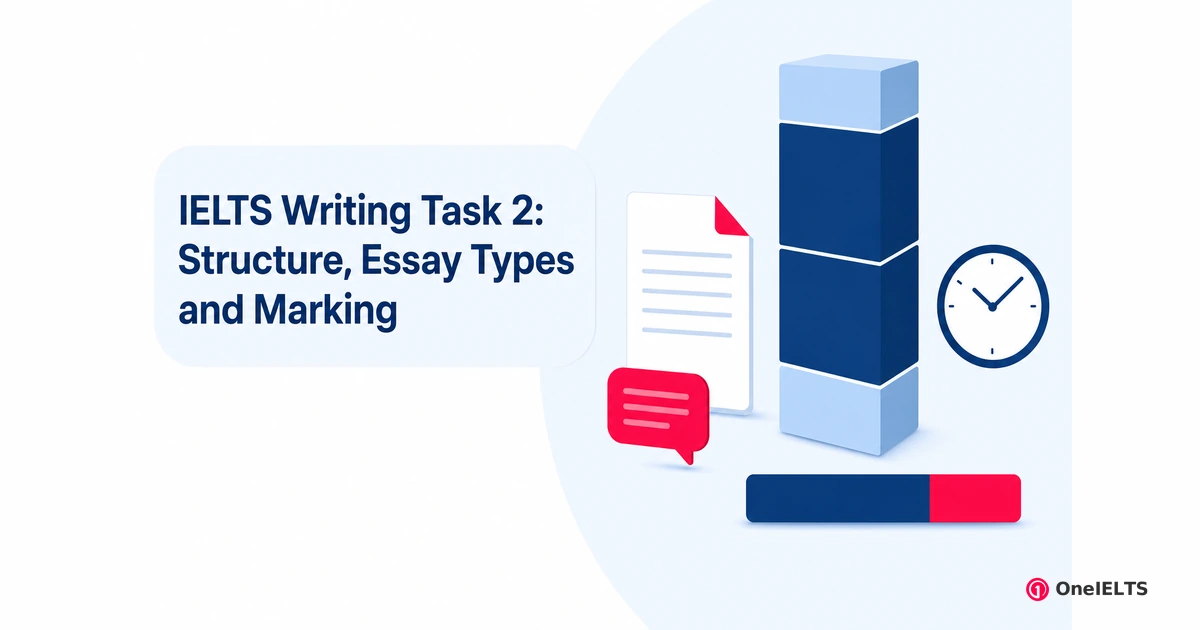
IELTS Writing Task 2 asks you to answer a point of view, an argument or a problem in a formal essay, and it is the same task in the Academic and General Training papers. Two figures govern it: a 250-word minimum, and a 40-minute allowance inside the 60-minute paper.
One number reframes the whole Writing test and four of the seven ranking guides never mention it. Task 2 contributes twice as much as Task 1, so it carries the two-thirds Writing weighting on its own.
This page covers the word floor, the five essay types, the essay structure, and taking a position under Task Response. Then building a body paragraph in a formal register, the marking criteria, band 6 to band 8, the topics, planning, task order, the tips, and practice.
What Is IELTS Writing Task 2?
IELTS Writing Task 2 is the second and larger of the two compulsory Writing tasks. It asks you to respond to a point of view, an argument or a problem in a formal essay of at least 250 words.
Four facts define it and nothing else does. It is a compulsory second task. It is an essay rather than a report. It is identical in both papers, so only the Task 1 half of the Writing test differs between Academic and General Training. And it is worth twice what Task 1 is worth.
That third fact gets asked as an FAQ on a ranking page, which is why it belongs here rather than three sections down. A General Training candidate and an Academic candidate sit the same Task 2 prompt type under the same rules.
The test owner states what the task tests in one sentence.
“This task tests if you can write a clear, relevant, well-organised argument, giving evidence or examples to support your ideas.”
A point of view or problem is what arrives, and a supported argument is what you hand back. The sections below take the rules, the shapes and the marking in that order.
How Many Words Must You Write in Task 2, and How Long Do You Get?
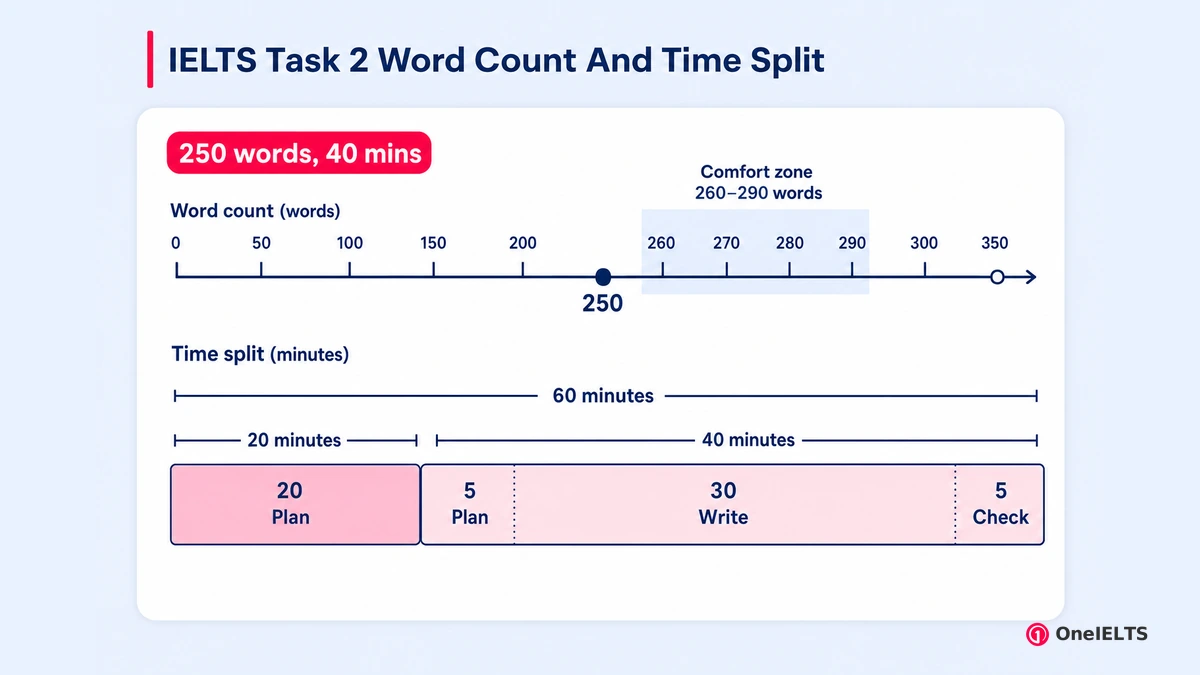
At least 250 words, in about 40 minutes of the 60-minute Writing paper. There is no maximum.
The 250-word minimum is strict, and a ranking page asks exactly how strict as an FAQ. The exam board answers it.
“You must write at least 250 words and will be penalised if your answer is too short.”
That is a Task Response penalty, and Task Response is a quarter of the essay score before the examiner weighs anything you argued.
There is no upper word limit. The board writes “While you will not be penalised for writing more than 250 words”, and the same sentence names the costs, which are real and are not marks. You may not have checking time left for correcting, and some ideas may not be directly relevant to the question. It adds a third in the same passage: handwriting that becomes unclear.
Relevance drift is the one worth fearing. A 340-word essay usually contains a paragraph that answers a nearby question rather than the one printed.
Aim for 260 to 290 words. That clears the floor comfortably and still leaves five minutes of checking inside the 40. Nobody counts your words in the exam room, so learn how many lines of your own handwriting make 250 and use line counting on the day.
One published FAQ deserves an uncomfortable answer. An unfinished essay is marked as written, and a missing conclusion costs you under Coherence and Cohesion as well as Task Response.
Which Essay Types Can Appear in IELTS Writing Task 2?
Five: opinion, discussion, advantages and disadvantages, causes and solutions, and the two-part question. Each is identified by its prompt instruction wording rather than by its topic.
- Opinion essay. The prompt asks how far you agree, so the essay must take one position and hold it throughout.
- Discussion essay. The prompt gives two views and asks you to discuss both, usually plus your own opinion.
- Advantages and disadvantages. The prompt asks whether the benefits outweigh the drawbacks, or simply to discuss both.
- Causes and solutions. The prompt names a problem and asks for its reasons and for remedies to it.
- Two-part question. The prompt asks two direct questions and both of them have to be answered.
One count discrepancy is worth knowing about. A test-owner article on this search result enumerates three essay types rather than five, so a candidate comparing two pages can come away with either number. Five is what the majority of ranking pages agree on, and the essay types page carries the full breakdown.
Identifying the type is the first thing you do with the prompt, and it belongs at hub level for one reason. The type decides the position you take and the shape of the two body paragraphs, so getting it wrong costs you under Task Response before you have written a word.
How Should You Structure an IELTS Writing Task 2 Essay?
Four paragraphs as the default: introduction, two body paragraphs, conclusion. A fifth paragraph earns its place only when the prompt genuinely asks for a third idea. Here is what each paragraph carries and roughly how long it runs.
- Introduction. Give the paraphrased prompt in one sentence, then state your position or say what the essay will do, in about 40 to 50 words.
- Body paragraph 1. One main idea, stated in a topic sentence, then explained and then illustrated, in about 90 to 110 words.
- Body paragraph 2. A second and genuinely different main idea, built the same way, in about 90 to 110 words.
- Conclusion. Restate the position in different words and add nothing new, in about 30 to 40 words.
The four-or-five-paragraph question gets published as an FAQ and never plainly answered, so here is the plain version. Four is the safe default. Five helps only when the extra paragraph carries a distinct idea rather than a padded restatement, and inside 40 minutes a fifth paragraph usually produces three thin paragraphs instead of two developed ones.
Task 2 does take a conclusion paragraph, unlike Task 1. That is the one structural difference between the two halves of the paper that candidates most often get backwards. Paragraph length matters less than the count, though a body paragraph under seventy words rarely develops anything.
What the four-paragraph essay does not decide is the order and content of those two body paragraphs. That changes with the essay type, which is what the essay-types page is for.
How Do You Present a Clear Position in a Task 2 Essay?
State your position in the introduction, keep it in both body paragraphs, and restate it in the conclusion. Three appearances, no position drift.
The word position does a lot of unexamined work on competitor pages, so define it. A clear position is the answer to the exact question the prompt asks, in one sentence, using words a reader could disagree with. “There are advantages and disadvantages” is not a position, because nobody could argue with it.
Four ways it fails, and each one is visible from the outside.
- No position at all. The essay describes both sides and never answers the question it was given.
- A position that appears only in the conclusion, after two carefully neutral body paragraphs.
- A position that changes between paragraph two and paragraph three without acknowledging the shift.
- A position that answers a question the prompt did not actually ask.
Task Response is the criterion this reaches, and it is the one that caps an otherwise fluent essay at band 6. Topic sentence alignment is the cheapest defence: if each topic sentence supports the position in the introduction, drift becomes almost impossible.
The test owner’s own first step adds a point the rest of this search result under-weights. A two-part prompt with only one part answered scores under Task Response no matter how good the prose is. Count the questions in the prompt before you plan.
How Do You Develop a Body Paragraph in Task 2?
One idea per paragraph, stated in a topic sentence, explained in your own reasoning, then supported with a concrete example. Then stop. Four moves build the paragraph.
- Topic sentence. Name the single idea this paragraph argues, in one sentence, with no example in it yet.
- Explanation. Say why that idea holds, in two or three sentences of your own supporting reasoning.
- Example. One concrete example, because a plausible specific beats an invented statistic every single time.
- Link back. One clause tying the idea to the position you stated in the introduction.
Idea development is where examples get candidates into trouble, and the test-owner pages are quiet about it. Examples may come from your own experience or from general knowledge. Inventing a named study or a percentage is a bad trade, because it buys nothing under Task Response and can cost you credibility inside the same criterion.
One ranking page’s band-8 checklist says as much. It asks whether the ideas are supported with clear examples, and warns specifically against vague research or survey results.
The commonest structural failure is quieter than any of that. Two body paragraphs making the same point in different words is one idea, not two, and paragraph unity cannot rescue it. Development is what gets capped.
How Is IELTS Writing Task 2 Marked?
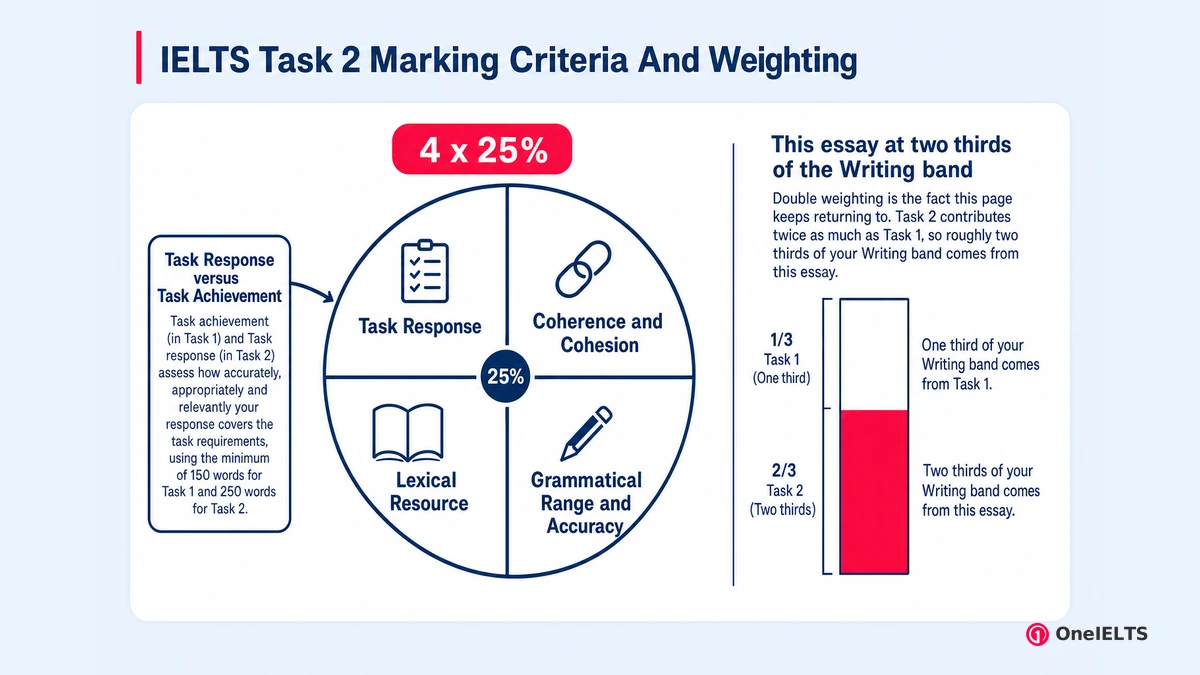
Four criteria, each worth a quarter of the Task 2 score, and the Task 2 score is worth twice the Task 1 score. Each criterion fails in a different way, set out here in a line apiece.
| Criterion | What it measures in Task 2 | What loses marks fastest |
|---|---|---|
| Task Response | Whether you answered every part of the prompt, held a position and developed the ideas you raised. | An unanswered second question, or ideas named but never explained. |
| Coherence and Cohesion | Paragraphing, the order the argument arrives in, and the links between sentences and paragraphs. | Two ideas inside one paragraph, or a connector at the start of every sentence. |
| Lexical Resource | Range and accuracy of vocabulary, including collocation and spelling accuracy in the words you choose. | A rare word used wrongly, and repetition of the prompt’s own nouns throughout. |
| Grammatical Range and Accuracy | Sentence variety and control, including complex sentences, articles, plurals and agreement. | Simple sentences only, or errors frequent enough to slow the reader down. |
The names matter. In Task 2 the first criterion is Task Response, not Task Achievement, and the exam board sets both out together.
“Task achievement (in Task 1) and Task response (in Task 2) assess how accurately, appropriately and relevantly your response covers the task requirements, using the minimum of 150 words for Task 1 and 250 words for Task 2.”
Double weighting is the fact this page keeps returning to. Task 2 contributes twice as much as Task 1, so roughly two thirds of your Writing band comes from this essay. Two of the seven ranking guides give that figure, and none of the four test-owner pages on this search result state it at all.
One FAQ answered in passing: spelling sits under Lexical Resource, occasional errors do not sink an essay, and errors that impede meaning do.
What Separates a Band 6 Essay from Band 7 and Band 8?
At band 6 the position exists but wanders and the ideas are stated rather than developed. At band 7 the position is clear throughout and each paragraph carries one developed idea. At band 8 the argument is sustained and the errors stop being noticeable. One checkable marker per cell, criterion by criterion.
| Criterion | Band 6 | Band 7 | Band 8 |
|---|---|---|---|
| Task Response | A band 6 essay answers the question but leaves parts underdeveloped. | A band 7 essay answers every part with a clear position held throughout. | A band 8 essay carries a sustained argument, well supported throughout. |
| Coherence and Cohesion | Paragraphs exist, though the order wanders and linkers repeat. | Four clear paragraphs, one idea each, linking a reader stops noticing. | Sequencing so natural that referencing carries the load unaided. |
| Lexical Resource | Enough range to argue, with repeated nouns and some wrong choices. | Range covers the topic, with occasional slips in less common words. | Precise choice throughout, collocation included, errors too rare to register. |
| Grammatical Range and Accuracy | Simple sentences dominate and errors are frequent enough to notice. | A mix of simple and complex sentences, most of them error free. | Wide range used flexibly, with errors appearing as slips not patterns. |
Two ranking pages ask how to get band 7 out loud, so here is the single highest-leverage change. Make each body paragraph carry one developed idea. It moves Task Response and Coherence and Cohesion together, and it is a planning decision rather than a writing skill, which means you can fix it before you write a sentence.
The arithmetic deserves honesty rather than encouragement. Because Task 2 is worth twice Task 1, a band 7 essay paired with a band 6 report produces roughly 6.5 in Writing, not 7. The full wording behind these markers sits in the official Writing band descriptors.
Which Topics Come Up in IELTS Writing Task 2?
A general-interest topic that needs no specialist knowledge. Eight areas recur often enough to prepare for, each producing a recognisable kind of prompt.
- Education. An education prompt is usually a should-question about schooling, curriculum or how children are taught.
- Technology. A technology prompt usually asks whether a change has helped or harmed the people using it.
- Environment. An environment prompt is often causes-and-solutions, on pollution, waste or conservation.
- Work and society. Two-part questions about careers, working hours and changing family roles.
- Health. Whether responsibility sits with individuals or with governments.
- Crime. Punishment against prevention, usually as an opinion prompt.
- Government spending. Which of two public priorities should receive limited funding.
- Globalisation. Whether cultural or economic effects outweigh the other.
No topic requires specialist knowledge and the prompt supplies whatever context you need. A candidate who has never read about urban planning can answer an urban-planning prompt from general reasoning, because the marking rewards the argument rather than the subject expertise.
Transferable ideas are what topic areas are actually for. You are not memorising topics. You are building two or three adaptable ideas per area that fit any prompt inside it. The IELTS Writing Task 2 topics page carries the question bank.
Do You Need to Plan Your Task 2 Essay Before You Start Writing?
Yes, and five minutes is the number. Essay planning is what stops the two body paragraphs making the same point. The 40 minutes divides in three.
| Minutes | What you are doing | What you should have by the end |
|---|---|---|
| 0-5 | Reading the prompt, counting the questions, identifying the type, choosing a position. | Two body-paragraph ideas written in the margin. |
| 5-35 | Writing the four paragraphs straight through without going back to edit. | A finished essay with a conclusion on it. |
| 35-40 | A checking pass on tense, articles, plurals and spelling. | The conclusion’s position matching the introduction’s. |
The five-minute plan buys three specific things: a decided position, two genuinely different ideas, and an example for each. Those three decisions are what the marking rewards, and all three are almost impossible to make while you are also forming sentences.
The number’s provenance is thin and worth naming. Of the seven ranking guides, exactly one publishes a minute budget, giving five to plan, thirty to write and five to review. The rank-2 page still lists “do I need to plan my essay?” as an open FAQ.
One thing about the 40 minutes that most pages state as if it were enforced. Recommended timing is what it is: a recommendation inside a single 60-minute paper, not a section timer that cuts you off.
Should You Write Task 2 Before Task 1?
There is no rule requiring Task 1 first, and there is a real argument for writing Task 2 first. It is an argument rather than a rule, and this section says so.
The case runs in three steps, each with a published source behind it. The Writing test is one-hour paper time with recommended times of 20 and 40 minutes rather than an enforced split. Double weighting is the second step, since Task 2 contributes twice as much to the Writing band as Task 1 does. And a candidate who over-runs on Task 1 arrives at the higher-value task already short.
Coverage of that conclusion is almost nonexistent, which is why this section exists. Across the seven ranking guides and six further pages checked on this search result, exactly one draws it. It does so as item five of an unheaded numbered list rather than in a heading of its own.
The counter-case deserves the same space. Task 1 is still worth a third of the band and it is still compulsory, so a candidate who over-runs on Task 2 has simply moved the same problem to the other end of the hour. Changing the task order helps one person: someone whose measured failure is arriving at Task 2 with fifteen minutes left.
So the decision rule is a measurement rather than a slogan. Run a timed full rehearsal over the whole hour three times. If Task 1 keeps eating Task 2’s minutes, switch the order, and if it does not, leave it alone. A timed IELTS Writing mock is the only way to run that test honestly.
One boundary on the evidence. What is published is that the times are recommendations and the paper is one hour. No test-owner document addresses the order at all.
What Are the Best IELTS Writing Task 2 Tips?
Seven task two tips change a score, and each is covered in full elsewhere on this page. They are listed here in priority order rather than explained again.
- Answer every part of the question, and count the question parts before you write. The essay-types section above.
- State your position in the introduction and keep that held position to the conclusion. The position section.
- One idea per body paragraph, developed. Not two named and neither explained. The body-paragraph section.
- Plan for five minutes before writing, because it makes you faster rather than slower. The planning section.
- Clear the 250-word minimum and stop chasing length. The word-count section.
- Use linking devices where the logic needs them, not at the start of every sentence.
- Do not use memorised openers, because examiners recognise them on sight.
Criterion weight is what orders that list. A tip matters in proportion to the criterion it moves, and the three that move Task Response come first: answering every part, holding a position, and idea development. Those three are worth more than the other four combined.
The tips that are not Task 2 specific, covering the whole paper and the wider preparation, live on the IELTS writing tips page.
How Do You Practise IELTS Writing Task 2?
Write full essays under the clock on one essay type at a time, and mark them against the four criteria before you compare them with any model. Five steps make a cycle.
- Take one essay type and write three essays on it before moving to the next one.
- Write the first untimed to get the shape right, then the next two as a timed essay in forty minutes.
- Mark your own essay against the four criteria, starting self-marking with whether the position matches between introduction and conclusion.
- Read a band-8 model essay for its structure and its idea development, never to lift its sentences.
- Rehearse the full sixty minutes with both tasks at least once a week.
Practice has a boundary worth stating. Writing twenty essays with no feedback trains the same errors twenty times over, so feedback rather than volume is the variable that moves a band.
One warning a ranking page raises and this page endorses. A memorised template that can be written before you have read the prompt is a template that will not answer it, and Task Response is exactly where that shows.
OneIELTS’s timed Writing mock is where the full-hour rehearsal in step 5 actually runs, with both tasks in one sitting and a band estimate at the end.
How Do You Write Strong Introductions in Task 2?
The introduction does two jobs and nothing else. It carries the paraphrased prompt so the examiner can see you understood the question, and it makes a position statement the rest of the essay will hold.
One frame does both: rewrite the prompt’s statement in your own sentence, then answer it in the next. Two failures are worth a clause each. Copied wording lifted from the prompt is not counted towards your 250. A general opening about how the modern world is changing answers nothing at all.
The IELTS Writing Task 2 introduction page covers the paragraph in full.
How Do You Use Linking Devices in a Task 2 Essay?
A linking device belongs at the join between ideas, not at the front of every sentence. Cohesion rewards a reader who can follow the argument and penalises a paragraph that reads like a list of connectors.
Two clauses hold the rule. Use one linker per paragraph transition. Inside a paragraph, let the ideas connect themselves through reference and repetition rather than through moreover.
The test owner’s own step warns about the same thing: over-use of connectors is as visible to an examiner as having none at all. The linking words for IELTS writing page carries the set.
How Do You Get Feedback on Your Writing?
Useful feedback names the criterion, not the sentence. Criterion-level feedback such as “your second body paragraph repeats the first idea” moves a band, and “good essay, work on grammar” does not.
Three sources exist. A teacher or examiner-trained marker, who can judge all four criteria. An automated checker, for surface errors only. A study partner marking against the public band descriptors.
Two of the related searches on this query hunt for a checker, so the limit is worth naming. An automated checker catches grammar and spelling, which sit inside two of the four criteria, and it cannot judge whether you answered the question. A marked essay from a timed paper covers what it cannot. Practising needs a free OneIELTS account.
How Can You Improve Your IELTS Writing Overall?
Structural improvement beats linguistic improvement, and it beats it quickly. A decided position, one idea per paragraph and a finished conclusion move more bands than a longer word list does.
Each has a reason. A decided position covers Task Response, which is the criterion that caps fluent essays. One idea per paragraph gives Coherence and Cohesion something to reward. A finished conclusion stops the essay losing marks in its last thirty seconds.
Effort allocation follows from the weighting. Since Task 2 is worth twice Task 1, split improvement time roughly two to one rather than evenly. The IELTS writing tips page carries the rest.
Written by Jamil Ahmed, reviewed 14 August 2026.
Last verified: 14 August 2026
Practice for the Real IELTS Exam
Apply what you’ve learned with free, exam-style practice:
- Take a free IELTS mock test — all four skills, real exam timing, AI band scoring
- Sit a Writing section mock — Task 1 and Task 2 in one timed hour with a band estimate
- Practise by question type — self-paced Writing sets with model answers