


The opening paragraph of a Task 2 essay does two jobs. It shows you understood the question, and it states your answer. Two sentences can carry both.
Three decisions make the paragraph, and the twelve pages ranking for it disagree on all three: how many parts, whether to open with a general statement, and how long it runs. On the first, the two exam boards publish opposite instructions.
This page settles each one and says what the ruling rests on. The parts, the paraphrased question, the position sentence, the outline statement, the word count no board states, a band 7 example from an exam board’s own answer key, the mistakes, the review check, and practice. Source disagreement is the story here.
What Is an IELTS Writing Task 2 Introduction?
An IELTS Writing Task 2 introduction is the first paragraph of your essay, and its whole job is to show the examiner two things. Question understanding first, then a stated answer to it.
The British Council’s own teaching material states the function. An introduction sets out for the reader, who in IELTS is the examiner, what the essay is going to be about, and it should refer back to the question without copying whole phrases from it. That is the examiner signal in one sentence.
Set your expectations for the rest of this page, because it is unusual. The paragraph is short and the advice about it is not settled. Twelve pages rank for this question and they disagree about how many parts it has, whether it starts with a general statement, and how many words it should run to.
Unsettled advice is not the same as unanswerable. Every disagreement below has evidence on both sides, and most of them resolve once you look at what the exam boards actually publish rather than at what teachers repeat.
Why Is the Introduction So Important?
It is the only paragraph the examiner reads before forming a view, and two of the four marking criteria start being decided in it.
IELTSPodcast supplies the one verbatim descriptor quotation available anywhere in the capture. At Band 7 under Task Achievement the descriptor requires a clear position presented throughout the response, and throughout starts here. It makes a sharper claim too, which is its claim rather than a board rule: without a clear position you will not get above Band 5 in Coherence and Cohesion.
A weaker corroboration exists and its weakness is worth naming. IELTS Jacky writes that Task Achievement and Coherence and Cohesion together carry 50 per cent of the marks, and names no source for the figure.
Now the counterweight, so you do not over-invest. IELTS Liz points out that the main proportion of your marks comes from your body paragraphs.
Both are right. The introduction is a criterion start rather than a criterion win, and body weighting is why every source that gives a time budget keeps this one small. Five minutes of forty is the figure two sources publish, and that ratio is the honest first impression of how much this paragraph is worth.
What Are the Parts of an IELTS Essay Introduction?
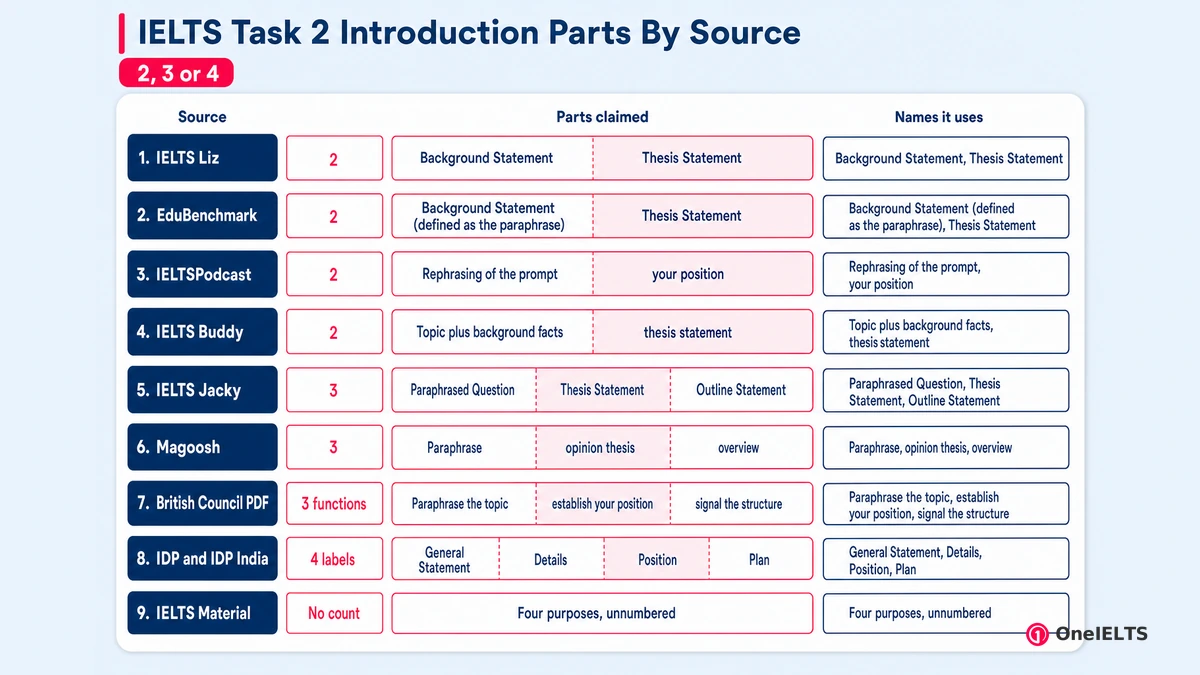
Two: a paraphrase of the question and your answer to it. A third element is optional and contested, and the four-part model on the test owners’ own pages is the same two parts split more finely.
| Source | Parts claimed | Names it uses |
|---|---|---|
| IELTS Liz | 2 | Background Statement, Thesis Statement |
| EduBenchmark | 2 | Background Statement (defined as the paraphrase), Thesis Statement |
| IELTSPodcast | 2 | Rephrasing of the prompt, your position |
| IELTS Buddy | 2 | Topic plus background facts, thesis statement |
| IELTS Jacky | 3 | Paraphrased Question, Thesis Statement, Outline Statement |
| Magoosh | 3 | Paraphrase, opinion thesis, overview |
| British Council PDF | 3 functions | Paraphrase the topic, establish your position, signal the structure |
| IDP and IDP India | 4 labels | General Statement, Details, Position, Plan |
| IELTS Material | No count | Four purposes, unnumbered |
The table looks worse than the disagreement is. Every model contains the paraphrase element and every model contains the answer element. What varies is whether the paraphrase is split into two sentences and whether a signposting sentence is added at the end.
So the argument is about two optional additions, not about four rival paragraphs. That reframing matters, because a reader who thinks the sources describe different paragraphs will pick one at random.
The real obstacle is the naming mismatch, and it is measurable. Background statement scores 18 on IELTS Liz and 8 on EduBenchmark, and zero on the other ten pages. General statement scores 4 on each of the three IDP pages and zero on IELTS Liz, Magoosh and the British Council PDF. Hook scores 15 on IELTS Liz and zero everywhere else.
Two more complete the mapping. Outline statement scores 4 on IELTS Jacky and zero elsewhere, and IELTSPodcast says rephrase and never once says paraphrase. Read across the vocabularies and the same paragraph appears five times under different labels.
What Is a Thesis Statement?
The sentence that states your answer to the question. Not a summary of the topic and not a plan of the essay. The answer.
Two sources put its essay weight bluntly. IELTS Jacky calls it the most important single sentence in your essay, and IELTS Buddy demands that you always include a thesis.
One thing breaks it more often than anything else, and Magoosh names it: trying to take both sides in the thesis. A stated answer that hedges has not answered the question, and no hedging is the whole discipline of the sentence.
Holding that position through the body paragraphs is a different skill. The handoff for it is the IELTS Writing Task 2 hub.
Should You Begin with a General Statement?
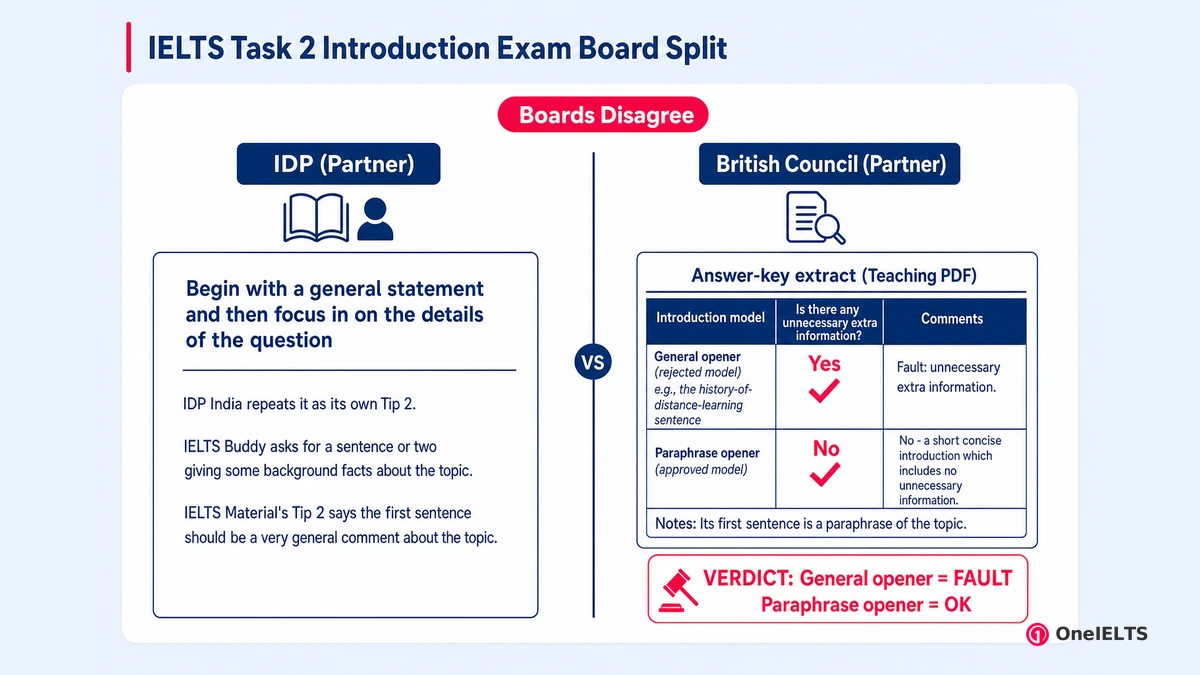
No. Start with the paraphrase. A general opening sentence is not marked, it costs words you need elsewhere, and the strongest published evidence against it comes from an exam board.
Both sides belong on the record. For the general opener: IDP’s page carries a heading reading “Begin with a general statement and then focus in on the details of the question”, and IDP India repeats it as its own Tip 2. IELTS Buddy asks for a sentence or two giving some background facts about the topic. IELTS Material’s Tip 2 says the first sentence should be a very general comment about the topic.
Against it, four voices. IELTS Jacky writes “It is tempting to start your essay with a general statement about the topic of the question. Do not do this.”
IELTS Liz names the three-part academic model in order to reject it, on the grounds that a hook exists to create interest and interest is not in the marking criteria. The AI Overview on this very search says “No hooks”. IELTS Material’s own Tip 5, roughly 200 words after its Tip 2, says to avoid long background information, general statements or hook sentences.
One fact settles it, and nobody on this search result has noticed it. The British Council’s teaching PDF, a 13-page document ranking organically on this query, marks a general opener as a fault in its published answer key.
Against the rejected model it answers “Yes” to the question “Is there any unnecessary extra information?”, citing the history-of-distance-learning sentence. Against the approved model it answers “No – a short concise introduction which includes no unnecessary information”, and notes that its first sentence is a paraphrase of the topic.
State plainly what that board split means. The two co-owners of this exam publish opposite instructions on the same question, and one of them shows its working.
So paraphrase first. If your paraphrase happens to read as a general statement about the topic, that is fine, because it came from the question rather than from your imagination. EduBenchmark reconciles the two camps exactly that way, by defining its background statement as the paraphrase.
How Do You Paraphrase the Question in the Introduction?
Rewrite the question’s statement in your own sentence, keeping every idea and changing the wording. Never lift a whole phrase, because copied words are not counted as yours.
Both boards agree here, which makes this the one rule the whole search result shares. IDP writes that copying the task word for word shows the examiner a limited range of language and can affect your band score. The British Council PDF’s answer key faults an introduction with a single line: “The opening sentence has been completely copied from the question.”
IELTSPodcast gives the more usable version. What you want to avoid is a copied chunk, meaning a phrase or a group of words. That is a sharper test than “do not copy the question”, because it names the unit to check.
Idea preservation is the test, and three things must survive the rewrite. The subject of the statement. The claim being made about it. And any limiting word such as only, all, most or should.
That third one carries the band consequence people miss. An introduction that paraphrases beautifully but drops a limiting word has changed the question, and the examiner marks the answer against the question you were set rather than the one you rewrote.
One category stays as it is. Proper nouns and any unavoidable term with no natural synonym get reused without penalty.
How Do You Use Your Own Words in the Introduction?
Change the structure first and the words second. A clause reorder forces new wording, while hunting for synonyms first usually produces the original sentence with worse vocabulary in it.
IDP makes the requirement its own tip, headed “Use your own words”, and treats own wording as the thing being assessed rather than as a stylistic preference.
One contrast shows the difference. A synonym swap turns “Some people believe university education should be free” into “Some individuals consider tertiary schooling ought to be complimentary”, which is worse English carrying the same shape. A restructure turns it into “Free university tuition has its supporters”, which changes the frame and the words follow.
The handoff for synonym selection, collocation and word-class change is the how to paraphrase for IELTS page.
How Do You State Your Position in the Introduction?
Answer the question in one sentence, in the introduction, with no hedging in it. Marker reading is the test: write it in words a marker cannot take two ways, and do it even when the prompt never uses the word opinion.
IDP makes “State your position” its own tip, and IDP India writes that it is essential to express and state your opinions in the introduction. The British Council’s analysis checklist phrases it as the question a marker actually asks: “Is the writer’s position clear? What is it?”
The marking consequence is the one verbatim descriptor on the search result. At Band 7 under Task Achievement, IELTSPodcast quotes a clear position presented throughout the response.
Three things a stated position is not, each with its repair.
- Not a summary of both sides. If the sentence gives two views and no verdict, add the verdict to the end of it.
- Not a promise to decide later. Replace “this essay will consider whether” with the answer you are going to argue.
- Not a question. Turn the question back into a claim and put the claim in the sentence.
One exception is honest to name. On a prompt asking only for causes and solutions there is no opinion to state, and the position sentence becomes a statement of what you will argue the cause is. The essay-types section below carries the per-type detail, because the prompt exception varies by type.
Do You Need an Outline Statement?
No, not as a separate sentence. Make the shape of your essay predictable from your position sentence instead, which is what the exam board’s own approved model does.
The case for it is well populated. IELTS Jacky makes it a named, mandatory third part and calls it the Outline Statement. IELTS Material makes it Tip 4. Magoosh recommends it and supplies a phrasebank of stock openings.
IDP and IDP India recommend it while calling it optional in their own words. IELTS Buddy never names it and then uses it in four of its five model introductions.
The case against has two voices and one of them is unusually direct. IELTS Liz: “Absolutely not needed at all. And certainly not for high scores.” On an opinion prompt, she adds, writing that the essay will discuss something does not present your opinion at all. IELTSPodcast is the only page attributing the objection to markers, noting that most IELTS examiners find this kind of announcement sentence unnecessary and that it often reads as a memorised phrase.
The British Council PDF resolves it, and again nobody cites it. Its analysis checklist requires that the reader can tell how the essay will be structured, so the function is required. Its approved model achieves that with no announcement sentence at all, and the answer key notes that from the second sentence you can already see which paragraph is coming. It then faults the rejected model precisely for an over-long announcement.
So the board requires the required function and rejects the sentence that announces it. So write a position sentence specific enough that the body has a predictable structure behind it, and you have satisfied the requirement without spending a sentence on it. The announcement is an optional addition, not a part.
If you cannot make it predictable, add a short appended clause to the end of the position sentence rather than a new sentence. That is IELTS Jacky’s own fallback, and it costs six words instead of twenty.
How Many Words Should the Introduction Be?
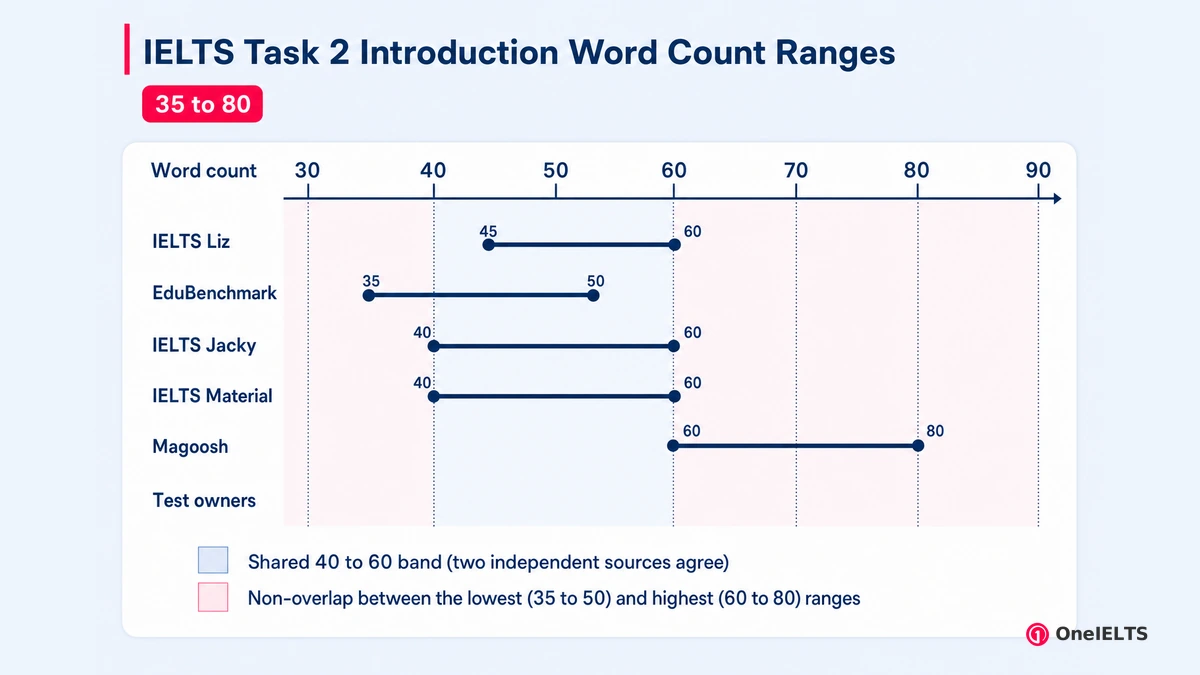
About 40 to 60 words, in two or three sentences, written in about five minutes. That is the working answer, and no exam board states any of those figures.
Every published range and its source, because they do not overlap.
- IELTS Liz: 45 to 60 words.
- EduBenchmark: 35 to 50, stated twice on the page.
- IELTS Jacky: 40 to 60.
- IELTS Material: 40 to 60.
- Magoosh: at least 60 words and at most 80.
The range collision is worth seeing plainly. Magoosh’s floor is IELTS Liz’s ceiling, and it sits ten words above EduBenchmark’s ceiling. A candidate following Magoosh writes an introduction EduBenchmark would call a third too long.
One detail shows how soft these figures are. IELTS Liz has published three different ranges herself. It is 45 to 60 in the article, around 40 to 50 in a reply on the same page, and 35 to 50 in her video, which a reader points out to her in the comments.
Then the board silence, stated as an absence rather than glossed over. All four test-owner documents in the capture give no word count for the introduction. IDP’s page, IDP India’s, IDP Vietnam’s and the British Council’s 13-page teaching PDF state none. The British Council PDF gives the whole task, at least 250 words in about 40 minutes, and stops there.
Sentence count and time are thinner still. Only IELTS Jacky states a sentence count for the introduction, at two to three. Only Magoosh and EduBenchmark give it a minutes budget, and both say five, which the AI Overview repeats. One warning from the capture: IELTSPodcast’s “two sentences” refers to its conclusion rather than its introduction, and that is exactly the kind of number that gets copied wrongly.
Take 40 to 60, which is the only range with two independent sources behind it. The reason to keep it short is not a rule but arithmetic, since every word spent here is a word not spent on the body paragraphs where IELTS Liz says most of the marks live.
What Does a Band 7 Introduction Contain?
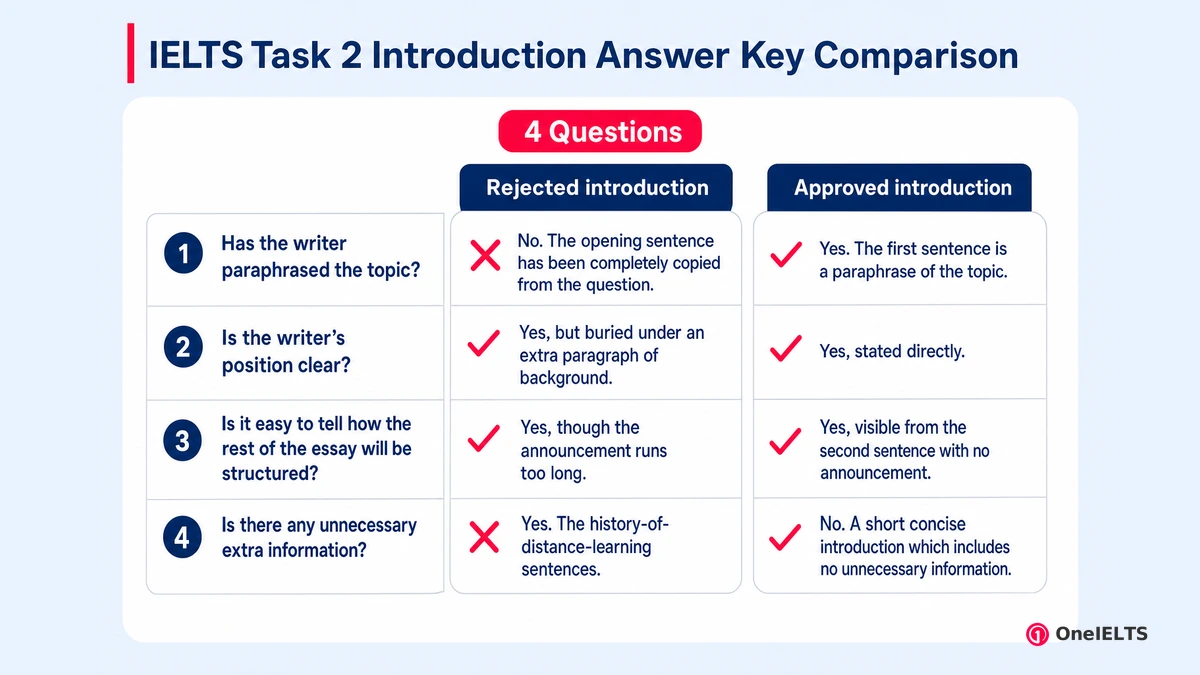
Two or three sentences, the first a paraphrase, the last a clear answer, and nothing else. That is exactly what the only marked example on the whole search result shows.
The source deserves an introduction of its own. The British Council publishes a 13-page teaching document that ranks organically on this query, and it contains two real introductions with a published answer key marking one good and one bad. Not one of the eleven other pages uses it.
| The four questions the answer key asks | The rejected introduction | The approved introduction |
|---|---|---|
| Has the writer paraphrased the topic? | No. The opening sentence has been completely copied from the question. | Yes. The first sentence is a paraphrase of the topic. |
| Is the writer’s position clear? | Yes, but buried under an extra paragraph of background. | Yes, stated directly. |
| Is it easy to tell how the rest of the essay will be structured? | Yes, though the announcement runs too long. | Yes, visible from the second sentence with no announcement. |
| Is there any unnecessary extra information? | Yes. The history-of-distance-learning sentences. | No. A short concise introduction which includes no unnecessary information. |
A copied opening is the first thing that key catches, and those four checklist questions are the useful part. You can run them on your own introduction in twenty seconds, and they come from the exam board rather than from a teacher.
The same document supplies one more thing no other page on this search result carries: band descriptor rows for Task Response and Coherence and Cohesion at Bands 7, 6 and 5.
Between the checklist and the descriptors there is still a gap. The four questions tell you whether the paragraph is built correctly, and only a band score tells you whether it earned anything. That is what a full Writing mock test is for.
How Is an IELTS Essay Introduction Marked?
On four criteria, a quarter each, and the introduction is where two of them start.
Task Response wants your position in it. Coherence and Cohesion wants a paragraph a reader can follow without going back to the start.
What the capture supports is narrower than what the capture claims. The British Council PDF is the only document in twelve reproducing descriptor rows, at Bands 7, 6 and 5, and IELTSPodcast is the only page quoting one verbatim. Everyone else asserts.
The handoff for the full marking scheme is the IELTS Writing pillar, which covers all four criteria and how they combine.
Which Common Mistakes Should You Avoid in the Introduction?
Five, and four of them are things the writer thought were helping.
- A copied phrase from the question rather than a rewrite. Copied words show no range, and in the exam board’s own answer key that single fault marks the introduction down.
- Opening with a general comment about the world rather than with the paraphrase. It is not marked, it spends words the body needs, and IELTS Jacky tells you outright not to do it.
- No position, or a hedged position. IELTS Jacky names this twice among his four mistakes, and it is the one the Task Response descriptor reaches directly.
- A memorised opening. IDP warns against inserting topic words into a learned frame, and IELTSPodcast notes that examiners are trained to spot memorised language on sight.
- An overlong paragraph. IELTSPodcast puts it shortest: many test takers overthink the introduction and end up writing too much.
Notice that only the first of those five is a technique failure. The other four are decisions, which is why reading a checklist fixes them faster than practice does.
EduBenchmark adds one measured warning about phrasing, and it is worth quoting because it names the shape rather than a single phrase. Avoid overused expressions such as “It is a burning issue.”
The wider Task 2 error inventory is not this page’s job, and the section below hands the phrasebank question off with it.
Which IELTS Writing Task 2 Introduction Phrases Are Safe to Use?
The ones that carry no content. Joining words are safe and content-bearing openings are not.
Say the tension out loud, because you arrived here wanting a phrasebank. Six separate search terms and two of the eight related-search chips on this query ask for introduction phrases, templates, starting lines or a phrases PDF. One screen above them, the AI Overview says examiners spot copied templates instantly and that it can lower your score. Both of those are real.
The line is whether the phrase is content bearing. A fixed opening that states something about the topic is a detectable template. A connective phrase that joins your own sentences is just grammar.
“In today’s rapidly changing world” is on the wrong side of that line. “For this reason” is on the right side. The handoff for the wider error list is the IELTS writing mistakes page.
What Should You Review in Your Introduction?
Four questions, and they are the exam board’s own. Has it paraphrased, is the position clear, can the reader tell how the essay is structured, and is anything in it unnecessary.
Their provenance is the reason to trust them over any teacher’s list. They are the analysis questions in the British Council’s own teaching document, the same four its answer key uses to mark one introduction good and another bad.
- Has it paraphrased the topic? If any phrase from the question survives intact, rewrite that clause before anything else.
- Is the position clarity there? If a marker could read the paragraph and not know your answer, add the answer.
- Can the reader tell how the essay is structured? If not, append a clause to the position sentence rather than adding a new one.
- Is there an unnecessary sentence? Unnecessary includes a general opening statement, a second paraphrase of the same idea, and an announcement the position sentence already implied.
A fifth check belongs here and it is this page’s own rather than the board’s. Does the answer sentence match the type of question you were given?
An opinion prompt needs a side. A discussion prompt needs both views acknowledged and then a side. An advantages-and-disadvantages prompt needs a decision only where the wording asks which outweighs which. A problem-and-solution prompt has no opinion in it at all.
That type match matters more than it sounds, because a perfectly built paragraph answering the wrong shape of question still loses Task Response. Source scarcity strengthens the case for using the board’s four. “Review your introduction” and “Review your introductory paragraph” are the only self check headings on the entire search result, and both of them are IDP’s.
Which Essay Types Need Your Opinion in the Introduction?
Opinion essays always, discussion essays almost always, and advantages-and-disadvantages only when the prompt asks which side outweighs the other. Problem-and-solution prompts do not ask for one.
IDP India turns that from a preference into a rule, writing that it is essential to state your opinion in the introduction. Opinion required is the default rather than the exception.
One word flips the outweigh case. Where the prompt asks whether the advantages outweigh the disadvantages it wants a verdict, and where it merely asks you to discuss both it does not.
The no opinion type is the fourth. Prompt wording decides all of this, and the handoff for the taxonomy and the trigger wordings is the IELTS essay types page.
How Do You Practise IELTS Writing Task 2 Introductions?
Write introductions alone, ten of them, without ever writing the essay that follows. It is the only paragraph in Task 2 short enough to practise at that volume, and volume is what fixes it. Five steps make a session.
- Open ten Task 2 prompts and write only the introduction for each. Hold a five-minute limit per prompt and stop when the time goes, finished or not.
- Count the words on every one. Anything over sixty takes a word cut before you move on, and the cut names the sentence doing no work.
- Run the board’s four questions on each: paraphrased, position clear, structure predictable, anything unnecessary.
- Reread only the first sentences, all ten together. If any two open with the same construction, a template is forming and it is visible from outside.
- Now take your three weakest and write the full essay for those. The introduction was never the problem on the other seven.
Step 4 is the unusual instruction and it earns its place. A memorised opening is invisible from inside one essay and obvious across ten, which is exactly how a marker reading a hundred scripts sees it. That repeated opening is the specific failure both the AI Overview and the test owner warn about on this query.
Step 1 needs prompts. IELTS Writing Task 2 practice is filtered to Task 2, so every set you open is an essay prompt with a statement to paraphrase. Practising needs a free OneIELTS account.
Written by Jamil Ahmed, reviewed 14 August 2026.
Last verified: 14 August 2026
Practice for the Real IELTS Exam
Apply what you’ve learned with free, exam-style practice:
- Take a free IELTS mock test — all four skills, real exam timing, AI band scoring
- Sit a Writing section mock — Task 1 and Task 2 in one timed hour with a band estimate
- Practise by question type — self-paced Writing sets with model answers