Every page ranking for this search hands you a list of sixty to a hundred and thirty. Exactly one attaches a band to using them badly, and none answers the question the search box keeps asking: how many linking words do you actually need? About fifteen, used flexibly.
This guide defines the class, answers the count question, and sets out the function category table. Then the skill split, the speaking set, Task 1, Task 2, and overuse. It closes on the words to avoid, the coherence criterion, word placement inside the sentence, and practice.
What Are Linking Words in IELTS?
Linking words are words and phrases whose only job is to show the relationship between two ideas. They are marked, because two of the four criteria measure whether a reader can follow you.
Start with the naming variant problem, since it costs nothing to fix. This search calls one word class six things: linking words, connectors, linkers, cohesive devices, discourse markers and transition words. IDP India says connector 55 times and linking word three times. IDP Australia says linker 21 times, and most niche sites say linking words. They all mean the same thing.
IDP Australia states what the class is for. Cohesion is the glue that holds your ideas together and lets them flow, and it is named in the assessment criterion for both Speaking and Writing.
One boundary saves you a wrong turn. These are function words that carry no subject matter, so a relationship signal is all a linking word supplies. That makes them a different set from content vocabulary rather than a substitute for it.
What Are Cohesive Devices?
Cohesive devices are the wider category. Every linking word is a cohesive device, and cohesive devices also cover pronoun reference, substitution, and the moves that stop you naming the same noun in every sentence.
Term coverage is the problem here. The string “cohesive device” returns zero on five of the eight captured pages, and the two that use it use it once each. A reader who meets the term in a band descriptor and then searches for it finds word lists.
Three devices are not linking words. Pronoun reference swaps a noun for it, they or this. Substitution replaces a phrase with one or so. A repeated noun becomes a shorter reference on its second appearance.
This matters for one practical reason. A candidate who thinks cohesion means linking words will add more linking words to fix a problem a pronoun would have solved. The handoff for the criteria is the IELTS Writing pillar.
How Many Linking Words Do You Need?
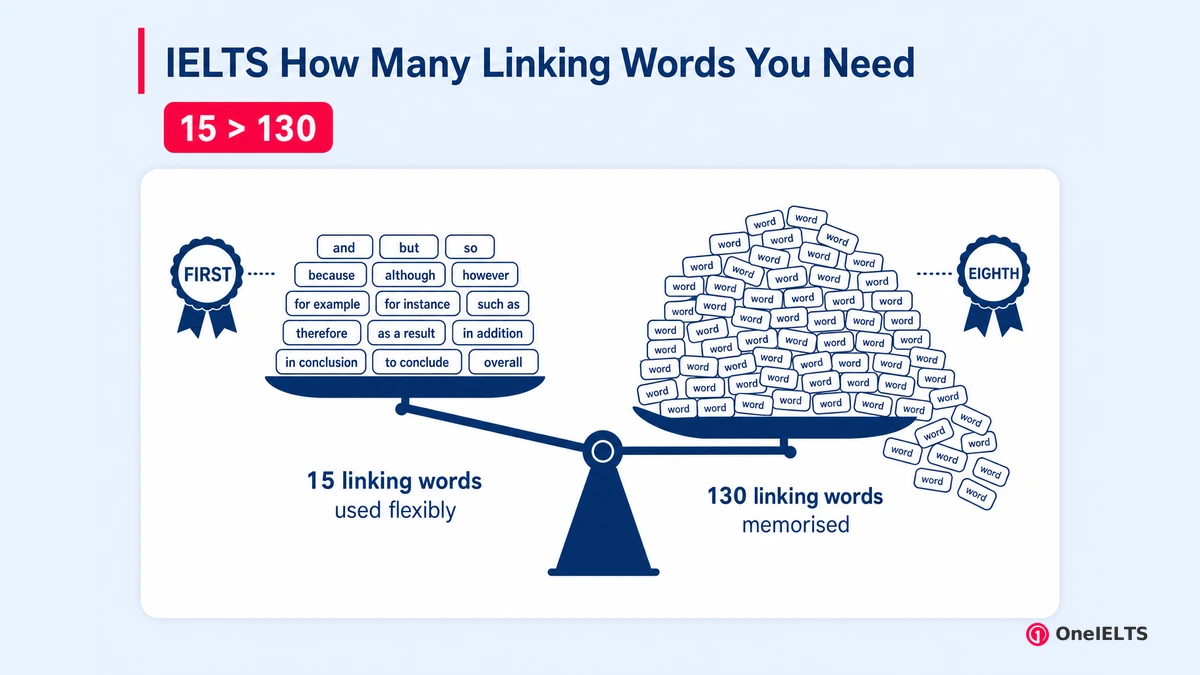
About fifteen, used flexibly, beats a hundred and thirty memorised. There is no official number, and the useful figure is not how many you know but how often you use one.
The question is real and nobody answers it. Google’s live People-also-ask block asks “What are the 20 linking words?” and “What are the 10 linking words in writing?” in the same box. The eight pages that rank publish 60, 63, 66, 93, 109, 122, 129 and 129 words. Not one of them answers how many you need.
IELTS Liz gives the only published answer, and it sits in her comment thread rather than her article. There is no correct number. Her diagnostic is the useful half of that: if you start almost every sentence with a linking word, it is mechanical. Usage frequency is the measure, not inventory.
The published count and the ranking order point the same way. The page listing the fewest words in this capture, about seventy, ranks first and is the AI Overview’s first named source. The page with the most, a hundred and twenty-nine, ranks eighth.
Six functions cover an essay. One or two words each for adding, contrasting, giving a reason, giving a result, giving an example and concluding, plus one sequencing word that is not firstly. That comes to roughly fifteen, and flexible use of fifteen reads better than a memorised hundred.
EduBenchmark reaches the same place. Do not overwhelm yourself trying to memorise all of them; pick a few and practise using them accurately and flexibly.
Which Linking Words Cover Each Function?
Nine functions cover everything the exam asks for, and the same function often needs a different word depending on whether you are speaking or writing.
The eight captured pages use 7, 9, 11, 12, 14, 14, 15 and 23 categories, and only three of those are a shared concept across all eight: adding information, contrast and examples. There is no agreed taxonomy, so this table uses the smallest set that covers the exam rather than the longest set anyone published. Each row carries the words this capture actually records for that skill.
| Function | Speaking | Writing |
|---|---|---|
| Adding | and, also, as well as | Furthermore, Moreover, In addition |
| Contrasting | but, while, on the other hand | However, On the other hand |
| Conceding | although, even though, despite | Although, Even though, Despite, In spite of |
| Giving a reason | because, since, the main reason is | Due to, Owing to, Because of |
| Giving a result | so, so that, for this reason | Therefore, Consequently, As a result |
| Giving an example | like, for instance, such as | For example, For instance, Such as, To illustrate |
| Comparing | similarly, in the same way | Equally, Likewise, Similarly |
| Sequencing | to begin with | Firstly, Secondly, Finally |
| Concluding | no spoken word is named anywhere | In conclusion, To conclude, Overall, To summarise |
One Speaking cell is empty and it is the informative one. Neither page publishing a separate speaking list names a word for closing a spoken answer, and Canam names it can be concluded that among the phrases to avoid there. The spoken close is a shift of tone rather than a phrase.
The per-skill choice is what the third column exists for. Four functions appear on exactly one page each, which is what an arbitrary category looks like: reformulation, deduction, reinforcement and concession, all on ielts-up.
Which Linking Words Show Contrast?
Contrast comes in three shapes rather than one long list. However opens a new sentence, although takes a clause following it, and despite takes a noun following it. The conjunction sets what follows it, so choosing between them is a grammar decision before it is a vocabulary one.
That single distinction produces the most common accuracy error in this word class. Despite the cost rose is wrong, Despite the cost, the scheme went ahead is right, and no amount of synonym collecting fixes the difference.
Contrast is one of only three functions every page in eight lists, and it is also the function carrying the most entries, at fifteen on one page. That is exactly where a reader collects synonyms and then misuses them. The handoff for clause types and sentence building is the complex sentences for IELTS page.
Do Speaking and Writing Need Different Linking Words?
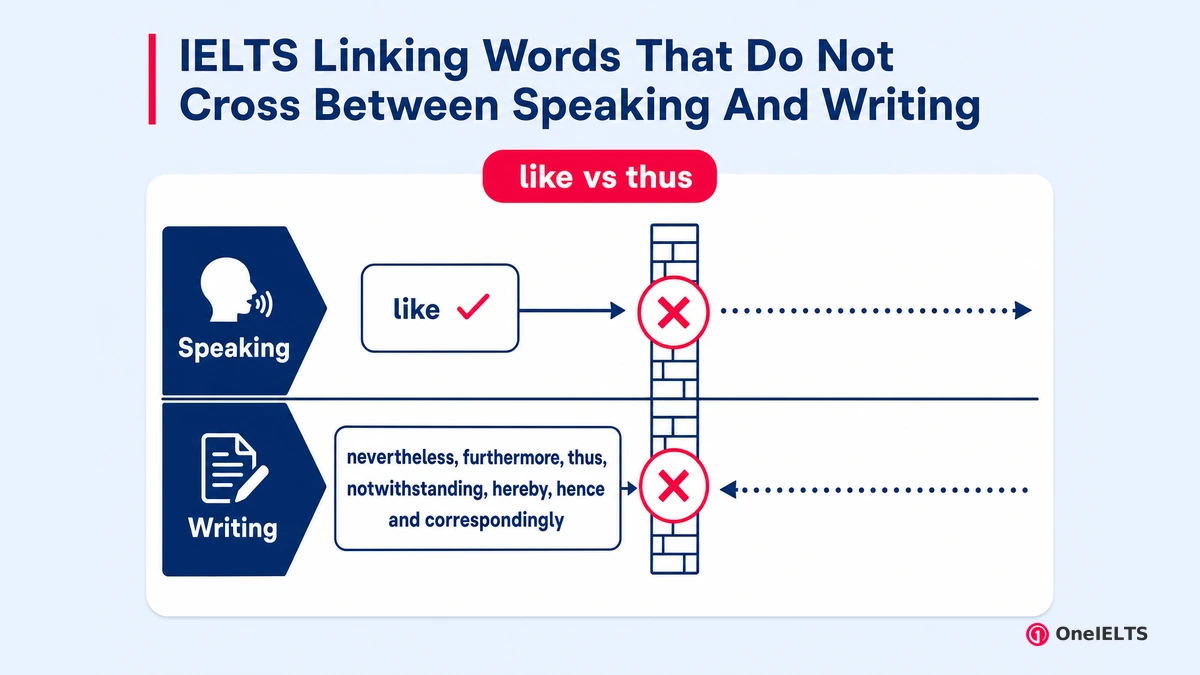
Yes, and a short list of words is wrong in one of the two. This is the clearest published rule on the search, and only two pages give you the actual words.
IDP Australia states the mechanism. Cohesion matters in both, but the use of linkers differs between the two. Speakers generally use simpler and often informal linking words, while writers use a wider variety of more formal ones to organise their ideas.
The crossover word table pulls Canam’s and IELTSPodcast’s named items into one place, which no page in the capture does.
| Word or phrase | Belongs to | Why |
|---|---|---|
| like | Speaking only | It is how examples get introduced in speech, and it carries an informal register in writing. IELTSPodcast states it as a rule: do not use the linking word like in the writing tasks. |
| nevertheless, furthermore, thus, it can be concluded that | Writing only | Canam names using academic written connectors in Speaking as one of the major mistakes candidates make. Its own speaking table then lists thus under giving a reason, further down the same page. |
| notwithstanding, hereby, hence, correspondingly | Writing only | Canam’s wording is that these seem more natural written down than spoken. IELTSPodcast independently names hereby and notwithstanding as words that work better in writing. |
Repetition tolerance splits the two skills as well. IELTSPodcast puts it directly. Do not worry too much about repeating some linking words while speaking, and do not carry that tolerance into the writing task. Canam contradicts itself here, saying both that you need not worry about repeating in Speaking and that you should avoid using the same one more than once.
The skill difference is stated far more often than it is applied. Four of the eight captured pages say the sets differ and only two publish a separate list. IDP India merges them on a page titled “Connectors for IELTS Writing and Speaking”.
Which Linking Words Suit IELTS Speaking?
The ones you already use in conversation. The formal written set is the single most recognisable sign of a memorised answer, and Canam calls using it in Speaking a major mistake.
Six functions cover a spoken answer, and conversational register is the test for every one of them.
- Adding: the everyday joining words, not the written ones EduBenchmark tells you to drop in personal questions.
- Contrasting: but and on the other hand, which the AI Overview names as the natural spoken pair.
- Giving an example: like, which belongs to speech only and is wrong in either writing task.
- Giving a reason: because, which EduBenchmark calls common and which is exactly right out loud.
- Buying thinking time: a short linker in place of the hesitation sound, held for the same beat.
- Returning to the question: one phrase that steers you back after a digression in Part 3.
Thinking time deserves its own note, because it belongs to Speaking alone and one page in eight names it. Linking words replace the hesitation sounds. IELTSPodcast puts it plainly: replace ahhs and umms with linkers, because those signal that you are not fluent.
The marking link differs too. In Speaking the fluency criterion is Fluency and Coherence rather than Coherence and Cohesion, and Canam and IELTSPodcast both put it at a quarter of the mark.
One boundary is worth stating. This section covers the crossover rule and the six functions, while the full Speaking word set carries its own search demand and its own parent topic, so it is not absorbed here.
Which Linking Words Suit IELTS Writing Task 1?
Sequence and comparison words, not argument words, because Task 1 is data reporting and it argues nothing.
This section exists because the demand does. “Linking words for ielts writing task 1” carries double the search demand of the Task 2 version, and it is the first related-search chip Google shows on this query. Exactly one of the eight captured pages publishes a Task 1 list at all.
Four groups cover what the task needs, taken from the one page that separates them.
- Sequencing for a process, where the linking word marks position in a stage order the diagram has already fixed for you.
- Comparison and contrast for two data sets, so one sentence carries both halves of the difference instead of two separate reports.
- Time expression words for a trend across years, which fix the period a figure belongs to before the figure is reported.
- The overview opener, a single phrase that signals the summary paragraph, which IELTSPodcast lists separately as starting a paragraph of its own.
A sequence word marks where you are in the stages and nothing more, while a comparison word does the second job of holding two figures in one sentence. Two Task 1 sub-cases need their own sets, and IELTSPodcast is the only source in eight that separates them: describing a process and describing a map.
One rule transfers from the crossover table, in that source’s own words: do not use speaking linkers in writing task 1 or 2.
Which Linking Words Describe a Process?
Stage markers, and you need about five of them: one to start, three to move on, and one to finish.
Process linking differs from essay linking in one way. The given order comes from the diagram, so the linking word marks sequence position rather than signalling an argument.
One warning comes with the shape. A process with seven stages does not need seven different sequence words, and the synonym reach at every stage is the same overuse error this page names further down. The handoff for building the answer is the IELTS Writing Task 1 flow chart page.
Which Linking Words Suit IELTS Writing Task 2?
Argument words: the ones that signal a reason, a result, a concession and a conclusion. Most of this SERP’s inventory sits here, and most of it you will never use.
EduBenchmark is the only page that maps functions to where they are used, through its “Commonly Used in” column, and these five slots follow that framing.
- The paragraph opener, which announces that a new reason is starting and is the slot most candidates fill with firstly.
- The second reason inside a paragraph, which needs an adding word rather than another listing word, because the paragraph has not moved on.
- The example slot, where for instance or such as attaches evidence to the claim you have just made rather than to the paragraph as a whole.
- The concession slot, which acknowledges the opposing view and then turns back, and needs a different word from plain contrast.
- The closing word, one phrase in the conclusion, which is the slot where in conclusion has become almost automatic across the whole SERP.
The concession slot is where band 7 vocabulary actually shows. Conceding a point and then answering it needs a different word from a simple contrast, and the long lists bury that function under fifteen contrast synonyms.
One thing to stop doing, from IELTS Liz: opening every body paragraph with firstly and secondly is mechanical, and mechanical is not good for anyone aiming at band 7 and above.
Which Linking Words Suit an Opinion Essay?
An opinion marker in the introduction and the conclusion, and ordinary reason and result words everywhere else. The essay type changes two sentences, not the whole set.
IELTS Liz keeps a small “Giving your Opinion” category for exactly this, with a caveat worth carrying. Those phrases belong where the prompt asks for your view, not scattered through the body. Two sentences in the essay are view sentences and the rest of it argues.
The general rule saves you hunting per type. A discussion essay needs one extra contrast marker to move between the two views, and that two-view move is the only type difference the word set makes. The handoff for the taxonomy is the IELTS essay types page.
Can You Overuse Linking Words?
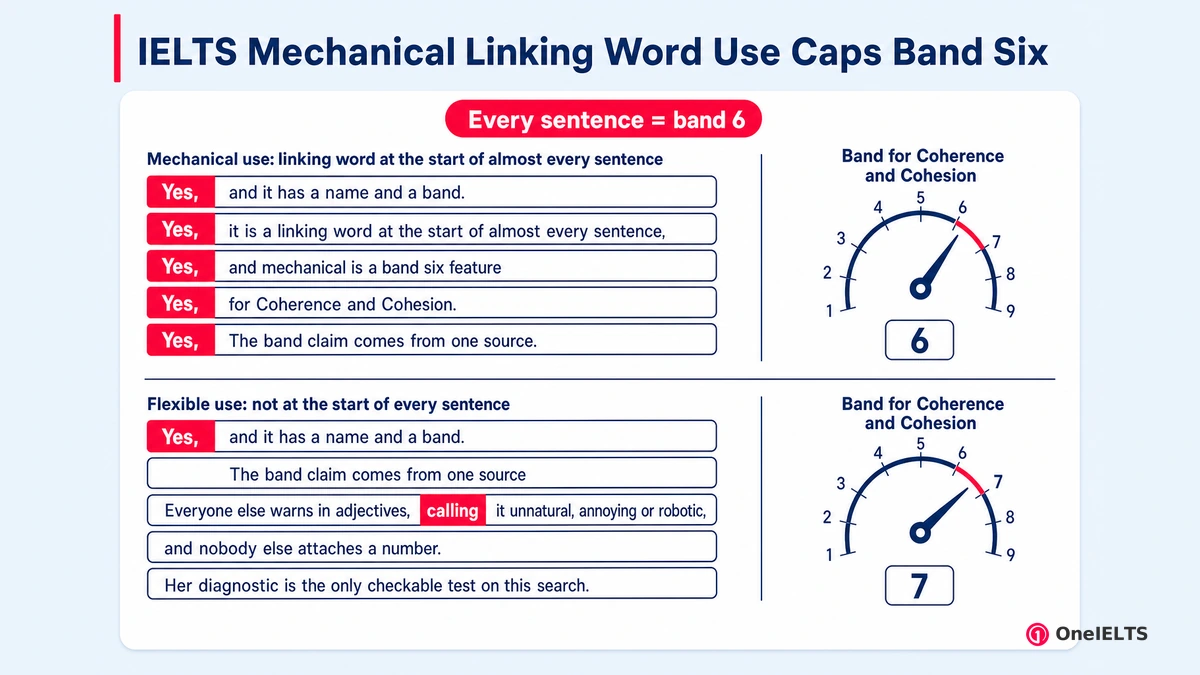
Yes, and it has a name and a band. Mechanical use is a linking word at the start of almost every sentence, and mechanical is a band six feature for Coherence and Cohesion.
The band claim comes from one source and you should be able to check it. IELTS Liz, in her comment thread, writes that band score 6 for Coherence and Cohesion is based on being mechanical with linking words, so getting above band 6 means showing flexibility instead. In the article itself she states the milder version, that using firstly and secondly to start each body paragraph is mechanical.
Then the count that makes it a gap. The string “mechanical” returns zero on seven of the eight captured pages. “Band descriptor” returns zero in body text on all eight. Everyone else warns in adjectives, calling it unnatural, annoying or robotic, and nobody else attaches a number.
Her diagnostic is the only checkable test on this search. There is no correct number, and if you start almost every sentence with a linking word, it is mechanical. Ten seconds on your own paragraph settles it.
ieltsmaterial supplies the worked example, and it is a stacked linker.
He studied very hard, and therefore, as a result, he aced the exam consequently.
Their diagnosis is that the linkers are repeated, the meaning gets diluted and coherence suffers. The repair keeps one of the three result words and deletes the other two. One relationship needs one signal.
An honest note about that source belongs here, because it is the confusion this page exists to fix. The same page tells you to try to use a lot of linking words in the paragraph, two paragraphs after publishing that example.
Which Linking Words Should You Avoid?
Four kinds, and this search keeps recommending all of them.
- The conversational filler in writing, meaning like and the informal openers. IELTSPodcast states it flatly, telling candidates not to use the linking word like in the writing tasks.
- The formal-written set in speaking, meaning nevertheless, furthermore, thus and it can be concluded that. Canam names using these in Speaking as one of the major mistakes candidates make.
- The clichés this search recommends without a caveat: in a nutshell, listed as a Conclusion connector by a test owner, and last but not least, published with its own model sentence.
- Firstly and secondly as the paragraph opener in every body paragraph, which is not the words themselves but the pattern, and the pattern is the mechanical feature named above.
Item 3 needs the criticism stated fairly. These phrases are not wrong. They are the most predictable phrase in the language for their slot, and predictability is what the flexibility measure is testing against.
One measured observation closes it. “In conclusion” appears on all eight captured pages and not one of them flags any of these as overused. The only hint anywhere is IELTS Liz conceding, in her comment thread, that some examiners find “in a nutshell” too informal.
Four kinds is the finding. A long banned list would repeat the mistake a long recommended list already makes.
Which Linking Words Sound Mechanical?
None of them, on their own. The rule here is pattern not word, and mechanical describes what happens when the same slot in every sentence carries the same kind of signal.
Three patterns produce it, and each one uses different words to the same effect. A linking word in first position across consecutive sentences. One sequence marker per paragraph whether or not the paragraphs are sequential. A different synonym for the same relationship each time it recurs, which is synonym churn rather than range.
The repeated slot is the common factor in all three. The cure is one sentence in eight pages: not every linking word belongs at the start of a sentence, and some go inside it. The handoff for the wider error list is the IELTS writing mistakes page.
How Do Linking Words Affect Coherence and Cohesion?
They are the visible half of one criterion worth a quarter of your Writing mark, and that criterion measures whether a reader can follow you rather than how many connectors you used.
Only two of the eight captured pages state the criterion weighting. IELTS Liz writes that the examiner needs to see a range of linking words to award a high score for Coherence and Cohesion, which is 25 per cent of your marks. IELTSPodcast states the same figure independently for Writing and gives the Speaking equivalent for Fluency and Coherence.
The correction this section exists to make is about the two halves. Cohesion is the joining: linking words, pronouns, reference. Coherence is whether the ideas arrive in an order that makes sense. A candidate who adds linking words to a badly ordered essay has improved neither, and idea order is the half no word list can fix.
IDP Australia frames the target as reader following. Your response must be easy to follow and understand, with appropriate use of cohesive features. Appropriate, not abundant.
Not one of the eight pages quotes a band descriptor, and one of them contains the word cohesion zero times while writing about it.
Coherence and Cohesion is scored on a whole paper. A band estimate against the four criteria on a timed Writing mock test shows whether your linking reads as flexible or mechanical.
Why Is Cohesion Important in IELTS?
Because it is an assessed feature in both skills, and because without it a correct answer can still be hard to follow.
IDP Australia provides the clearest demonstration on this search and no competitor reproduces it. They print a Speaking Part 1 answer with no linking at all, diagnose the missing element in one line, then print the same answer again with linkers in place. That worked rewrite shows the difference faster than any list does.
Their definition is the one to keep. Cohesion is the glue that holds your ideas together and lets them flow, and idea flow is the outcome the criterion is named for. The handoff for the four criteria is the IELTS Writing pillar.
Where Should a Linking Word Go in a Sentence?
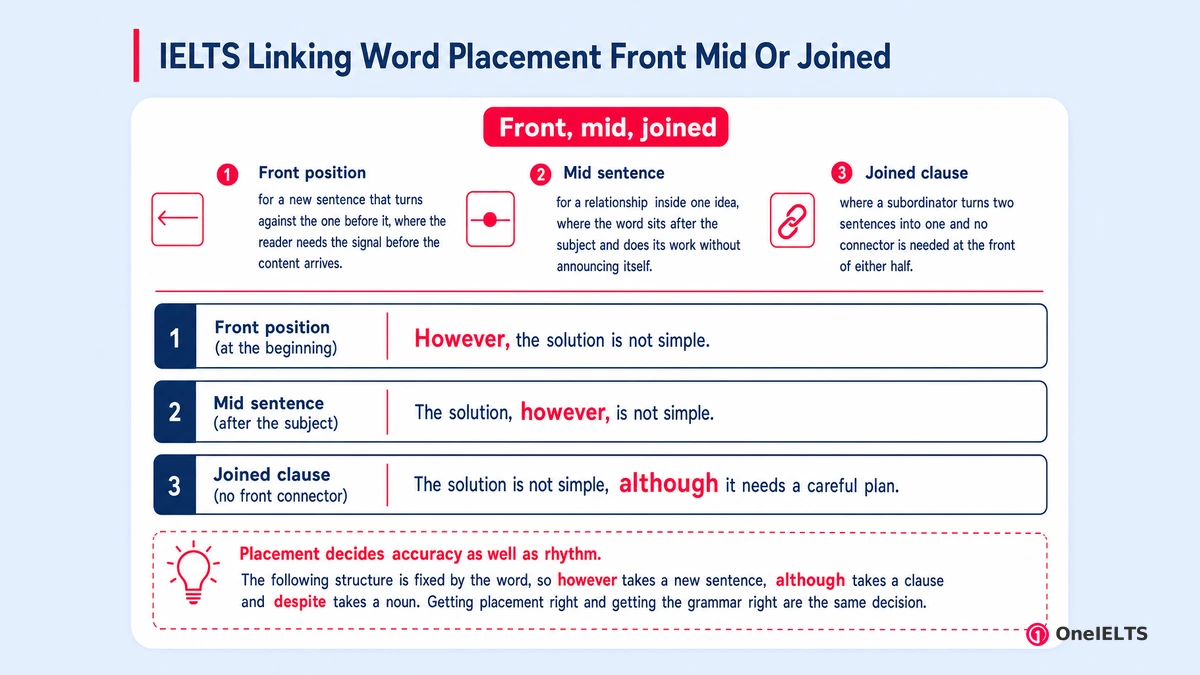
Not always at the front. Moving the linking word inside the sentence is the single change that stops an essay reading mechanically, and exactly one page in the capture mentions it.
That page is IELTS Liz again. Not all linking words need to be at the start of a sentence, and they could come within a sentence. It is the only placement guidance in the eight-page capture, and it is the direct cure for the mechanical problem the same author names.
Three positions are available, and most essays use one of them.
- Front position, for a new sentence that turns against the one before it, where the reader needs the signal before the content arrives.
- Mid sentence, for a relationship inside one idea, where the word sits after the subject and does its work without announcing itself.
- Joined clause, where a subordinator turns two sentences into one and no connector is needed at the front of either half.
Placement decides accuracy as well as rhythm. The following structure is fixed by the word, so however takes a new sentence, although takes a clause and despite takes a noun. Getting placement right and getting the grammar right are the same decision.
The practical instruction is short. Read your paragraph and count the sentences that begin with a linking word. If it is most of them, pick two to move inward and delete a third.
How Do You Practise Using Linking Words?
Practise subtraction, not collection. Write a paragraph normally, then take linking words out until removing one more would break the meaning. That number is how many you needed.
The routine that follows is a subtraction drill and it runs on writing you have already produced. Five steps, one body paragraph at a time.
- Write one body paragraph on a real prompt without thinking about linking at all. Do not plan the connectors; just make the argument.
- Now count the sentences that begin with a linking word. Write that front-position count down before you change anything.
- Delete every one of them. Read the paragraph aloud. Most of it will still make sense, and that is the finding.
- Put back only the ones whose removal changed the meaning or the direction. Move one of those inside its sentence instead of at the front.
- Repeat on a second paragraph and compare the two numbers. The second one should be lower before you delete anything.
Step 3 is the unusual instruction and it needs its reason. A linking word that survives the deletion test with no meaning change was decoration, and decoration at the front of consecutive sentences is the mechanical pattern that caps Coherence and Cohesion at band 6. Deleting is the only way to find out which ones were doing work.
IELTS Liz supplies the only interactive drill on this search, an eight-gap fill-in with reveal answers. This routine is deliberately the opposite exercise, because filling gaps trains collection and this one trains judgement not collection.
The prompts for steps 1 and 5 have to come from somewhere. IELTS Writing Task 2 practice is filtered to Task 2, so each set gives you an argument to build a paragraph on. Practising needs a free OneIELTS account. The grid is browsable when you are logged out, and opening a set is what requires signing in.
Written by Jamil Ahmed, reviewed 14 August 2026.
Last verified: 14 August 2026
Practice for the Real IELTS Exam
Apply what you’ve learned with free, exam-style practice:
- Take a free IELTS mock test — all four skills, real exam timing, AI band scoring
- Sit a Writing section mock — Task 1 and Task 2 in one timed hour with a band estimate
- Practise by question type — self-paced Writing sets with model answers