IELTS Writing Task 1 opens the 60-minute Writing test and asks you to report information in your own words. Which information depends on your paper. IELTS Academic Writing Task 1 gives you a visual; IELTS General Training Writing Task 1 gives you a situation to answer by letter. Both share a 150-word minimum and a 20-minute allowance out of the hour. There is no upper limit and no penalty for going over, whatever the summary above these results tells you.
This guide covers the two versions, the seven question types, the word floor, and how to read a visual for its key features. It then works through the four-paragraph structure, the overview, the four marking criteria, band 6 to band 8, the common mistakes, a 20-minute plan and how to practise.
What Is IELTS Writing Task 1?
IELTS Writing Task 1 is the compulsory first task in the 60-minute Writing test, and it asks you to report given information in continuous prose of at least 150 words.
Four facts define it. It is compulsory, it comes first, it reports rather than argues, and every figure you need is prompt-supplied data. The exam board states the last one plainly: “In Task 1, all the information you require is given in the diagram.”
IELTS Liz draws the line the test-owner pages never quite draw: report not essay. A report carries no thesis, no opinion and no conclusion of your own. The sections below cover the two versions, the rules they share, the structure that fits every visual, and how examiners score the result.
What Do You Have to Write in Academic Task 1 and General Training Task 1?
Academic Task 1 asks for a 150-word report on a visual; General Training Task 1 asks for a 150-word letter responding to a situation. Same time, same word floor, completely different task. The table sets the two versions side by side on what arrives, what you produce, and what earns the marks.
| What you are given | What you must produce | What the examiner rewards |
|---|---|---|
| Academic: a bar chart, line graph, pie chart, table, map or process diagram, with every figure you need already printed on it. | A report of at least 150 words that summarises the main features and compares them, written in continuous paragraphs. | Selection and comparison: five well-chosen facts, grouped into two body paragraphs, beat a full list of every number shown. |
| General Training: a short situation, such as a complaint, a request or an apology, plus three bullet points you have to cover. | A letter of at least 150 words that answers the situation and covers all three bullets, with an appropriate opening. | Register and purpose: a tone matched to the reader, all three bullets addressed, and a clear reason for writing. |
Both versions run on the same clock and the same floor. You get 20 minutes, at least 150 words, the shared marking criteria, no opinions of your own, and connected prose rather than notes.
What changes is everything else. The Academic paper never asks for a letter and the General Training paper never asks for a chart, so you only ever have to learn one of the two.
The Academic report takes an academic or semi-formal/neutral style, which is the exam board’s own wording; treat it as the semi-formal neutral style of a university assignment. The letter register moves with the prompt instead: formal to a stranger, semi-formal to a named contact, informal to a friend.
Which register the prompt implies is the first decision a General Training candidate makes, and the General Training letter page works through openings, purposes and sign-offs.
Which Question Types Can Appear in IELTS Writing Task 1?
Seven types can appear: bar chart, line graph, pie chart, table, process or flow chart, map, and a mixed prompt that combines two of them. General Training candidates get a letter instead of any of these. Each type carries a different writing job, named here with the page that owns its method.
- Bar chart. Compares quantities across categories, and the writing job is grouping, so decide which bars belong together before you write anything.
- Line graph. Shows change over time, and the writing job is trend language plus tense control across the years the axis actually covers.
- Pie chart. Shows shares of a whole, and the writing job is proportion language, because raw numbers miss the point of the visual.
- Table. Carries the most raw data of any type, and the writing job is selection, since reporting every cell is impossible in 150 words.
- Process or flow chart. Shows stages rather than figures, and the writing job is sequencing and the passive, because nobody named performs the steps.
- Map. Shows a place at two points in time, and the writing job is location and change language, including compass directions.
- Multiple or mixed charts. Two visuals in one prompt, and the writing job is splitting the paragraphs between them without running short on either.
You do not choose. One prompt arrives, the type is not announced in advance, and a table prompt can follow a map prompt, with a process diagram after either. That is why the shared four-paragraph structure below is worth more than any per-type trick, and why even mixed charts reuse it.
How Many Words Must You Write in Task 1, and How Long Do You Get?
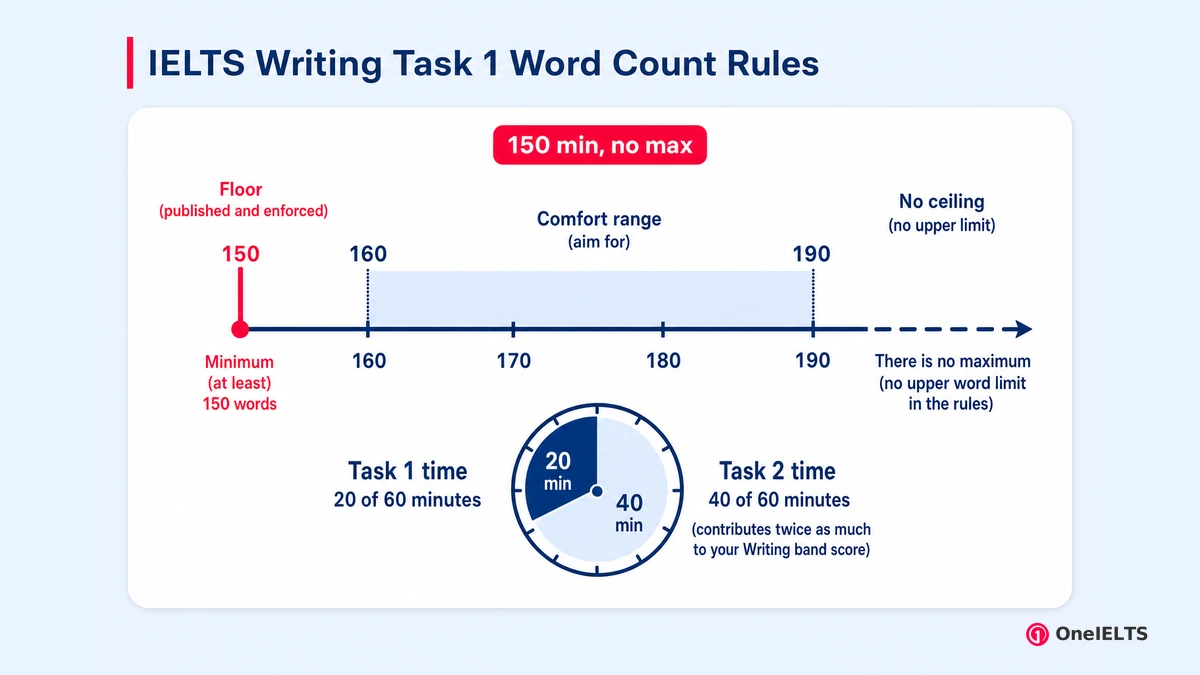
At least 150 words, in about 20 minutes of the 60-minute hour. There is no maximum, and that sentence needs saying because the AI summary above these results says otherwise.
The floor is published and enforced.
“You must write at least 150 words and will be penalised if your answer is too short.”
That is a Task Achievement penalty, and Task Achievement is one of four equally weighted criteria.
The ceiling is not published at all. The same page reads, “While you will not be penalised for writing more than 150 words…”, so there is no upper word limit anywhere in the rules. The AI summary still advises 160-180 words “to avoid penalties”.
Over-writing costs time rather than marks. The exam board finishes that sentence.
“…a longer Task 1 answer may mean that you have less time to spend on Task 2, which contributes twice as much to your Writing band score.”
Read that as time transferred to Task 2, priced by the double weighting of Task 2. Aim for 160-190 words, not because a cap exists but because it clears the 150-word minimum without eating the 40 minutes Task 2 needs.
Nobody counts your words in the exam room. Learn how many of your own handwritten lines make 150, then rely on line counting on the day.
What Are the Key Features in an IELTS Writing Task 1 Visual?
The key features are the facts a reader would notice first: the largest and smallest values, the biggest change, the point where two lines cross, the category that behaves unlike the rest. Selecting them is the skill the task is actually testing.
Every Task 1 prompt carries the same rubric line, and most candidates read straight past it. Summarise the information by selecting and reporting the main features, and make comparisons where relevant. Three verbs sit in that instruction: select, report, compare. Marks are won on the first, because selecting and reporting is a judgement the visual cannot make for you. A four-step reading routine gets you there.
- Read the axis labels, the units and the time span before you look at a single number, because the units decide half of your vocabulary.
- Decide which task family the visual belongs to: change over time, comparison at one moment, or a sequence of stages that carries no figures.
- Mark the extremes, then mark the one category that breaks the pattern, since that outlier is usually the sentence an examiner remembers most.
- Sort what is left into two logical groups, each big enough to carry a body paragraph and small enough to describe in four sentences.
An answer that reports every number scores lower than one reporting five well-chosen facts. Task Achievement is a selection criterion, so completeness is not the target, and the rubric phrase comparisons where relevant gives the game away.
How Should You Structure an IELTS Writing Task 1 Answer?
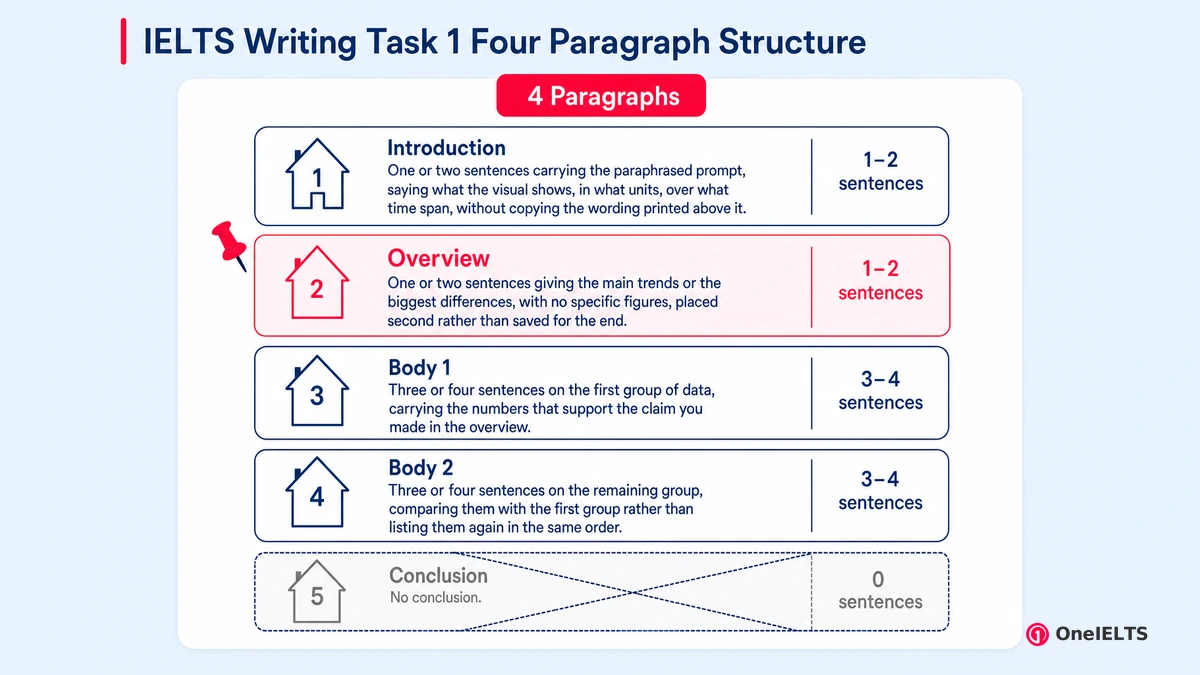
Four paragraphs: introduction, overview, first body paragraph, second body paragraph. No conclusion. The same four-paragraph structure fits every visual type, which is why it repays learning once rather than once per chart.
- Introduction paragraph. One or two sentences carrying the paraphrased prompt, saying what the visual shows, in what units, over what time span, without copying the wording printed above it.
- Overview. One or two sentences giving the main trends or the biggest differences, with no specific figures, placed second rather than saved for the end.
- Body paragraph 1. Three or four sentences on the first group of data, carrying the numbers that support the claim you made in the overview.
- Body paragraph 2. Three or four sentences on the remaining group, comparing them with the first group rather than listing them again in the same order.
So no, Task 1 does not take a conclusion. IELTS Advantage asks the question out loud in its own FAQ, and the answer is that the overview already does that job, near the top where a marker meets it first.
The order is worth obeying because Coherence and Cohesion is one of the four criteria, and a predictable shape is the cheapest way to score on it. What the structure does not fix is what goes inside the body paragraphs. That changes with every type, which is what the type pages are for.
How Do You Write the Overview Paragraph?
Two sentences, placed straight after the introduction, stating the biggest patterns in the visual and containing no specific figures.
Task Achievement expects an overview in every Task 1 answer. Leaving the overview paragraph out is the single most-cited reason a Task 1 answer stalls at band 5 or 6, and three of the ranking guides list it as a mistake in as many words. Two short checklists keep it honest, starting with what belongs inside.
- The overall trend, or which categories sit highest and lowest across the whole of the visual
- Whether that pattern holds for the entire time span or breaks partway through it
- The one contrast a reader would take away after reading nothing else on the page
The avoid side is shorter to state and easier to get wrong.
- Specific figures, percentages and dates, all of which belong in the two body paragraphs
- Opinions, causes or predictions about why the data behaves the way that it does
- A restatement of the introduction, with the same facts rearranged into different words
Two sentence frames help, and they are frames rather than phrases to copy.
For change over time: “Overall, X rose steadily across the period while Y fell, and the gap between them widened.”
For comparison: “Overall, X was the largest category throughout, and Y the smallest by a clear margin.”
On overview placement, one clause settles it. The overview goes second, not last, and calling it a conclusion and moving it to the end is a real and common error.
How Is IELTS Writing Task 1 Marked?
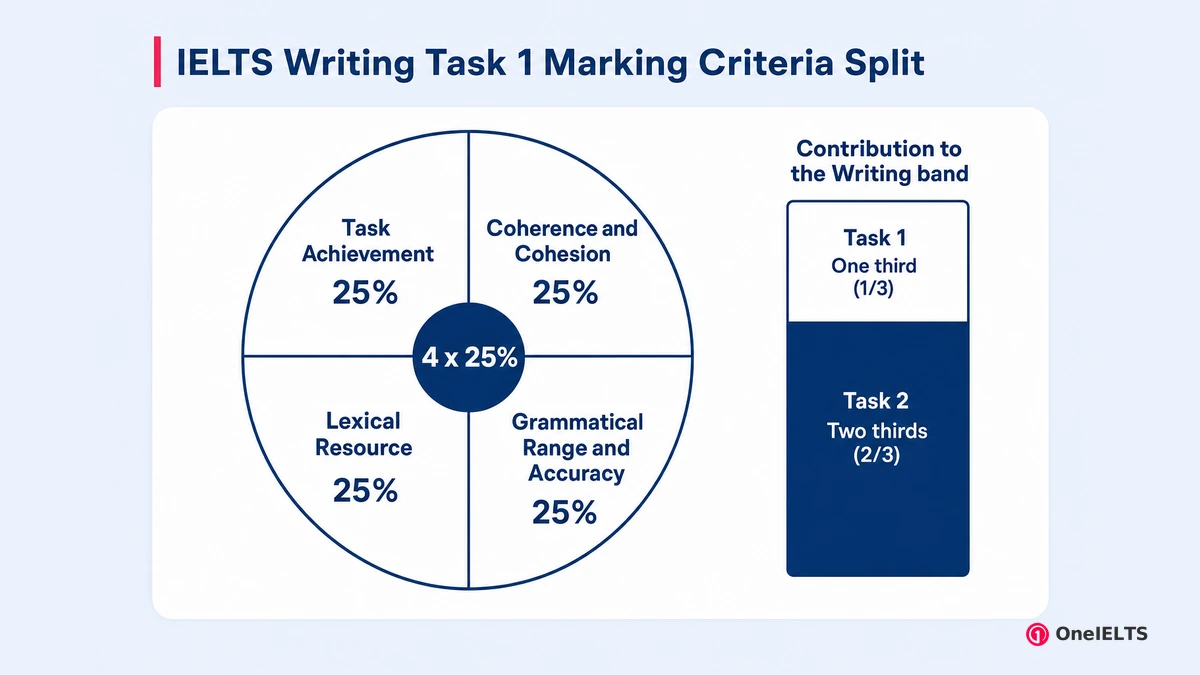
Four criteria, each worth a quarter of the Task 1 score: Task Achievement, Coherence and Cohesion, Lexical Resource, and Grammatical Range and Accuracy. Each one measures something different and fails in a different way, which the table sets out in a line apiece.
| Criterion | What it measures in Task 1 | What loses marks fastest |
|---|---|---|
| Task Achievement | Whether you selected the main features, reported them accurately and met the 150-word floor without adding opinions of your own. | A missing overview, or a full list of every figure on the visual with no selection behind it. |
| Coherence and Cohesion | How the answer is organised: paragraphing, the order the information arrives in, and the linking between sentences and groups. | One block of text with no paragraph breaks, or linkers dropped mechanically at the start of every sentence. |
| Lexical Resource | The range and accuracy of your vocabulary, especially trend verbs, degree adverbs and the language of proportion. | A rare word attached to the wrong movement, and one repeated verb covering every change on the chart. |
| Grammatical Range and Accuracy | Sentence variety and control, including tense choice, comparatives, articles, plurals and subject-verb agreement. | Holding a single tense across a date change, and dropping plurals on countable nouns all the way through. |
The names matter here. In Task 1 the first criterion is Task Achievement, not Task Response; Task Response is the Task 2 name. The exam board sets both out together.
“Task achievement (in Task 1) and Task response (in Task 2) assess how accurately, appropriately and relevantly your response covers the task requirements, using the minimum of 150 words for Task 1 and 250 words for Task 2.”
The four are equally weighted criteria, but the two tasks are not. Task 1 accounts for about a third of your Writing band, against the two-thirds Writing weighting that Task 2 carries, because Task 2 contributes twice as much. Follow that arithmetic and an hour perfecting Task 1 vocabulary is worth roughly half an hour spent on Task 2, which is not how most candidates divide a study week.
What Separates a Band 6 Task 1 Answer from Band 7 and Band 8?
At band 6 the information is there but unselected; at band 7 it is selected, grouped and mostly accurate; at band 8 the comparisons carry the answer and the errors are rare enough to stop being noticeable. One checkable marker per band, criterion by criterion, moves the difference from adjectives to evidence.
| Criterion | Band 6 | Band 7 | Band 8 |
|---|---|---|---|
| Task Achievement | Reports most of the data, with no clear overview and little sign of selection. | Clear overview plus grouped detail, with the main features chosen rather than transcribed. | Selects the features that matter and uses comparison rather than listing throughout. |
| Coherence and Cohesion | Paragraphs exist but the order wanders, and linkers repeat or sit in the wrong place. | Four clear paragraphs, logical grouping, and linking a reader stops noticing. | Information sequenced so well that referencing carries the load and cohesion goes invisible. |
| Lexical Resource | Enough vocabulary to describe the chart, with repeated verbs and some wrong word choices. | Range covers trend, degree and proportion, with occasional slips in less common words. | Precise word choice throughout, collocation included, with errors too rare to register. |
| Grammatical Range and Accuracy | Simple sentences dominate, and tense, article or plural errors are frequent enough to notice. | A mix of simple and complex sentences, with the majority of sentences error-free. | Wide range used flexibly, and errors appear as slips rather than as patterns. |
Put simply, a band 6 answer contains the data, a band 7 answer selects it, and a band 8 answer compares it. In marked practice papers the commonest band-6 signature is not weak grammar at all; it is an accurate, complete answer with no overview in it.
If band 7 is the target, the highest-leverage change runs to two sentences: write the overview. It moves Task Achievement and Coherence and Cohesion at once, which no other single fix does. One caveat, though, since your Task 1 band is the smaller of two inputs: a band 7 answer here alongside a band 6 Task 2 will not produce a 7 in Writing. The official Writing band descriptors set out the full wording behind these markers.
What Are the Most Common Mistakes in IELTS Writing Task 1?
The recurring ones are giving an opinion, omitting the overview, copying the prompt wording, listing every number, and running past 20 minutes. Eight turn up again and again, and the ranking guides treat all eight as advice. Three of them are rules.
- Giving an opinion or explaining a cause. Task 1 is a factual report and the prompt supplies no reasons, so speculation costs you under Task Achievement.
- Leaving out the overview. A missing overview is the fastest way to cap Task Achievement below band 7, and two sentences repair it.
- Paraphrasing the prompt badly, or copying it word for word. Copied prompt wording is not counted towards your 150 words, so you write it for nothing.
- Reporting every figure instead of selecting. Length without selection does not raise the band, because Task Achievement rewards the choice you made, not the total.
- Writing in notes or bullet points. This is a published penalty, and the answer has to be connected prose rather than a list of observations.
- Writing under 150 words. Also a published penalty, applied whether you stopped at 148 words or ran out of time at 90.
- Going off what the visual actually shows. Penalised outright, and it happens most when a candidate explains causes the chart never contained.
- Over-running the 20 minutes. Nothing is deducted for it, but you start Task 2 short of time, and Task 2 is worth double.
Items 5, 6 and 7 are not folklore. The exam board publishes both of these.
“You will also be penalised if your answer is not written as a whole piece of connected text (i.e. you must not use notes or bullet points).”
“…you will be penalised if what you write does not relate to the topic.”
Plagiarised writing is penalised severely on top of that. So three of the eight cost marks by published rule and five cost marks through the criteria, which is the distinction the rest of the list depends on.
How Do You Plan the 20 Minutes for IELTS Writing Task 1?
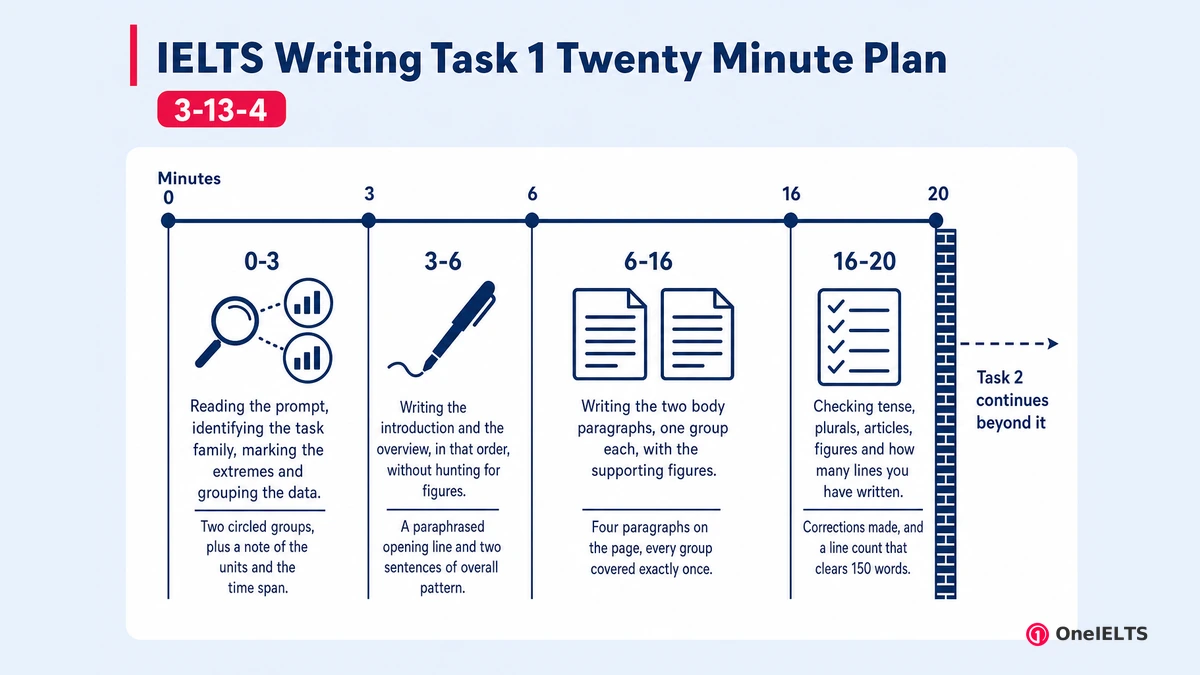
About three minutes reading and selecting, thirteen writing, four checking, and you stop at twenty whatever state the answer is in. Minute by minute, the plan looks like this.
| Minutes | What you are doing | What you should have on the page by the end |
|---|---|---|
| 0-3 | Reading the prompt, identifying the task family, marking the extremes and grouping the data. | Two circled groups, plus a note of the units and the time span. |
| 3-6 | Writing the introduction and the overview, in that order, without hunting for figures. | A paraphrased opening line and two sentences of overall pattern. |
| 6-16 | Writing the two body paragraphs, one group each, with the supporting figures. | Four paragraphs on the page, every group covered exactly once. |
| 16-20 | Checking tense, plurals, articles, figures and how many lines you have written. | Corrections made, and a line count that clears 150 words. |
Those first three minutes are reading and selection time, not warm-up. The closing checking pass earns more than it looks like it should, because tense and plurals are where Grammatical Range and Accuracy leaks.
The twenty-minute wall is worth respecting for a reason you can price. Minutes past it are time transferred to Task 2, and Task 2 is worth double. What the 20-minute allowance is not, though, is an enforced section timer. IELTS Liz makes the point plainly: the hour is yours to use as you wish, and you may write Task 2 first. Only the total writing hour is fixed.
So rehearse the hour rather than the task. Sit a timed IELTS Writing mock with both tasks in one sitting. The failure you are training out is the transfer of time between them, and timing Task 1 alone hides it completely.
How Do You Practise IELTS Writing Task 1?
Practise one visual type at a time under the clock, and check the answer against the four criteria rather than against a model answer’s wording. Five steps, in this order, turn writing more answers into writing better ones.
- Pick one type and write three answers on it before moving on, because the language is type-specific while the structure is not.
- Write the first answer untimed to get the shape right, then put the next two under twenty minutes of timed practice.
- Mark your own answer against the four criteria in order, and begin self-marking with the question of whether the overview is there.
- Compare with a model answer for structure and selection only, never to lift its sentences into your own next attempt.
- Rehearse the full hour with both tasks at least once a week, because that full-hour rehearsal is the only thing that trains pacing.
Single-type practice has a boundary worth stating out loud. Writing ten more bar chart answers will not help a candidate who has never learned map language, because the shortfall there is vocabulary rather than volume, and the type pages exist for exactly that.
OneIELTS’s own timed Writing mock gives the routine somewhere to happen, with practice charts as the raw material and a band estimate at the end. The three sections below cover the vocabulary the criterion rewards, the tense the visual dictates, and where the charts come from.
What Vocabulary Do You Need for IELTS Writing Task 1?
The vocabulary that moves Lexical Resource in Task 1 is narrow and learnable: trend verbs, degree adverbs, proportion language and the words for reading a chart accurately. Trend verbs carry direction (rose, plateaued), degree adverbs carry size (sharply, marginally), proportion language carries share (a quarter of), and chart words name the parts (axis, category).
Precision beats rarity, because the criterion rewards accuracy of use and gives no credit for an unusual word attached to the wrong movement. Our IELTS Task 1 vocabulary guide holds the lists.
Which Tense Should You Use in IELTS Writing Task 1?
The tense follows the time span printed on the visual, not the task. Past simple for a period that has ended, present simple for undated or current data, future forms for projected data, and a mix when the visual crosses from one to another.
A chart running from 2010 to 2035 needs past simple up to the present year and a future form beyond it. The error this prevents is the tense change mid-answer that never happens, which Grammatical Range and Accuracy marks down quietly. Our IELTS writing tenses guide works through each case.
How Much of the Writing Test Does Task 1 Decide?
About a third. Task 2 “contributes twice as much to your Writing band score”, in the exam board’s words, which converts to a one-third Writing share for Task 1 and two thirds for Task 2.
That double weighting carries a practice time split with it. Give ten hours to Writing and three or four of them belong to Task 1, with the rest going to IELTS Writing Task 2. Most candidates divide the time evenly and lose the difference.
Where Can You Find IELTS Writing Task 1 Practice Charts?
The raw material is easy to find: the test owners publish official sample tasks, and the niche sites each run a chart bank. What is scarce is a timed environment with marking attached. A free sample gives you a prompt and nothing else, with no clock, no band estimate and no feedback against Task Achievement.
A timed mock test supplies all three, which is what IELTS Writing Task 1 practice at OneIELTS is for. Practising needs a free OneIELTS account. The grid is browsable logged out; only opening a set requires sign-in.
Written by Jamil Ahmed, reviewed 14 August 2026.
Last verified: 14 August 2026
Practice for the Real IELTS Exam
Apply what you’ve learned with free, exam-style practice:
- Take a free IELTS mock test — all four skills, real exam timing, AI band scoring
- Sit a Writing section mock — Task 1 and Task 2 in one timed hour with a band estimate
- Practise by question type — self-paced Writing sets with model answers