Lexical Resource measures the range, precision and accuracy of your word choice, and it sets a quarter of the band for Writing Task 1 and for Writing Task 2. This page covers the Writing test only, focused on Task 2 topic vocabulary and that criterion; general word lists and Task 1 trend vocabulary have their own OneIELTS pages.
The page runs from the criterion and its weight to how the band descriptors set your band, with one Task 2 sentence rewritten at bands 6, 7 and 8. Then come the task split, academic words with the collocation each needs, topic vocabulary, linking words and idioms. Six exercises with answers and an improvement routine close it.
What Is Lexical Resource in IELTS Writing?
Lexical Resource is one of the four IELTS Writing assessment criteria, and it rates the range, precision and accuracy of your vocabulary on a 0 to 9 band. The other three are Task Response (Task Achievement in Task 1), Coherence and Cohesion, and Grammatical Range and Accuracy.
Examiners apply it separately to Task 1 and Task 2. It covers word choice, less common vocabulary, collocation, spelling and word formation. The criterion judges the words you use correctly, not how many “advanced” words appear.
Speaking uses the same criterion name with different descriptors. A Speaking word list therefore doesn’t transfer straight into an essay.
Why Is Vocabulary Important for IELTS Writing?
Lexical Resource sets 25% of the band for each Writing task, and because Task 2 counts twice as much as Task 1, the vocabulary in your essay carries the most weight in your Writing score. Under that Lexical Resource weighting, a one-band gap moves the task score by a quarter band. The Task 2 weighting is published on ielts.org.
Weak words pull Task Response down too, because imprecise vocabulary blurs your position. Repetition of the prompt’s own words is the most common reason scripts stay at band 6 for vocabulary. Test takers in India often hold band 7 in Reading but a lower Writing band, with vocabulary precision a frequent cause.
How Is Your Lexical Resource Score Decided?
The examiner matches the vocabulary in your script against the Lexical Resource band descriptors and picks the band whose wording fits best. The check covers range, use of less common words, collocation, and errors in spelling and word formation.
Each row paraphrases the May 2023 Task 2 grid on ielts.org, checked on 7 October 2026.
| Band | Range of vocabulary | Less common words and collocation | Spelling and word formation errors |
|---|---|---|---|
| Band 9 | Full flexibility and precise use, with a wide range handled naturally | Very natural, sophisticated control of lexical features | Minor errors are extremely rare and barely affect communication |
| Band 8 | A wide resource used fluently and flexibly for precise meanings | Skillful use of uncommon or idiomatic items, with occasional slips in word choice and collocation | Occasional errors with minimal impact on communication |
| Band 7 | Enough resource for some flexibility and precision | Some less common or idiomatic items; awareness of style and collocation, though inappropriacies occur | Only a few errors, and they don’t detract from overall clarity |
| Band 6 | Generally adequate for the task, with meaning clear despite restricted range or imprecise choices | A risk-taker shows wider range but more inaccuracy or inappropriacy | Some errors that don’t impede communication |
| Band 5 | Limited but minimally adequate, with frequent simplifications and repetitions | Frequent lapses in the appropriacy of word choice | Noticeable errors that may cause the reader some difficulty |
Control of less common lexical items moves you up, not the number you attempt. Spelling errors bite at band 5, where they turn noticeable. The Writing band descriptors page covers all four criteria.
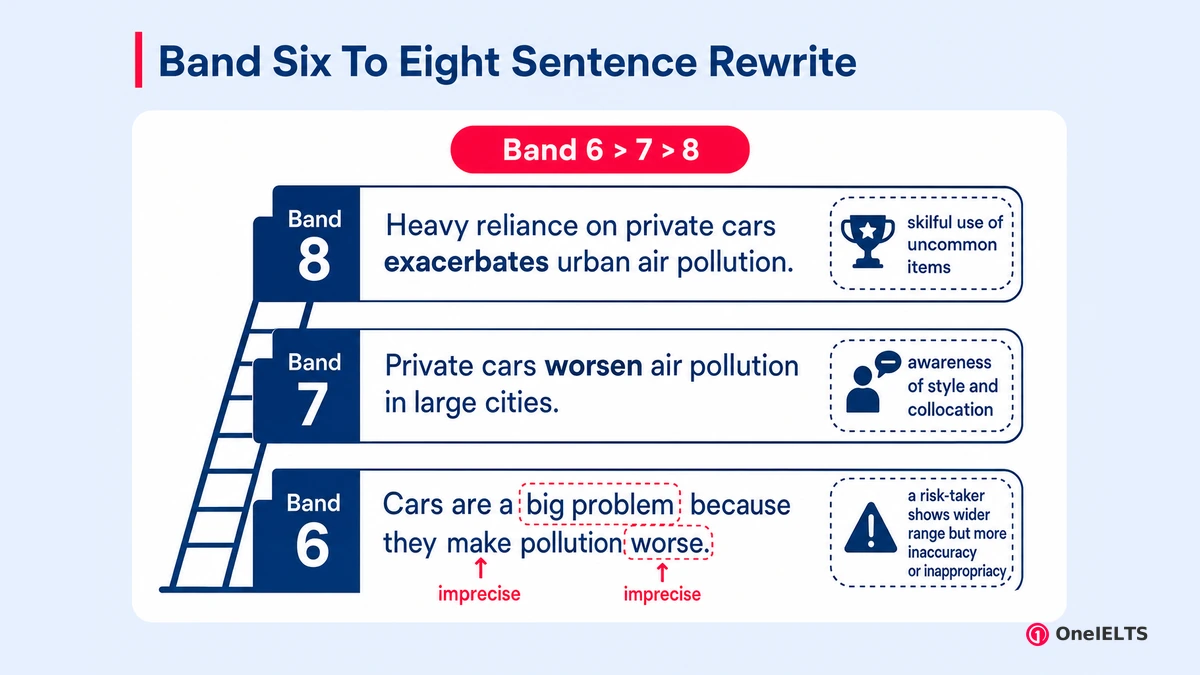
One Task 2 sentence on traffic congestion climbs the scale.
- Band 6: “Cars are a big problem because they make pollution worse.” The resource “is generally adequate and appropriate”.
- Band 7: “Private cars worsen air pollution in large cities.” Here “An awareness of style and collocation is evident.”
- Band 8: “Heavy reliance on private cars exacerbates urban air pollution.” This shows “skilful use of uncommon and/or idiomatic items”.
How Does Vocabulary Differ Between IELTS Writing Task 1 and Task 2?
Task 1 vocabulary describes data, processes or letter purposes precisely, while Task 2 vocabulary argues a position on an abstract topic, so Task 2 needs topic nouns, evaluative adjectives and cause-effect verbs that Task 1 rarely uses. Cause and effect language does most of the work in an essay, and almost none in a letter.
Each of the three task types asks for a different word set.
- Academic Task 1: trend verbs, degree adjectives and adverbs for charts, tables, maps and processes, all collected on the Task 1 vocabulary page.
- General Training Task 1: register-matched vocabulary for formal, semi-formal and informal letters, so your letter register fits the reader, from “I am writing to complain” to “Thanks so much”.
- Task 2: topic vocabulary, evaluative language and cause-effect verbs for an argued essay, such as “a serious drawback”, “leads to” and “stems from”.
Which Academic Words Raise the Tone of a Task 2 Essay?
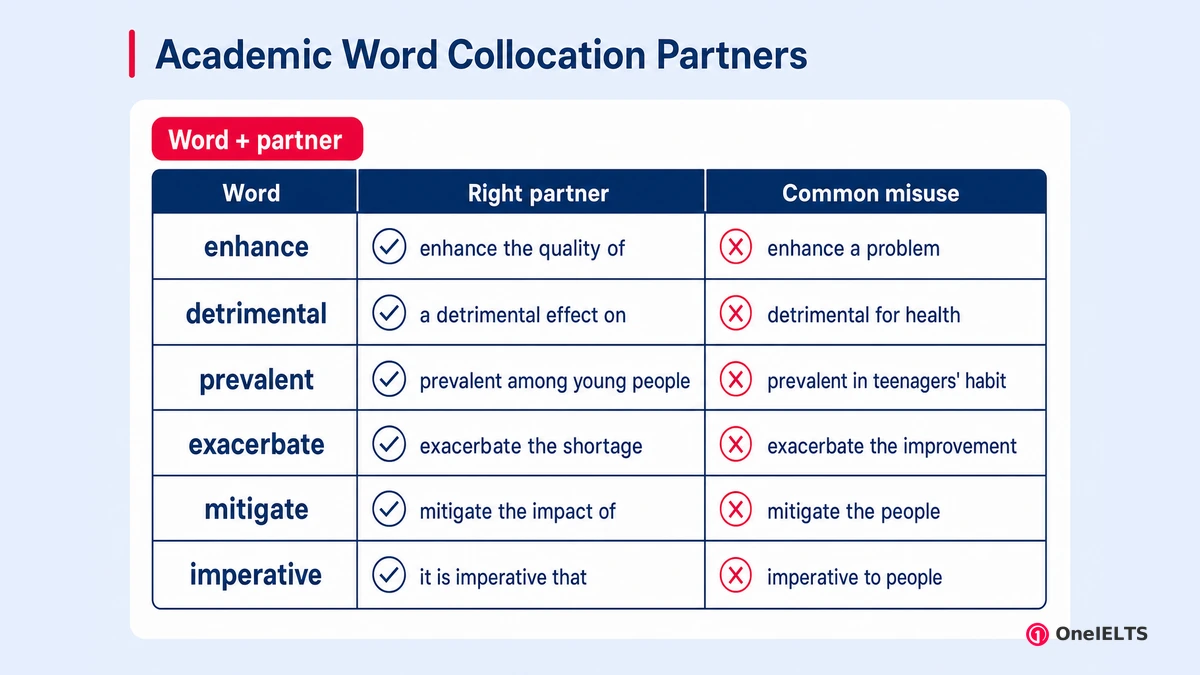
Precise, formal words such as “enhance”, “detrimental”, “prevalent”, “exacerbate”, “mitigate” and “imperative” replace vague everyday words, but they earn Lexical Resource credit only when used with their natural collocation partner.
Each upgrade pairs the academic word with its collocation partner and the usual mistake.
| Everyday word | Academic alternative | Natural collocation | Common misuse |
|---|---|---|---|
| improve | enhance | enhance the quality of | enhance a problem |
| harmful | detrimental | a detrimental effect on | detrimental for health |
| widespread | prevalent | prevalent among young people | prevalent in teenagers’ habit |
| make worse | exacerbate | exacerbate the shortage | exacerbate the improvement |
| reduce | mitigate | mitigate the impact of | mitigate the people |
| necessary | imperative | it is imperative that governments | imperative to people |
The academic register also drops informal words: “kids” becomes “children”, “stuff” becomes “items”, “a lot of” becomes “many”, “get” becomes “obtain” and “really” becomes “highly”. Stop opening every essay with “nowadays”. Formal vocabulary needs precision more than rarity. The band 6 descriptor holds risk-takers at 6 when wider range brings inaccuracy.
Which Topic Vocabulary Do You Need for IELTS Writing Task 2?
Task 2 prompts recur across a small set of themes, so learning three or four collocations per theme covers most essays; the table gives the starter set for each. Global warming, modern technology and food and nutrition recur most, and each sentence frame puts topic-specific vocabulary in a usable clause.
Nine Task 2 themes follow, three collocations each.
| Topic | Starter collocations (3-4) | Essay-ready sentence frame |
|---|---|---|
| Education | rote learning, vocational training, academic performance | Vocational training prepares students for [career], whereas rote learning rarely lifts academic performance. |
| Technology | screen time, the digital divide, automation of jobs | The automation of jobs widens the digital divide unless [group] receives retraining. |
| Environment | carbon emissions, renewable energy sources, deforestation | Switching to renewable energy sources cuts carbon emissions faster than [policy] does. |
| Health and food | sedentary lifestyle, processed food, obesity rates | Cheap processed food and a sedentary lifestyle push obesity rates up in [country]. |
| Crime | deterrent effect, rehabilitation programs, reoffending rates | Rehabilitation programs lower reoffending rates more reliably than the deterrent effect of [punishment]. |
| Work | work-life balance, remote working, job security | Remote working improves work-life balance but can weaken job security for [workers]. |
| Globalization | multinational corporations, cultural homogenization, international trade | International trade lets multinational corporations spread, which drives cultural homogenization in [region]. |
| Government and society | public funding, allocate resources, infrastructure investment | Governments must allocate resources to infrastructure investment before [sector] receives public funding. |
| Travel and tourism | mass tourism, the local economy, cultural heritage | Mass tourism supports the local economy yet puts cultural heritage at risk in [city]. |
Practice these frames on real Task 2 topics.
What Is a Vocabulary Collocation?
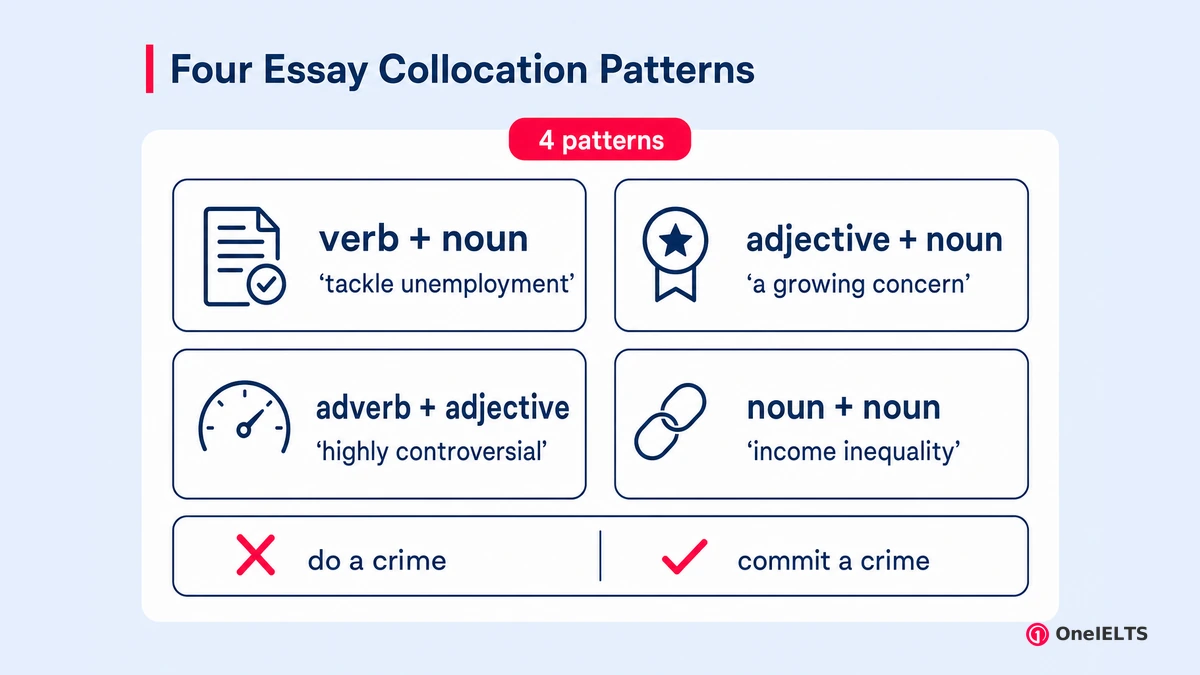
A collocation is a pair or group of words that native writers habitually combine, such as “commit a crime”, “heavy traffic” or “pose a threat”. Think of it as a fixed word partnership.
It matters for your score because the band 7 descriptor rewards “awareness of style and collocation”. A wrong partner such as “do a crime”, “strong rain” or “make a research” counts as a word-choice error, even when the meaning is clear.
Four patterns do most of the work in essays. Verb + noun gives you “tackle unemployment”. Adjective + noun gives “a growing concern”, and adverb + adjective gives “highly controversial”. Noun + noun gives “income inequality”.
How Do Cohesive Devices and Linking Words Fit Into Writing Vocabulary?
Linking words such as “moreover”, “consequently” and “whereas” are scored under Coherence and Cohesion, not Lexical Resource, so they help a different 25% of the task score and do not add vocabulary range on their own.
A mechanical string of cohesive devices (“Firstly… Secondly… Moreover… Furthermore…”) can lower Coherence and Cohesion. Precise referencing such as “this trend” or “such measures” helps both criteria.
Use “in addition” for addition, “consequently” for result and “nevertheless” for contrast. “Albeit” needs a reduced clause (“effective, albeit costly”), and “conversely” must introduce an opposite point. See linking words for Task 2.
Should You Use Idioms as Vocabulary Words in IELTS Writing?
No for Academic Task 1 and for Task 2 essays, where idioms clash with the formal register; a light idiom can suit a General Training informal letter. Idioms such as “a piece of cake” or “once in a blue moon” are informal and often misused, so they risk a style error rather than earning range.
In an essay, write “straightforward” for “a piece of cake” and “rarely” for “once in a blue moon”. Most idiomatic language lists target Speaking, as on OneIELTS’s IELTS Speaking vocabulary page. Read how to use quotes or idioms in an essay.
Which IELTS Writing Vocabulary Exercises Can You Try With Answers?
Six short exercises test one Lexical Resource skill each: verb precision, collocation, word form, register, spelling and paraphrase. The answer key sits under each task sentence, so you can self-check as you go.
Try each one before reading its answer.
- Upgrade the vague verb: “Social media makes loneliness worse.”
- Fix the collocation: “Young people do crimes for money.”
- Correct the word form: “The country’s economical growth slowed.”
- Replace the idiom: “Passing the exam was a piece of cake.”
- Correct the spelling: “The goverment must protect the enviroment.”
- Avoid repeating the prompt word “pollution” in your essay.
How Can You Improve Your Vocabulary for IELTS Writing?
The fastest route is to learn words in collocations by Task 2 topic, use each new word in your own essay sentences within a week, and review your marked essays for repeated words and wrong partners. Readers who still need everyday English first can start with OneIELTS’s guide to improving your English vocabulary.
Six habits make up the weekly routine.
- Read opinion articles on Task 2 topics and note whole collocations, not single isolated words.
- Keep a topic notebook with one example sentence for every collocation you record each week.
- Rewrite your own weak sentences with a more precise word chosen from your topic notebook.
- Review new words at spaced intervals, using spaced review after one day, one week and one month.
- Check every new word’s partner in a learner’s dictionary before you use it in an essay.
- Get marked essay feedback on repeated and misused words, then fix them in a rewrite.
What Is the Best Way to Learn Topic-Specific Collocations?
The best way to learn topic-specific collocations is to collect them from real texts on one Task 2 theme at a time and use each in a sentence of your own. Start with a quality newspaper’s opinion articles, check each partner in a collocation dictionary, then write a practice essay on the same theme. The IELTS Writing Task 2 vocabulary list adds more words per topic.
How Do Synonyms Help You Avoid Repetition in IELTS Writing?
The role of synonyms is to let you refer to the prompt’s key idea without repeating its exact words, which the Lexical Resource descriptors treat as limited range.
Every synonym needs the right register and collocation: “rise in crime” works, “ascent in crime” doesn’t. Paraphrasing a whole phrase replaces the prompt words more safely than a one-word swap. These synonyms for IELTS Writing show safe swaps that cut repetition.
Are 1000 Vocabulary Words for IELTS Worth Memorizing for Writing?
No, memorizing a 1000-word list rarely helps Writing on its own, because examiners reward words used precisely in context, not words recognized on a list. Treat a word list as a menu: pick 10 to 15 words per topic, then learn their collocations and word forms so they join your active vocabulary. Memorization builds recognition, but the exam tests production. Browse the vocabulary words for IELTS Writing as that menu.
Does Band 9 Writing Vocabulary Mean Using Rare Words?
No, band 9 Lexical Resource means a wide range used naturally and with sophisticated control, where errors are only rare slips, not a script full of rare words. The May 2023 grid says “Minor errors in spelling and word formation are extremely rare”; “slips” is older wording.
Band 9 requires natural use, and a precise common word beats a misused rare one. The IELTS Writing band descriptors hold the band 8 and 9 lines.
Can an Online IELTS Essay Checker Score Your Writing Vocabulary?
Yes, an online IELTS essay checker can flag repeated words, wrong collocations and spelling errors and estimate a Lexical Resource band, but its estimate is a practice guide, not an official score. OneIELTS Writing practice gives criterion feedback, so vocabulary weaknesses show up apart from grammar and task response. Treat any estimated band as a direction, then check it in IELTS Writing practice.
Written by Jamil Ahmed, reviewed 7 October 2026.
Last verified: 7 October 2026
Practice for the Real IELTS Exam
Apply what you’ve learned with free, exam-style practice:
- Take a free IELTS mock test — all four skills, real exam timing, AI band scoring
- Sit a Writing section mock — Task 1 and Task 2 in one timed hour with a band estimate
- Practice by question type — self-paced Writing sets with model answers