Examiners do not score your Writing and Speaking on a gut feeling; they match your answer against IELTS band descriptors, the published marking criteria that define each band from 1 to 9. Writing and Speaking each carry four equally weighted criteria worth 25% apiece, so one weak criterion caps the whole skill. This guide covers the public version descriptors, the four Writing criteria, the four Speaking criteria, how descriptors map to a band, what each overall band level means, and how to use them to improve.
What Are IELTS Band Descriptors?
Band descriptors are the published, criterion-by-criterion rubric examiners use to award each band from 1 to 9. The assessment criteria exist as a public version for Writing and Speaking, so you can read the exact wording an examiner applies. Listening and Reading skip descriptors and use a raw-score-to-band conversion instead. That receptive vs productive split matters: the two receptive skills are marked by a key across band 1 to 9, while the two productive skills are judged against descriptive bands.
What Are the Four IELTS Writing Marking Criteria?
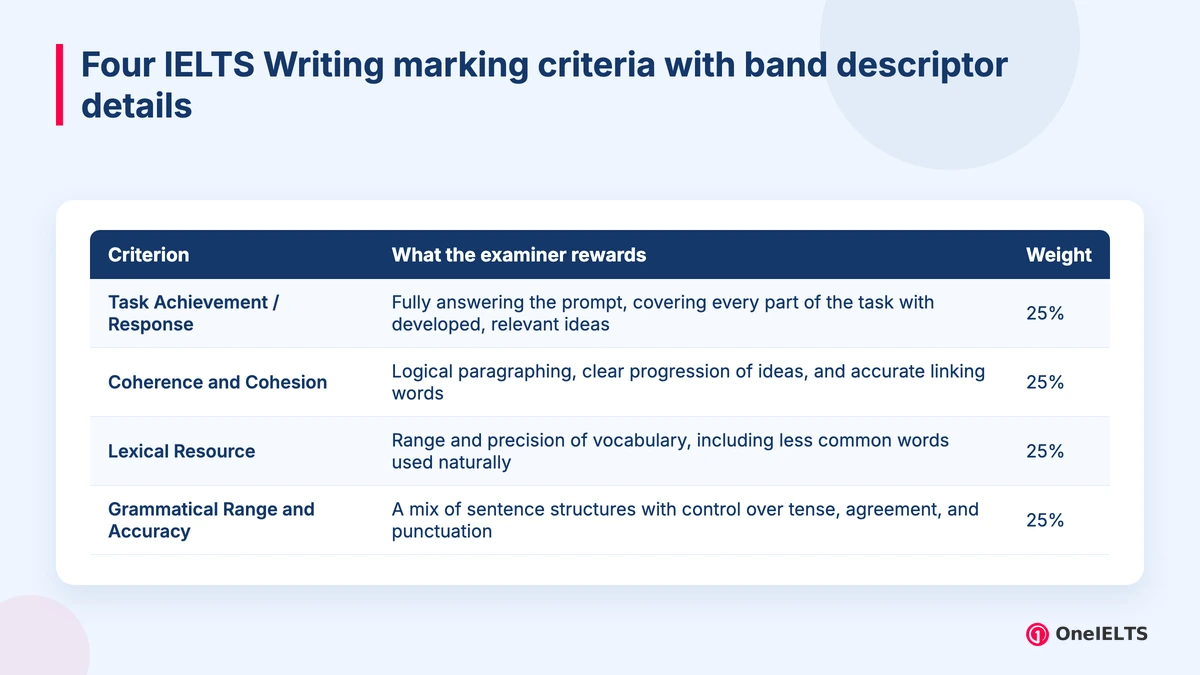
The IELTS Writing band is built from four marking criteria, and the table below shows what each one rewards and how much it counts.
| Criterion | What the examiner rewards | Weight |
|---|---|---|
| Task Achievement / Response | Fully answering the prompt, covering every part of the task with developed, relevant ideas | 25% |
| Coherence and Cohesion | Logical paragraphing, clear progression of ideas, and accurate linking words | 25% |
| Lexical Resource | Range and precision of vocabulary, including less common words used naturally | 25% |
| Grammatical Range and Accuracy | A mix of sentence structures with control over tense, agreement, and punctuation | 25% |
Because task achievement, coherence and cohesion, lexical resource, and grammatical range weigh 25% each, a weak score on any one pulls the whole Writing band down.
What Are the Four IELTS Speaking Marking Criteria?
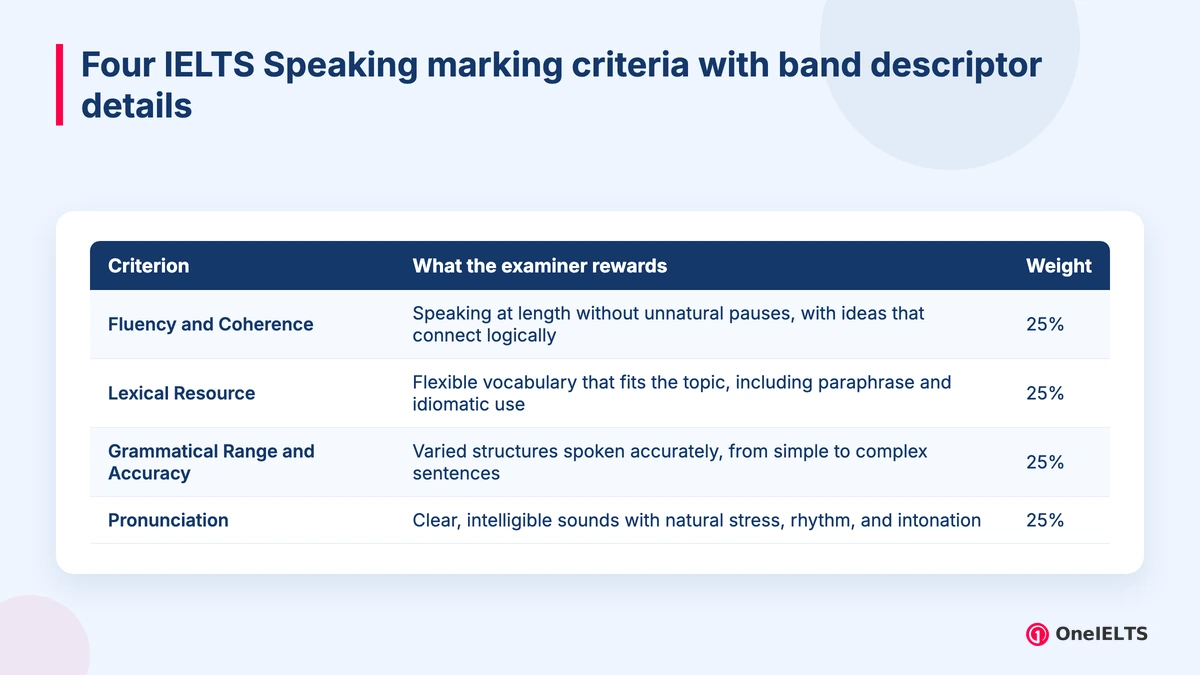
IELTS Speaking uses its own four criteria, set out here with the quality each one measures and its share of the band.
| Criterion | What the examiner rewards | Weight |
|---|---|---|
| Fluency and Coherence | Speaking at length without unnatural pauses, with ideas that connect logically | 25% |
| Lexical Resource | Flexible vocabulary that fits the topic, including paraphrase and idiomatic use | 25% |
| Grammatical Range and Accuracy | Varied structures spoken accurately, from simple to complex sentences | 25% |
| Pronunciation | Clear, intelligible sounds with natural stress, rhythm, and intonation | 25% |
Fluency and coherence, lexical resource, grammatical range and accuracy, and pronunciation count 25% each, so pronunciation alone can hold back an otherwise strong performance.
How Do Band Descriptors Translate Into a Band Score?
Listening and Reading convert a raw mark out of 40 into a band using a fixed table, with no examiner judgement involved. Writing and Speaking instead average the four criterion bands an examiner awards. The four section bands are then averaged and rounded to the nearest half band, or to a whole band, to produce your overall band. Because each skill rests on an average of four criteria or a raw score conversion, the maths rewards even strength across the board.
What Does Each IELTS Band Descriptor Level Mean?
Each whole band carries a named descriptor label that signals how well you handle English, summarised in the table below for the headline levels.
| Band | Descriptor label | What it signals |
|---|---|---|
| Band 9 | Expert user | Full operational command of English; accurate, fluent, and complete understanding |
| Band 8 | Very good user | Fully operational command with only occasional unsystematic inaccuracies |
| Band 7 | Good user | Operational command, with occasional inaccuracies in unfamiliar situations |
| Band 6 | Competent user | Generally effective command despite some inaccuracies and misunderstandings |
| Band 5 | Modest user | Partial command, coping with overall meaning in most situations |
These short labels keep band meaning skimmable. An expert user, very good user, or competent user result maps to detailed wording, and that full per-criterion text lives in the official PDFs.
How Can You Use Band Descriptors to Raise Your Score?
Using band descriptors to study means scoring your own answers the way an examiner would, then spending your practice time on the criterion that is dragging the band down. In my own marking of practice essays, candidates most often lose half a band by treating all four criteria as one lump rather than fixing the weakest one first. The five practical uses below turn the rubric into a study plan.
- Self-assess against each criterion. Read your answer once per criterion and self-assess it, giving each of the four a band rather than judging the whole piece at once.
- Target the lowest-scoring criterion first. Find your weakest criterion and fix it first, because lifting a band-6 area gains more than polishing a band-8 one.
- Learn the band 7 vs band 8 wording. Compare the band 7 vs band 8 wording in the descriptor so you know the exact gap, such as wider vocabulary range or fewer errors, you must close.
- Mark your own essays. Mark your own essays against the public rubric weekly, recording each criterion band so you can track which area is improving and which is stuck.
- Get criterion-mapped feedback. Ask a teacher for criterion-mapped feedback rather than a single score, so every comment ties to task response, cohesion, lexis, or grammar.
Where Can You Find the Official IELTS Band Descriptors?
The official public-version descriptors are published free by IELTS for Writing and Speaking, so you can download the same Writing and Speaking rubric the examiners use. The public version PDF on ielts.org is the same rubric used by examiners worldwide, which is why scoring your own work against it mirrors a real marking session. For how those criterion bands roll up into your final number, see our IELTS band score guide.
How Are Listening and Reading Bands Decided Without Descriptors?
Listening and Reading bands come from a fixed raw-score-to-band table, not examiner descriptors, so your band depends only on how many of the 40 questions you answer correctly. Your raw score out of 40 feeds a published conversion table, and Academic vs General Training Reading use different conversion tables because the General Training texts are easier. For practice that builds that raw score, work through our IELTS Listening guide.
Last verified: 30 June 2026
Practice for the Real IELTS Exam
Apply what you’ve learned with free, exam-style practice:
- Take a full IELTS mock test
- Practice by section: Listening, Reading, Writing, Speaking
- Structure your essays with IELTS Writing templates