To immigrate to Canada you convert your four IELTS General Training band scores into a Canadian Language Benchmark level, and Express Entry then reads that level. Most economic routes want CLB 7, which is IELTS 6.0 in every skill. The Canadian Language Benchmark is Canada’s official yardstick for English, and the IELTS to CLB mapping happens one skill at a time, never on your overall band. That per-skill conversion is the catch: your CLB is set by your weakest section, so a 7.5 average with a 5.5 in Writing still drops you below the floor. This guide covers what the benchmark is, how the conversion works, the level Canadian immigration needs, the score behind CLB 9, the full chart, and how to calculate your own CLB.
What Is the Canadian Language Benchmark (CLB)?
The Canadian Language Benchmark is Canada’s 12-level scale for measuring English ability, and Immigration, Refugees and Citizenship Canada (IRCC) uses it to judge language in immigration applications. It runs from CLB 1 for a near-beginner up to CLB 12 for an expert user. This 12-level scale gives IRCC a single ruler that every approved test maps onto. For IELTS, IRCC converts your General Training scores into a CLB level, and that level is what Express Entry actually scores rather than the raw band.
How Do You Convert IELTS to CLB?
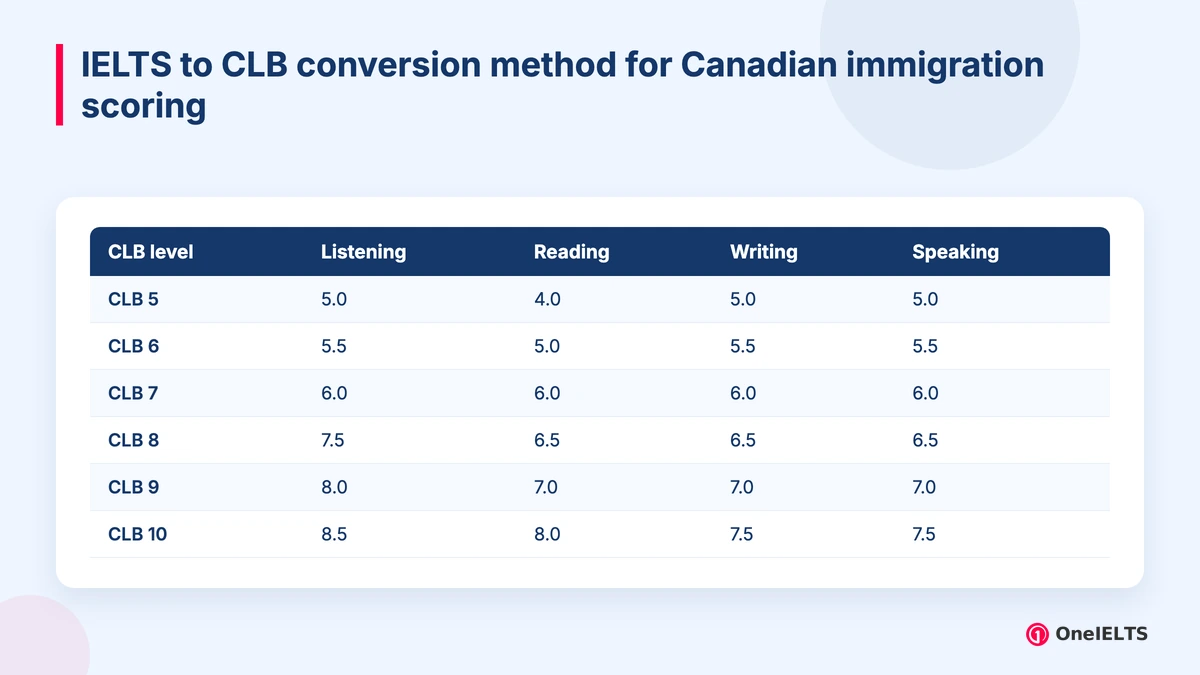
You convert IELTS to CLB by reading each skill against IRCC’s official conversion, where the rule of thumb that anchors the table is CLB 7 = 6.0 each. The table below maps the per-skill bands for General Training onto CLB levels 5 through 10.
| CLB level | Listening | Reading | Writing | Speaking |
|---|---|---|---|---|
| CLB 5 | 5.0 | 4.0 | 5.0 | 5.0 |
| CLB 6 | 5.5 | 5.0 | 5.5 | 5.5 |
| CLB 7 | 6.0 | 6.0 | 6.0 | 6.0 |
| CLB 8 | 7.5 | 6.5 | 6.5 | 6.5 |
| CLB 9 | 8.0 | 7.0 | 7.0 | 7.0 |
| CLB 10 | 8.5 | 8.0 | 7.5 | 7.5 |
What CLB Level Do You Need for Canadian Immigration?
Most applicants need CLB 7, which means IELTS 6.0 in every skill, the CLB 7 floor that IRCC sets for the Federal Skilled Worker Program and most Express Entry routes. The Comprehensive Ranking System scores language directly, so a higher benchmark earns more CRS points and lifts you up the draw. Some streams sit lower than that floor. The CLB 5 trades route is the clearest case, since several skilled-trades and Provincial Nominee Program categories accept CLB 5 from a strong tradesperson.
What IELTS Score Equals CLB 9?
CLB 9 needs IELTS 8.0 Listening, 7.0 Reading, 7.0 Writing and 7.0 Speaking — the 8/7/7/7 split that IRCC treats as advanced English. Reaching CLB 9 earns the maximum CRS points for language, which is what pushes a profile above the cut-off in competitive Express Entry draws. Score below 8/7/7/7 and IRCC drops your language points, even when your overall band still looks high.
What Is the IELTS to CLB Conversion Chart?
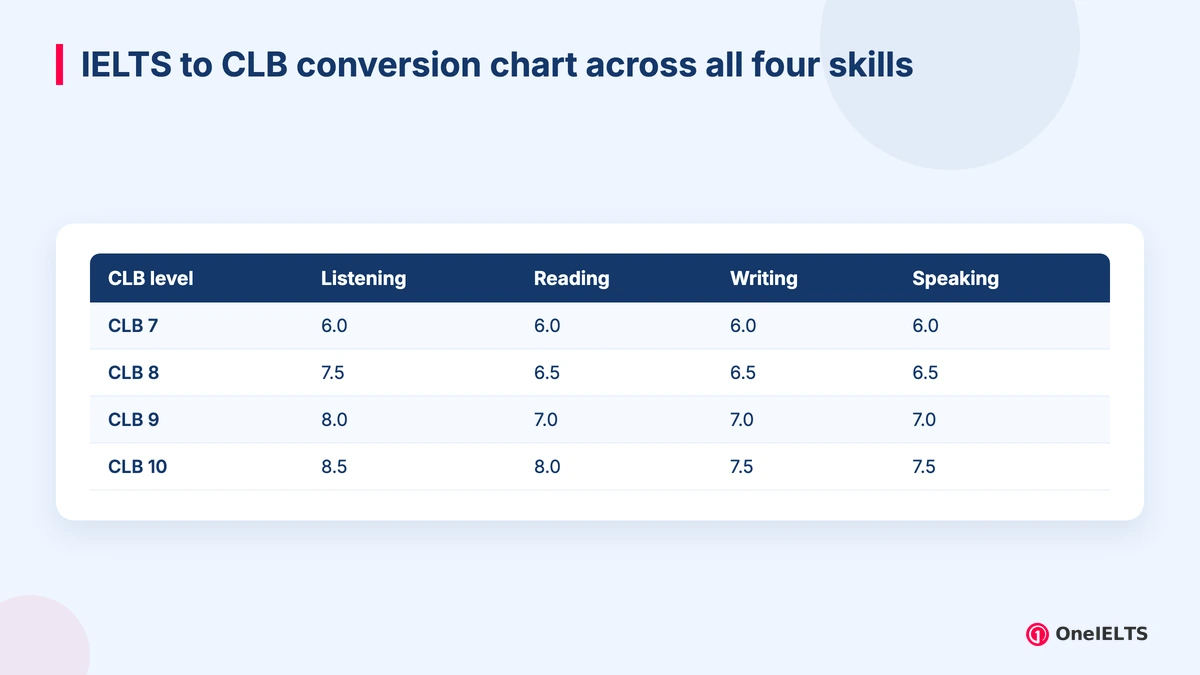
The chart below sets out the IRCC equivalency chart for General Training, listing the per-skill bands for the higher CLB 7/8/9/10 levels that economic immigration cares about most. Read it down each column, because IRCC scores the chart per skill, not by your overall band.
| CLB level | Listening | Reading | Writing | Speaking |
|---|---|---|---|---|
| CLB 7 | 6.0 | 6.0 | 6.0 | 6.0 |
| CLB 8 | 7.5 | 6.5 | 6.5 | 6.5 |
| CLB 9 | 8.0 | 7.0 | 7.0 | 7.0 |
| CLB 10 | 8.5 | 8.0 | 7.5 | 7.5 |
How Do You Calculate Your CLB From IELTS Scores?
Working out your benchmark means turning four skill bands into one number, and the lowest skill governs the result. The steps below walk through the calculation that decides your Express Entry points.
- Take your four IELTS General Training band scores. Read your Listening, Reading, Writing and Speaking results off the Test Report Form as four separate numbers, not as one rounded overall band.
- Map each to CLB using the table. Match every skill against the IRCC conversion above, so you map each to CLB level on its own — your Reading band gives a Reading CLB, your Writing band gives a Writing CLB.
- Take the lowest of the four. Your reported benchmark is the weakest of those four skill levels, because the lowest skill governs what IRCC records — one CLB 6 skill caps you at CLB 6.
- Use that CLB for Express Entry points. Enter that single benchmark into your profile, since IRCC awards Express Entry points off that level and not off your IELTS overall band.
Why Does Your Lowest Skill Decide Your CLB?
IRCC benchmarks each skill separately, so your weakest section sets your effective CLB. Each skill carries its own per-skill benchmark, and a single weakest section drags the whole profile down to its level. This is why a high overall does not count for Express Entry. A 7.5 average with one CLB 6 skill is recorded as CLB 6, which can sink eligibility you thought you had. For the wider picture, our IELTS for Canada guide sets out how each benchmark feeds the immigration routes.
Does CLB Use Academic or General Training IELTS?
For immigration, CLB uses IELTS General Training, not Academic. IRCC maps the General Training module onto the benchmark for economic immigration, so that is the version Express Entry expects. Academic is built for university admission rather than immigration use, and it does not feed an Express Entry language score. If you are unsure which module fits your goal, our IELTS Academic vs General Training comparison breaks down the difference.
Last verified: 30 June 2026
Practice for the Real IELTS Exam
Apply what you’ve learned with free, exam-style practice:
- Take a full IELTS mock test
- Practice by section: Listening, Reading, Writing, Speaking
- Structure your essays with IELTS Writing templates