


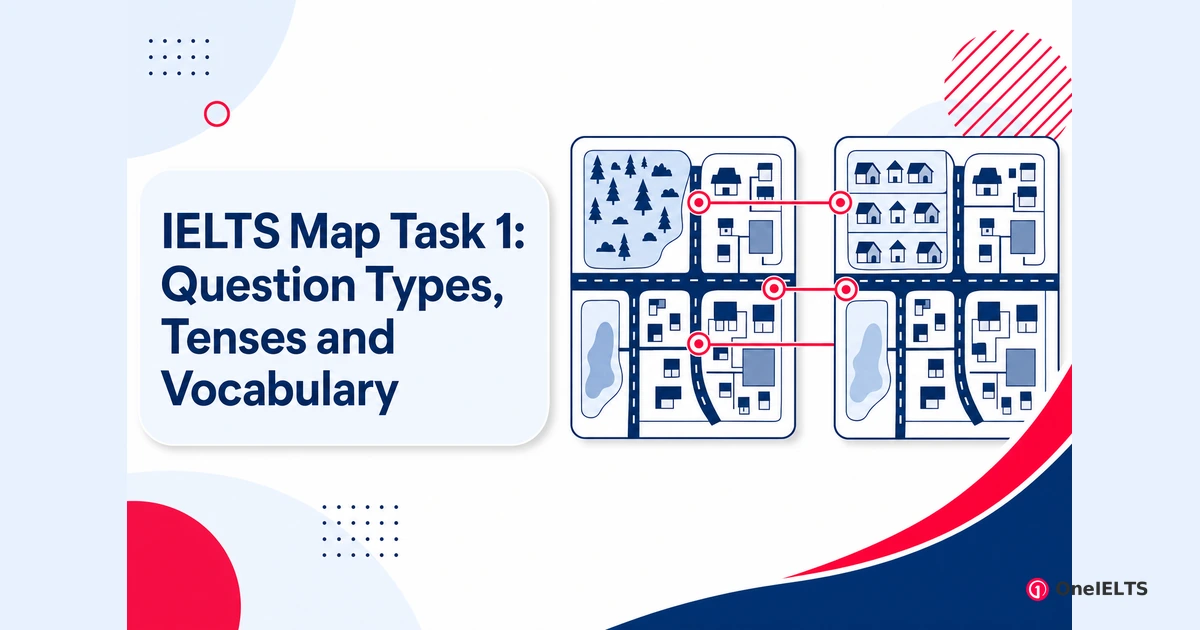
An IELTS Task 1 map prompt shows a place from above, at two or three dates or once with no dates at all, and asks for a 150-word report in 20 minutes. There are two map question types, not one, and most guides teach only the first.
A time-invariant map shows one undated place, and none of the before-and-after machinery runs on it.
The second decision is the paragraph split. Splitting by date is the intuitive choice and it is the one that removes the comparison requirement from your answer.
One property drives it. A map carries no numbers, so there is no trend to report and the overview cannot be built the way every other Task 1 overview is built. This guide covers the two types, the single map, the main features, the overview, the detail paragraphs, tenses, direction words, a model answer, scoring high and practice.
What Is an IELTS Task 1 Map Question?
An IELTS Task 1 map question is an Academic Writing Task 1 prompt showing a place from above, whether a town, a village, a site, an island or the floor plan of a building. It usually asks you to describe how the place changed between two or three dates.
Three sub-shapes turn up and each one reads differently. A town or area over time, a site development before and after building work, and a floor plan. Floor plans are worth naming because a candidate who has only ever seen towns will not recognise one as a map prompt.
The property that governs this whole page is the absence of figures. A map is a figure-free visual, so there is nothing to select and rank, and the marks come from what changed, where it sits, and the grammar you change it with.
One confusion is worth clearing early. A before and after pair is one visual shown twice, not two visuals, so it is not a multiple-chart question and it is not marked like one.
The 150-word minimum, the 20 minutes and the four criteria belong to the IELTS Writing Task 1 hub.
Which Two Types of Map Question Can You Get?
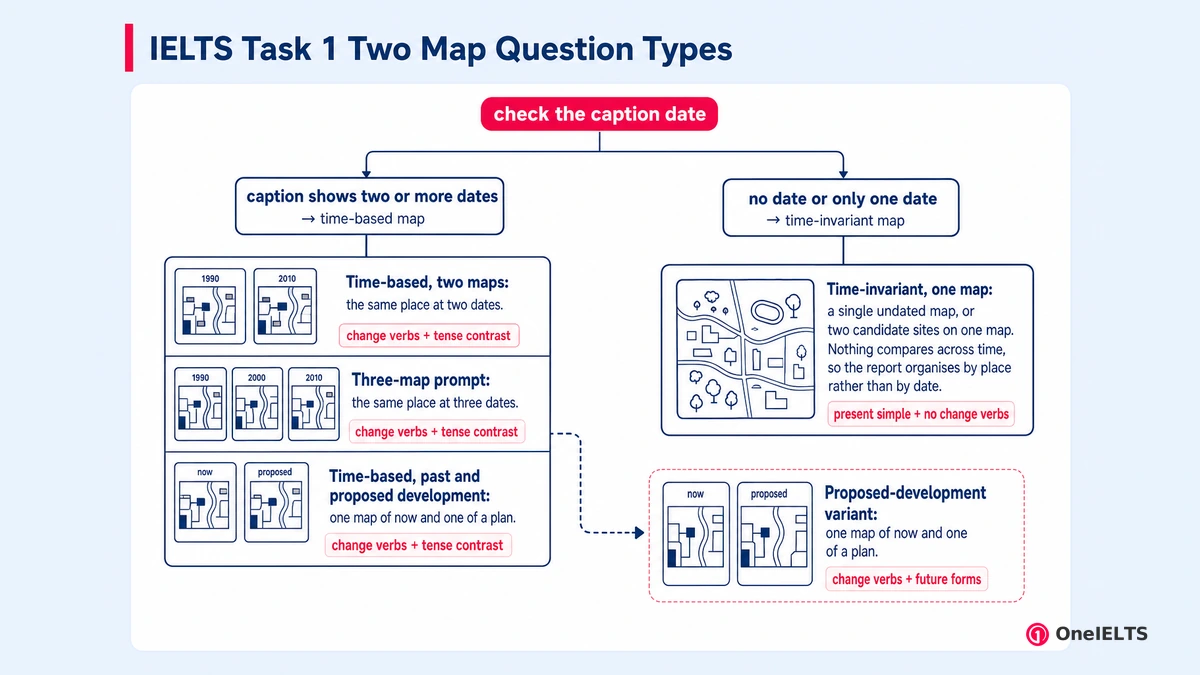
Two: a time-based map, and a time-invariant map. The first shows the same place at two or three dates and asks about the changes. The second shows one place once, with no dates and no changes, and asks what is there.
The test owner’s own guidance names both types and gives each one a heading. Most preparation guides teach only the first. One of the most widely read opens by defining the map question as a comparison of three maps in different time periods, which is true of the type it teaches and untrue of the other.
- Time-based, two maps: the same place at two dates. The commonest shape by far, and the one every method on the internet is written for.
- Three-map prompt: the same place at three dates. Rarer, and it forces a three-body structure or a grouped one, because two paragraphs cannot carry three time points evenly.
- Time-based, past and proposed development: one map of now and one of a plan. Everything after the overview switches into future forms, because the changes have not happened.
- Time-invariant, one map: a single undated map, or two candidate sites on one map. Nothing compares across time, so the report organises by place rather than by date.
Telling them apart takes one move. Read the caption date first, and if there is no date or only one, you are in the second family and the change verbs and tense contrasts below do not apply.
Readers do search for the single-map case by name, which is why it gets its own section rather than a footnote.
How Do You Answer a Time-Invariant Single Map Question?
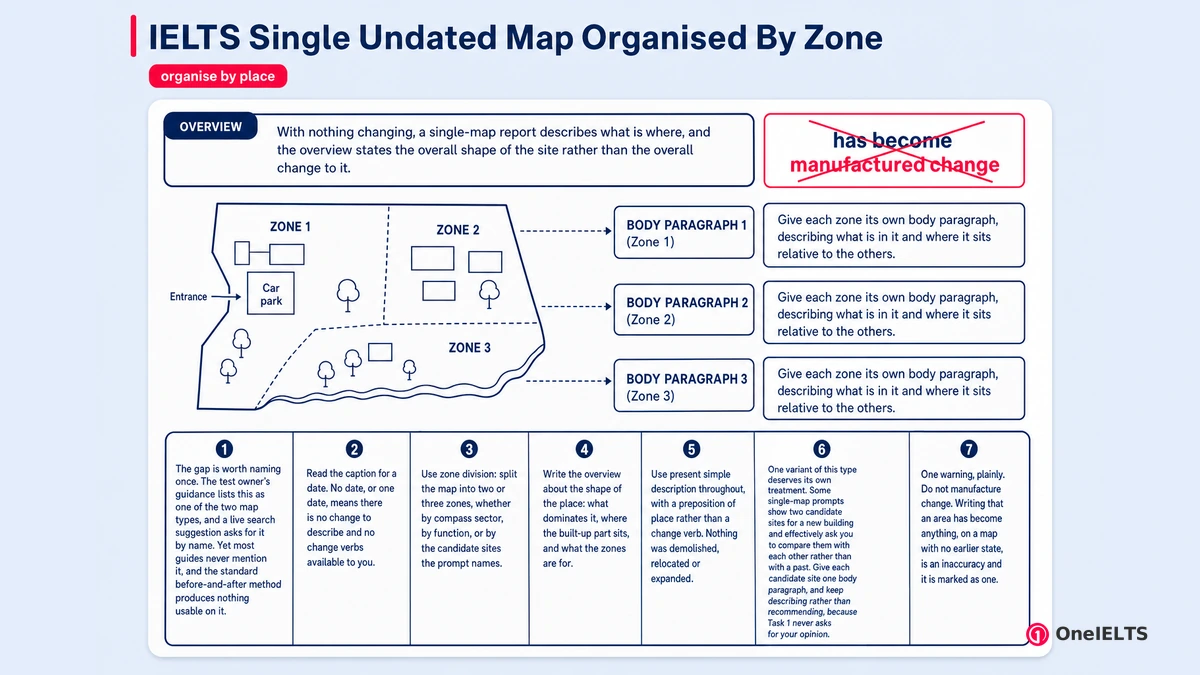
Organise by place instead of by time. With nothing changing, a single-map report describes what is where, and the overview states the overall shape of the site rather than the overall change to it.
The gap is worth naming once. The test owner’s guidance lists this as one of the two map types, and a live search suggestion asks for it by name. Yet most guides never mention it, and the standard before-and-after method produces nothing usable on it.
- Read the caption for a date. No date, or one date, means there is no change to describe and no change verbs available to you.
- Use zone division: split the map into two or three zones, whether by compass sector, by function, or by the candidate sites the prompt names.
- Write the overview about the shape of the place: what dominates it, where the built-up part sits, and what the zones are for.
- Give each zone its own body paragraph, describing what is in it and where it sits relative to the others.
- Use present simple description throughout, with a preposition of place rather than a change verb. Nothing was demolished, relocated or expanded.
One variant of this type deserves its own treatment. Some single-map prompts show two candidate sites for a new building and effectively ask you to compare them with each other rather than with a past. Give each candidate site one body paragraph, and keep describing rather than recommending, because Task 1 never asks for your opinion.
One warning, plainly. Do not manufacture change. Writing that an area has become anything, on a map with no earlier state, is an inaccuracy and it is marked as one.
How Do You Identify the Main Features on a Map?
Look for four kinds of change and nothing else: what is new, what has gone, what has moved, and what has changed size or purpose. Anything on the map outside those four is detail you do not have the words for.
- New: a new structure in the later map that is absent from the earlier one, built on empty land or on the site of something removed.
- Gone: a removed feature from the earlier map with nothing in its place, or with something else standing there instead.
- Moved: a relocated building, meaning the same feature in a different position, which is one move rather than a demolition plus a construction.
- Changed: the same feature made larger, smaller, or given a change of use such as a factory becoming flats.
- Unchanged: an unchanged feature that stayed exactly as it was. These earn a sentence too, because a report of changes alone has not described a place.
The four types are how you group the features, not just how you spot them, and that is what separates a band 7 selection from a band 5 one. Two changes of the same kind in opposite corners of the map belong in the same sentence.
Three to five features across the whole report is the number to aim at. A map usually offers ten or more and the word count only pays for a handful of them.
How Do You Write the Overview for a Map?
Two sentences straight after the introduction, describing the overall character of the change rather than any single change. Typically that the place became more built up, more industrial, more residential or more open, plus one thing that stayed the same.
Here is the problem nobody else names, and it is why candidates freeze at this paragraph. Every other Task 1 overview is built out of a trend: a rise, a fall, a largest and a smallest. A map has no figures and therefore no trend, so the reader has nothing to summarise in the way they were taught.
One source states it directly: an IELTS map is different from a chart or a table because there are not usually any key changes or trends to identify.
The published band descriptors quietly supply the replacement. Band 7 asks for a clear overview of main trends, differences or stages, and a map overview is built out of the second word rather than the first.
- The direction of the change as a whole: more built up, more industrial, more residential, greener, or more open than before.
- The single biggest change on the map, named without figures and without compass points attached to it.
- One unchanged feature, which is what turns a list of changes into a description of a place.
Two rules hold across every source. The overview carries more weight than any other paragraph in Task 1, and it must not contain detail. The descriptors put it plainly: band 5 recounts detail mechanically with no clear overview, and band 6 presents an overview with information appropriately selected.
Keep compass directions out of it. They belong in the body paragraphs, and in the overview they turn a general statement into a specific one, which is the opposite of what the paragraph is for. Begin with a signal phrase so the paragraph is unmistakable, for example Overall or Looking at the maps.
How Do You Write the Detail Paragraphs for a Map?
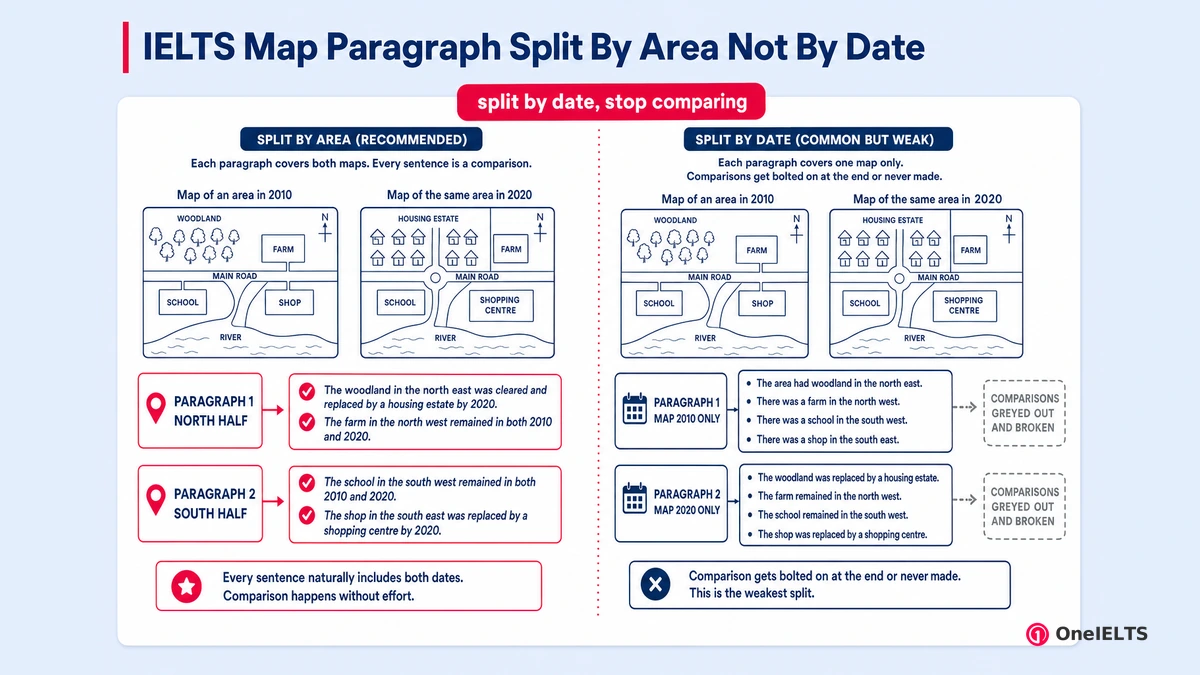
Split the body by area or by feature, never by date. Writing everything about the first map and then everything about the second is the intuitive split, and it is the one that stops you comparing.
Four splits appear across the guides: by date, by feature, by size of change, and by changed versus unchanged. Exactly one source states what the first of those costs, and it is the most decisive sentence on this search. Divide the information into paragraphs based on different time periods, and you will not be comparing.
- By area division: north half in one paragraph, south half in the other. The recommended default, because every sentence naturally contains both dates and comparison happens without effort.
- By feature tracking: roads and transport in one paragraph, buildings and land use in the other. Equally good, and better when the changes cluster by type rather than by place.
- By size of change: the biggest change first and the rest after. It works, but it needs judgement about what counts as biggest and it can leave an unbalanced second paragraph.
- The date-by-date split: the whole first map, then the whole second. Intuitive, widely used in published samples, and the weakest, because the comparison gets bolted on at the end or never made.
A comparing sentence is the mechanism the whole section exists for, and it looks like this: the woodland in the north east was cleared and replaced by a housing estate by 2020. One sentence, one feature, both states.
Two body paragraphs cover two maps. For three maps, use either three short paragraphs or two grouped by area, and never one paragraph per map plus a summary.
Which Tenses and Sentence Structures Do Map Essays Use?
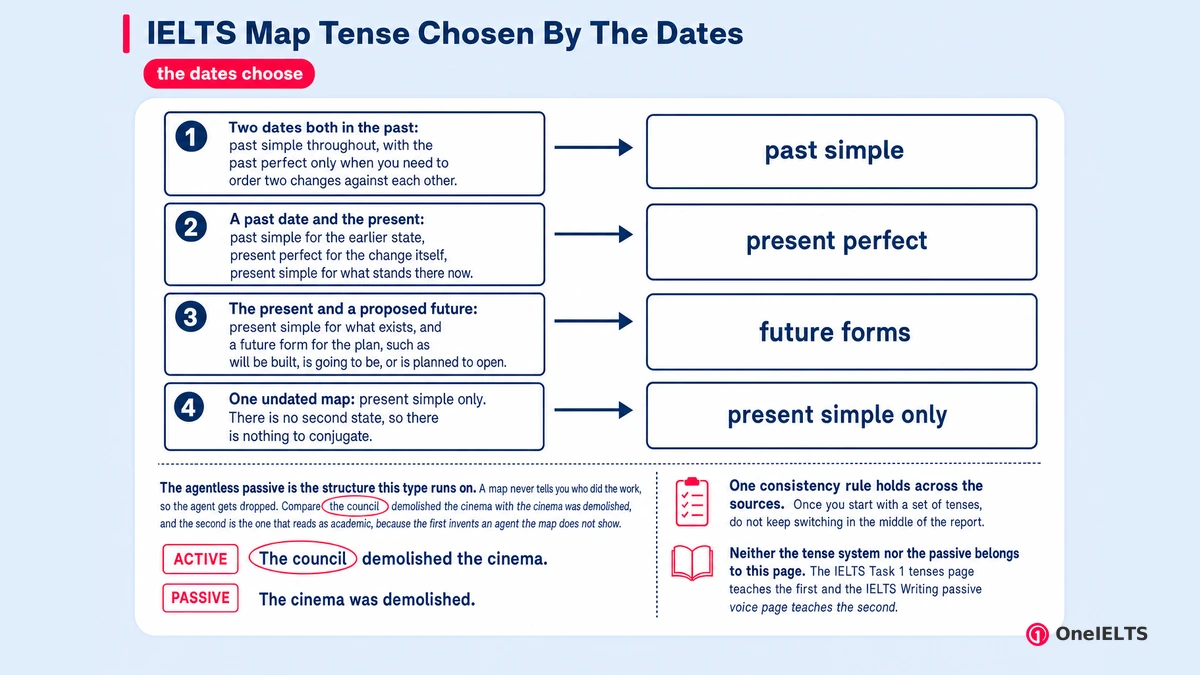
The dates on the maps choose the tense, not you. And whichever date pairing you land on, the passive does most of the work, because who built the thing is never shown.
The coverage gap here is measurable. Across the ten guides captured for this page, only one uses the term past simple at all and only two mention the present perfect. Two say nothing about tense whatsoever, on a question type whose entire difficulty is tense.
- Two dates both in the past: past simple throughout, with the past perfect only when you need to order two changes against each other.
- A past date and the present: past simple for the earlier state, present perfect for the change itself, present simple for what stands there now.
- The present and a proposed future: present simple for what exists, and a future form for the plan, such as will be built, is going to be, or is planned to open.
- One undated map: present simple only. There is no second state, so there is nothing to conjugate.
The agentless passive is the structure this type runs on. A map never tells you who did the work, so the agent gets dropped. Compare the council demolished the cinema with the cinema was demolished, and the second is the one that reads as academic, because the first invents an agent the map does not show.
One consistency rule holds across the sources. Once you start with a set of tenses, do not keep switching in the middle of the report.
Neither the tense system nor the passive belongs to this page. The IELTS Task 1 tenses page teaches the first and the IELTS Writing passive voice page teaches the second.
Which Words Indicate Directions on an IELTS Map?
Compass words when the map gives you a compass, a preposition of place when it does not, and neither of them in the overview. One source states the two-branch rule directly: if the map shows a compass, use it to fix locations; if it does not, describe position relative to other features instead.
One convention comes with it, and it is a convention rather than a rule. On a town or area map with no compass, north can normally be taken as directly up the page.
- Compass direction: in the north-east, on the western side, in the south-western corner. Only when the map supplies a compass.
- Relative position: opposite the school, across from the river, adjacent to the car park, between the road and the coast.
- Relative to the whole: in the centre, along the northern edge, at either end. Useful when a feature spans the map rather than sitting at one point.
A reader who has read two guides has met a contradiction here, and the context resolves it. One source advises avoiding specific locations when describing generally, while two others build whole sections on directional language. The advice against them is about the overview, where a compass point makes a general statement specific. In the body paragraphs, a locating method is the difference between a reader who can picture the place and one who cannot.
One instruction beats every word list. If the map has a key or a scale, read it and use its wording, because a map key supplies the labels the examiner expects. Map vocabulary itself has its own page and no list belongs here.
What Does an IELTS Map Writing Task 1 Model Answer Look Like?
Four paragraphs, about 170 words, every change expressed as a comparison, and no compass point in the overview. Read a model answer for its paragraph split and its verb forms, never for its sentences.
The demand on this search is loud and one-sided. Six of the eight related searches ask for a sample answer, a band 9 sample or a PDF, and the highest-ranking result is an archive of prompts with no method attached to it at all.
- The paragraph split. Work out whether the writer divided by area, by feature or by date, and whether the comparison survived the choice.
- The verb forms. Run a verb form count of the passives, then note which tense pairing the dates on the maps forced.
- The overview. Check whether it names an overall character or just lists the first two changes, which is the commonest weak version.
- The feature count. Three to five across the whole report is the target, and a model carrying twelve is not a model.
- Ignore the sentence patterns. Place names change every time and a memorised sentence rarely survives the next map.
The shape to hold in your head is simple enough: an introduction paraphrasing the prompt and naming both dates, then the overview, then body one and body two.
Length needs precise attribution. The 150-word minimum is the published rule. Beyond it, the most-read guide on this question type recommends a word range of about 170 to 190 and argues that a longer report loses marks for poor selection. That is an experienced teacher’s guidance rather than an IELTS rule. Going over is not itself penalised, and the IELTS Writing Task 1 hub covers that question.
How Do You Score High on an IELTS Maps Task?
Five things decide the band, and three of them are decisions you make before writing a word. Which map type you have, how you split the paragraphs, and which tense pairing the dates force.
- An overview that names the overall character of the change. Without one the published descriptors cap Task Achievement, and this overview requirement is the single most common omission.
- A paragraph split that forces comparison. Split by area or feature and every sentence compares; split by date and the comparison may never happen at all.
- Tense chosen by the dates and held to the end. Tense consistency matters because switching mid-report reads as not having understood the maps.
- Feature grouping: three to five features, grouped, with the unchanged ones mentioned. Not ten features listed, and not two described at length.
- Location language in the body and none in the overview. The examiner needs to picture the place and the overview needs to stay general.
Two failure modes exist only on this type and both are an accuracy error rather than a style one. Describing a single undated map as though it had changed, and describing a proposed development in the past tense. Each says something about the maps that is not true, and each is marked that way.
Three of the five are band decisions taken in the first two minutes, which is exactly what disappears under exam pressure. A timed IELTS Writing mock is the only place to find out whether yours survive.
How Do You Practise IELTS Map Task 1 Questions?
Practise the three pre-writing decisions on ten prompts before you write a single full report, because on this type the band is mostly decided before the first sentence.
- Take ten map prompts and write three things for each: the map type, the tense pairing the dates force, and the paragraph split you would use.
- On five of them, write only the overview, meaning two sentences naming the overall character and one unchanged feature. Five overviews cost less than one report.
- Write one full report untimed, then count your features. More than five and you are listing rather than selecting.
- Write two more as a timed report of twenty minutes each, checking the clock as you finish the overview. It should read about minute eight.
- Mark your own report for Task Achievement first. Is there an overview, does every body sentence compare, and did you mention anything that stayed the same?
Step one is the decision drill and it needs its reason stated. The two mistakes this type punishes hardest, a wrong tense and a split that removes comparison, are both made in the first two minutes and neither is visible once the report is written.
The overview drill in step two and the feature count check in step three catch different failures, and self-marking in step five catches what is left. The ten prompts come from IELTS Task 1 map practice. It is filtered to map questions only, so every prompt you open is the type you are drilling. Practising needs a free OneIELTS account.
How Do You Structure a Map Description?
Four paragraphs: introduction, overview, body one, body two. That is the same report skeleton as every other Task 1 answer, and only the contents of the overview change.
One instruction is map-specific and the shared shape does not cover it. The introduction with dates has to name both of them, not just the place, because the dates are what tell the examiner which tense pairing you are working in.
The three-map variant takes either three short body paragraphs or two grouped by area. Never three plus a summary, because that paragraph count pushes the report past its word budget without adding a comparison.
The four-paragraph shape is a Task 1 rule rather than a map rule, and the IELTS Writing Task 1 page owns it.
Which Vocabulary Describes Infrastructure and Buildings on a Map?
A small closed set, covering the nouns for what appears on a town or site map and the words for the kind of area it sits in. It stays closed because maps reuse the same dozen structures.
Four categories cover almost everything. A structure noun for buildings, a transport feature for roads and access, land use for farmland, industry and green space, and a water feature for rivers, lakes and the coast. The categories matter more than the words, because a reader who knows the four can scan any map systematically instead of hunting.
One instruction beats any word list you could memorise. Use the map key wording the prompt supplies. It is free, it is correct, and it is the language the examiner expects to see. The IELTS map vocabulary page holds the sets themselves.
Which Words Describe Actions and Changes to a Map?
Five change verb family groups, plus one for what stayed the same. Every change on any map falls into one of the six.
One example verb each is enough to show the shape: constructed, demolished, relocated, extended, converted, and remained unchanged. A relocation, an extension and a conversion are three different claims about the same two maps, and choosing between them is the analysis rather than the vocabulary.
That is the point worth taking. The verb you choose is the analysis. Saying a building was relocated rather than demolished and rebuilt tells the examiner you read the two maps against each other instead of describing them one at a time.
Most of these verbs appear in the passive on this question type, for the reason the tense section above gives. An unchanged feature takes the active, because nothing was done to it.
Where Can You Find Sample Map Questions and Answers?
On a practice set filtered to map questions, so the prompts you drill are all the type you are drilling and both map families show up rather than only the before-and-after pair.
Filtering matters more on this type than on most. A prompt archive mixes a map prompt in with the other Task 1 types, and the biggest collection on this search is a raw list with no method attached. A filtered practice set gives you the question shape without the noise, and the question-type filter does that work before you open anything.
That makes a filtered set the better drill source. IELTS Writing Task 1 map practice opens only this type. Practising needs a free OneIELTS account. One thing to know: a practice link carries the question type but not the exam type, so check the exam type if you have been working in General Training mode.
Written by Jamil Ahmed, reviewed 14 August 2026.
Last verified: 14 August 2026
Practice for the Real IELTS Exam
Apply what you’ve learned with free, exam-style practice:
- Take a free IELTS mock test — all four skills, real exam timing, AI band scoring
- Sit a Writing section mock — Task 1 and Task 2 in one timed hour with a band estimate
- Practise by question type — self-paced Writing sets with model answers