IELTS Task 1 vocabulary is a small closed set: the words for what moved, in which direction, by how much and when, plus the language for how big a share something is. Roughly forty items in total.
Every guide tells you to alternate a trend verb with its noun to show range. Almost none states the word-order rule that makes the swap grammatical. A verb takes an adverb after it; a noun takes an adjective in front of it. Get that backwards and form switching produces the error the advice invites. Strength is the second decision, because a degree adverb is a claim about the data.
Learn this functional word set by function rather than by chart type. The sections run trend, form switching, degree, stability, comparison, percentages, figures, time, words to avoid, chart-type extensions and practice.
What Is Vocabulary in IELTS Writing Task 1?
Task 1 vocabulary is the working set of words used to report data. It covers the verbs and nouns for a change, the adverbs and adjectives for its size, the language of comparison and quantity, and the time expressions that anchor all of it.
The size is the reassuring part. This is one of the smallest high-yield sets in the whole exam, at roughly forty items across six functions. That functional word set is closed vocabulary rather than an open list, and it carries any chart, table, graph or diagram. The sections below take the six in turn.
Direction of change comes first, then size of change, then stability. Comparison follows, then quantity language for shares and figures, then time. Every one of those is a job the sentence has to do, which is why the set is grouped this way.
One misconception the search results create is worth clearing early. The set is not chart-specific. A bar chart and a line graph showing change over time need the same words, and only maps, processes and letters need genuinely different ones. The 150-word minimum, the four criteria and the overview belong to the IELTS Writing Task 1 hub rather than here.
Which Vocabulary Describes Increase and Decrease?
About a dozen verbs run in each direction, and every one has a noun form you will also need. Learn each noun pair from the start, verb and noun together, because the range instruction that follows depends on having both. Five groups cover the movement.
- UPWARD, regular strength: rise / a rise, increase / an increase, grow / growth, climb / a climb, go up. No upward trend verb here claims a size.
- UPWARD, strong: soar, rocket, surge, jump, peak. Reserve every one of these for a change that really is dramatic, because the strength is a claim about the data.
- DOWNWARD, regular strength: fall / a fall, decrease / a decrease, decline / a decline, drop / a drop, dip / a dip. These are the downward trend verb equivalents of group one.
- DOWNWARD, strong: plummet, plunge, collapse, slump. The same rule applies, since the word asserts a magnitude and the magnitude has to be there.
- IRREGULAR: fluctuate / a fluctuation, vary / a variation, and the pair for the extremes, peak and trough. Use these when the line has no single direction.
The verb collocation notes are scattered across the sources and collected nowhere. You reach a plateau and you reach a peak. You fall to a low point or you hit a low point, and only the first of those takes to. IELTS Liz flags the same shift on the noun: to peak at, but a peak of.
One distinction is worth carrying away because a single source draws it and everyone else blurs it. Improve and an improvement describe a situation rather than a number. Use them for an economic condition or an employment rate, and use increase for a quantity. That is a magnitude claim of a different kind, and mixing the two reads as imprecision.
How Do You Switch Between Verb and Noun Forms in Task 1?
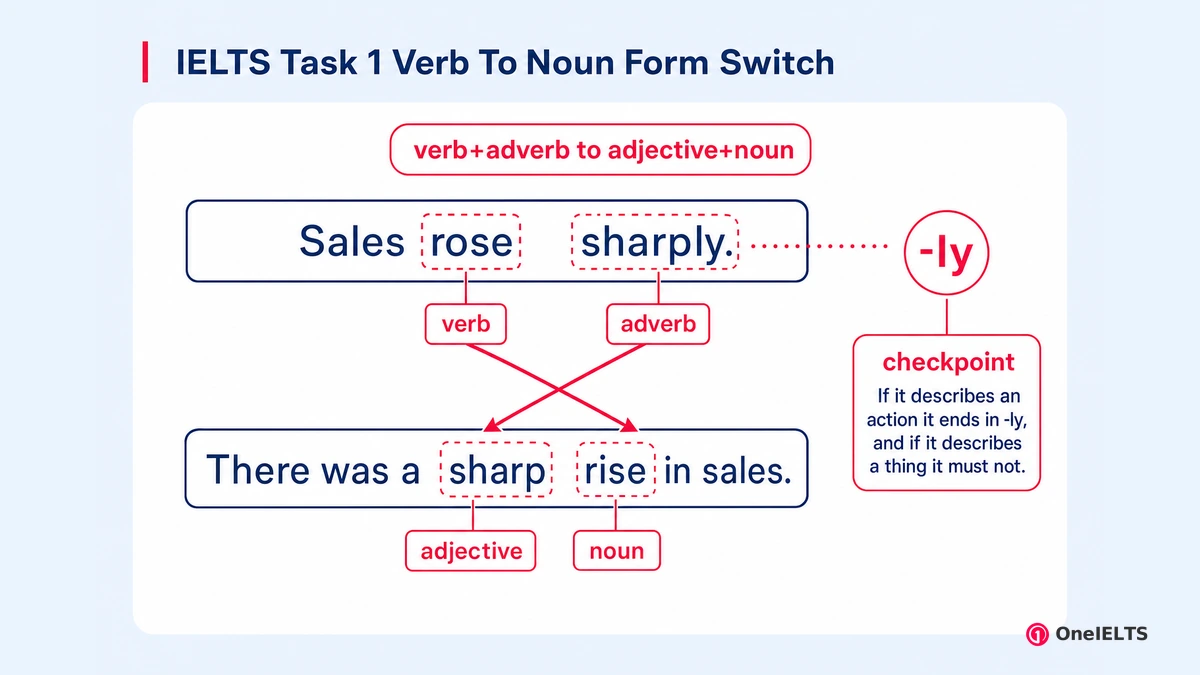
Change the word class on both sides of the pair, not one. Verb plus adverb becomes adjective plus noun: a verb takes an adverb after it, and a noun takes an adjective in front of it. Swap the verb for its noun and you must swap the adverb for its adjective too, then launch the new sentence with There was.
Start with what the advice leaves out. Nine pages tell the reader to alternate between the two forms. The test owner writes it this way.
“Remember that you can switch between different parts of speech to show that you have a range of vocabulary.”
IELTS Liz puts it as “You should alter your sentences to use the noun form of the word and the verb form of the word”.
Almost none of them states the word-order rule that makes the alternation grammatical, and several print the two forms as facing table columns with no instruction at all. The result is predictable. A candidate told to vary writes “a significantly increase” or “it increased significant”. The conversion runs in five steps.
- Start from the verb version, which is subject plus verb plus adverb. Sales rose sharply.
- Take the noun form of the verb, so that rose becomes a rise.
- Take the adjective form of the adverb, so sharply becomes sharp. This is the step that gets missed.
- Launch the noun version with There plus was or were plus a or an. There was a sharp rise.
- Reattach the subject with a preposition, giving There was a sharp rise in sales.
One page in nine states the pattern in as many words: “The word order is normally verb + adverb”, and “Adjectives describe things and they go BEFORE a noun. The word order is Adjective + Noun”. The same page supplies the launcher nobody else does, “There + a form of the verb TO BE + the article before the adjective and noun”.
Most trend words keep the same spelling in both classes, which is why the swap sounds easy. Four do not, and the same page is the only one to list them.
“Fortunately, most of the verbs have the same spelling or form when they are nouns. Just be careful with the EXCEPTIONS: To grow becomes the noun growth. To fluctuate becomes the noun fluctuation. To reduce becomes reduction. To lose becomes a loss”
An irregular noun form is not the only thing that moves. The stress shift is worth knowing because you will use this word set aloud in Speaking Part 3: “Verb: To inCREASE. Noun: an INcrease.”
The self-check is one question. Read the sentence back and ask which word is doing the describing. If it describes an action it ends in -ly, and if it describes a thing it must not.
Which Line Graph Adverbs and Adjectives Show Degree of Change?
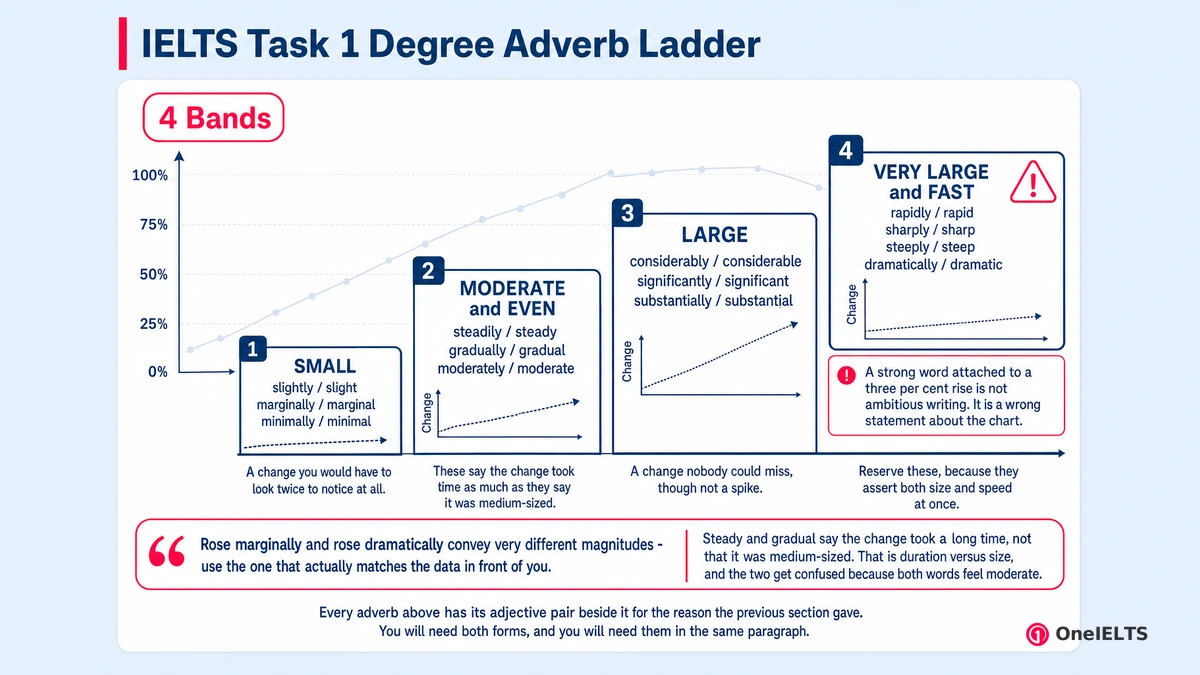
Four bands of strength, and picking the wrong band is an accuracy error rather than a style one. The adverb is a claim about how big the change was, and the examiner is looking at the same chart you are. The ladder runs weakest to strongest.
- SMALL: slightly / slight, marginally / marginal, minimally / minimal. This degree band covers a change you would have to look twice to notice at all.
- MODERATE and EVEN: steadily / steady, gradually / gradual, moderately / moderate. These say the change took time as much as they say it was medium-sized.
- LARGE: considerably / considerable, significantly / significant, substantially / substantial. A change nobody could miss, though not a spike.
- VERY LARGE and FAST: rapidly / rapid, sharply / sharp, steeply / steep, dramatically / dramatic. Reserve these, because they assert both size and speed at once.
Adverb strength is what turns that ladder into a rule. One source puts the magnitude accuracy point exactly.
“Rose marginally and rose dramatically convey very different magnitudes – use the one that actually matches the data in front of you.”
A strong word attached to a three per cent rise is not ambitious writing. It is a wrong statement about the chart.
Band 2 hides a distinction the other sources miss. Steady and gradual say the change took a long time, not that it was medium-sized. That is duration versus size, and the two get confused because both words feel moderate.
Every adverb above has its adjective pair beside it for the reason the previous section gave. You will need both forms, and you will need them in the same paragraph.
Which Words Describe Stability and No Change?
A stability sentence uses a linking verb plus an adjective, not a verb plus an adverb. None of the words in this group ends in -ly, which trips up candidates who have just learned the adverb ladder. Five patterns cover everything that stayed put.
- The verbs are remain and stay, and remain is far more common in written reports.
- The stability adjective follows the verb: constant, steady, stable, unchanged, level. No -ly on any of them.
- The stronger version is level off, plateau or stabilise, for something that stops changing after a period of movement.
- The noun version is no change, no significant change or little variation, which lets you launch with There was.
- The near-miss group is broadly similar, roughly the same and virtually identical, for values that are close rather than static.
The -ly point deserves its own sentence. Remain steady and remained steadily look equally plausible to a learner, and only one of them is English, because a linking verb takes an adjective.
The plateau collocation is fixed: you reach a plateau, and levelled off is the verb form of the same idea.
Selection matters here more than vocabulary does. A feature that did not change is still a key feature, and an unchanged feature left out of the report means the data has not been described.
Which Vocabulary Do You Need for Making Comparisons?
Three patterns cover almost every comparison a Task 1 report needs: more or less than, as much as, and the superlative. A small set of phrases for saying that two things are close rounds it out, and two more groups handle order and contrast.
- DIFFERENCE: higher than, lower than, twice as high as, roughly half the level of, three times greater than. This comparison pattern is the one that carries a figure.
- SIMILARITY: as high as, broadly comparable with, roughly the same as, on a par with. Useful when the gap is not worth a number.
- SUPERLATIVE: the highest, the lowest, the largest share, the smallest proportion. One superlative form per paragraph is usually enough.
- RANKING: followed by, second only to, ahead of, behind. A ranking phrase carries order without repeating figures.
- CONTRAST CONNECTORS: whereas, while, in contrast, by comparison. These join two clauses and are not comparison words on their own.
The test owner explains why this group earns marks. A mechanical description that lists each value in turn hides the main trend and lacks the language of comparison and contrast. Comparison is what turns a list into a report.
Item 5 is where candidates overreach. A contrast connector does not create a comparison. If the two clauses either side of whereas do not actually differ, the word is doing no work at all. Cohesive devices have their own page and are covered there.
Which Percentage and Fraction Words Do You Need?
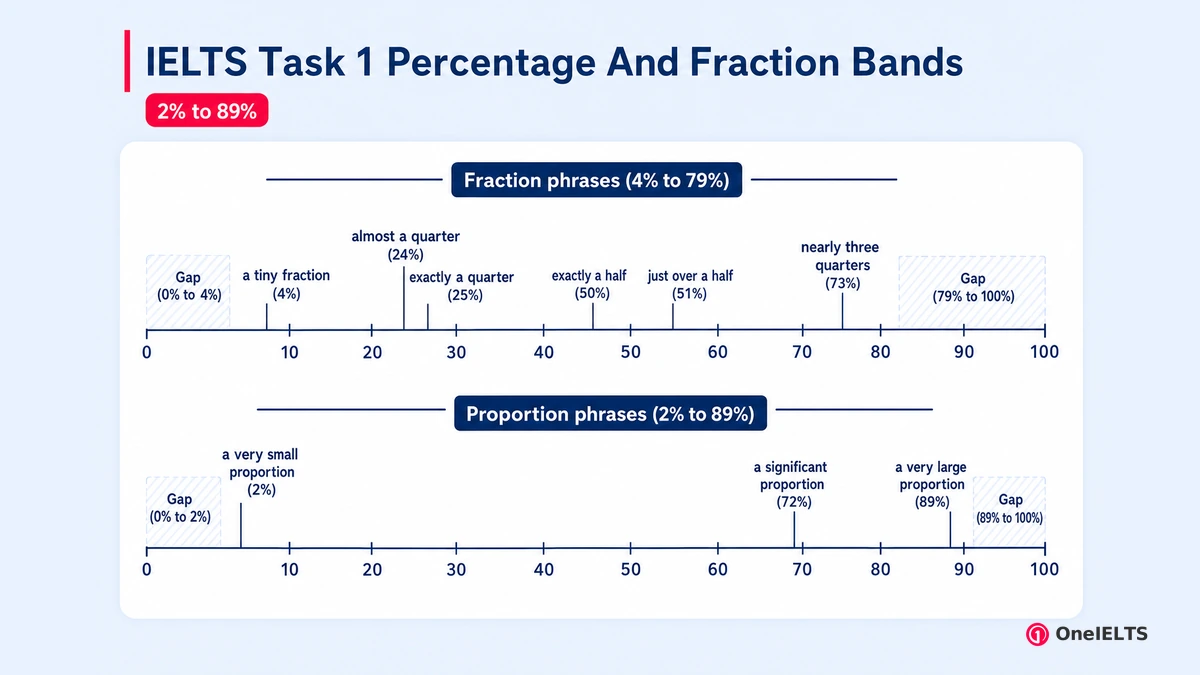
A short ladder of fraction and proportion phrases lets you report a share without repeating the figure. The useful skill is matching the phrase to the number rather than collecting the phrases. One page in nine bands them numerically, and this table reproduces its phrases at each number band.
| Roughly this share | Fraction phrase | Proportion phrase |
|---|---|---|
| under 5% | “a tiny fraction” (4%) | “a very small proportion” (2%) |
| around a quarter | “almost a quarter” (24%), “exactly a quarter” (25%) | not banded at this share |
| exactly a half | “exactly a half” (50%) | not banded at this share |
| just over a half | “just over a half” (51%) | not banded at this share |
| around three quarters | “nearly three quarters” (73%) | “a significant proportion” (72%) |
| over 85% | not banded at this share | “a very large proportion” (89%) |
Those gaps are real and worth naming. The one source that bands this language runs two separate scales, fractions from 4% to 79% and proportions from 2% to 89%, and they do not meet in the middle. Above 80% you have proportion language and no fraction phrase, and between a quarter and two thirds you have the reverse.
Two words get confused constantly. A percentage figure names the number itself. A proportion phrase converts that share into words. A figure is any number printed on the chart, and a fraction is a share written as part of one.
Placement is governed by a rule the sources agree on. Keep numbers, percentages and quantities out of the general trend statement, because the overview names the striking feature and the figures live in the body. The total share of a pie and the percentage-point distinction belong to the pie chart page.
Which Vocabulary Describes Specific Figures?
Approximation language is allowed, and that is the first thing to know. When a chart does not let you read an exact value, estimating as closely as you can and saying so is correct behaviour rather than a fudge. The test owner is explicit about it.
“In some line graphs and bar charts, it is difficult to know what the exact number is in the diagram. In this case, it’s fine to guess a number as close as you can.”
Eight pages in nine never say this. The approximation language itself sorts into five jobs.
- Close from either side: approximately, roughly, about, around, more or less.
- Close from below: just under, a little less than, nearly, almost, close to.
- Close from above: just over, a little more than, well over.
- The advanced forms: in the region of, in the vicinity of, in the range of. Use one of them, not three.
- The exact marker: exactly, precisely, stood at. These are for a readable value only.
One page in nine makes the part-of-speech form point, and it feeds straight back into the word-order section above. The same idea has three forms, so all three of these sentences are available to you.
“There were approximately 10,000 users of this mobile phone application in 2009. There was an approximate number of 10,000 users of this mobile phone application in 2009. There was an approximation of 10,000 users of this mobile phone application in 2009.”
Approximately is the adverb, approximate the adjective, approximation the noun. What none of them licenses is reporting every figure, because key feature selection is the instruction and a report that transcribes the chart is marked down whatever its vocabulary looks like.
Which Time Expressions Cover Periods of Change?
Four kinds of time phrase cover it: a point, a span, a rate and a sequence. The grammar around them causes more errors than the words themselves, and a fifth group handles the whole period.
- A POINT: in 2010, by 2015, at the start of the period, at the end of the period. A time point pins one value.
- A SPAN: between 2010 and 2015, from 2010 to 2015, over the following decade, during the second half of the period.
- A RATE: annually, per year, each decade, over a ten-year period. A rate expression turns a total into a speed.
- A SEQUENCE: initially, subsequently, thereafter, in the final years. A sequence marker orders two movements.
- THE WHOLE: throughout the period, over the entire period, across the two decades.
Three grammar rules come straight from the sources and candidates break all three. A time span usually needs an article, so it is over the following decade. The word year takes no s inside a compound, so it is a ten-year period rather than a ten-years period. That compound hyphen is not optional either.
Prepositions carry the figure and the time together. Something rose from one value to another, rose by the difference between them, and stood at a value on a given date.
This set matters more than its size suggests. A Task 1 report is almost entirely made of time-anchored sentences, so a candidate holding four time phrases will use each of them twice.
Which Words and Phrases Should You Avoid in Task 1?
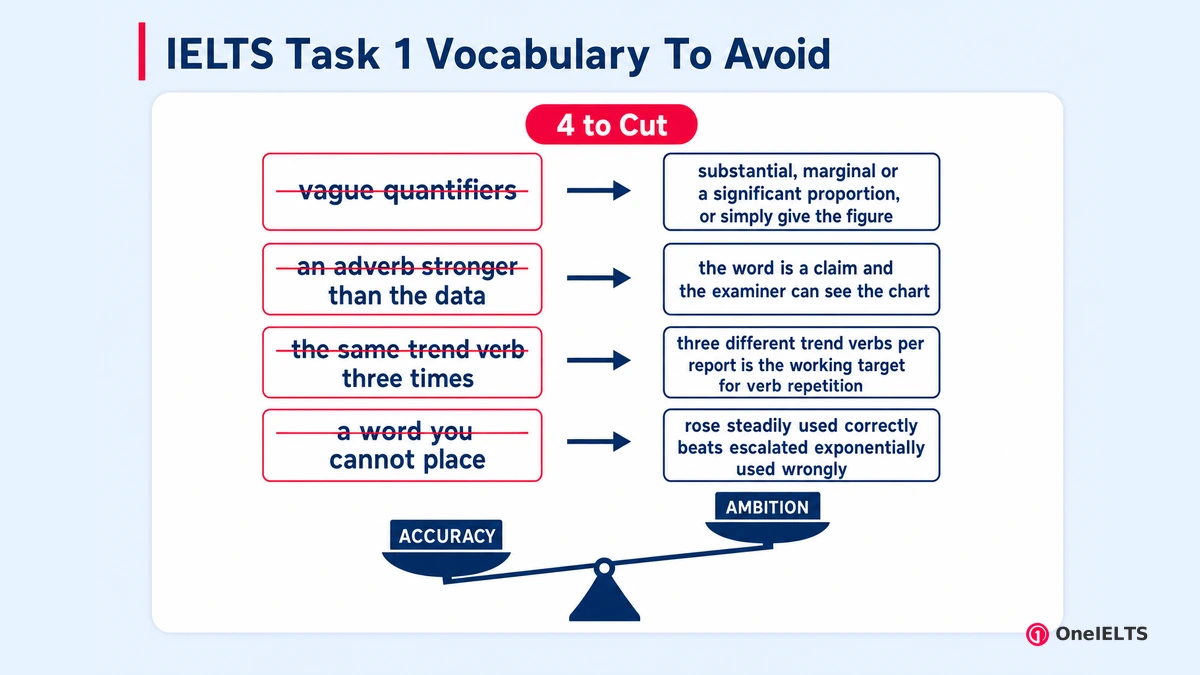
Avoid four things: vague quantifiers, an adverb stronger than the data, the same trend verb three times, and any word you cannot place. The last one is the rule the other three follow from, and it reverses the instinct the search results create.
One source states the underlying principle plainly, and it is worth reading twice.
“Band descriptors reward accurate use of less common vocabulary, not uncommon vocabulary used incorrectly.”
Lexical Resource measures accuracy over ambition. The four things to cut follow from that.
- VAGUE QUANTIFIERS: very big, very small, a lot of. Write substantial, marginal or a significant proportion instead, or simply give the figure.
- AN OVERSTATED ADVERB: skyrocketed for a three per cent rise, plummeted for a ten per cent fall. The word is a claim and the examiner can see the chart.
- THE SAME TREND VERB THREE TIMES: if increased appears three times in a paragraph it gets noticed. Three different trend verbs per report is the working target for verb repetition.
- A WORD YOU CANNOT PLACE: a rare word in the wrong slot scores below the plain word it replaced. Rose steadily used correctly beats escalated exponentially used wrongly.
None of that is an argument for plain writing. The criterion does reward range, and the safe way to get range is more functions rather than a rarer synonym for rose. Add a comparison, a stability sentence, an approximation.
Under timed conditions the words that arrive are the ones you can place. A timed IELTS Writing mock is the only place to find out which those are.
Does Task 1 Vocabulary Change With the Chart Type?
The functional core does not, and the edges do. Trend, degree, comparison, quantity and time language works on every visual that shows numbers. Maps, processes and letters need their own sets, and each chart type adds a handful of words rather than a fresh list.
One page in nine addresses the question directly, and its answer is also this site’s architecture. Learning trend verbs, comparison phrases and overview language as functions lets you combine the pieces across task types, instead of keeping a separate list for bar charts, line graphs and pie charts. Add a small chart-type extension once the core is solid. Each visual below adds only what is named.
- Bar chart adds grouping and category language, because the decision on a bar chart is which bars to compare with which.
- Line graph makes the fullest use of the core set, and adds peak and trough language for the extremes.
- Pie chart adds the segment noun set and share nouns, plus the percentage-point distinction that trips candidates up.
- Table adds selection language for reporting a category without listing every figure inside it.
- Process diagram adds the sequence marker set and the passive, which replace trend language entirely.
- Map adds change verbs for places and prepositions of position, with no numbers involved at all.
- Multiple charts adds neutral transitions that move between two visuals without claiming a link that is not there.
How Do You Practise IELTS Task 1 Vocabulary?
Practise the conversion drill, not the list. Write one sentence about a real chart, then rewrite it in the other form. Ten form pairs will teach you more than a thousand-word list, because the pair is exactly where the error lives. Five steps make a session.
- Open a real chart and write five verb-plus-adverb sentences about it, one for each key feature you can see.
- Rewrite all five as adjective-plus-noun sentences. Check each one for the -ly, which should have disappeared.
- Run an adverb audit against the chart. Anything you called dramatic that turns out to be under ten per cent gets downgraded.
- Add one stability sentence and one comparison sentence, since function coverage is where candidates lose ground.
- Count your trend verbs. If any appears more than twice, swap one, and swap it for a different verb rather than a stronger one.
Step 2 is the unusual instruction and it earns its place. The -ly disappearing is visible proof that the word class changed on both sides, which makes it the fastest verb repetition check and error check you have.
Step 1 needs real charts, and IELTS Writing Task 1 practice is filtered to Task 1 so every prompt you open has data to describe. Practising needs a free OneIELTS account.
Which Vocabulary Do Task 1 Overviews Need?
General words and no figures. The overview names the shape of the data, meaning the clearest trend and the highest and lowest values, and it is the one paragraph where the quantity language above has to stay out.
Three small groups run the whole paragraph. The signal opener starts it: overall, it is clear that, in general. The shape word carries the direction: upward, downward, broadly stable. The extreme marker closes it: the highest, the lowest.
One rule governs the rest, and the sources agree on it. Do not put numbers, percentages or quantities in the general trend statement. A figure in the overview is a detail, and this is a figure-free paragraph by design.
What an overview is and why Task 1 needs one belongs to the IELTS Writing Task 1 hub.
Which Tenses Should Be Used in a Task 1 Report?
The dates on the chart choose the tense, not the writer. Past dates take the past simple, an undated or present chart takes the present simple, and projected years need a projection form.
Tense selection matters on a vocabulary page for one reason. The trend verbs above are irregular often enough to change the word you actually write rather than just its ending. Rise becomes rose, fall becomes fell, grow becomes grew. An irregular trend verb misremembered under time pressure costs you Grammatical Range and Accuracy marks.
One kind of mixed-tense report is legitimate. A chart running from a past year to the present needs the past simple and the present perfect in the same paragraph, and that is not a contradiction.
The tense system itself belongs to the IELTS writing tenses page.
Which Linking Words Do Task 1 Reports Need?
Fewer than you think. A Task 1 report needs contrast, addition and sequence, and almost nothing else, because the essay connectors that signal argument have no job in a report that makes no argument.
Three groups cover it. The contrast connector group is whereas, while and in contrast. The addition connector group is similarly, likewise and also. The sequence marker group is initially, subsequently and thereafter.
A connector is marked under the coherence criterion rather than under vocabulary. Loading a report with them does not raise Lexical Resource, and mechanical linking at the start of every sentence lowers Coherence and Cohesion instead.
The full set of cohesive devices lives on the linking words for IELTS page.
Where Can You Find Task 1 Chart Vocabulary Practice?
On real Task 1 prompts. This vocabulary is only tested by whether it arrives while you are describing an unseen chart, which no word list can simulate.
A list tests recognition and the exam tests production. The gap between those two is exactly the conversion error this page is built around, and a real prompt is the only production test available to you.
Vary the chart type rather than repeating one. The core set is meant to transfer, and you only find out whether it has by using it on chart variety you have not rehearsed.
A filtered practice set carries the question type but not the exam type. A reader working in General Training mode will therefore see General sets on the same link. Practising needs a free OneIELTS account.
Written by Jamil Ahmed, reviewed 14 August 2026.
Last verified: 14 August 2026
Practice for the Real IELTS Exam
Apply what you’ve learned with free, exam-style practice:
- Take a free IELTS mock test — all four skills, real exam timing, AI band scoring
- Sit a Writing section mock — Task 1 and Task 2 in one timed hour with a band estimate
- Practise by question type — self-paced Writing sets with model answers