Most candidates who repeat the IELTS don’t lose marks on hard questions; they lose them on the same habits every sitting. The common IELTS mistakes cluster into three places: Listening and Reading errors that cost answers you knew, Writing errors that break your task response, and Speaking errors that sound unnatural.
The nine below run in that order, and the closing section explains how to avoid them. Fixing a recurring habit like ignoring the word limit or weak paraphrasing lifts your band faster than another full mock test.
1. Ignoring the Word Limit
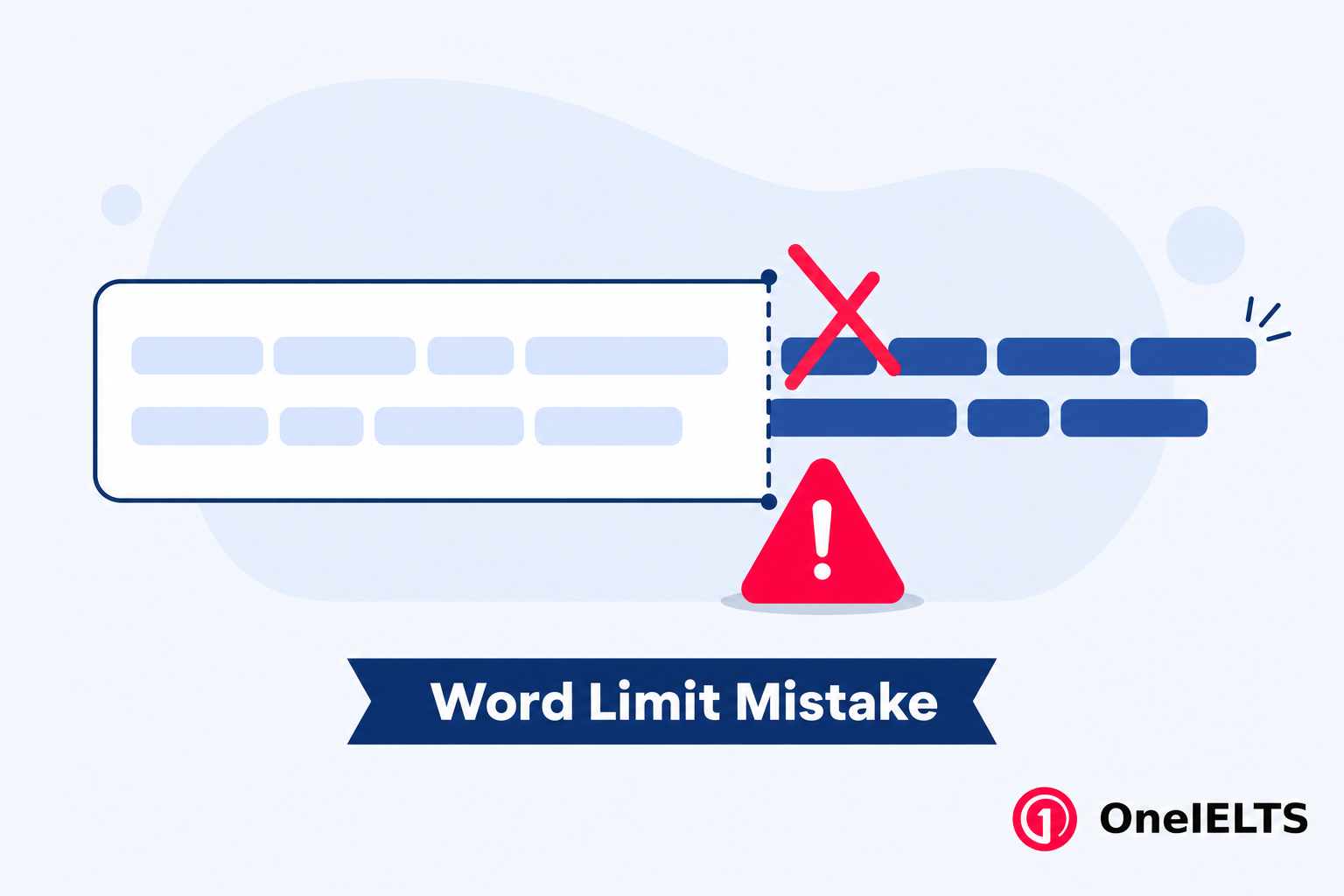
Writing more than the stated word limit, such as a “NO MORE THAN THREE WORDS” instruction, turns a Listening or Reading answer into an invalid answer even when the content is right. Read the instruction on every single question, because the cap changes between tasks.
2. Transfer Errors on the Answer Sheet
Transfer errors lose marks even when you heard the word correctly: a misspelling or wrong format on the answer sheet scores zero. In the paper test, use the transfer time deliberately and copy each answer exactly as you wrote it.
3. Missing the Distractors in the Audio
Distractors trap candidates who write the first thing they hear. A speaker corrects themselves mid-sentence, such as “Tuesday, actually Wednesday,” which makes the first answer trap so common. Listen for correction signals like “actually,” “sorry,” or “I mean” before you commit.
4. Not Paraphrasing the Prompt
Copying the prompt word for word wastes your first chance to show range. Examiners reward paraphrasing, so rewrite the question in your introduction using synonyms, or restructure the sentence entirely. Not paraphrasing the prompt signals limited vocabulary before you’ve written a real argument.
5. Over-complicating Your Sentences
Over-complicating your writing backfires. Long, convoluted sentences sacrifice clarity and grammar in a bid to sound advanced, and one slip inside them costs accuracy marks. Controlled sentences score higher than risky long ones, so write only what you can punctuate correctly.
6. Task Response Issues in the Essay
A neat, well-formatted essay still fails on task response if it doesn’t fully answer the prompt or hold a clear position. Read the question twice and address every part of it, then keep one consistent stance from your introduction to your conclusion.
7. Using Contractions in Academic Writing
Using contractions like “don’t” or “can’t” reads as too informal for Academic Writing Task 1 and Task 2. Write out fully as “do not” or “cannot” instead. These informal abbreviations are fine in Speaking, but in Academic Writing they cost you on the lexical criterion.
8. Overusing Idioms in Speaking
Overusing idioms hurts your Speaking score, especially when forced idioms come out incorrectly. Examiners hear the strain immediately. Reserve idioms for natural use only, sticking to the ones you’re confident about, and let fluency carry the answer rather than a memorised phrase.
9. Clumsy Endings in Your Answers
Clumsy endings weaken a strong Speaking answer when you keep trailing off or repeat filler words like “so… because.” Finish your thought, then pause naturally to signal you’ve stopped. A clean stop reads as confidence; a fade-out reads as a candidate who ran out of ideas.
How Can You Avoid the Most Common IELTS Mistakes?
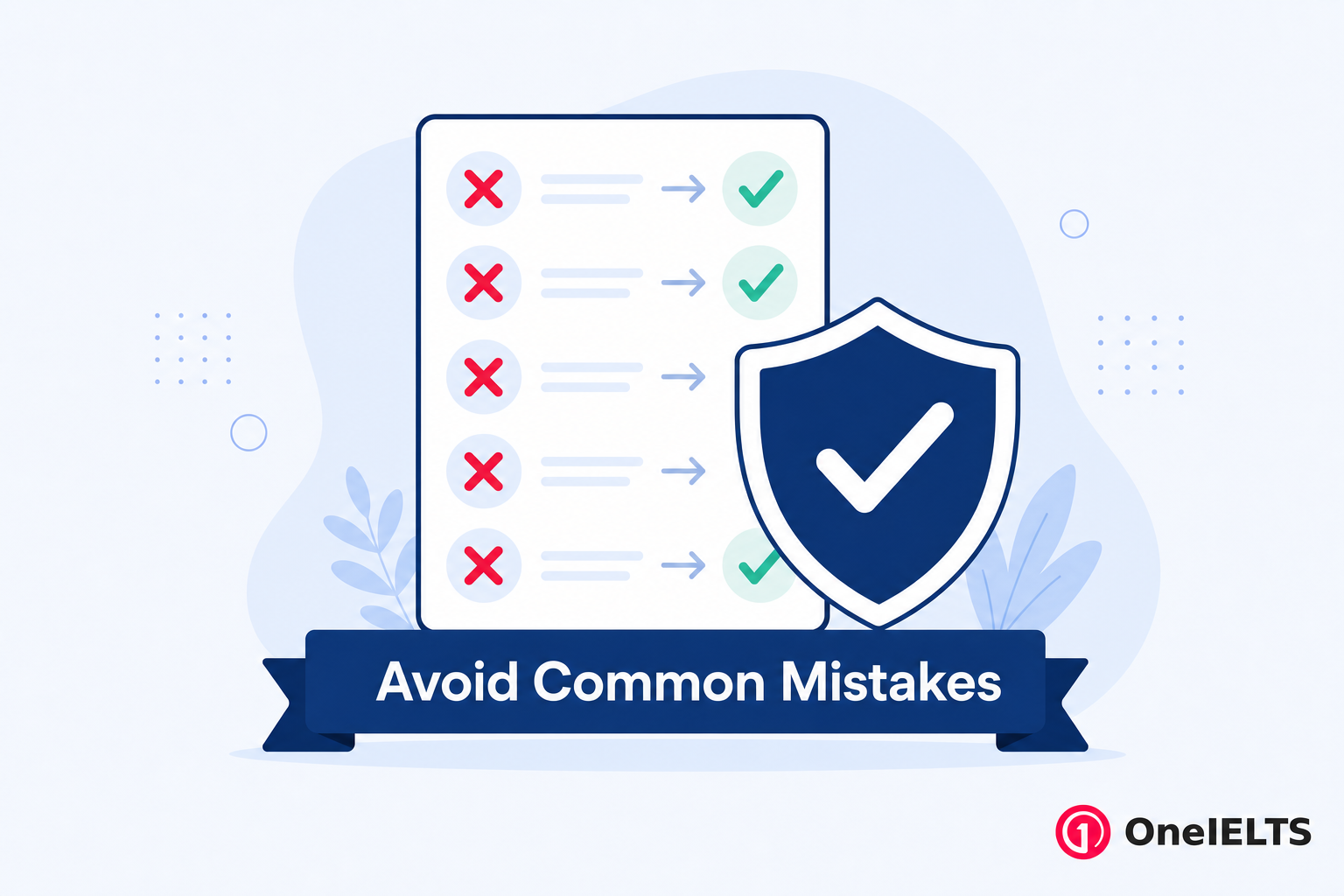
You avoid mistakes most reliably by turning each error into a fixed pre-test habit rather than hoping it won’t recur on the day. The five habits that prevent the nine errors above are listed here.
- Read instructions first on every question, checking the word limit and format before you answer in Listening or Reading.
- Paraphrase the prompt in your own words at the start of each Writing task to show vocabulary range.
- Keep your sentences controlled and accurate instead of stretching for length that breaks your grammar.
- Answer the whole task and hold one clear position from your essay’s introduction through to its conclusion.
- Review by cause after each mock, grouping errors so you fix the habit, not just the single question.
Which IELTS Section Has the Most Common Mistakes?
Writing and Speaking attract the most common mistakes, because they are criteria-judged rather than scored on right or wrong answers. Fixing your weakest section of these two will lift the band fastest, since a half-band gain on a criterion outweighs one more correct Listening answer. Our guide on how to improve your IELTS band breaks down where those criterion marks hide.
Last verified: 30 June 2026
Written by Jamil Ahmed.
Practice for the Real IELTS Exam
Apply what you’ve learned with free, exam-style practice:
- Take a full IELTS mock test
- Practice by section: Listening, Reading, Writing, Speaking
- Structure your essays with IELTS Writing templates