General Training Task 1 gives you a situation, a person to write to and three bullet points, and asks for a letter of at least 150 words in about 20 minutes. Candidates arrive asking how many letter styles exist, and the guides answer two, three or five.
The count is the wrong question. What the band descriptor rewards is style consistency, and the thing that fixes your style is the salutation choice the prompt hands you. That one line decides the sign-off, the contractions and the vocabulary.
The second decision is just as cheap. The three bullet points are your bullet point plan, never your format, because a letter presented as bullets loses marks.
One correction first: letters appear in General Training Writing Task 1 only. This guide covers the styles, choosing the register, openings, the structure, the language, personal detail, common topics, the word count, marking, sample questions and practice.
What Is IELTS General Training Writing Task 1?
General Training Writing Task 1 is an exam task that gives you a short situation, names the person you must write to, and lists three points to cover. It asks you to answer with a letter of at least 150 words.
Every task has the same three parts. The topic, the person you are writing to, and the three bullet points telling you what to write about. Reading that anatomy off the situation prompt in ten seconds is what makes the rest of the task manageable.
The misconception worth killing early appears twice in the search data. Letters are a General Training Task 1 job only. Academic Writing Task 1 asks for a report on a chart, and neither module asks for a letter in Task 2.
One thing almost no guide mentions. An email task is answered exactly the same way as a letter task, so the format below covers both. The rubric is also explicit that you do not need to write any addresses at the top.
The four criteria and the two-task split belong to the IELTS Writing pillar and the IELTS Writing Task 1 hub.
Which Styles of Letter Does IELTS Ask For?
Three: formal, semi-formal and informal. The number is the least useful thing about them, because the guides do not agree on it and the examiner does not mark it.
The disagreement is real and worth naming once. One widely read guide teaches two styles and advises dropping the middle one entirely. Another teaches three and then splits the middle one in half, which makes five in practice. The highest-traffic page on this search never mentions the middle style at all.
All of them are describing one style continuum with different numbers of stops marked on it. The continuum runs from a stranger to a friend, and each guide cuts it somewhere.
- Formal: to someone you have no personal relationship with, such as a company, a manager you have never met, a council or an editor. You may not even know their name.
- Semi-formal: to someone you know in a professional or practical capacity, such as your own manager, a landlord, a neighbour or a colleague. You know the name and you are not friends.
- Informal: an informal letter to a friend or a family member. This is the only style where the recipient relationship, rather than the subject, sets the tone.
IELTS settles the count itself, on its General Training Writing format page: depending on the task, the letter may be personal, semi-formal or formal in style. No page on this search quotes that line.
Note the naming. The test owner says personal where most guides say informal, which is a fourth variant rather than a fourth style. Its own article on the middle style defines it by function rather than by label: a semi-formal letter is neither formal nor informal. You write one to someone you know about something negative, or to someone you have a professional relationship with.
What IELTS does not publish is a boundary between the three, and the examiner is not checking which box you picked. So the count is settled and still not useful, which is why the next section replaces it with a test.
Is Your Letter Formal, Semi-Formal or Informal?
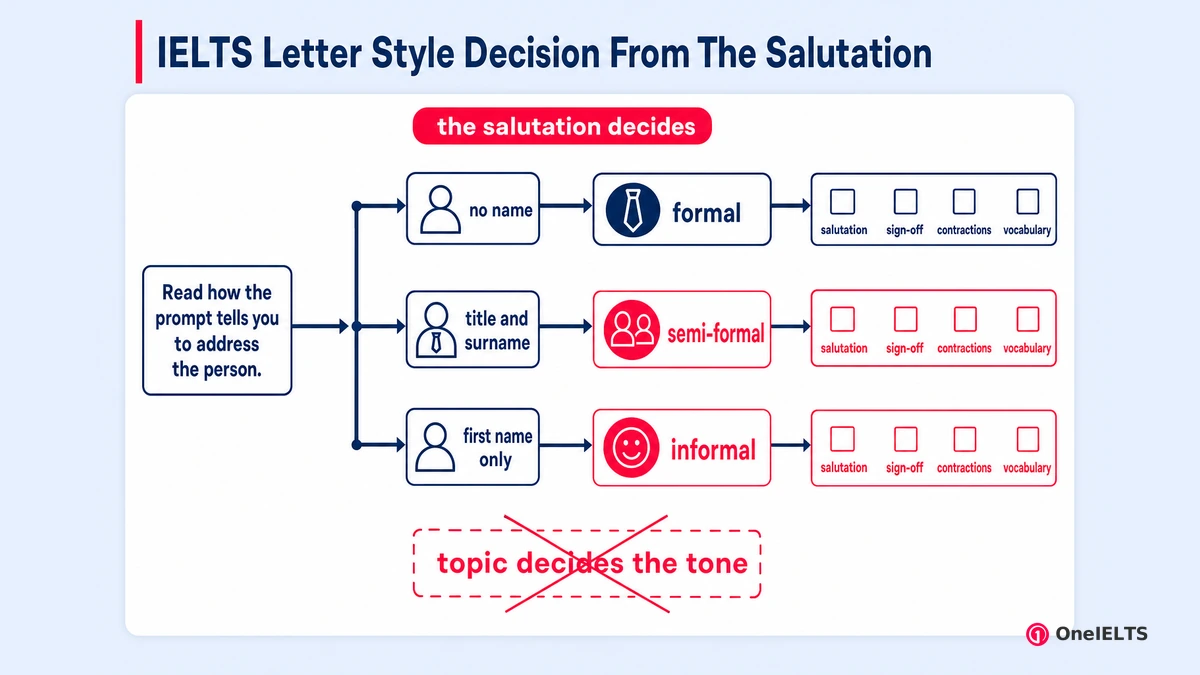
Read how the prompt tells you to address the person. That one line fixes the style, and the style then has to hold for the whole letter.
The criterion is what makes this the right question. IELTS states that to reach band 7 or above for the content of a semi-formal letter, you need to write in a consistent style and not include language that is too formal or informal. The examiner is not checking which of two or three boxes you picked, only whether you stayed inside one.
Three steps settle it in about thirty seconds.
- Read the salutation signal. No name at all means formal. A title with a surname means semi-formal or formal. A first name on its own means informal.
- Apply the relationship test. A friend or a relative means informal. Anyone professional, whether a manager, landlord, colleague or official, means semi-formal or formal even if you know them well.
- Ignore the subject entirely. A complaint to a friend is still an informal letter, and a friendly note to your manager is still not one.
Step three is the one candidates get wrong, and one guide states it sharply: tone is never determined by the topic of the letter, only by who it is written to. The same source offers a blunt working rule for anyone who freezes, which is to treat the letter as informal only when the question actually contains the word friend. Tone versus topic is the whole confusion in four words.
Then comes the section’s real deliverable. Once you have chosen, four agreeing choices have to line up: the salutation, the sign-off, whether you use contractions, and the vocabulary. If any one of the four disagrees with the other three, style consistency is broken and the band drops, whatever category you thought you were writing in.
Which Opening and Closing Should an IELTS Letter Use?
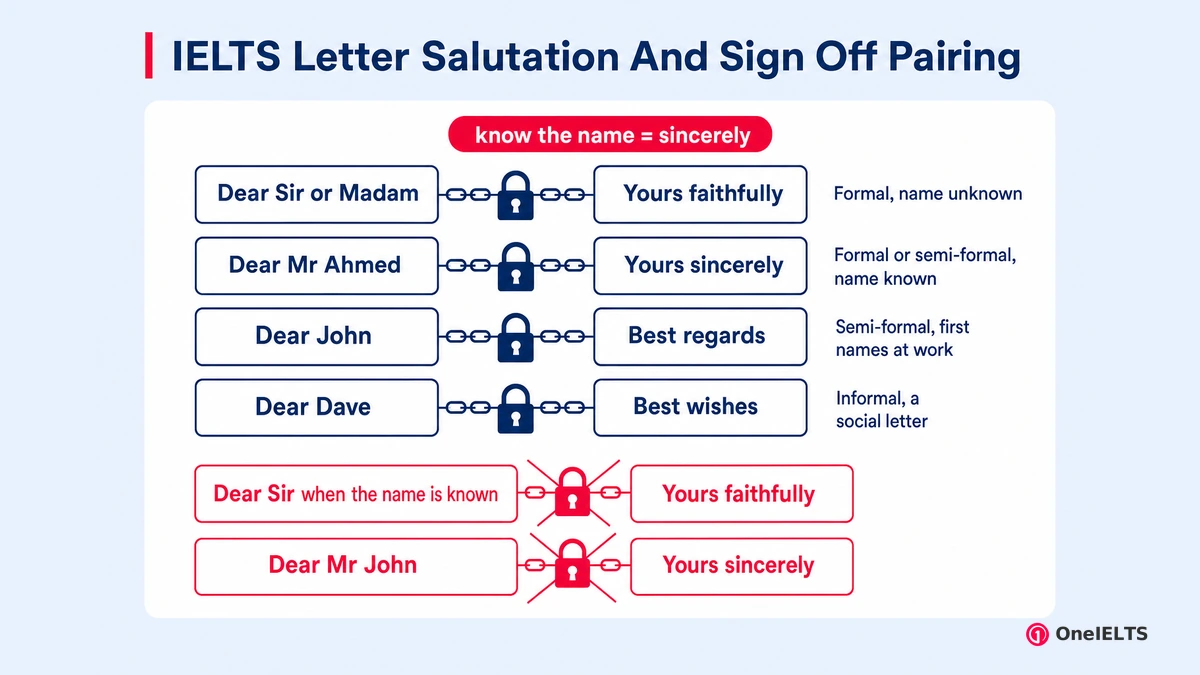
The sign-off is decided by the salutation, not chosen separately. Know the name and you close with Yours sincerely; do not know it and you close with Yours faithfully; be on first-name terms and you use neither.
Every pairing in this table comes from the captured guides rather than from invention.
| How you address them | How you sign off | What this style is |
|---|---|---|
| Dear Sir or Madam | Yours faithfully | Formal, name unknown |
| Dear Mr Ahmed | Yours sincerely | Formal or semi-formal, name known |
| Dear John, a colleague | Best regards | Semi-formal, first names at work |
| Dear Dave, a friend | Best wishes | Informal, a social letter |
One source publishes the rule underneath the sign-off pairing, and it is what makes the table memorable rather than memorisable. The difference is whether you know the person’s name and whether you use a title with it. No name means Sir or Madam. A title and surname means you know who they are but not them. A first name alone means you know them personally.
Two naming errors get flagged explicitly in the captured set. Writing Dear Sir when the prompt has already given you the name, and writing Dear Mr followed by a first name.
The opening statement is a different thing from the salutation and candidates conflate the two. The first line of the body says why you are writing. Use I am writing with regard to in a formal letter, I am writing to in a semi-formal one, and I just wanted to let you know in an informal one.
How Do You Use the IELTS Letter Writing Structure?
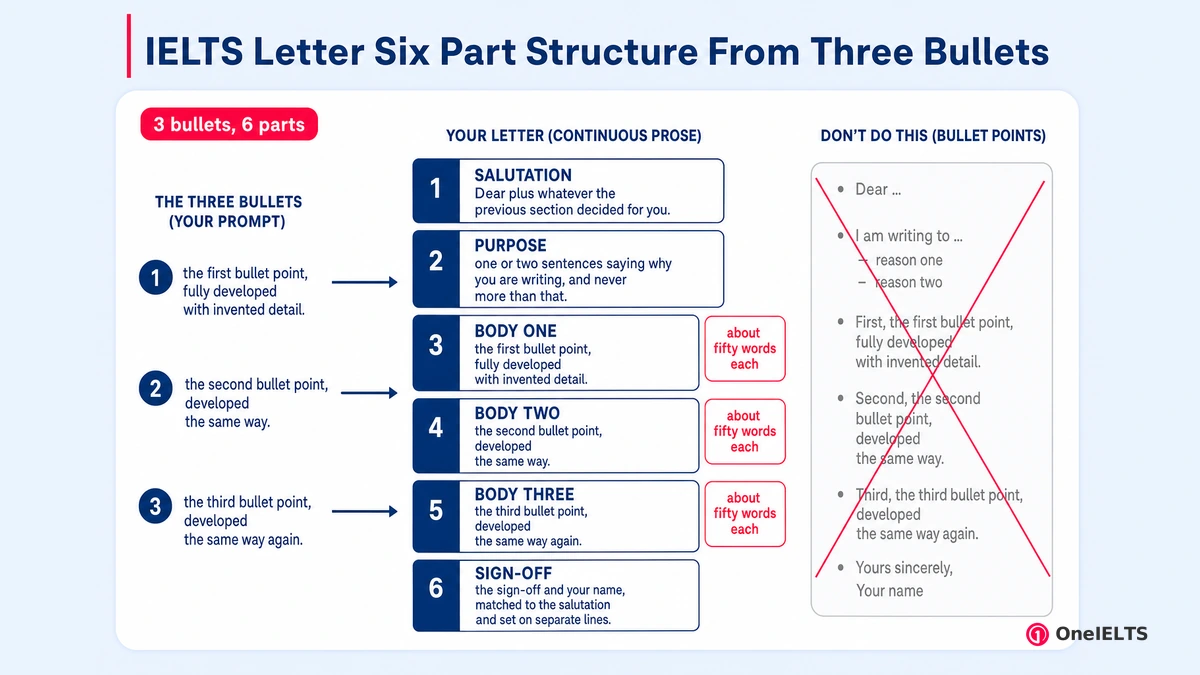
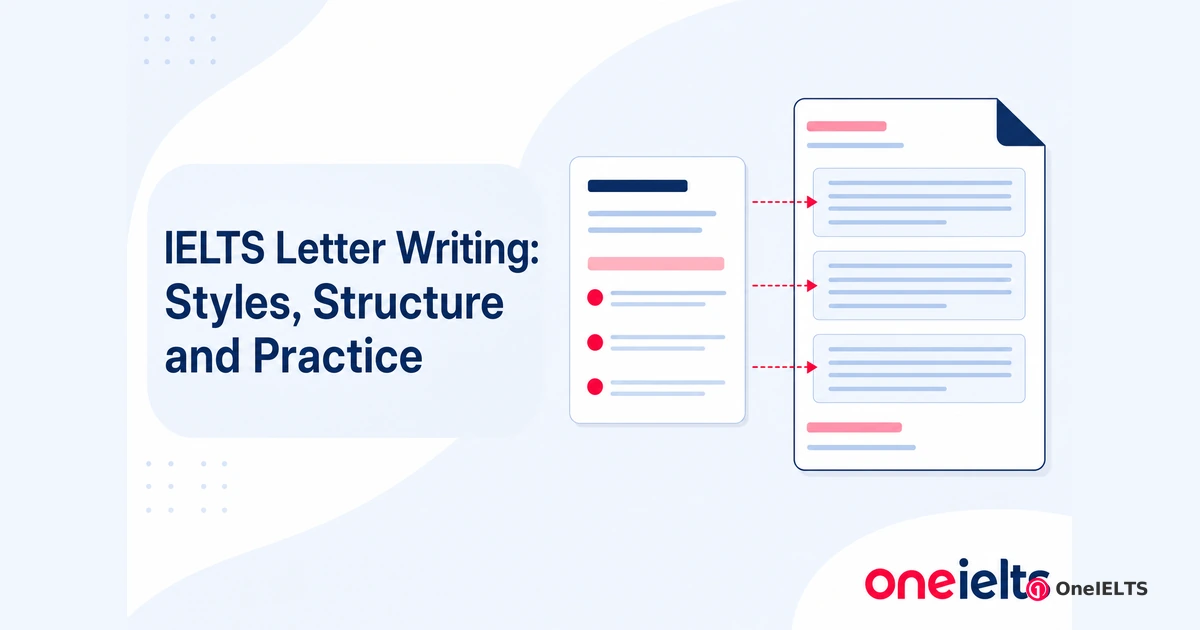
Six parts, and the three bullet points supply three of them. One paragraph per bullet, in the order the question gives them, is the whole structure. Here is the six-part template.
- The salutation: Dear plus whatever the previous section decided for you.
- The purpose paragraph: one or two sentences saying why you are writing, and never more than that.
- Body paragraph one: the first bullet point, fully developed with invented detail.
- Body paragraph two: the second bullet point, developed the same way.
- Body paragraph three: the third bullet point, developed the same way again.
- The sign-off and your name, matched to the salutation and set on separate lines.
Three bullet-point rules sit on three different pages and no single guide carries all of them. Cover all the points, because a missing point costs Task Achievement. Follow the bullet point order the question gives. Use key words from each bullet, or a clear synonym, so the examiner can see which one a paragraph answers.
The format rule that catches people out comes from a test owner. Marks are deducted if you present your answer in bullet points, and the letter must be continuous prose. The bullets are the plan, not the layout.
One source publishes a paragraph length, offered here as guidance rather than a rule: about fifty words each, with a blank line between paragraphs. A closing statement is worth adding in a formal letter and worth skipping in an informal one, where the sign-off already does that work.
Which Words Change Between a Formal and an Informal Letter?
Five things change together, and the contraction is the one an examiner spots first. Everything else moves in the same direction at the same moment.
- Contractions: I’m and don’t in an informal letter, I am and do not in a formal one. The test owner allows contractions in semi-formal letters too.
- Phrasal verbs and idioms: put up with and a bit of a nightmare informally, tolerate and a considerable inconvenience formally. A phrasal verb is a style marker before it is a vocabulary choice.
- Voice: mostly active in an informal letter and more passive in a formal one, so the passive voice tracks the register without you thinking about it.
- Transition words: but and so informally, however, therefore and nevertheless formally. A transition word out of place breaks the style faster than a noun does.
- The request itself: could you in a semi-formal letter, I would be grateful if you could in a formal one. The polite request form is the clearest single marker in the letter.
The test owner gives a caution nobody else does, and it cuts against the usual advice. In a semi-formal letter, language that is too formal is a fault as well. A very polite construction such as it would be greatly appreciated if is out of place there, and so is anything that belongs in a text message.
Grammar moves with the style too, which turns this into technique rather than a lookup table. Simpler structures suit an informal letter and more complex ones suit a formal one, so a mid-letter style switch shows up in the grammar before it shows up in the vocabulary. Linking words have their own page, and the IELTS Writing Task 2 connectors guide covers them in full.
How Do You Add Personal Comments to an Informal Letter?
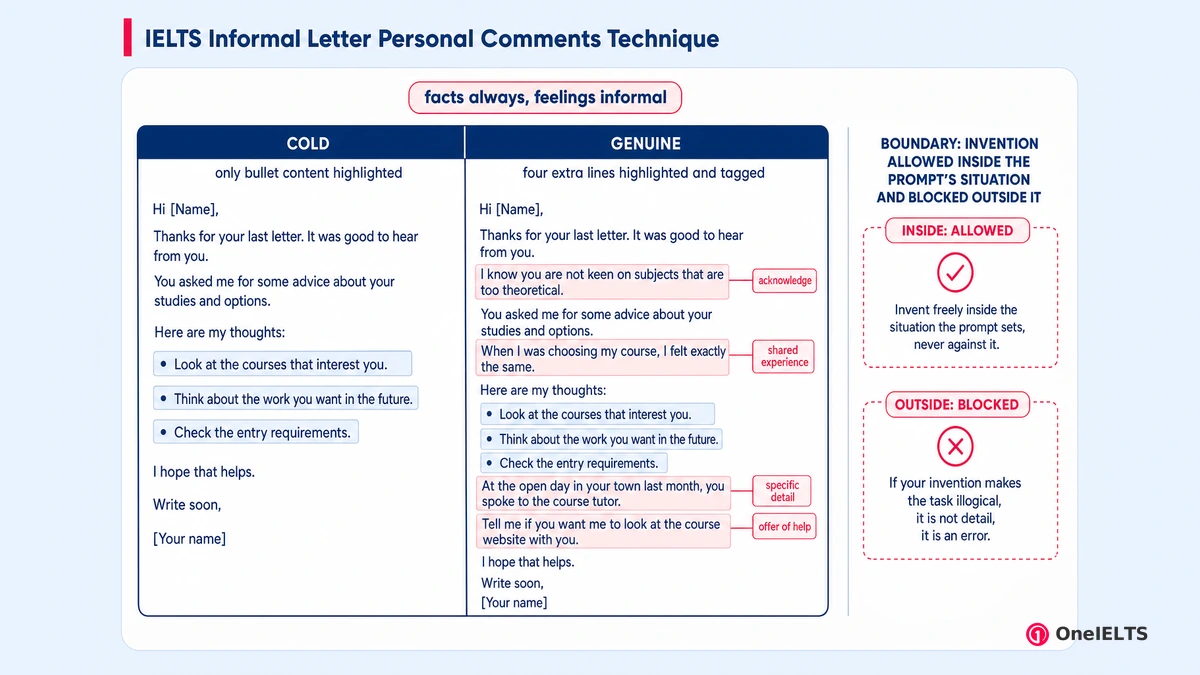
Yes, you invent the details, and inventing them is the job rather than a shortcut. The bullet points give you the skeleton, and everything that makes the letter sound like a real letter is something you made up.
Exactly one guide in the capture gives that permission outright, and a candidate who has not read it writes three thin paragraphs. You must use your imagination to fill in the details and to decide the names of the people in your letter. You may invent the recipient’s name, and you may use your own name or invent one.
The limit matters as much as the permission. Invent freely inside the situation the prompt sets, never against it. One captured letter scored around band 6.5 partly because its invented detail contradicted the prompt’s own premise, claiming a job title that made the request in the letter impossible. If your invention makes the task illogical, it is not detail, it is an error.
An ex-examiner publishes the four moves that make an informal letter sound genuine.
- Acknowledge what the person likes or does not like, so the letter is addressed to them and not to anyone.
- Refer to a shared experience in one clause. It does not have to be true, but it has to be specific.
- Mention a specific reference that belongs only to this person or this situation, such as a name, a place or a habit.
- Make an offer of help or a promise to follow up, which is the most natural way to close an informal letter.
The same source names a trade-off nobody else does. Students add information at the expense of tone, and a letter that covers all three bullets in flat, careful prose scores worse than one that covers them warmly. Tone versus information is the choice, and on this task tone is what Task Achievement is measuring.
None of this applies to a formal complaint, where invented warmth is exactly wrong. Invent facts in every style, and invent feelings only in the informal one.
Which Letter Topics Come Up Most Often?
Seven purposes cover almost every task that appears, and the purpose is a better thing to prepare than the topic, because the topic changes every session and the purpose does not.
- Complaint, usually formal. State the facts before the feeling, stay polite, and say what you want done. A complaint letter with no requested outcome is only a description.
- Request, any style. Say what you are asking for in the first body sentence, then justify it. A request letter that opens with the justification buries its own purpose.
- Apology, any style. Apologise, explain without excusing, and offer to put it right. A thank-you note follows the same shape with the apology removed.
- Invitation, informal or semi-formal. Give the occasion, the practical details and a reason the person should come.
- Application or resignation, formal. Name the role or the intention in the first line, before any explanation of it.
- Explanation, semi-formal or informal. An explanation letter is entirely reason, so its purpose sentence has to set up a situation the reader does not yet know about.
- Arrangement, often formal. Two people have to agree on something, so the letter ends with a proposal and a question.
One thing separates this list from the ones already published. The captured guides between them name six of the seven, and not one lists a thank-you letter, even though it is a real task type and sits in OneIELTS’s own General Training practice sets.
The instruction that follows is practical. Prepare by letter purpose rather than by topic, because two rehearsed openings per purpose is fourteen sentences and covers the whole task type.
Which Word Count Does an IELTS Letter Require?
At least 150 words, and IELTS penalises an answer that is too short. The 150-word minimum is the only official figure on this task, and everything else here is teacher guidance marked as such.
The published rule is short. You need to write at least 150 words and will be penalised if your answer is too short, and you should spend no more than 20 minutes on the task.
Two independent guides then converge on the same working target of 160 to 180 words, and a third puts its ceiling at 200. Convergence between unrelated sources is the reason to repeat a recommended range at all. Going over the count is not itself penalised. The real cost of a long letter is time taken from Task 2, which the IELTS Writing Task 1 hub explains in full.
The twenty-minute plan below spends more of the time on planning than a chart task does.
- Minutes 1-2: read the situation, identify who you are writing to, and decide the style.
- Minutes 3-5: invent the details for each of the three bullet points, allowing two facts per bullet.
- Minutes 6-17: write, in order, the salutation, the purpose paragraph, three body paragraphs and the sign-off.
- Minutes 18-20: check that the four style choices agree, then count your words.
Planning time is the part candidates cut first and should cut last. Worth knowing as calibration: the test owner’s own article on the semi-formal letter publishes no word count and no timing at all. Those numbers come from the task rubric and from the format page, not from a style guide, and Task 2 weighting is why the clock matters more than the target.
What Skills Are Assessed in General Training Writing Task 1?
The same four criteria as every Writing task, but Task Achievement behaves differently on a letter. Here it measures whether you covered the three points and whether your tone fits the reader, which is why a style error is so expensive.
IELTS assesses Task Achievement, Coherence and Cohesion, Lexical Resource, and Grammatical Range and Accuracy. Each band descriptor belongs to the pillar rather than to this page. Two teaching sources put the tone decision at a quarter of the mark, and that figure is theirs rather than an official weighting.
- All three bullet points covered and developed rather than mentioned. A point named in half a sentence has not been covered.
- A tone that fits the reader, held from the salutation to the sign-off. Tone consistency is the thing being marked, not the label you would give it.
- Prose rather than bullet points, with paragraphs that separate the three points visibly on the page.
- Language that is accurate before it is impressive, because the first aim is to communicate clearly rather than to display vocabulary.
- Point development above the minimum length, since a short letter is penalised however good it is.
The test owner names the abilities the task is designed to test: requesting or sharing factual information, communicating needs, preferences, concerns or feelings, and expressing opinions or complaints. Every task is one of those three jobs, and naming the job is faster than naming the topic.
The same source states that copying from any external source carries a serious penalty, so a memorised answer is not a safe strategy. Getting four style choices to agree is easy at a desk and hard at minute eighteen, which is what a timed IELTS Writing mock tells you.
Where Can You Find IELTS Letter Sample Questions?
Everywhere, and that is the problem. Sample letters are the most abundant thing on this topic and the easiest to misuse, so read a model letter for its style choices and never for its sentences.
The search results say it plainly. Half the live search suggestions on this topic ask for samples, topics with answers or a PDF, and the top organic result is a paginated sample directory of task titles rather than a guide. The supply is enormous and almost none of it explains the choices behind the letter.
- The salutation and the sign-off. Check that they agree, then work out which style the writer chose and why they chose it.
- The purpose sentence. It should be findable in the first two lines and it should not contain a bullet point’s content.
- The paragraph map. One paragraph per bullet, in order. If it is not, work out what the writer did instead and whether it worked.
- The contractions. Count them. Zero in a formal letter, several in an informal one, and inconsistency is the fault to hunt for.
- The invented details, meaning names, dates and places. Note how much was made up, because it is always more than candidates expect.
One warning about the official samples specifically, and it is worth being precise about. The test owner’s own page carries its task prompt and its model answer as images rather than text, so neither can be searched or copied. That is a reason to read them rather than harvest them.
How Do You Practise IELTS Letter Writing?
Practise the style decision on ten prompts before you write a single letter. The decision takes thirty seconds, it carries a large share of Task Achievement, and it is the only part of this task you can drill without writing 150 words.
- Take ten letter prompts and write only three words for each: the style, the salutation and the sign-off. Ten decisions take ten minutes.
- On five of them, write only the purpose sentence. One sentence, five times, is the fastest way to stop burying the reason for writing.
- Write one full letter untimed, then check that the four style choices agree: salutation, sign-off, contractions and vocabulary.
- Write two more as a timed letter of twenty minutes each. Check the clock when you finish the purpose paragraph, and it should read about minute seven.
- Mark your own letter for Task Achievement first. Are all three bullets developed, is it prose rather than bullets, and is it over 150 words?
Step one is the style drill, and the unusual instruction earns its reason. The style error is made in the first line and is invisible afterwards, so it is the one mistake that never gets fixed by writing more letters. Purpose sentence practice in step two fixes the second most common opening fault, and self-marking in step five catches the rest.
The ten prompts have to come from somewhere, and IELTS Writing practice is where the OneIELTS sets live. One thing the link cannot do for you: it carries the question type but not the exam type, so switch Exam type to General in the left rail after the page opens. Practising needs a free OneIELTS account.
An exam type switch is a two-second job and it is the difference between drilling letters and drilling bar charts.
How Do You Write a Job Application Letter?
Formal style, always. An application letter opens with the named role, because one that makes the reader hunt for what you want has failed its own purpose sentence.
One thing separates this purpose from the other six. An application is the only letter type where the reader decides something about you, so the bullet points usually ask about your relevant experience rather than about a situation outside you.
The style choice needs no thought here. You will not know the person’s name, so an unknown recipient means Dear Sir or Madam paired with Yours faithfully. The IELTS job application letter page writes the letter itself.
Which Tenses Do IELTS Letters Use?
More than any chart task. A letter usually needs the past for what happened, the present for the current situation and a conditional form for what you want to happen next.
That tense range belongs to a letter page rather than a grammar page for one reason. The three bullet points often sit in three different time frames: what happened, how things are now, and what you want done. A past narrative in paragraph one and a present description in paragraph two is normal, and a letter that stays in a single tense has usually not developed all three points.
One form carries most of the requests. The conditional request, as in I would be grateful if you could, is also the clearest formal-versus-informal marker in the whole letter. The IELTS writing tenses page teaches the system.
How Do You Get the Tone Right in an Informal Letter?
By writing to a person rather than to a task. Contractions and casual vocabulary are necessary and not sufficient, because a letter can follow every informal rule and still read as cold.
An ex-examiner diagnoses the informal tone problem better than anyone else on this topic. Even when students use contractions, add a discourse marker or two and shorten their sentences, the letter they produce still does not feel like a genuine letter to a friend. A cold register survives every rule on the checklist.
The missing ingredient is a shared reference, something only these two people have between them, and the personal-comments section above lists the four moves that supply it. Then apply the read-aloud check. Read the letter aloud and ask whether you could send it unchanged to two different friends. If you could, it is not informal enough.
Where Can You Find IELTS General Writing Task 1 Practice?
On General Training sets, which are letters. You have to switch the exam type yourself, because the link cannot carry it.
The constraint is worth stating precisely, since getting it wrong sends readers to the wrong sets. The practice link opens the Writing practice hub, and the Exam type switch sits in the left rail. General Training sets are there and they are letters. The question type filter is not module-aware, so the chart types listed beside it belong to Academic and are not letter filters.
It is worth the two clicks. A real General Training set gives you the three bullet points in the form the exam uses them, which is the part a sample letter cannot teach. The IELTS Writing practice hub carries the real bullet points. Practising needs a free OneIELTS account.
Written by Jamil Ahmed, reviewed 14 August 2026.
Last verified: 14 August 2026
Practice for the Real IELTS Exam
Apply what you’ve learned with free, exam-style practice:
- Take a free IELTS mock test — all four skills, real exam timing, AI band scoring
- Sit a Writing section mock — Task 1 and Task 2 in one timed hour with a band estimate
- Practise by question type — self-paced Writing sets with model answers