IELTS Writing band descriptors set out, criterion by criterion and task by task, what a Task 1 or Task 2 script must show to earn each band from 0 to 9. Four criteria each carry 25% of a task’s score: Task Achievement (Task Response in Task 2), Coherence and Cohesion, Lexical Resource, and Grammatical Range and Accuracy. Task 2 counts twice as much as Task 1. The overall nine-band scale and the Speaking descriptors have their own pages.
This page covers the public version, the criteria, both task grids, the shared criteria, band profiles, lost marks, the band 6 stall, self-marking and scoring. Every table names the phrase that holds a script at its band.
What Are IELTS Writing Band Descriptors?
The IELTS Writing band descriptors are the published marking criteria that certified examiners use to award a band from 0 to 9 on each of four criteria, separately for Task 1 and Task 2. Task 2’s set is identical for Academic and General Training, while Task 1 Task Achievement has separate Academic (report) and General Training (letter) lines.
Each criterion is judged independently, so one script can earn band 7 for vocabulary and band 6 for grammar. A certified examiner reads the script against the descriptor lines and picks the best-fitting band for each criterion. Each criterion band then feeds a task score on the nine-band scale.
The descriptors describe performance in words. They aren’t a checklist of required phrases or a quota of “advanced” words.
Where Can You Find the Official IELTS Writing Band Descriptors?
They’re on ielts.org, in one Writing Band Descriptors PDF marked “Updated May 2023” that holds a Task 1 grid, General Training letter lines included, and a Task 2 grid. Search results call this the public version: the wording IELTS releases for test takers and teachers, bands 0 to 9 against four criteria. IDP and the British Council co-own IELTS with Cambridge and mark against the same grids.
The May 2023 revision reworded descriptors to remove ambiguities examiners reported, per the IELTS writing scales review. Copies on Scribd, Studocu and Yumpu can carry older wording, so check the date on any band descriptor PDF. Checked on 7 October 2026.
What Are the Four IELTS Writing Assessment Criteria?
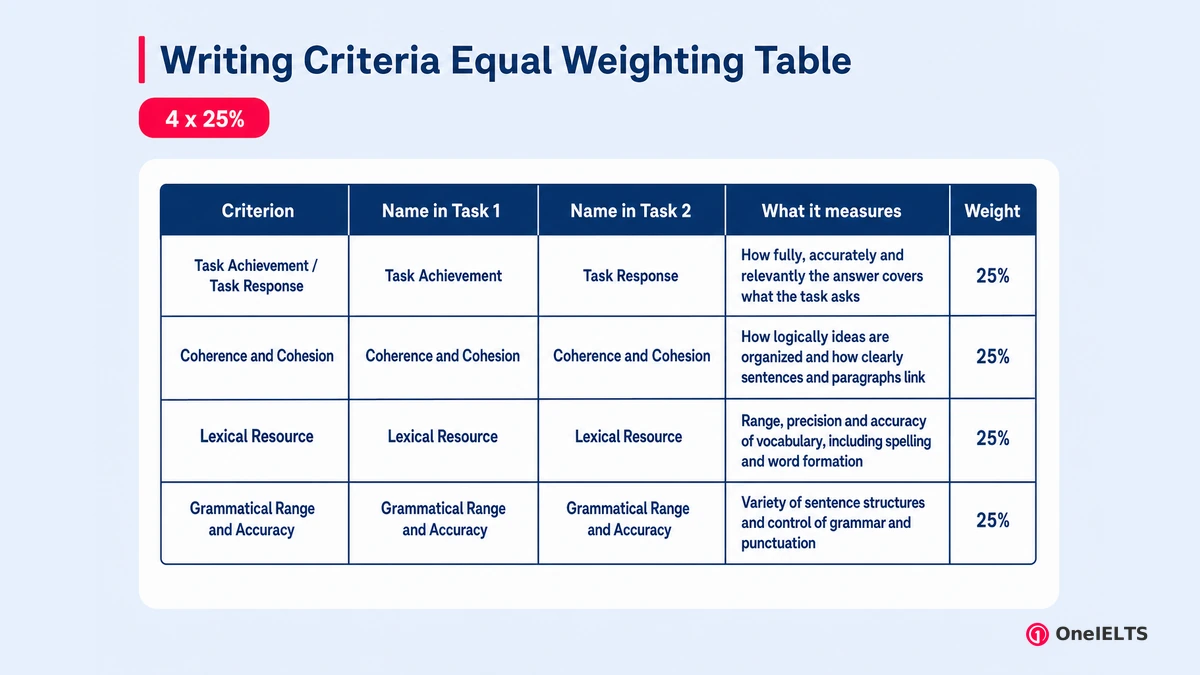
The four criteria are Task Achievement (Task 1) or Task Response (Task 2), Coherence and Cohesion, Lexical Resource, and Grammatical Range and Accuracy, each worth 25% of that task’s score. IELTS gives them equal weighting, so a task score is the plain average of four bands.
Only the first criterion changes its name. Task 1 is judged on whether it achieves a defined task, a report or a letter, while Task 2 is judged on how it responds to an argument prompt. The table maps each criterion to its name in both tasks, with no band thresholds yet.
| Criterion | Name in Task 1 | Name in Task 2 | What it measures | Weight |
|---|---|---|---|---|
| Task Achievement / Task Response | Task Achievement | Task Response | How fully, accurately and relevantly the answer covers what the task asks | 25% |
| Coherence and Cohesion | Coherence and Cohesion | Coherence and Cohesion | How logically ideas are organized and how clearly sentences and paragraphs link | 25% |
| Lexical Resource | Lexical Resource | Lexical Resource | Range, precision and accuracy of vocabulary, including spelling and word formation | 25% |
| Grammatical Range and Accuracy | Grammatical Range and Accuracy | Grammatical Range and Accuracy | Variety of sentence structures and control of grammar and punctuation | 25% |
What Are the IELTS Writing Task 1 Band Descriptors?
IELTS Writing Task 1 uses the same four criteria as Task 2, but its first criterion is Task Achievement. That means a clear overview of key features in an Academic report, and a clear purpose, consistent letter tone and all bullet points covered in a General Training letter. Task Achievement is defined around a 150 words minimum.
Five bands show where the report and the letter separate.
| Band | Academic Task 1 (report) | General Training Task 1 (letter) | Phrase that holds it at this band |
|---|---|---|---|
| Band 9 | Every requirement of the report is met fully and appropriately, with extremely rare lapses in content. | Every requirement of the letter is met fully and appropriately, with extremely rare lapses in content. | “All the requirements of the task are fully and appropriately satisfied.” Applies to both modules. |
| Band 8 | Key features are skillfully selected, then clearly presented, highlighted and illustrated, with only occasional omissions. | All bullet points are clearly presented and appropriately illustrated or extended, with occasional omissions or lapses. | “Key features are skilfully selected” (Academic); “All bullet points are clearly presented” (General Training). |
| Band 7 | A clear overview identifies main trends or differences, and data are appropriately categorized; illustration could go further. | All bullet points are covered, the purpose is clear, and the tone stays consistent and appropriate. | “It presents a clear overview” (Academic); “The tone is consistent and appropriate to the task” (General Training). |
| Band 6 | Selected key features are adequately highlighted and an overview is attempted, but some detail is missing or excessive. | All bullet points are covered and adequately highlighted; the purpose is generally clear, with minor tone inconsistencies. | “A relevant overview is attempted” (Academic); “There may be minor inconsistencies in tone” (General Training). |
| Band 5 | Selected key features aren’t adequately covered; detail is recounted mechanically, sometimes with no supporting data. | All bullet points appear but one or more is thin; the purpose may be unclear and tone variable. | “The recounting of detail is mainly mechanical” (Academic); “The purpose may be unclear at times” (General Training). |
The other three criteria barely change between tasks, so these Task Achievement lines are the only module-specific descriptors.
What Are the Band Descriptors for IELTS Writing Task 2?
IELTS Writing Task 2 is marked on Task Response plus three shared criteria, each worth 25%. Task Response judges how fully the essay covers every part of the essay prompt and whether it holds a clear position throughout, in at least 250 words.
Five stages run from band 9 to 5.
| Band | What the essay does | Phrase that holds it at this band |
|---|---|---|
| Band 9 | Explores the prompt in depth with a fully developed position; ideas are relevant, fully extended and well supported. | “A clear and fully developed position is presented which directly answers the question/s.” |
| Band 8 | Addresses the prompt appropriately and sufficiently; the position is well developed, with only occasional omissions or lapses. | “A clear and well-developed position is presented in response to the question/s.” |
| Band 7 | Addresses the main parts appropriately with a clear, developed position; support may over-generalize or lose focus. | “A clear and developed position is presented”, though support shows “a tendency to over-generalise”. |
| Band 6 | Addresses the main parts, some more fully than others; the position is relevant but conclusions wobble. | “The conclusions drawn may be unclear, unjustified or repetitive”, and some main ideas stay underdeveloped. |
| Band 5 | Addresses the main parts incompletely; a position is expressed but its development isn’t always clear. | “The writer expresses a position, but the development is not always clear.” |
Position means answering the question asked: a both-views prompt needs both views plus your opinion. Supporting ideas must be extended. Off-question essays and memorized language lose heavily, and a proven memorized answer scores band 0. Both modules share these descriptors.
How Is Coherence and Cohesion Marked in IELTS Writing?
Coherence and Cohesion rewards logical organization with a clear progression of ideas, plus accurate, flexible linking through cohesive devices, reference and substitution. The table splits logical progression from linking.
| Band | Organization and progression | Linking and paragraphing | Phrase that holds it at this band |
|---|---|---|---|
| Band 9 | The message can be followed effortlessly, and any lapses in coherence or cohesion are minimal. | Cohesion very rarely attracts attention, and paragraphing is skillfully managed throughout the response. | “Cohesion is used in such a way that it very rarely attracts attention.” |
| Band 8 | Information and ideas are logically sequenced, so the message can be followed with ease. | Cohesion is well managed with occasional lapses; paragraphing is used sufficiently and appropriately. | “Information and ideas are logically sequenced, and cohesion is well managed.” Task 2 wording. |
| Band 7 | Ideas are logically organized with a clear progression throughout; a few minor lapses may occur. | Reference and substitution are used flexibly, with some inaccuracies or some over- or under-use. | “A range of cohesive devices including reference and substitution is used flexibly but with some inaccuracies.” |
| Band 6 | Ideas are generally arranged coherently with clear overall progression, but the central topic may blur. | Linking within or between sentences may be faulty or mechanical; referencing can lack clarity. | “Cohesion within and/or between sentences may be faulty or mechanical due to misuse, overuse or omission.” |
| Band 5 | Organization is evident but not wholly logical, and overall progression may be missing. | Devices are limited, overused or inaccurate, and paragraphing may be inadequate or missing altogether. | “The relationship of ideas can be followed but the sentences are not fluently linked to each other.” |
The band-6 trap is opening sentences with “Firstly”, “Moreover” and “In addition”, which is mechanical cohesion. Band 7 needs referencing and substitution (this, these, such, the latter), not more connectors. Good paragraphing gives each paragraph one central topic. See coherence and cohesion in IELTS Writing Task 2.
How Is Lexical Resource Marked in IELTS Writing?
Lexical Resource measures vocabulary range and precision, control of less common vocabulary and collocation, and accuracy in spelling and word formation. Rare words forced in don’t count: a misused advanced word costs precision in word choice. The table shows each band’s tolerance.
| Band | Range and precision | Errors allowed | Phrase that holds it at this band |
|---|---|---|---|
| Band 9 | Full flexibility and precise use are widely evident, with very natural, sophisticated control of lexical features. | Minor errors in spelling and word formation are extremely rare and barely affect communication. | “Full flexibility and precise use are widely evident.” Even a rare slip leaves meaning untouched. |
| Band 8 | A wide resource is used fluently and flexibly, with skillful use of uncommon and idiomatic items. | Occasional inaccuracies in word choice, collocation, spelling or word formation, with minimal impact on communication. | “There is skilful use of uncommon and/or idiomatic items when appropriate”, despite occasional inaccuracies. |
| Band 7 | Enough resource for some flexibility and precision, plus some less common items used with collocation awareness. | Only a few spelling or word-formation errors, and they don’t detract from overall clarity. | “An awareness of style and collocation is evident, though inappropriacies occur.” Style slips still happen here. |
| Band 6 | Adequate and appropriate range; meaning stays generally clear despite restricted range or imprecise word choice. | Some spelling or word-formation errors appear, but they don’t impede communication with the reader. | “The meaning is generally clear in spite of a rather restricted range or a lack of precision.” |
| Band 5 | Limited but minimally adequate range, with frequent simplifications and repetitions limiting variation in expression. | Spelling and word-formation errors may be noticeable and may cause some difficulty for the reader. | “Simple vocabulary may be used accurately but the range does not permit much variation in expression.” |
Under the band 6 “risk-taker” note, wider range with more errors still scores 6. Memorized idiomatic language that misses the register hurts style, and spelling errors add up. Build topic words with IELTS Writing Task 2 vocabulary.
How Is Grammatical Range and Accuracy Marked in IELTS Writing?
Grammatical Range and Accuracy measures the variety of sentence forms a script uses and how accurately its grammar and punctuation are controlled. Punctuation is assessed here, not under Coherence and Cohesion. Each band pairs range with expected accuracy.
| Band | Range of structures | Accuracy | Phrase that holds it at this band |
|---|---|---|---|
| Band 9 | A wide range of structures is used with full flexibility and control throughout the response. | Punctuation and grammar are appropriate throughout; minor errors are extremely rare and barely noticeable. | “A wide range of structures is used with full flexibility and control.” |
| Band 8 | A wide range of structures is used flexibly and accurately across the whole response. | Most sentences are error-free, punctuation is well managed, and errors are occasional and non-systematic. | “The majority of sentences are error-free, and punctuation is well managed.” Errors are non-systematic. |
| Band 7 | A variety of complex structures is used with some flexibility and accuracy across paragraphs. | Grammar and punctuation are generally well controlled; a few errors persist without impeding communication. | “Grammar and punctuation are generally well controlled, and error-free sentences are frequent.” |
| Band 6 | A mix of simple and complex sentence forms appears, but flexibility stays limited. | Complex structures are less accurate than simple ones; errors occur but rarely impede communication. | “Examples of more complex structures are not marked by the same level of accuracy as in simple structures.” |
| Band 5 | The range of structures is limited and rather repetitive, with complex sentences attempted but faulty. | Grammatical errors may be frequent and cause the reader difficulty; punctuation may be faulty. | “Although complex sentences are attempted, they tend to be faulty.” Accuracy peaks in simple sentences. |
Band 7 to band 8 is a frequency judgment: error-free sentences are “frequent” at 7 and “the majority” at 8. A broken complex sentence raises range but lowers accuracy, so grammatical control beats ambition. Practice with complex sentences in IELTS Writing.
What Do IELTS Examiners Look For in Each Writing Band?
Examiners look for a recognizable band profile across all four criteria. Band 9 shows full, natural control with rare minor slips, band 7 a clear position and frequent error-free complex sentences, and band 5 partial task coverage with frequent errors that make the reader work. The table reads each band as one script, not as four separate scores.
| Band | What a script at this band looks like across the four criteria |
|---|---|
| Band 9 | The prompt is explored in depth, cohesion goes unnoticed, vocabulary is precise and natural, and grammar shows full control with rare slips. |
| Band 8 | A well-developed response that reads with ease, using a wide, flexible vocabulary and a majority of error-free sentences with occasional lapses. |
| Band 7 | A clear, developed position, logical organization with clear progression, some less common vocabulary, and frequent error-free sentences in varied complex structures. |
| Band 6 | Main parts addressed, coherent overall but sometimes mechanical, adequate vocabulary with imprecise choices, and complex sentences less accurate than simple ones. |
| Band 5 | Partial coverage, organization without full logical progression, limited vocabulary with noticeable slips, and frequent grammar errors that cause the reader some difficulty. |
| Band 4 | A minimal or tangential response, a position the reader must search for, basic repetitive vocabulary, and errors that may impede meaning. |
| Bands 3 to 1 | Little or no relevant response, no logical organization, and errors that predominate and block meaning; 20 words or fewer always rate band 1. |
| Band 0 | Reserved for non-attendance, no attempt at the question, writing wholly in another language, or proof of a totally memorized answer. |
A jagged profile, with different bands per criterion, is normal. That’s why the task score is an average. The bottom of the scale follows fixed rules: a response of 20 words or fewer is rated band 1, and band 0 needs proof of a memorized response or no English attempt at all. An underlength response above 20 words isn’t automatically band 1; it simply gives too little evidence for higher bands.
Why Does an IELTS Writing Task 1 Answer Lose Marks?
A Task 1 answer loses marks mostly through Task Achievement. The usual causes are a missing or buried overview, every figure listed with no selection, inaccurate data, an underlength answer, or a letter whose purpose or tone doesn’t fit the bullet points.
In an Academic report, the overview is the one sentence that names the main trends. Because Task 1 counts half as much as Task 2, a half band lost here moves your Writing band less than the same loss in Task 2. The calculation section at the end shows the numbers.
Seven triggers cause most of the damage, each listed below with the criterion it hits and the band it typically blocks.
- No clear overview of main trends (Academic). Without one sentence summing up the main trends, Task Achievement can’t reach band 7, which asks for “a clear overview”.
- Every figure recounted mechanically. Listing each number with no selection matches the band 5 wording, “the recounting of detail is mainly mechanical”, and holds Task Achievement near 5.
- Misread or invented data. Wrong figures cost data accuracy under Task Achievement, since the criterion checks that information, figures and trends are reported accurately.
- An opinion or cause added to a data report. Academic Task 1 reports only what the visual shows, so speculation about causes counts as irrelevant content under Task Achievement.
- Fewer than 150 words. The underlength penalty works through evidence: ielts.org warns that a short answer may not show enough language features to award higher bands.
- A bullet point skipped or barely covered (General Training). Band 7 Task Achievement needs all bullet points covered and clearly highlighted, so one thin point holds the letter near 5.
- Tone that shifts between formal and informal (General Training). A register that drifts mid-letter breaks the band 7 requirement that tone stays consistent and appropriate to the task.
Why Does a Task 2 Essay Stay at Band 6?
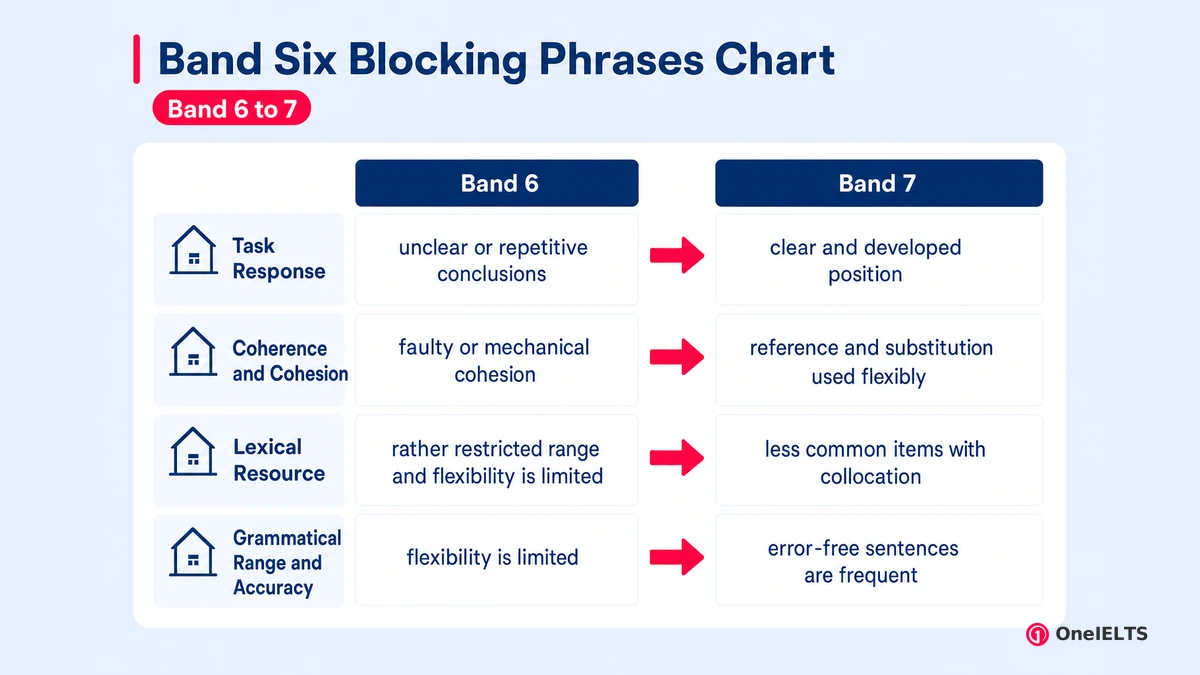
An essay stays at band 6 because each criterion has a band-6 phrase that blocks band 7 on its own. They are unclear or repetitive conclusions, mechanical cohesion, restricted range and shaky complex sentences. Mark a stalled script line by line and you’ll usually find two or three at once, the band 6 plateau.
Each row sets band 6 wording against what band 7 requires.
| Criterion | Band 6 phrase that holds the essay | What band 7 requires instead | One concrete fix |
|---|---|---|---|
| Task Response | “The conclusions drawn may be unclear, unjustified or repetitive.” The position exists but doesn’t hold. | “A clear and developed position is presented.” The same view runs from introduction to conclusion. | State your view in the introduction, echo it in each topic sentence, and close on it. |
| Coherence and Cohesion | “Cohesion within and/or between sentences may be faulty or mechanical due to misuse, overuse or omission.” | “A range of cohesive devices including reference and substitution is used flexibly”, with only some inaccuracies. | Cut sentence-opening connectors by half and replace them with this, these, such or the latter. |
| Lexical Resource | “The meaning is generally clear in spite of a rather restricted range or a lack of precision in word choice.” | “There is some ability to use less common and/or idiomatic items”, with “an awareness of style and collocation”. | Learn topic words as collocations, such as “curb emissions”, instead of single words from lists. |
| Grammatical Range and Accuracy | “A mix of simple and complex sentence forms is used but flexibility is limited.” | “A variety of complex structures is used with some flexibility and accuracy” and “error-free sentences are frequent”. | Pick two complex sentence patterns you control well and proofread each one before moving on. |
One criterion at 7 and three at 6 gives a task average of 6.25, so fixing vocabulary alone often changes nothing. IELTS doesn’t publish Writing rounding; that’s arithmetic. Move position and error-free sentences together.
How Can You Use the Writing Band Descriptors to Improve Your Score?
Use them by marking your own scripts criterion by criterion against the descriptor for your target band, finding the one phrase that holds each criterion down, and practicing until that phrase disappears. That beats writing more essays at random. It also beats “band 9 vocabulary” lists, because the descriptors name the fault and a vocabulary list doesn’t. Give Task 2 roughly twice the practice time, since it carries twice the weight.
Six steps turn self-assessment into a weekly routine.
- Read the four descriptor lines for your target band. Copy them onto one page so you mark against the exact wording, not your memory of it.
- Self-assess one script per criterion, not as a whole. Give it four separate bands, because a single overall guess hides your weak criterion.
- Find the blocking phrase in the band below your target. If you want 7, read the band 6 line and underline every sentence it describes.
- Rewrite the same script to remove that phrase. Fixing a known fault in a familiar essay teaches more than drafting a brand new one.
- Compare against sample answers marked on all four criteria. The official IELTS samples carry band scores and examiner comments you can check your own marking against.
- Repeat under timed conditions and track each criterion separately. Use IELTS Writing practice for timed practice: 20 minutes for Task 1, 40 for Task 2.
How Is Your IELTS Writing Band Score Calculated?
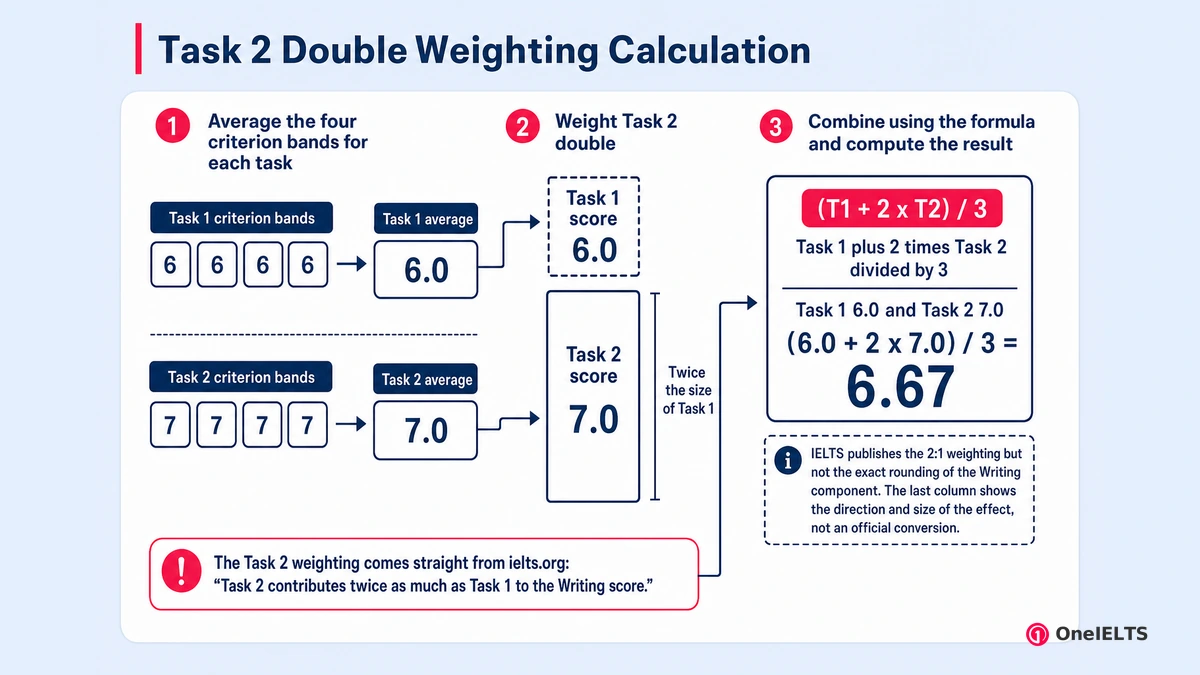
Each task receives four criterion bands averaged into a task score; Task 2 counts twice as much as Task 1, and the combined result is reported as a whole or half band. In three steps: average each task’s four criteria, weight Task 2 double, then report the Writing component in whole or half bands.
The Task 2 weighting comes straight from ielts.org: “Task 2 contributes twice as much as Task 1 to the Writing score.” Three worked scripts show the effect.
| Task 1 criterion bands | Task 1 average | Task 2 criterion bands | Task 2 average | Weighted result (Task 1 + 2 x Task 2, divided by 3) |
|---|---|---|---|---|
| 6, 6, 6, 6 | 6.0 | 7, 7, 7, 7 | 7.0 | 6.67 |
| 7, 7, 7, 7 | 7.0 | 6, 6, 6, 6 | 6.0 | 6.33 |
| 6, 6, 6, 6 | 6.0 | 6, 7, 7, 6 | 6.5 | 6.33 |
IELTS publishes the 2:1 weighting but not the exact rounding of the Writing component. The last column shows the direction and size of the effect, not an official conversion.
Does an Overall Band of 6.25 Round Up to 6.5 in IELTS?
Yes, an overall average of 6.25 is rounded up to 6.5, because IELTS rounds the overall band to the nearest half band and an average ending in .25 goes up. One ending in .75 rounds up to the next whole band, and 6.125 rounds down to 6.0. This rounding rule covers the four skills in your IELTS band score; the Writing band already arrives as a whole or half band.
How Can You Get 8.5 in IELTS Writing?
The requirements for 8.5 are band-8-or-better work on every criterion in both tasks, with Task 2 at or near band 9 because it carries double weight. The band 8 descriptors ask for mostly error-free sentences and skillful use of uncommon vocabulary. Band 9 adds near-invisible cohesion and a fully developed position. Task 1 at 8 and Task 2 at 9 gives 8.67 through double weighting, though Writing rounding isn’t published. See IELTS band 8.
How Do You Get 7+ in IELTS Writing?
The requirements for 7+ are a clear and developed position in Task 2, a clear overview in Task 1, and at least two criteria per task lifted from band 6 to band 7. By Task 2 weighting, a band 7 essay plus a band 6 Task 1 gives 6.67; the reverse gives 6.33. Remove the phrases the table above sets out; these IELTS Writing band 7 essays show the result.
How Does Your Writing Band Feed Into the Overall IELTS Band Score?
The Writing band is one of four equally weighted component scores, with Listening, Reading and Speaking, that are averaged and rounded into the overall band. Writing gets no extra weight, though it’s often the lowest component for test takers in India. IELTS’s 2024-2025 Indian Academic means are 6.2 Writing, 6.4 Listening, 6.9 Reading and 6.5 Speaking. User labels sit in the IELTS overall band descriptors.
Written by Jamil Ahmed, reviewed 7 October 2026.
Last verified: 7 October 2026
Practice for the Real IELTS Exam
Apply what you’ve learned with free, exam-style practice:
- Take a free IELTS mock test — all four skills, real exam timing, AI band scoring
- Sit a Writing section mock — Task 1 and Task 2 in one timed hour with a band estimate
- Practice by question type — self-paced Writing sets with model answers