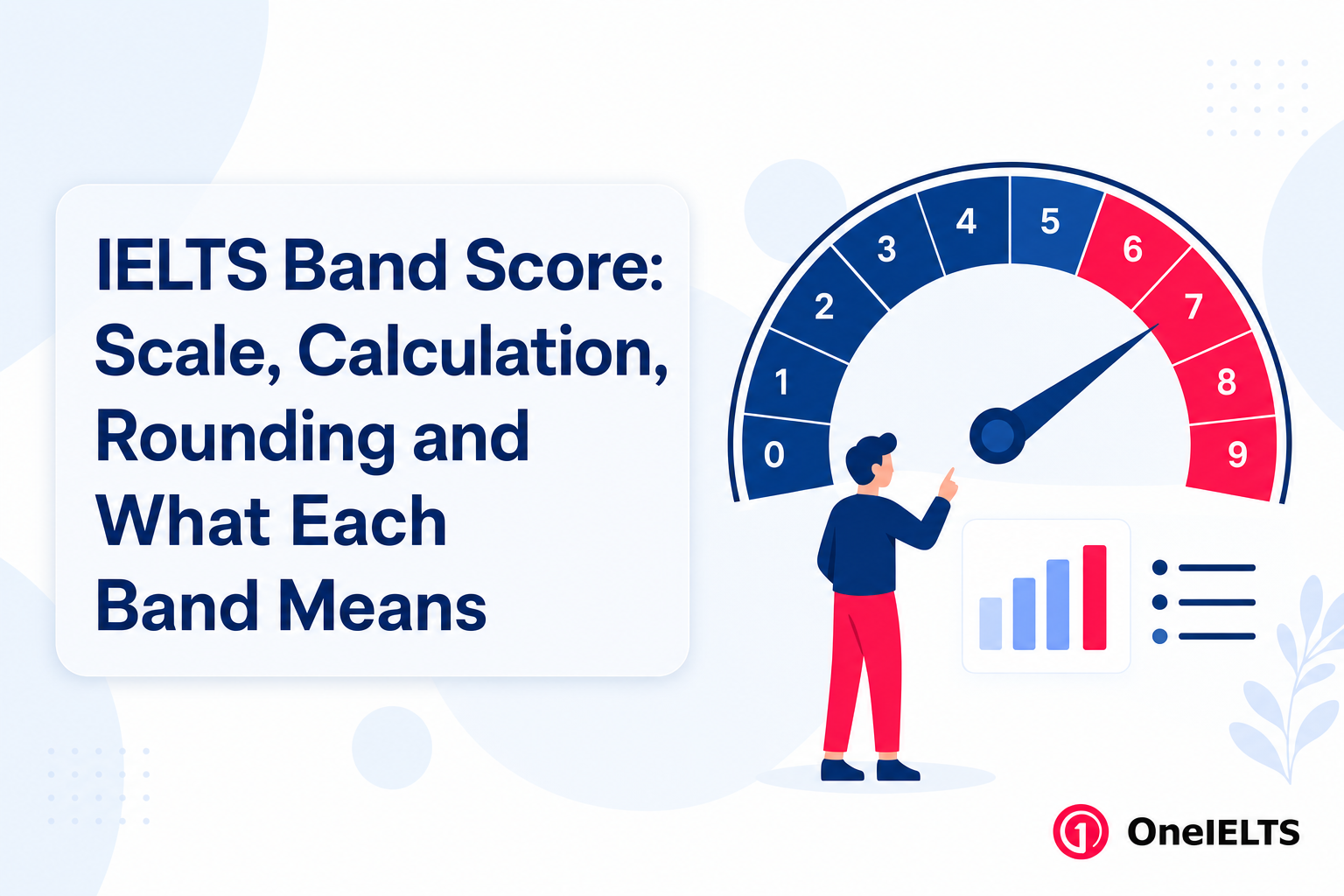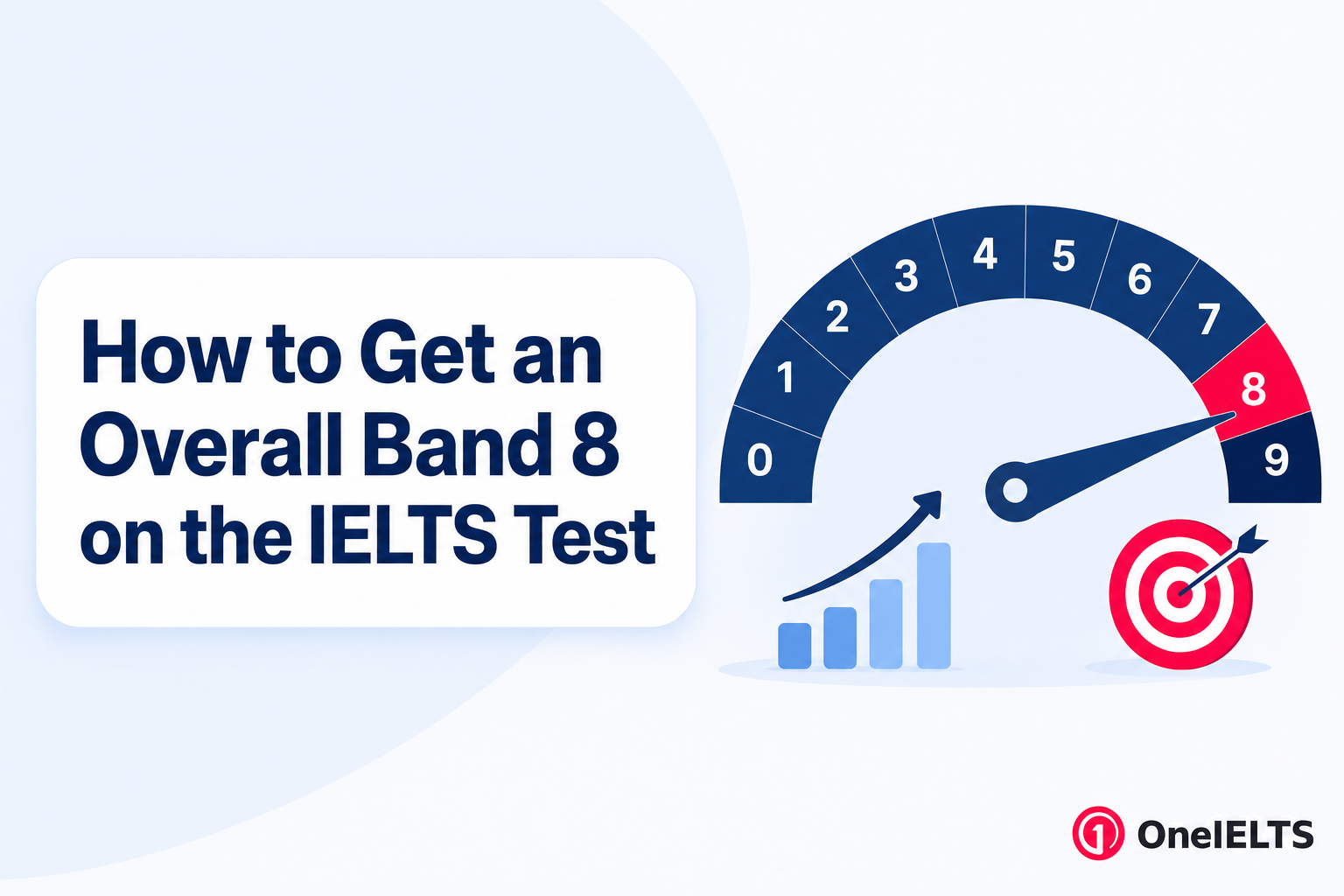
To reach an IELTS band 8 you do not need four flat 8s. The overall is the rounded average of Listening, Reading, Writing and Speaking, so two 8.5s can offset a 7.5. A band 8 marks you as a Very Good User of English.
This guide walks through how to score band 8 in each skill, whether band 8 maps to CEFR C1 or C2, and the overall tips that tie it together. Because the band is a rounded average, you can lean on your strongest skills while you steady the weaker one.
How Can You Score Band 8 in IELTS Listening?
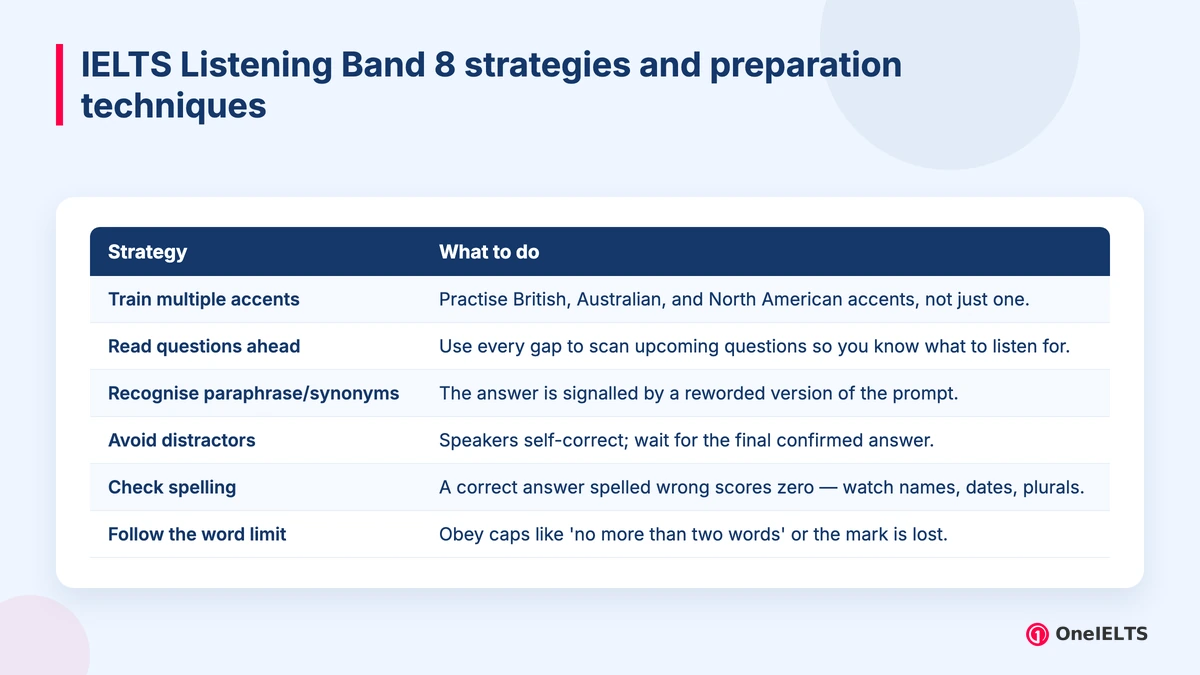
Band-8 Listening rests on predicting answers, hearing meaning rather than words, and writing the answer down cleanly. You train your ear, read ahead, and protect easy marks from careless slips. The methods that move you to band 8 in Listening sit in the list under here.
- Train multiple accents. The test mixes British, Australian, North American and other English accents, so practise across all of them rather than the single accent you find easiest to follow.
- Read questions ahead. Use every gap before a recording to scan upcoming questions, so you know the exact information to listen for and you are not reading and listening at once.
- Recognise paraphrase and synonyms. The audio rarely repeats the question wording, so train yourself to match paraphrase and synonyms, because the answer is signalled by a reworded version of the prompt.
- Avoid distractors. Speakers often correct themselves or name a wrong option first, so learn to avoid distractors and wait for the final confirmed answer before committing.
- Check spelling. A correct answer spelled wrong scores zero, so check spelling on every transferred word, especially names, dates and plurals you tend to rush.
- Follow the word limit. Each question sets a strict word limit, such as “no more than two words”, so count your words and never exceed the cap or the mark is lost.
How Can You Score Band 8 in IELTS Reading?
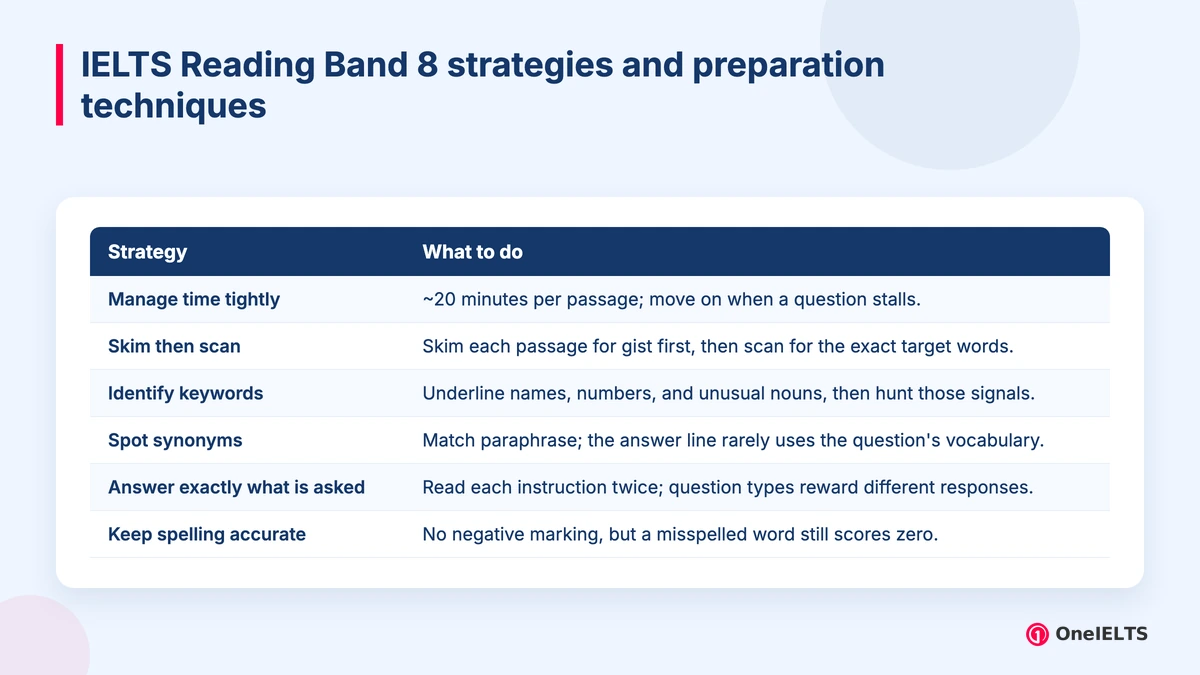
Band-8 Reading is won on the clock. You read with purpose, find answers fast, and trust that there is no negative marking, so you never leave a blank. Skimming, scanning and tight pacing carry you across all three passages. The ways to push your Reading to band 8 are set out next.
- Manage time tightly. Spend about twenty minutes per passage and move on when a question stalls, because strong time management protects the easy marks waiting in later sections.
- Skim then scan. Use skimming scanning as two steps: skim each passage for its gist first, then scan for the specific words the question targets rather than rereading whole paragraphs.
- Identify keywords. Underline the keywords in each question, names, numbers and unusual nouns, then hunt those exact signals in the text to locate the answer quickly.
- Spot synonyms. Passages reword the question, so match synonyms and paraphrase, because the answer line rarely uses the same vocabulary the question does.
- Answer exactly what is asked. Read each instruction twice and answer exactly what is asked, since a true/false/not-given question and a heading-match question reward very different responses.
- Keep spelling accurate. Transfer answers carefully and keep spelling accurate, because there is no negative marking but a misspelled word still scores zero on the answer sheet.
How Can You Score Band 8 in IELTS Writing?
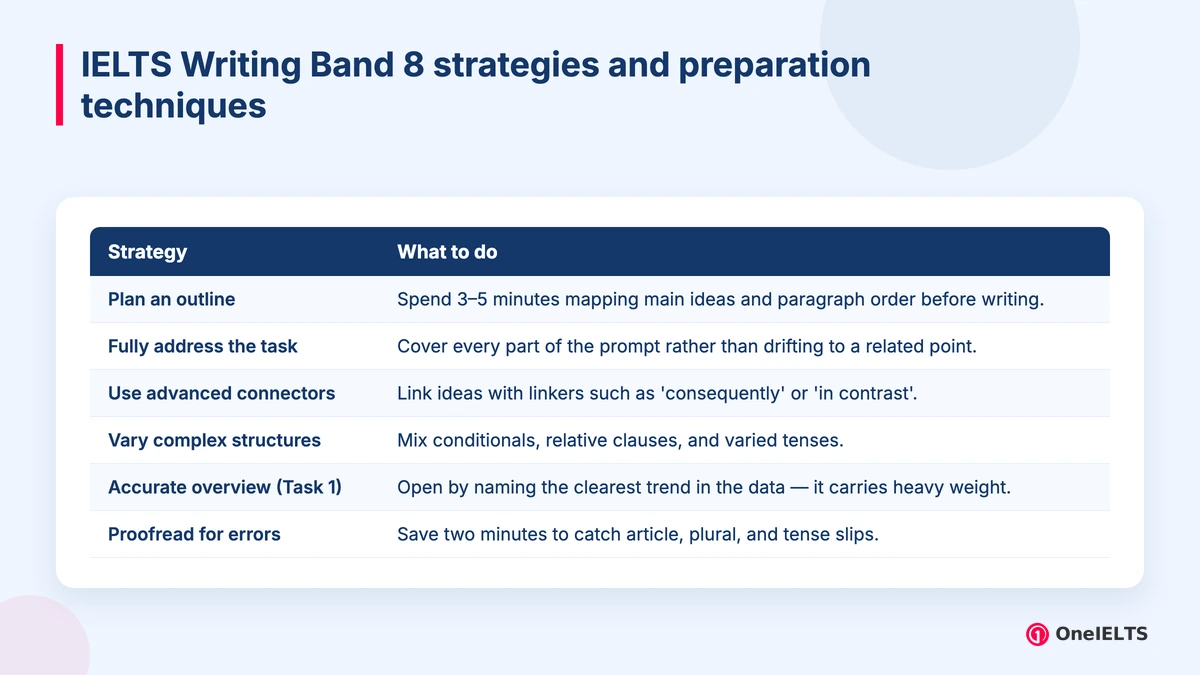
Band-8 Writing turns on task response and control, not on rare words. You plan, answer the whole question, and keep your language varied yet accurate. Writing often caps a candidate’s overall band, so this section earns the most practice. The methods behind band-8 Writing follow here.
- Plan an outline. Spend three to five minutes on an outline before you write, mapping your main ideas and paragraph order so the essay stays coherent under time pressure.
- Fully address the task. Strong task response means you cover every part of the prompt, because a band 8 answers the whole question rather than drifting onto a loosely related point.
- Use advanced connectors. Link ideas with advanced connectors such as “consequently” or “in contrast”, so your argument flows logically without leaning on the same basic linkers throughout.
- Vary complex structures. Mix complex structures, conditionals, relative clauses and varied tenses, so the examiner sees a flexible range rather than one repeated sentence pattern across the essay.
- Keep an accurate overview (Task 1). In Task 1, open with an accurate overview that names the clearest trend in the data, because the overview carries heavy weight in the band-8 mark.
- Proofread for errors. Save two minutes to proofread for errors, catching slips in articles, plurals and tense that quietly drag an otherwise strong band-8 answer down to a 7.
How Can You Score Band 8 in IELTS Speaking?
Band-8 Speaking sounds natural and unhurried. You keep talking, use real idiom, and answer the actual question instead of reciting a script. Fluency and a relaxed delivery matter more than chasing rare grammar. The ways to reach band 8 in Speaking come next.
- Extend fluency. Build fluency by answering in two or three full sentences, adding a reason or an example, so you never reply in a single short clause that stalls the conversation.
- Reduce fillers. Cut habitual fillers like “um”, “you know” and “basically”, because a stream of fillers breaks the smooth delivery that band 8 rewards.
- Vary intonation. Use natural intonation to stress key words and signal a question or contrast, so your speech sounds engaged rather than flat and rehearsed.
- Avoid memorised answers. Examiners detect memorised answers fast, so respond to the real question with no memorised answers and let your genuine opinion shape each reply.
- Paraphrase the examiner. When you need a second, paraphrase the examiner’s question to restate it in your own words, which buys thinking time while still sounding fluent.
- Use natural collocations. Reach for natural collocations such as “make a decision” or “heavy traffic”, because word pairings that sit right mark you as an advanced speaker.
Is an IELTS Band 8 CEFR Level C1 or C2?
An IELTS band 8 maps to CEFR C1 (advanced), not C2. The common “C1 or C2” confusion comes from band 8 sitting at the very top of the C1 advanced user range. The C2 band requires a higher score, because C2 needs 8.5-9 on the IELTS scale. So a band 8 confirms you as a strong advanced user at C1, while a near-perfect 8.5 or 9 crosses into C2, where the band 8 meaning shifts toward mastery.
What Are the Overall Tips to Score Band 8 in IELTS?
Crossing into band 8 across all four skills means scoring with high precision under exam pressure. You win marks by reading patterns, controlling the clock, and playing to your strengths rather than chasing perfection everywhere. The overall tips that hold across every section are set out below.
- Prioritise accuracy over flashiness. Score with high precision by getting simple answers right, because one clean correct response beats an ambitious sentence that collapses into an error.
- Predict answer patterns. Practise enough past papers to predict answer patterns, so you anticipate where a Listening distractor or a Reading paraphrase is likely to appear.
- Control timing. Control timing in every section by setting a per-question pace, since running out of clock costs more marks than any single hard question does.
- Plan before writing. Plan before writing each essay, mapping your argument first, because a clear structure lifts coherence and saves you from rewriting under pressure.
- Avoid memorised responses. Give no memorised responses in Speaking or Writing, since rehearsed templates rarely fit the exact prompt and examiners mark them down.
- Lean on your strongest two skills. Because the overall is a rounded average, lean on your strongest skills, pushing two of them to 8.5 to offset a 7.5 in your weakest.
How Rare Is a Band 8 in IELTS?
A band 8 sits in roughly the top few percent of test-takers worldwide. It is rare because band 8 demands near-native control, with only rare slips across reading, listening, writing and speaking. The British Council scale names this level a Very Good User, and very few candidates hold that standard steadily across all four skills on test day.
Is It Hard to Get Band 8 in IELTS?
Yes – band 8 is hard because it demands near-native consistency across all four skills. What tips a band 8 from a 7.5 is consistency under pressure, not a single brilliant section. Writing often caps it, since a 7.5 essay with small recurring errors holds the average back even when Listening and Reading already sit at 8.5.
Is Band 8 Considered a Good IELTS Score?
Yes – band 8 exceeds almost every university and visa requirement. As a Very Good User score it sits well above cut-offs, because most universities ask for 6.5 to 7.0 and most visa routes set their bar lower still. See how the bands compare in our good IELTS score guide before you decide your target.
How Long Does It Take to Prepare for Band 8?
Preparation time for band 8 varies widely with your starting level, often several focused months. A candidate already near 7.0 may need a few months, while someone starting lower needs longer. Consistent study matters more than total hours, so steady daily practice beats occasional long sessions. Build a routine with our IELTS preparation guide to keep that consistency.
Last verified: 30 June 2026
Practice for the Real IELTS Exam
Apply what you’ve learned with free, exam-style practice:
- Take a full IELTS mock test
- Practice by section: Listening, Reading, Writing, Speaking
- Structure your essays with IELTS Writing templates