


Thirteen pages rank for this search and one of them answers the length question. Writing more does not raise your band, and the only page that says so adds that a longer essay opens you to more criticism.
This guide defines concise writing, names the wordiness sources, and supplies the phrase deletion list the search does not have. Then the word minimums, whether length raises your score, and which marking criteria word economy actually touches. It closes on Task 1, Task 2, where cutting goes too far, the mistakes, the editing pass and practice.
What Does Concise Writing Mean?
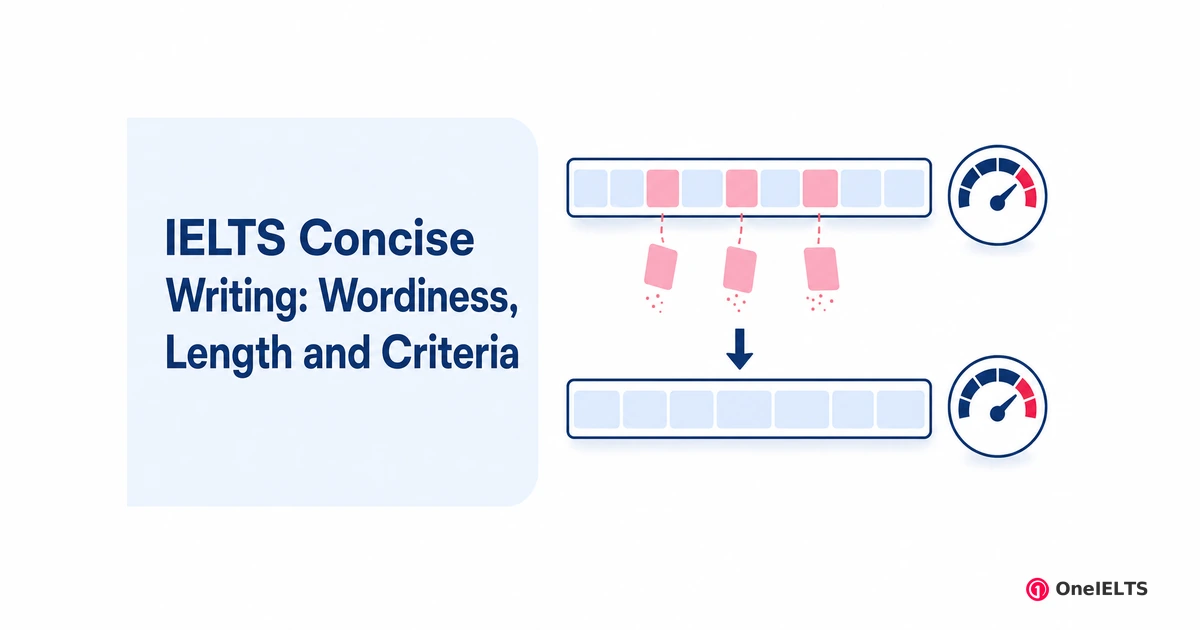
Concise writing means every word in the sentence is doing a job, and any word that is not doing a job comes out. The cutting operation is the whole of it, and shorter is only the side effect.
The line the search keeps missing is the one between concise and short. IDP draws it in the cleanest sentence anywhere in the capture: conciseness is not merely about reducing word count, it is about making every word earn its place. IELTS Mumbai draws the same line from the other side, writing that conciseness does not mean leaving out information but presenting it efficiently.
Word purpose is the test, then, and not length. A sentence of thirty words with no unnecessary words in it is concise. A sentence of twelve words carrying three empty ones is not.
This page does three things the search does not do together. It names the phrases to cut, answers whether length costs you marks, and says which criterion the cutting actually feeds. Efficient presentation is the target throughout.
What Are the Sources of Wordiness?
Wordiness is not one habit but several, and you cannot cut what you cannot name. ZIM Academy is the only page on this search that classifies the wordiness sources at all, and it cites Williams, Style: Toward Clarity and Grace, for the grouping.
- Doubled pairs. Two words meaning the same thing, joined by and: each and every, first and foremost, true and accurate. One of the two always goes.
- Redundant modifiers. A modifier already contained in the noun it modifies: completely finish, past memories, end result, final outcome. Finishing is already complete and an outcome is already final.
- Redundant categories. Naming the category a word already belongs to: oval in shape, larger in size. Oval is a shape, so the last two words do nothing.
- Nominalisation. A verb turned into a noun, which then needs a second verb to carry it. The example from ieltsonlinetests is exact: to evaluate becoming for the evaluation of costs two words and gains nothing.
- Expletive openers. It is, there is and there are, which push the real subject into the middle of the sentence and delay the point of it.
Two more are harder to see than these five, because they look like writing rather than like padding. The first is a phrase doing the work of a single word, and the second is writing about your own essay. Both get a section below.
Which Words Create Complex Wordiness?
Complex wordiness is a multi-word phrase doing the work of a single word, and often a whole clause where a conjunction would do.
ZIM gives three cuts and each is a straight swap. In light of the fact that becomes Because. Despite the fact that becomes Although. In the event that becomes If. Three multi-word phrases, three conjunction substitution moves, and no meaning lost in any of them.
One more from the same page is closer to an essay sentence. In order to fight crime, there is a need for more efforts from the government becomes To fight crime, the government must make more efforts. Eighteen words down to eleven, and the shorter version has a real subject doing a real verb.
Clause compression of that kind is not the same as writing short sentences. Nothing here tells you to avoid subordination, and the case for a long sentence when it is accurate belongs to the complex sentences for IELTS page.
What Counts as Metadiscourse?
Metadiscourse is writing about your writing instead of writing the thing, announcing what you are about to say rather than saying it.
ZIM names four kinds. Hedging language covers perhaps, somewhat, to a certain extent and in my opinion. Emphatic phrases cover it is obvious that, as everyone knows, undoubtedly and of course. Sequencer phrases cover in this part of the essay and now we discuss. Attributors cover I was concerned with and I have concluded that.
Two pages in the capture make the exam-specific point and neither connects it to metadiscourse. IELTS Podcast writes that most examiners find a sentence like This essay will address this issue, using examples and evidence to support my opinion unnecessary, because it adds nothing vital and often reads as memorised. ieltsonlinetests adds that examiners are trained to spot memorised phrases and will reduce your score for them.
Say the connection out loud, because nobody on this search does. The memorised-phrase problem and the metadiscourse problem are one problem. A sentence that announces your essay is a sentence that could have been written before you read the question.
What a real introduction should contain instead is the IELTS Writing Task 2 introduction page’s subject.
Which Phrases Can You Delete in Concise Writing?
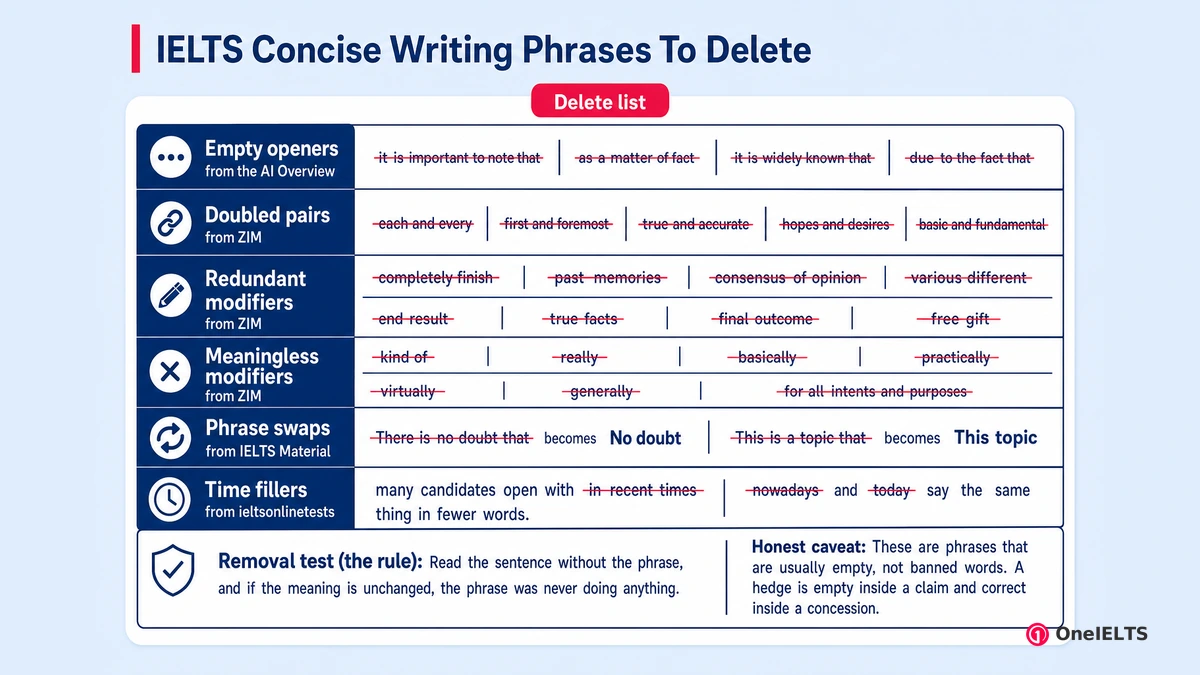
The empty openers, the doubled pairs, the redundant modifiers, the meaningless modifiers, the wordy time fillers, and any phrase that survives being removed.
The gap is worth stating first. Google’s own AI Overview names “due to the fact that” as the first phrase to cut, and not one of the thirteen captured pages carries it in a delete list. This section exists because of that.
Every entry below is quoted from the capture, and the grouping asks one question of each phrase: why is it empty?
- Empty openers, from the AI Overview: it is important to note that, as a matter of fact, it is widely known that, due to the fact that.
- Doubled pairs, from ZIM: each and every, first and foremost, true and accurate, hopes and desires, basic and fundamental.
- Redundant modifiers, from ZIM: completely finish, past memories, consensus of opinion, various different, end result, true facts, final outcome, free gift.
- Meaningless modifiers, from ZIM: kind of, really, basically, practically, virtually, generally, for all intents and purposes.
- Phrase swaps, from IELTS Material: There is no doubt that becomes No doubt, and This is a topic that becomes This topic.
- Time fillers, from ieltsonlinetests, with its own observation attached: many candidates open with in recent times, and the page notes that nowadays and today say the same thing in fewer words.
One rule makes these deletable phrases usable rather than memorisable. Read the sentence without the phrase, and if the meaning is unchanged, the phrase was never doing anything.
The honest caveat matters as much as the list. These are phrases that are usually empty, not banned words. A hedge is empty inside a claim and correct inside a concession.
How Long Should Your Writing Task Answer Be?
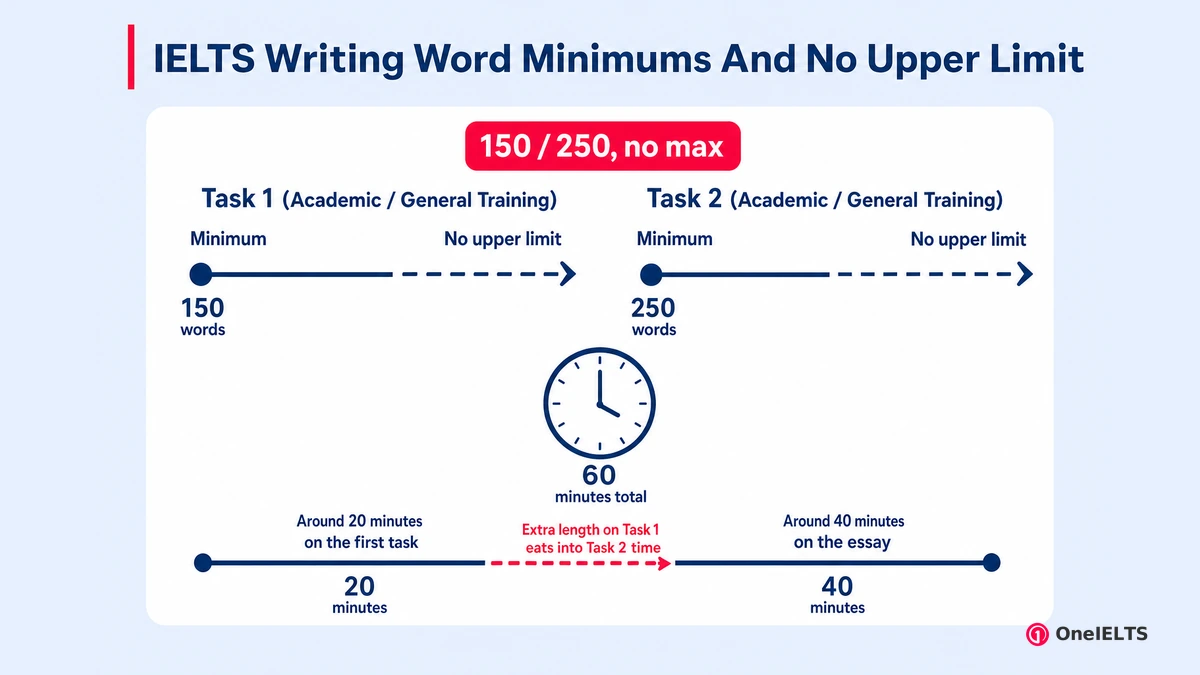
At least 150 words for Task 1 and over 250 for Task 2. IELTS Material is the only captured page that provides both word minimums in one place.
Four of the thirteen captured pages give no word target at all. That includes IDP’s 1,826-word article about conciseness and the exam board’s own ten-step essay guide. IDP India’s format table lists the duration, the tasks and the marks, and no word counts at all. It then lists “write fewer than the required number of words” as a band 5 mistake, naming an official requirement it never states.
The upper end is addressed on one page. ZIM Academy writes that there is no word limit for either task, and that writing beyond the minimum wastes time, because the longer you write the less time you have for the other one.
Put the two halves together and the picture is simple. The minimum is a length floor you have to clear, and everything above it is a time trade-off rather than a marks decision. No upper limit exists in anything the capture contains, and no penalty attaches to going past the floor.
Counting what you have written is a separate skill from deciding how much to write, and it has its own page.
How Many Words Does Each Writing Task Need?
Task 1 needs at least 150 words and Task 2 needs over 250. IELTS Material states both, and Oxford Language Club gives the same pair of figures independently.
Those two task minimums are where the sourcing stops being uniform, and the source standing differs from here on.
IELTS Liz gives a real-world range for Task 2 and it is her figure rather than an official one. Essays are designed to be quite short, she writes, between 270 and 290 words across four or five paragraphs. Her paragraph estimates come with the same flag attached: most introductions run around 50 words, though 40 or 60 may suit what the background and thesis need. She calls these estimates, not rules.
The exam board supplies the timing split. Around 20 minutes on the first task and 40 on the essay, with roughly 5 to 10 minutes planning, 15 to 20 drafting and 10 proofreading and editing.
How to count what you have written, and what counts as a word, belongs to the how to count words in IELTS writing page.
Does a Longer Answer Raise Your Band Score?
No. Nothing in the capture supports writing more to score more, and one page says the opposite outright.
The measurement is the finding. Across all thirteen captured pages, “over the word limit” and “under length” return zero, and “penalise” and “penalize” return zero in every article body. Nobody on this search discusses a length penalty at all.
IELTS Liz is the exception and her wording is worth quoting.
You will not get a higher score for a longer essay. In fact, a longer essay can open you up to more criticism and a lower score.
ZIM supplies the mechanism she does not. The time cost is the real price of over-writing, because every extra minute spent on one task is a minute taken from the other.
The failure runs both ways, and one page in thirteen says so. IELTS Mumbai writes that being too brief can omit key data and reduce your score for Task Achievement. That under-length risk is the counterweight to everything above it.
Then the official silence, which this page will not paper over. None of these are the exam board’s words. Its own essay guide gives no word target and attaches no penalty to length, so the lower score risk described here is a well-sourced reading rather than a ruling.
The trade is easier to feel than to read about. A full Writing mock test puts both tasks on one clock, which is where over-writing on the first one starts costing the second. Practising needs a free OneIELTS account.
Which Marking Criteria Does Concise Writing Affect?
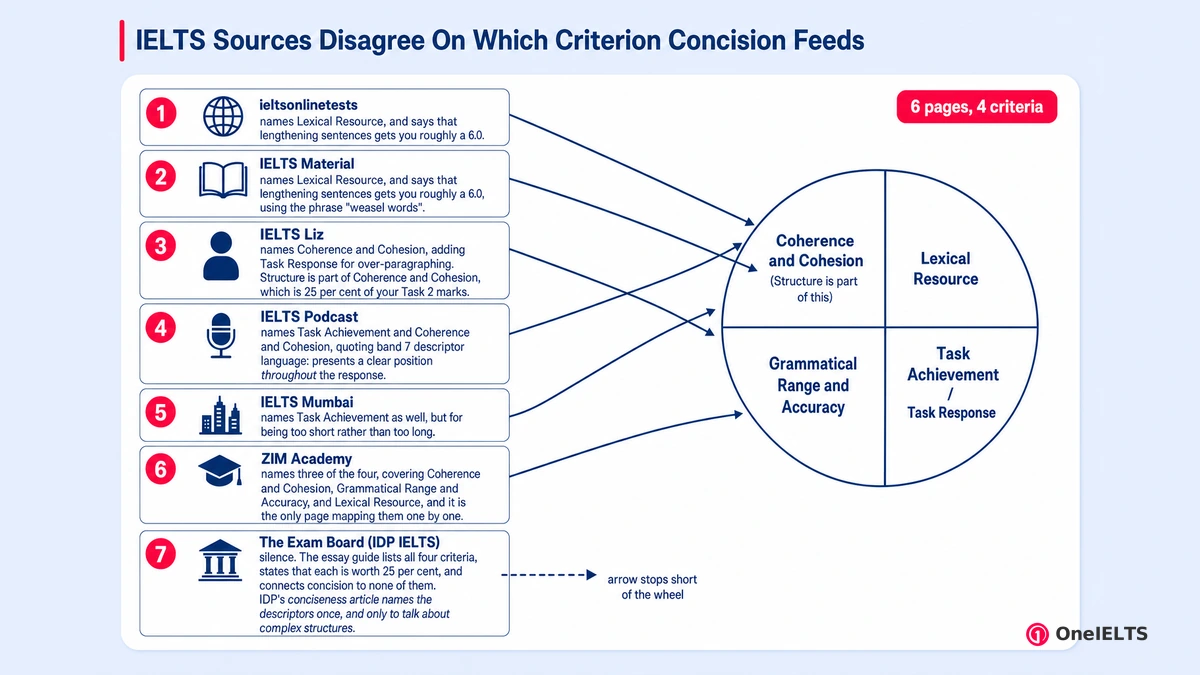
Six captured pages attach concision to a marking criterion and they name four different ones. Each page below asks the reader to accept a different criterion, and every criterion attribution here is that page’s own.
- ieltsonlinetests and IELTS Material both name Lexical Resource, and both say that lengthening sentences gets you roughly a 6.0. IELTS Material’s version reads as a rewrite of the older page, carrying the same unusual phrase “weasel words” and the same 6.0 claim.
- IELTS Liz names Coherence and Cohesion, adding Task Response for over-paragraphing. Structure is part of Coherence and Cohesion, she writes, which is 25 per cent of your Task 2 marks.
- IELTS Podcast names Task Achievement and Coherence and Cohesion, quoting band 7 descriptor language: presents a clear position throughout the response.
- IELTS Mumbai names Task Achievement as well, but for being too short rather than too long.
- ZIM Academy names three of the four, covering Coherence and Cohesion, Grammatical Range and Accuracy, and Lexical Resource, and it is the only page mapping them one by one.
Then the exam board silence, which is the finding that matters most. The board’s own essay guide lists all four criteria, states that each is worth 25 per cent, and connects concision to none of them. IDP’s conciseness article names the descriptors once, and only to talk about complex structures. The board simply does not make this claim.
What can honestly be resolved, then, is this. Concision is not a criterion. It is a behaviour that shows up in whichever criterion the wasted words were costing you.
A padded paragraph reads as weak organisation. A hedge-filled claim reads as an unclear position. An abstract phrase reads as thin vocabulary. That is why five sources name five different criteria and all of them can be partly right.
Which Band Descriptors Reward Clear Writing?
Each of the four criteria carries the same criterion weighting, at 25 per cent of the essay score, and both writing tasks feed the overall writing band.
The capture holds exactly two pieces of descriptor language and this section uses only those two. IDP quotes “a variety of complex structures”, and quotes it while making the point that this does not mean every sentence must be long or convoluted. IELTS Podcast quotes “presents a clear position throughout the response” as band 7 Task Achievement language, putting its own emphasis on throughout.
ZIM adds a band 6 reading rather than a quotation, stating that band 6 Grammatical Range and Accuracy requires the ability to use complex structures.
Be clear about the limit. No page in this capture quotes a descriptor that names concision, wordiness or length at all. The wording itself sits on the IELTS writing band descriptors page.
How Do You Write Concisely in Task 1?
In Task 1 the wordiness is rarely empty phrases. It is describing every number instead of describing the pattern. IELTS Mumbai is the only captured page treating concision as a Task 1 problem at all.
Five moves do the work.
- Data selection over listing. The AI Overview puts it plainly: do not list every number or year. Take the highs, the lows and the big changes and leave the rest on the chart.
- Trend grouping over repetition. IELTS Mumbai’s own worked sentence carries four facts at once: Sales of electronic devices, including smartphones and laptops, increased significantly over the period, while traditional products such as desktop computers showed a decline.
- Comparative language instead of separate sentences. Two figures joined by a comparison do the work of two sentences and read as analysis rather than as a list.
- No opinion at all. IELTS Mumbai lists personal opinions among its Task 1 mistakes, because the task is factual rather than argumentative. The AI Overview says the same thing shorter: state only what the chart shows.
- No vague quantities. IELTS Mumbai names some increase and a lot of changes as the failures here. The AI Overview gives the fix: swap “a big change” for “a 50% increase”.
Then the warning unique to this task, and one page in thirteen states it. IELTS Mumbai writes that being too brief may omit key data and reduce your score for Task Achievement. The omitted data risk is real in Task 1 in a way it is not in Task 2, because cutting here can remove the very figures the marks were attached to.
How Do You Group Data in Writing Task 1?
Data grouping means naming what several figures have in common once, instead of naming each figure separately.
The electronics sentence above is the first worked example, and its shape is worth reading twice. Two rising categories and one falling category, in one sentence, joined by a single contrast. Shared behaviour is what licenses the grouping.
The second example from the same source is a paraphrase rather than a cut, and it is honest to say so. The graph below shows the number of international students studying in Australia from 2000 to 2020 becomes The given line graph illustrates the growth in the number of overseas students enrolled in Australian universities between 2000 and 2020. That rewrite is longer than the original. Paraphrase versus cut is a real distinction and this page is about the second operation.
Group figures that behave the same way. Grouping figures that behave differently hides the pattern the examiner is looking for, and the IELTS Writing Task 1 page covers what to do with each chart type.
How Do You Write Concisely in Task 2?
In Task 2 the wordiness is padding: saying the same idea twice in different words to reach the word count. The AI Overview names it directly, warning against repeating the same idea using different words just to pad your word count.
Five moves again, and they are different moves from Task 1’s.
- One idea per paragraph, with one example. The AI Overview asks you to dedicate each paragraph to one core idea with a single clear example, which is also what idea development means in practice.
- A direct topic sentence. Start each body paragraph with one clear sentence stating the main idea, rather than approaching it over three.
- No essay-announcing opener. This is the metadiscourse point above, applied where it costs the most.
- Connector restraint. This is the only place in the capture where the exam board comes close to the subject, and its wording is direct. “Don’t fall into the trap of trying to put a linking word in every sentence. Essays will score higher when the writer uses linking words only where necessary and appropriate.”
- The active version. Two captured pages teach the active voice as a concision technique, because the active version usually drops the auxiliary the passive needs. When the passive is the right choice is the passive voice in IELTS writing page’s question.
IELTS Liz supplies the structural evidence on paragraph count. Four or five paragraphs in total. One body paragraph means you have failed to organise your ideas and will sit around band 5 for Coherence and Cohesion. Too many body paragraphs means each idea is underdeveloped, which lowers Task Response instead.
Which essay type you are answering, and how to state a position, sit with the essay-type and introduction pages rather than here.
When Does Concise Writing Go Too Far?
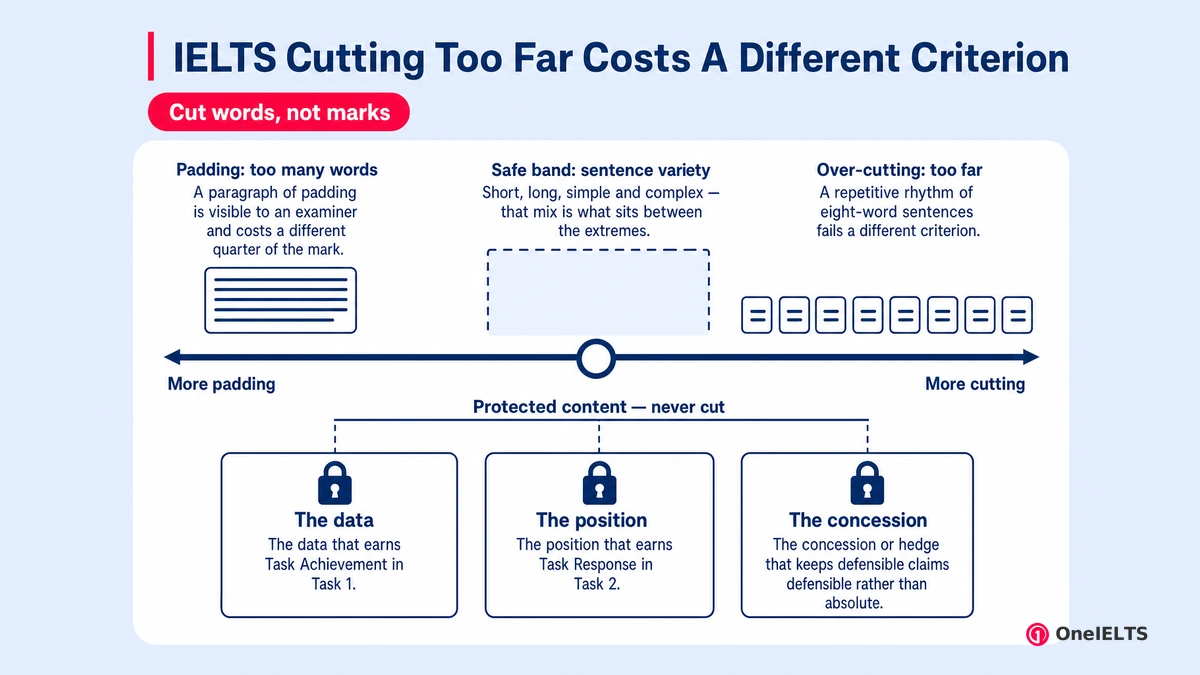
Cutting can run past its own purpose, and an answer made entirely of short sentences fails a different criterion from the one padding fails.
ZIM Academy states the over-cutting case and one page in thirteen is all there is. It is wrong to think every sentence in an essay must be short. Short simple sentences make writing repetitive, and by its reading of the band descriptors, band 6 Grammatical Range and Accuracy requires the ability to use complex structures.
IDP makes the same point from a test owner’s side, and in one sentence it argues against both extremes. Although the band descriptors encourage a variety of complex structures, that does not mean every sentence must be lengthy or convoluted. That is the most useful line in the whole capture, because it refuses both the padding and the chopping.
Sentence variety is what sits between them. A repetitive rhythm of eight-word sentences is as visible to an examiner as a paragraph of padding, and it costs a different quarter of the mark.
Three things count as protected content and never come out. The data that earns Task Achievement in Task 1. The position that earns Task Response in Task 2. The concession or hedge that keeps defensible claims defensible rather than absolute.
The rule fits in one line. Cut words that carry no meaning, never sentences that carry a mark.
When a longer sentence is worth the grammatical risk is the complex sentences for IELTS page’s question rather than this one’s.
Which Concise Writing Mistakes Cost Marks?
Seven failures, each with a symptom you can look for. Every one is traceable to the capture.
- Padding to reach the count. The symptom is a second half of a paragraph that restates the first. The AI Overview names it, and IELTS Liz’s version is blunter: at no time do you add extra padding or unnecessary description or information.
- The memorised opener. The symptom is a first sentence that could have been written before you saw the question. IELTS Podcast and ieltsonlinetests both name it.
- Connector overuse. The symptom is every sentence beginning with a linking word. The exam board warns against a linking word in every sentence, and the AI Overview asks for few, precise connectors instead of heavy transition chains.
- Overlong sentences that break. The exam board gives the test: “A sentence is probably too long if you need to take a breath in the middle of reading it. Try splitting this up into smaller sentences.” The AI Overview adds that long sentences cause grammar errors.
- Vague wording doing precise work. The symptom is “a big change” sitting where a figure belongs. Both the AI Overview and IELTS Mumbai name it.
- Word repetition. The symptom is the same noun four times in a paragraph. The exam board’s proofreading note reads: “The same word appears many times. Think about any other words you could use instead.” A synonym fixes it only when the synonym is accurate.
- Cutting the answer itself. The symptom is a Task 1 answer with no data or a Task 2 answer with no position. IELTS Mumbai attaches this one to Task Achievement.
Nothing beyond those seven appears in the capture, so nothing beyond those seven appears here.
How Do You Edit for Clarity and Conciseness?
Compress what you mean into the fewest words, and do not state what your reader can easily infer. That principle comes from Williams, quoted by ZIM Academy, and it is the whole editing pass in one line.
Run the pass in this order.
- Read for the empty openers. Delete anything sitting in front of the real subject of the sentence.
- Read for doubled pairs and redundant modifiers. Cut the second word of each pair and the modifier the noun already contains.
- Read for nominalisation. If a noun is hiding a verb, put the verb back and drop the carrier verb it needed.
- Read for hedges in claims. A hedge review keeps the ones inside concessions, where they are accurate, and removes the ones inside claims, where they read as weakness.
- Read for idea repetition rather than word repetition. If two sentences make the same point, one of them goes.
- Read the longest sentence aloud in your head. If you would need a breath in the middle of it, split it.
IDP supplies the tone this pass needs. When it comes to trimming the fluff, be ruthless, and if a word or phrase does not add value, let it go.
The editing budget comes from the exam board. Roughly 10 minutes of the 40 on the essay goes to proofreading and editing, and its guide asks you to proofread, then edit, then proofread again.
What Should You Check When You Proofread Your Essay?
The exam board’s guide separates proofreading from editing and asks for a proofreading pass twice, once before the edit and once after.
Six checks fit in your head under pressure.
- Does every paragraph make one point?
- Is there a sentence you cannot read in one breath?
- Do repeated words appear more than twice in the same paragraph?
- Is there an opener that could be deleted without loss?
- In Task 1, are there missing figures the answer needs?
- In Task 2, does your position check pass, with the position stated in the introduction as well as the conclusion?
The order carries the point. Proofread, edit, then proofread again, because the second pass catches the errors the edit introduced. Grammar and spelling errors more generally sit on the common IELTS writing mistakes page.
How Do You Practise Concise Writing?
Cut your own writing rather than reading about cutting. Three moves, and the third one is the test.
Move one is the cutting drill. Take an answer you have already written and make a ten percent cut without losing a single fact or a single position. Cutting is easier to learn on your own writing than on somebody else’s examples, because you already know what every sentence was meant to do.
Move two is the delete-list pass. Run the groups from this page over that same answer, one group at a time: empty openers, doubled pairs, redundant modifiers, meaningless modifiers, phrase swaps, time fillers.
Move three is a fresh timed attempt, to see whether the habits held under the clock. The first two moves are untimed and this one is not, which is the whole point of doing them in that order. The prompts come from IELTS Writing Task 1 practice. Practising needs a free OneIELTS account. The grid is browsable when you are logged out, and opening a set is what requires signing in.
The words you remove are not the point. The marks those words were costing you are.
Written by Jamil Ahmed, reviewed 14 August 2026.
Last verified: 14 August 2026
Practice for the Real IELTS Exam
Apply what you’ve learned with free, exam-style practice:
- Take a free IELTS mock test — all four skills, real exam timing, AI band scoring
- Sit a Writing section mock — Task 1 and Task 2 in one timed hour with a band estimate
- Practise by question type — self-paced Writing sets with model answers