Coherence and Cohesion judges how logically your ideas are organized and how clearly your sentences and paragraphs are tied together. It’s one of four Writing criteria, with a 25% weighting in Task 1 and in IELTS Writing Task 2. Coherence works at essay and paragraph level, in meaning and order. Cohesion works at sentence and phrase level, in the language that links.
This page defines and separates the two, then maps the band descriptors device by device. It covers paragraphing, logical organization, cohesive devices, reference, substitution and ellipsis, and ends with one Task 2 paragraph rewritten from band 6 to band 7. Linking-word lists live on the OneIELTS connectors page, and the other three criteria on the Writing band descriptors page.
What Is Coherence and Cohesion in IELTS Writing?
Coherence and Cohesion is one of the four IELTS Writing assessment criteria. It measures how logically information and ideas are organized and progress through your response, and how accurately and flexibly they’re linked within and between sentences and paragraphs.
It carries 25% of each task’s score, alongside Task Response (Task Achievement in Task 1), Lexical Resource, and Grammatical Range and Accuracy. It’s marked in Task 1 and Task 2, in Academic and General Training alike. A certified examiner reads your script for four things the descriptors name: logical organization, clear progression, paragraphing, and the range and accuracy of cohesive devices, reference and substitution included.
The other three criteria sit in the IELTS Writing band descriptors guide. The criterion’s name joins two different ideas, and the next two sections pull them apart.
What Is Coherence in Writing?
Coherence is the quality that makes your writing make sense as a whole. Your ideas follow a logical sequence, each one connects to your main point, and a reader can trace your line of thought from the introduction to the conclusion.
It lives in meaning and structure, not in particular words, so an essay with no linking words can still be coherent. Three things create it: a clear position, a sensible order of ideas, and one central idea per paragraph. Incoherence shows up as ideas that jump, a paragraph that drifts off topic, or a conclusion that adds a new argument.
Order alone changes it, as two versions of one argument show.
Logical: “Cars fill city roads. Traffic slows the buses. People stop taking buses.”
Shuffled: “People stop taking buses. Cars fill city roads. Traffic slows the buses.”
The first is a logical organization of cause and effect. The second uses the same three facts, but the reader has to rebuild the chain.
What Is Cohesion in Writing?
Cohesion is the set of language links that tie sentences and paragraphs together on the surface of a text. These are the words and grammar that point back, point forward, or signal how one idea relates to the next.
Each link is a cohesive tie, and four grammatical types do most of the work. Conjunction uses linking words such as however and therefore. Reference uses pronouns and demonstratives such as it, they, this and these. Substitution puts one or so in place of a repeated noun or clause, and ellipsis leaves out words the reader can recover.
Lexical cohesion adds a fifth route through synonyms and word families. This classification comes from Halliday and Hasan’s Cohesion in English (1976). Cohesion can be correct while the text is still incoherent, which is why the criterion tests both.
What Is the Difference Between Coherence and Cohesion in IELTS?
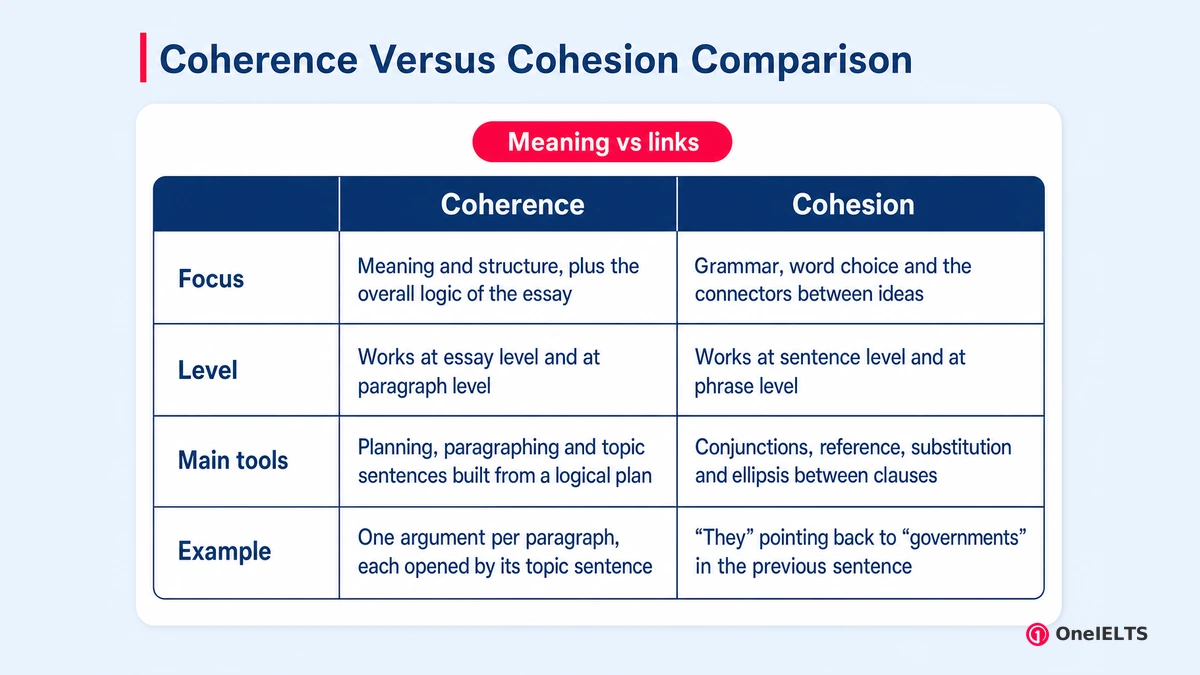
Coherence is about meaning and the logical order of ideas across the essay and its paragraphs, while cohesion is about the words and grammar that link one sentence or clause to the next. Five features separate the two halves of the criterion in this table.
| Feature | Coherence | Cohesion |
|---|---|---|
| Focus | Meaning and structure, plus the overall logic of the essay | Grammar, word choice and the connectors between ideas |
| Level | Works at essay level and at paragraph level | Works at sentence level and at phrase level |
| Main tools | Planning, paragraphing and topic sentences built from a logical plan | Conjunctions, reference, substitution and ellipsis between clauses |
| Typical band-6 fault | The central topic of a paragraph is not always clear | Linking is faulty or mechanical through misuse or overuse |
| Example | One argument per paragraph, each opened by its topic sentence | “They” pointing back to “governments” in the previous sentence |
A text can be cohesive without being coherent, because well-linked sentences can still wander off the question. It can also be coherent with weak cohesion: a sound logical plan written in short, unlinked sentences. IELTS rewards the two together, and that’s why examiners score them under one criterion.
What Are the IELTS Coherence and Cohesion Band Descriptors?
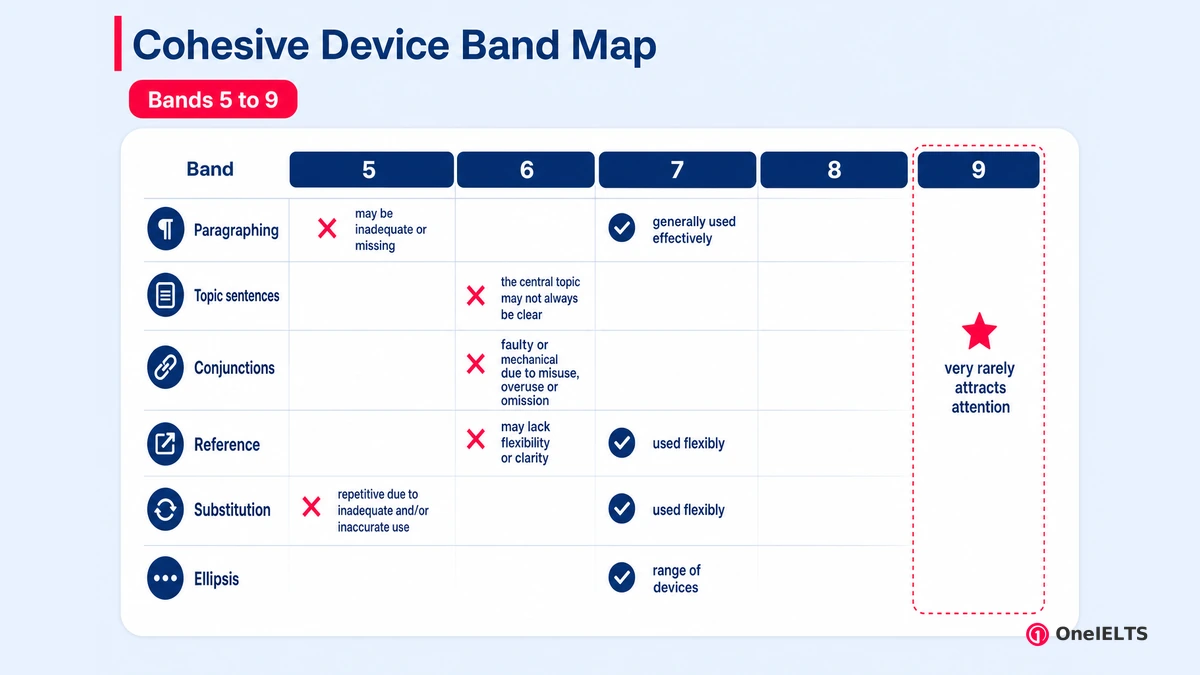
The descriptors move from a message that “can be followed effortlessly”, with cohesion that “very rarely attracts attention” at band 9, to cohesion that “may be faulty or mechanical” at band 6. At band 5, paragraphing “may be inadequate or missing”. Every quoted line comes from the May 2023 public version on ielts.org, checked on 7 October 2026, with British spelling kept inside quotation marks.
| Band | Organization and progression | Cohesive devices, reference and substitution | Paragraphing | Phrase that holds it at this band |
|---|---|---|---|---|
| Band 9 | The message can be followed effortlessly, and any lapses in coherence or cohesion are minimal. | Cohesion is used so smoothly that it very rarely attracts the reader’s attention at all. | Paragraphing is skillfully managed, so every paragraph has a clear role and a natural boundary. | “Cohesion is used in such a way that it very rarely attracts attention.” |
| Band 8 | Information and ideas are logically sequenced, and the message can be followed with ease. | Cohesion is well managed, though occasional lapses in coherence and cohesion may still occur. | Paragraphing is used sufficiently and appropriately, with each paragraph carrying one developed idea. | “Information and ideas are logically sequenced, and cohesion is well managed.” |
| Band 7 | Ideas are logically organized with a clear progression throughout, and only a few minor lapses occur. | A range of devices, reference and substitution included, is used flexibly with some over- or under-use. | Paragraphing generally supports overall coherence, and ideas inside each paragraph follow a logical sequence. | “A range of cohesive devices including reference and substitution is used flexibly but with some inaccuracies or some over/under use.” |
| Band 6 | Ideas are generally arranged coherently, and there is a clear overall progression across the essay. | Linking may be faulty or mechanical, and reference and substitution may lack flexibility or clarity. | Paragraphing may not always be logical, and the central topic may not always be clear. | “Cohesion within and/or between sentences may be faulty or mechanical due to misuse, overuse or omission.” |
| Band 5 | Organization is evident but not wholly logical, and overall progression may be lacking in places. | Cohesive devices may be limited or overused, with some inaccuracy, and sentences aren’t fluently linked. | Paragraphing may be inadequate or missing, so the reader can’t see where each idea begins. | “Organisation is evident but is not wholly logical and there may be a lack of overall progression.” |
Six tools map onto those lines, each tied to the band that rewards it and the phrase that penalizes it.
- Paragraphing: band 7 says it’s “generally used effectively”, while band 5 penalizes paragraphing that “may be inadequate or missing”.
- Topic sentences: unnamed in the grid, they stop the band 6 fault “the central topic may not always be clear”.
- Conjunctions: band 7 tolerates “some over/under use”, but band 6 penalizes linking that’s “faulty or mechanical due to misuse, overuse or omission”.
- Reference: first named at band 7 as “used flexibly”, it drops to band 6 when it “may lack flexibility or clarity”.
- Substitution: paired with reference at band 7, its absence at band 5 leaves writing “repetitive due to inadequate and/or inaccurate use”.
- Ellipsis: no band line names it, so it earns credit inside band 7’s “range of cohesive devices”, inaccuracies included.
“Mechanical” at band 6 describes linkers stacked at the start of sentences. That’s why band 7 comes through reference and substitution, not more connectors. Task 1 uses the same core lines, though its grid drops the paragraphing and central-topic lines below band 8. The other three criteria live in the full IELTS Writing band descriptors page.
How Should You Paragraph an IELTS Essay for Coherence?
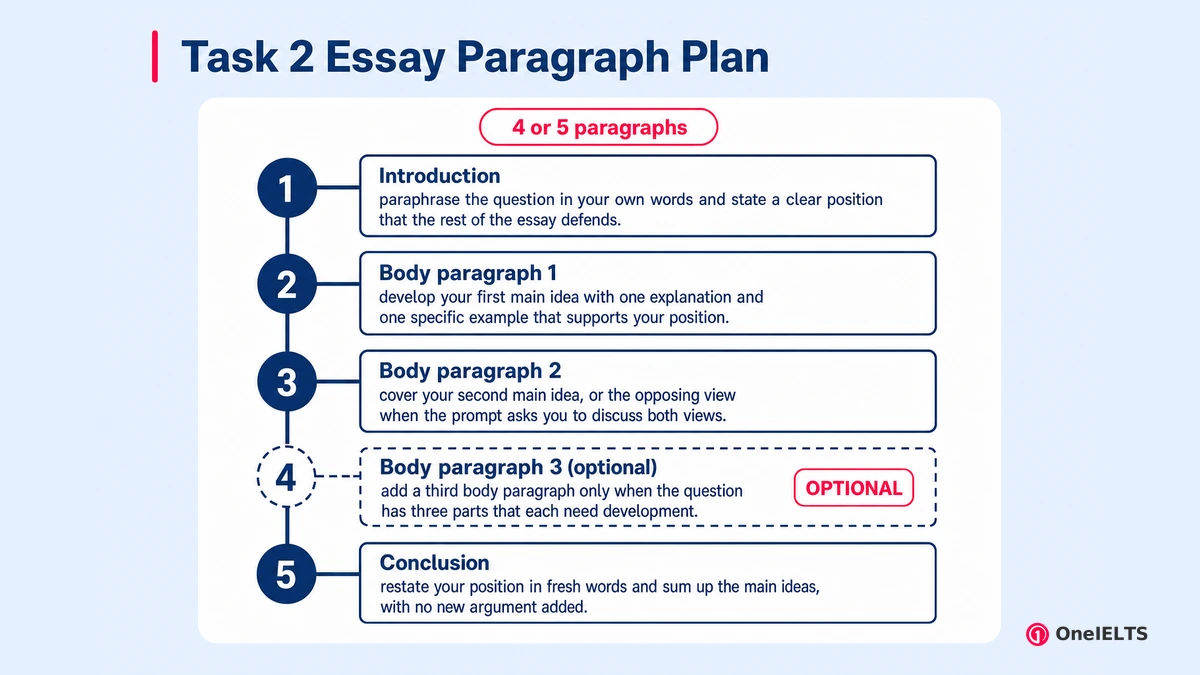
Give every body paragraph one central topic, open it with a sentence that states that topic, and develop it with explanation and an example. Start a new paragraph when the idea changes, so a Task 2 essay usually runs to four or five paragraphs.
The descriptors track this closely. At band 5, paragraphing “may be inadequate or missing”; at band 6 it “may not always be logical”; at band 7 it’s “generally used effectively”. One-sentence paragraphs and a single block of text both cost marks. Task 1 swaps this plan for an introduction, an overview paragraph and two detail paragraphs.
A coherent Task 2 essay follows a five-part plan, with the third body paragraph used only when the prompt needs it.
- Introduction: paraphrase the question in your own words and state a clear position that the rest of the essay defends.
- Body paragraph 1: develop your first main idea with one explanation and one specific example that supports your position.
- Body paragraph 2: cover your second main idea, or the opposing view when the prompt asks you to discuss both views.
- Body paragraph 3 (optional): add a third body paragraph only when the question has three parts that each need development.
- Conclusion: restate your position in fresh words and sum up the main ideas, with no new argument added.
How Can You Improve Coherence in IELTS Writing?
Plan before you write, give each paragraph a topic sentence, and order your ideas so each one builds on the last, with every sentence tied to your position. Coherence is mostly decided before your first sentence, in the essay plan.
Paragraphing has its own section above, so these seven techniques cover what happens inside and across paragraphs.
- Plan for 3 to 5 minutes before writing: jot your position, two main ideas and one supporting example each, so the essay plan fixes the order before you write.
- Write a topic sentence for each body paragraph: open with one sentence that names the paragraph’s idea, so the examiner knows its job from the first line.
- Order ideas from general to specific: move from the claim to the reason to the example, so the logical progression inside each paragraph feels natural to the reader.
- Support each idea with explanation and an example: follow every claim with why it’s true and one supporting example, such as a city, policy or figure.
- Keep every paragraph on its central topic: cut any sentence that belongs to a different paragraph’s idea, even when it’s a good point you want to make.
- State your position early and hold it to the conclusion: put your view in the introduction, echo it in each topic sentence, and close on the same view.
- Write at a level you can control: choose ideas you can explain clearly in plain English, because an ambitious argument you can’t express breaks the line of reasoning.
What Are Cohesive Devices in IELTS Writing?
Cohesive devices are the words and grammatical structures that link ideas across sentences and paragraphs: conjunctions and linking phrases, reference words, substitution, ellipsis, and lexical links such as synonyms. Examiners credit the range you use accurately, not the number you know. Word lists by function sit on the IELTS Writing Task 2 connectors page.
Five device types do the linking, and the next two sections cover reference, substitution and ellipsis in depth.
- Conjunctions and linking phrases: words such as however and as a result signal relationships.
- Reference: reference words like it, plus demonstratives such as this and these, point back.
- Substitution: one, ones and do so replace a word or clause already used.
- Ellipsis: words are left out because the reader can recover them easily.
- Lexical cohesion: synonyms, word families and collective nouns repeat an idea without repeating words.
How Do You Use Pronouns and Reference for Cohesion?
Referencing replaces a noun or idea you’ve already mentioned with a word that points back to it: a pronoun, a demonstrative plus a summary noun, or a phrase such as the former or the latter. The reader follows the link without hearing the same noun again. Former and latter only work when exactly two options came just before.
Reference is the device the band 7 line names outright, so it’s worth getting right. The band 6 risk is reference that “may lack flexibility or clarity”, which usually means unclear reference: a bare “this” or “it” that could point to two nouns. The fix is a demonstrative pronoun with a noun, “this policy” rather than a bare “this”.
Five reference types cover most Task 2 essays, each shown with a short example.
- Personal pronouns: it, they and them replace a noun, as in “Governments fund schools because they benefit society.”
- Demonstrative + summary noun: this trend or these measures sum up a whole sentence, as in “This trend worries parents.”
- Comparative reference: such policies and a similar approach point back to an earlier idea while comparing it with another.
- The former and the latter: these pick out the first or second of two options, as in “the latter costs less”.
- Synonyms as lexical reference: children becomes young people in the next sentence, so the idea continues without the repeated word.
How Do Substitution and Ellipsis Improve Cohesion?
Both cut repetition: substitution swaps a repeated word or clause for a short placeholder, and ellipsis drops words the reader can recover from the sentence before. Substitute words include one, ones, do so and so.
Substitution replaces a repeated noun or verb phrase. “Some cities build new roads; others choose cheaper ones.” Here ones stands for roads. “Governments should fund public transport, and many already do so.” Do so stands for the whole verb phrase.
Ellipsis goes further and leaves a gap. “Some students prefer online classes; others, face-to-face teaching.” The omitted words, “prefer”, are obvious from the first clause.
The band 7 descriptor names “reference and substitution” used flexibly, so these devices separate band 7 from the band 6 “mechanical” script. Ellipsis only works when the gap is obvious. A gap the reader can’t fill counts as an inaccuracy in cohesion.
How Can You Improve Cohesion in IELTS Writing?
Use fewer, better-chosen linking words, place some inside sentences, and do more of the linking with reference, substitution and synonyms. Scripts that stall at band 6 on this criterion tend to show the same habit: a linker opening almost every sentence, with a bare “this” doing the referencing.
Each of these six fixes removes one named fault, and none needs a new word list.
- Use linking words sparingly: one linker every two or three sentences fixes mechanical linking, which the band 6 line calls “faulty or mechanical”.
- Move some linkers inside the sentence: a sentence position after the subject, as in “Cities, however, …”, fixes the “Firstly, Secondly, Moreover” pattern.
- Check each linker’s meaning: confirm what a linker signals before you use it, which fixes misuse such as “on the contrary” for “on the other hand”.
- Replace repeated nouns with pronouns and synonyms: swap the third “public transport” for “it” or “such services”, which fixes repetition.
- Put a noun after this or these: write “this policy” instead of a bare “this”, which fixes unclear reference that could point two ways.
- Read the paragraph without its linkers: if it still makes sense, cut some, because overuse is a fault the descriptors name at bands 5 and 6.
What Are Examples of Coherence and Cohesion in IELTS Writing Task 2?
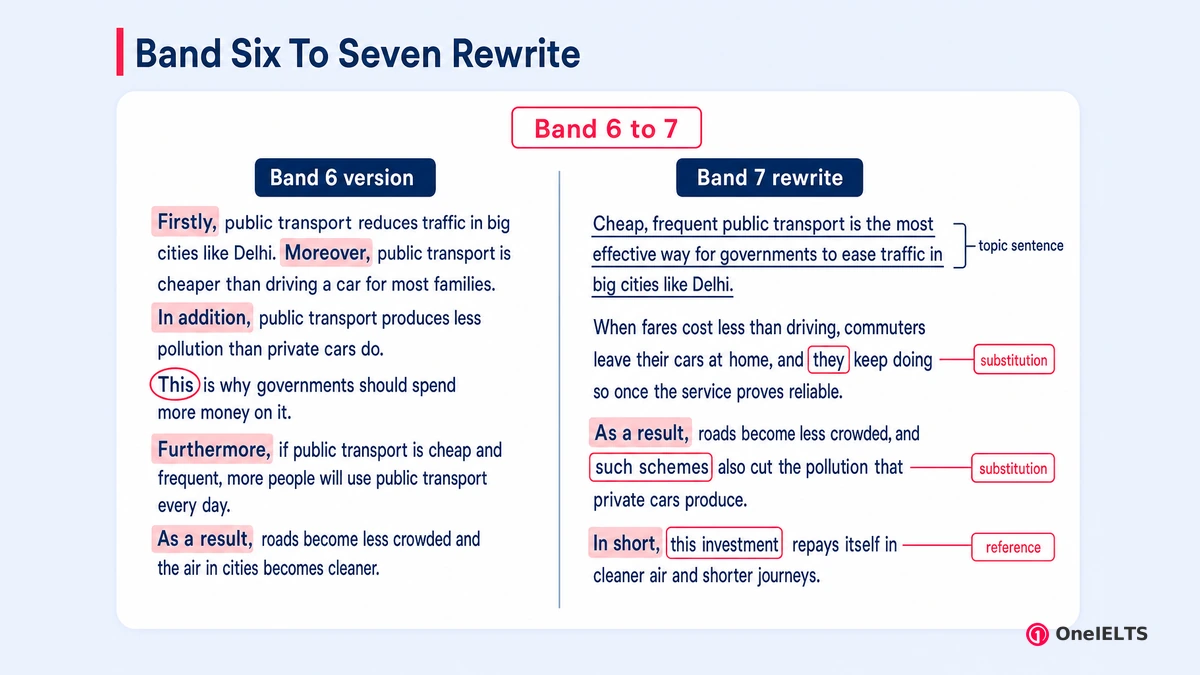
The clearest example is one body paragraph shown twice: a band 6 version with mechanical linking and unclear reference, and a band 7 rewrite of the same ideas with a topic sentence, reference and substitution. Both come from a Task 2 essay on public transport.
Band 6 version
Firstly, public transport reduces traffic in big cities like Delhi. Moreover, public transport is cheaper than driving a car for most families. In addition, public transport produces less pollution than private cars do.
This is why governments should spend more money on it. Furthermore, if public transport is cheap and frequent, more people will use public transport every day. As a result, roads become less crowded and the air in cities becomes cleaner.
Band 7 rewrite
Cheap, frequent public transport is the most effective way for governments to ease traffic in big cities like Delhi. When fares cost less than driving, commuters leave their cars at home, and they keep doing so once the service proves reliable. As a result, roads become less crowded, and such schemes also cut the pollution that private cars produce. In short, this investment repays itself in cleaner air and shorter journeys.
Five changes lift the paragraph, each matched to the descriptor phrase it removes and the one it satisfies.
| Change made | Band-6 phrase it removes | Band-7 phrase it satisfies |
|---|---|---|
| Topic sentence added, naming one central topic before any supporting point | “Paragraphing may not always be logical and/or the central topic may not always be clear” | “the sequencing of ideas within a paragraph is generally logical” |
| Sentence-initial linkers cut from five to two, with grammar doing the rest | “cohesion within and/or between sentences may be faulty or mechanical due to misuse, overuse or omission” | “A range of cohesive devices including reference and substitution is used flexibly” |
| The bare “This is why” becomes “this investment”, with one clear target | “The use of reference and substitution may lack flexibility or clarity” | Reference “used flexibly”, so a pointed “this” plus noun earns band 7 credit |
| Repeated noun replaced by “they” and “such schemes” across the rewrite | “may lack flexibility or clarity and result in some repetition or error” | Substitution through “such schemes” is the device band 7 names beside reference |
| Ideas reordered cause before effect: cheap fares, then switching, then fewer cars | Band 6 asks only for “a clear overall progression”, so order inside paragraphs can wander | “there is a clear progression throughout the response” from the first sentence onward |
The rewrite says nothing new. It drops three sentence-opening linkers, gives “this” a noun, and lets “they” and “such schemes” carry the repeated noun. Each descriptor phrase in the table points to one edit, so you can run the same check on your own Task 2 essay. The subsections cover linkers, openings and endings, full band 7 essays, and Task 1.
Which Linking Words Should You Use in an IELTS Task 2 Essay?
The linking words that serve a Task 2 essay best are a small set you can use accurately, one or two for each function (adding, contrasting, giving examples, showing results, concluding), not a memorized list. For this criterion, accuracy and placement beat range: one well-placed contrast word earns more than five synonyms for result. The full set by function is on the IELTS Writing Task 2 connectors and functions page.
How Do You Write a Coherent Introduction and Conclusion in Task 2?
The requirements for a coherent introduction and conclusion are a paraphrased question and a clear position at the start, and the same position restated, with no new argument, at the end. A conclusion that shifts position breaks coherence as well as Task Response, because the reader can’t follow one line of thought.
The examiner expects the conclusion to answer the question the introduction set. Templates for both ends sit in the IELTS essay introduction and conclusion guide, and each paraphrase there keeps the position fixed.
What Does a Band 7 Task 2 Essay Do With Coherence and Cohesion?
The features a band 7 Task 2 essay shows are a clear progression of ideas, one central topic per paragraph, and a range of cohesive devices. Those devices, including reference and substitution, are used flexibly, with only some over- or under-use. The rewrite above is that standard in one paragraph. For flexible cohesion across a whole script, read the IELTS Writing band 7 essays, which work as sample essays.
Does Coherence and Cohesion Work the Same Way in IELTS Writing Task 1?
Yes, Task 1 is marked against the same Coherence and Cohesion criterion, with near-identical descriptor wording, but the structure changes. Examiners expect an introduction, an overview and two paragraphs of grouped data in Academic Task 1, and a paragraph per bullet point in a General Training letter. Academic Task 1 cohesion leans on comparison language and sequence words, such as while, whereas and followed by. See the IELTS Writing Task 1 connectors page.
Written by Jamil Ahmed, reviewed 7 October 2026.
Last verified: 7 October 2026
Practice for the Real IELTS Exam
Apply what you’ve learned with free, exam-style practice:
- Take a free IELTS mock test — all four skills, real exam timing, AI band scoring
- Sit a Writing section mock — Task 1 and Task 2 in one timed hour with a band estimate
- Practice by question type — self-paced Writing sets with model answers