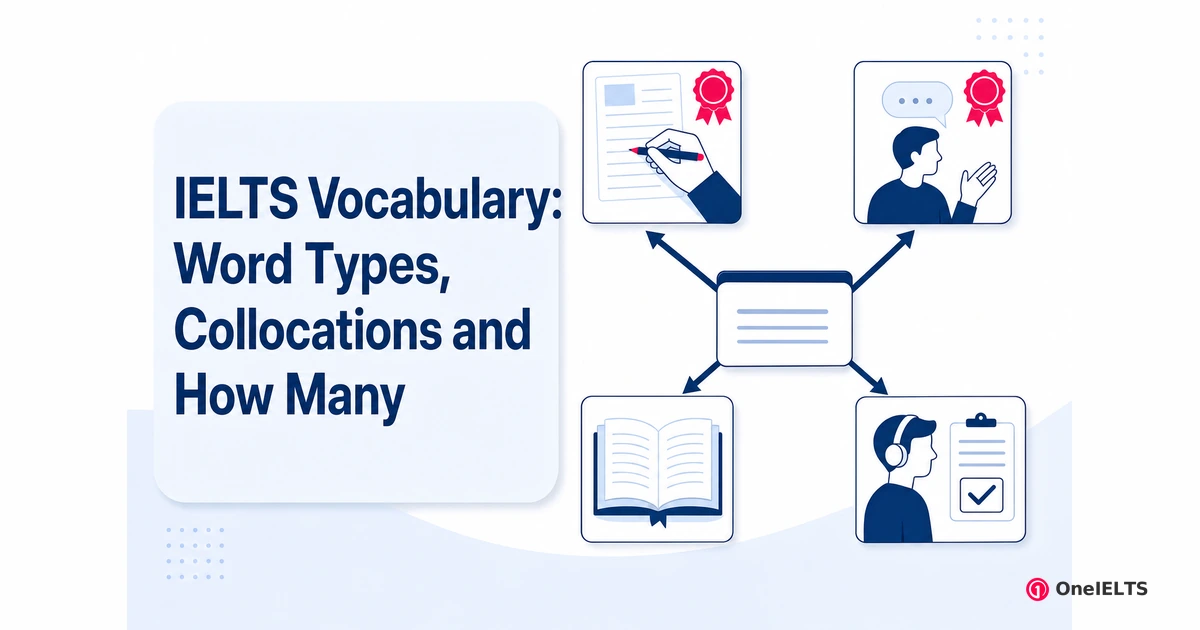
IELTS vocabulary is the range and precision of the words and fixed phrases you can use, recognise and spell across the four IELTS papers. It is one job in name and four in practice. Writing and Speaking mark it as Lexical Resource, so the word has to come out of you as productive vocabulary. Reading and Listening give it no marks, so receptive vocabulary is enough there, except that Listening also needs spelling accuracy on the answer sheet.
This guide defines the term, says why it matters, and splits the papers by what each one does with a word. Then the types, the common topics, collocations, what a wider range means, and how many words you need. It closes on how to improve, PDF against your own list, the word sets per task, and practice.
What Is IELTS Vocabulary?
IELTS vocabulary is the range and precision of the words and fixed phrases you can use in the test. It is not a fixed official list. It is the working word stock of topic words, collocations and everyday expressions you can reach for accurately under exam conditions.
Say the negative once and clearly, because the search results imply otherwise. There is no official IELTS word list, no prescribed number of words, and no set text to learn from. The sections here work through what the term covers and what the marking does with it.
Four things sit inside the term. Single words carry the subject matter. A collocation pair is two words that habitually travel together. A fixed phrase has a meaning you cannot assemble from its parts. A word family is one root in its noun, verb, adjective and adverb forms.
One misconception is worth killing early. Vocabulary in IELTS is not the same as difficult vocabulary, and Lexical Resource measures whether the word is the right one rather than whether it is rare.
Why Is Vocabulary Important for IELTS?
Because it is one of four equally weighted criteria in both Writing and Speaking, which makes it a quarter of each of those bands. In Reading and Listening it earns nothing, and it still decides whether you understand the question at all.
The weighting comes from the published band descriptors rather than from a blog. Lexical Resource is one of the four criteria making up the writing band, and one of the four making up the speaking band.
Two consequences follow and the sources draw neither. A quarter of two bands is a large share of any Writing or Speaking score. It is also the only self-study criterion on the list, in that you can improve it entirely on your own time without a partner, a marker or a timer.
The 25 per cent figure is also why most guides stop at Writing and Speaking, and stopping there leaves half the test unprepared. Watching the criterion move across all four papers at once takes a full IELTS mock test rather than a word list.
Which IELTS Sections Score Vocabulary and Which Only Use It?
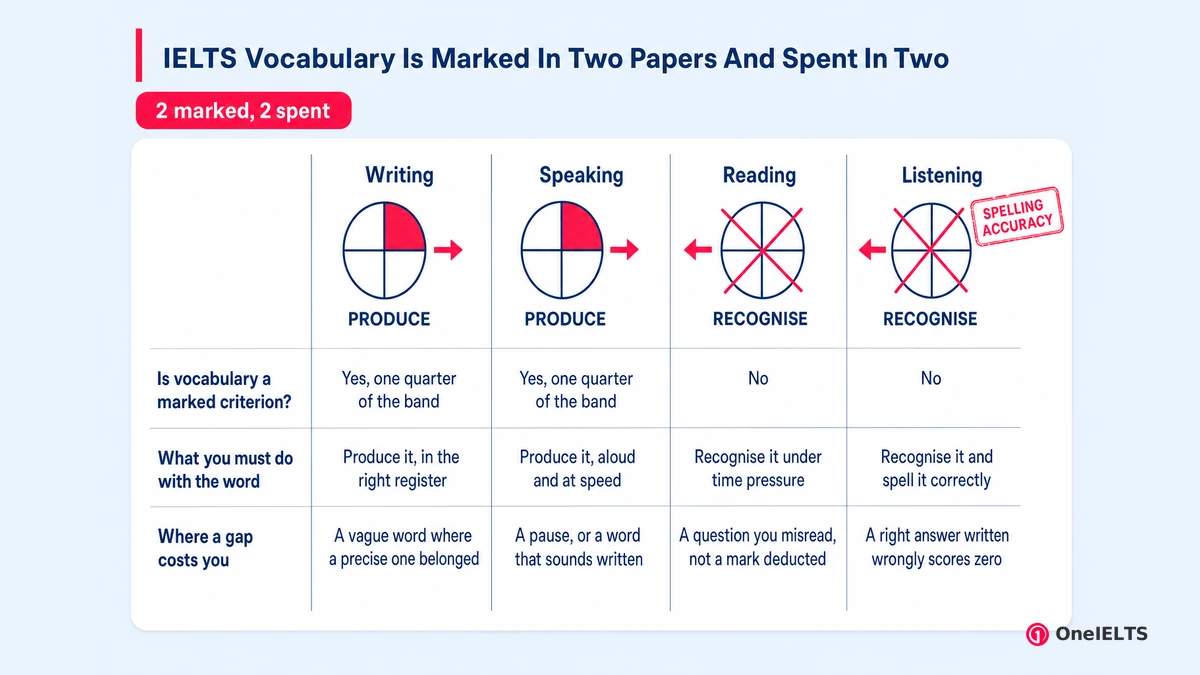
Two of the four papers score your vocabulary and two of them only spend it. Writing and Speaking mark it as Lexical Resource, which makes it productive vocabulary. Reading and Listening give it no marks at all, so receptive vocabulary is enough in both, and Listening adds spelling accuracy on top of that.
The gap is worth stating once. Every guide quoting the 25 per cent weighting names Writing and Speaking, and Google’s own AI Overview on this search opens by scoping vocabulary to speaking and writing. Reading and Listening are left out of it entirely.
| IELTS paper | Is vocabulary a marked criterion? | What you must do with the word | Where a gap costs you |
|---|---|---|---|
| Writing | Yes, one quarter of the band | Produce it, in the right register | A vague word where a precise one belonged |
| Speaking | Yes, one quarter of the band | Produce it, aloud and at speed | A pause, or a word that sounds written |
| Reading | No | Recognise it under time pressure | A question you misread, not a mark deducted |
| Listening | No | Recognise it and spell it correctly | A right answer written wrongly scores zero |
The study consequence is the only reason to print that table. A word you can recognise on a page is not a word you can produce in an essay, and the recognition gap between those two states is where most preparation time disappears. Recognition work and production work are different exercises.
Name the Listening rule for what it is. Hearing a word you know and writing it wrongly scores exactly the same as not knowing it, which makes spelling a vocabulary problem rather than a carelessness problem.
How the four criteria combine into a band is the IELTS band score page’s subject.
What Are the Important Types of IELTS Vocabulary?
Five types do the work, and only the first two are worth serious time for most candidates.
- Topic words are the nouns and verbs a subject needs, such as emissions or curriculum. They earn in every paper, because they are also what you recognise in Reading and Listening.
- A collocation pair is two words that always travel together, such as a steep rise or play a pivotal role. They earn most in Writing and Speaking, where the examiner hears whether the pair is natural.
- A phrasal verb is an everyday two-part verb such as bring about or put off. It earns most in Speaking, where formal single-word equivalents can sound stiff.
- An idiomatic phrase is a fixed expression whose meaning you cannot work out word by word. It earns only when it lands naturally, and the descriptors never require one.
- A word family is the noun, verb, adjective and adverb built on one root, such as pollute, pollution, polluted and pollutant. One root learned four ways is four words.
One point ranks these five and no source makes it. The examiner is listening for whether words go together correctly, so a candidate who knows two hundred collocations outperforms one who knows a thousand isolated words.
Synonyms and linking words each have their own page and neither is printed here.
What Are the Common IELTS Vocabulary Topics?
About ten recurring themes cover nearly every Writing Task 2 prompt and Speaking Part 3 question. The efficient move is ten to fifteen usable items per theme rather than a thousand words overall.
- Environment, covering biodiversity, sustainability, conservation and emissions.
- Technology, covering innovation, automation, integration and the digital divide.
- Education, covering curriculum, critical thinking, acquisition and vocational training.
- Society and population, covering urbanisation, demographics, welfare and infrastructure.
- Health, covering preventive care, sedentary lifestyle, life expectancy and public healthcare.
- Work and employment, covering job security, remote working, skills shortage and career progression.
- Crime and law, covering deterrent, rehabilitation, offender and enforcement.
- Travel and tourism, covering infrastructure, seasonal demand, cultural exchange and over-tourism.
- Media and advertising, covering coverage, influence, consumer behaviour and misinformation.
- Government and money, covering subsidy, public spending, taxation and economic growth.
State the bound out loud, because it is the useful half. This is a closed and bounded word set you can finish, not an open one you fall behind on. Ten topic themes at a dozen items each is roughly a hundred and twenty items, which is a fortnight of work rather than a year of it.
These are the themes the published topic runs on the ranking guides share, and four of them are the AI Overview’s own examples. No theme is expanded into a full list here, because that is what the child pages are for.
What Is a Collocation in IELTS Vocabulary?
A collocation is a pair or short group of words that native speakers habitually put together, such as heavy rain, a steep rise or a sharp decline. Each word in the collocation pair is ordinary and the fixed combination is not.
It belongs on a parent vocabulary page rather than only on a skills page for one reason. The collocation is the storage unit worth keeping, not the word. Learning steep as a synonym for sharp teaches nothing, and learning a steep rise teaches a whole clause of an essay.
The published descriptor gloss settles the argument. An awareness of style and collocation means using words that go together correctly, which is a natural word partner test rather than a rarity test.
One check tells you which you have learned. If you can only use the word after choosing a partner for it, you learned a word. If the partner arrives with it, you learned a collocation.
This section shows the unit in written register. Drilling collocations for speech is the IELTS speaking vocabulary page’s job.
What Does a Wider Range of Vocabulary Mean in IELTS?
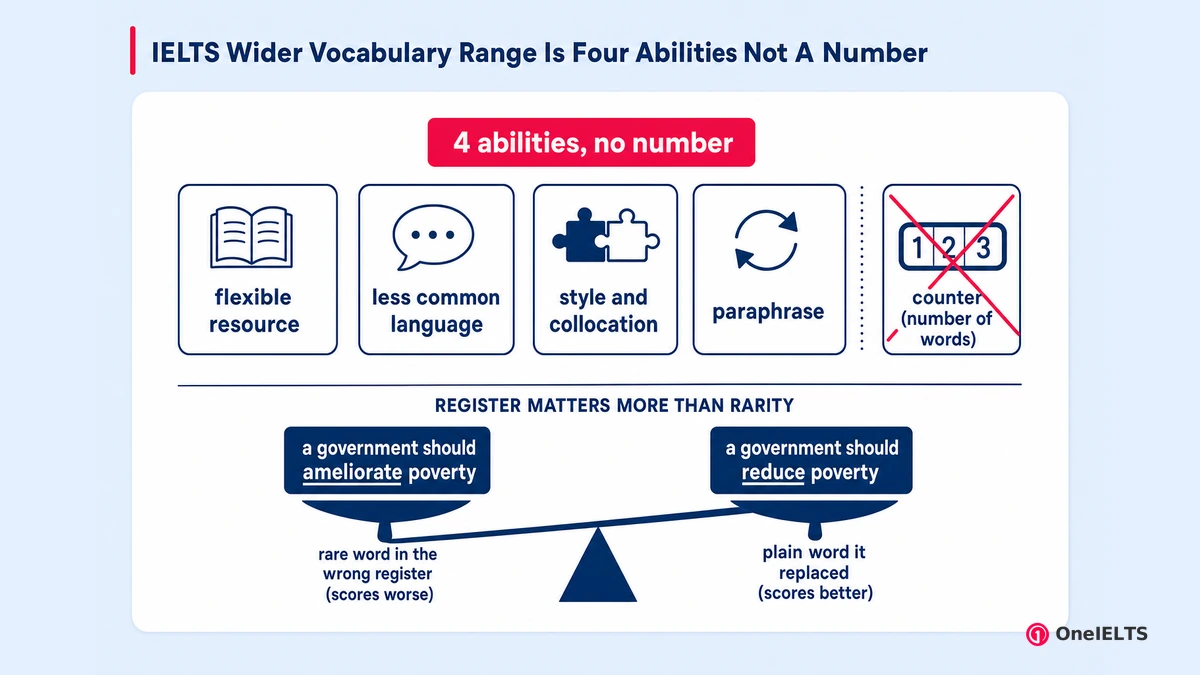
It means four specific abilities named in the band descriptor, and none of them is a number. A wider range is measured by what you can do with words rather than by how many you own.
Exactly one page in these search results unpacks the band 7 Lexical Resource wording term by term, and it does not rank in the organic top twenty, so most readers never reach it. The four abilities follow, each with the action it implies.
- A flexible resource means reaching the right words across a range of topics without pausing or picking the wrong one. Build by theme rather than alphabetically.
- Less common vocabulary and idiomatic language means using uncommon words, or phrases with an idiomatic meaning. Add these last, once the ordinary word is secure.
- Style awareness and collocation means using words that go together correctly and suit the register. Learn the pair, then check it belongs in an essay before using it in one.
- Successful paraphrase means filling a gap with other words when the exact one will not come. Rehearse a second way of saying each theme’s key idea.
Now the half nobody writes. The descriptor says less common and with an awareness of style, and those two conditions cut in opposite directions.
A rare word dropped into the wrong register scores worse than the plain word it replaced, because it satisfies the first condition and fails the second. Writing that a government should ameliorate poverty satisfies rarity and fails register; writing that a government should reduce poverty satisfies both. That register mismatch is the commonest way a band 7 vocabulary attempt loses marks.
Across the ten guides captured for this page, the word overuse does not appear once. Filling the paraphrase gap has its own page and is only defined here.
How Many Vocabulary Words Do You Need for IELTS?
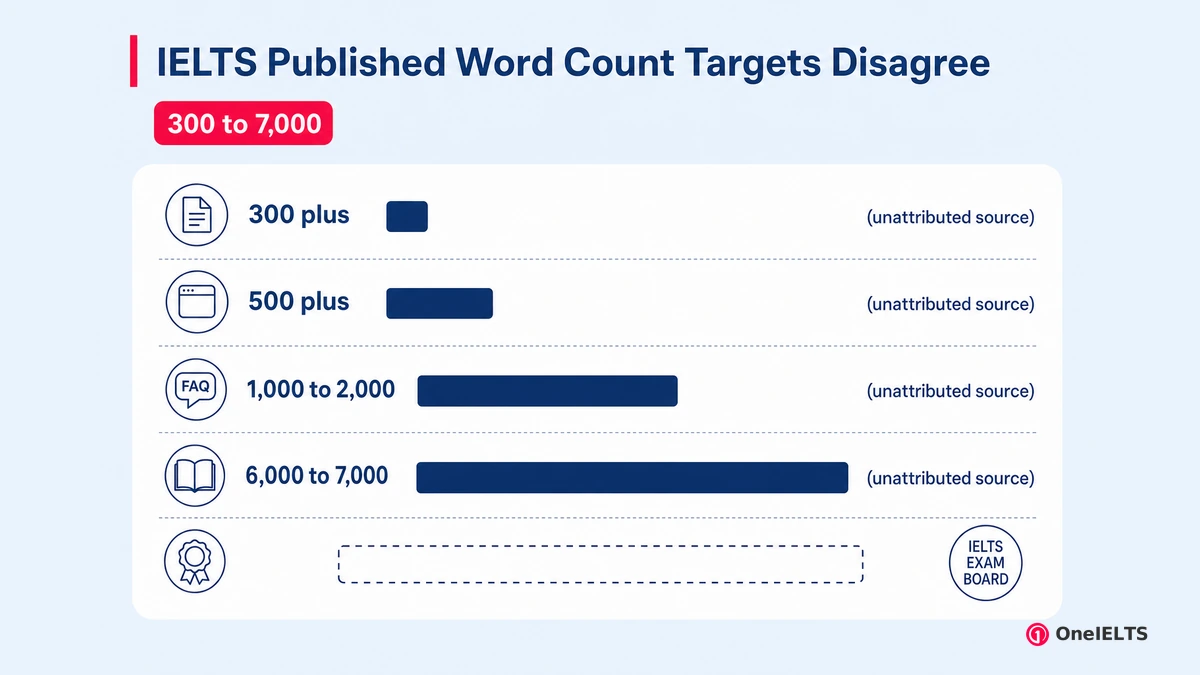
IELTS publishes no target, and the guides that do publish one disagree by a factor of more than twenty. The honest working answer is that a few hundred well-chosen words and pairs across a dozen themes reaches the band 7 threshold, because the criterion measures use rather than size.
The list below is evidence about the search results, not advice.
- One guide states you must have a collection of 6,000 to 7,000 most used vocabulary words.
- Another site’s own FAQ answers that 1,000 to 2,000 commonly used words is generally sufficient for a high score.
- Two of the highest-ranking pages promise 500-plus words in their titles.
- A fourth promises 300-plus words in its title.
- Not one of the four attributes its number to IELTS, and IELTS itself publishes none.
Both halves of that are true and they are different statements. IELTS publishes no target, which is the official position. Third-party guides on this search do publish targets and every published target is an unattributed figure that contradicts the others.
A coverage test replaces the number for anyone who came here for one. Pick a theme, write a Task 2 paragraph on it without looking anything up, and count how many times you stalled or repeated a word. That count is your gap, and theme completion means fixing it before you move to the next theme.
How Do You Improve Your IELTS Vocabulary?
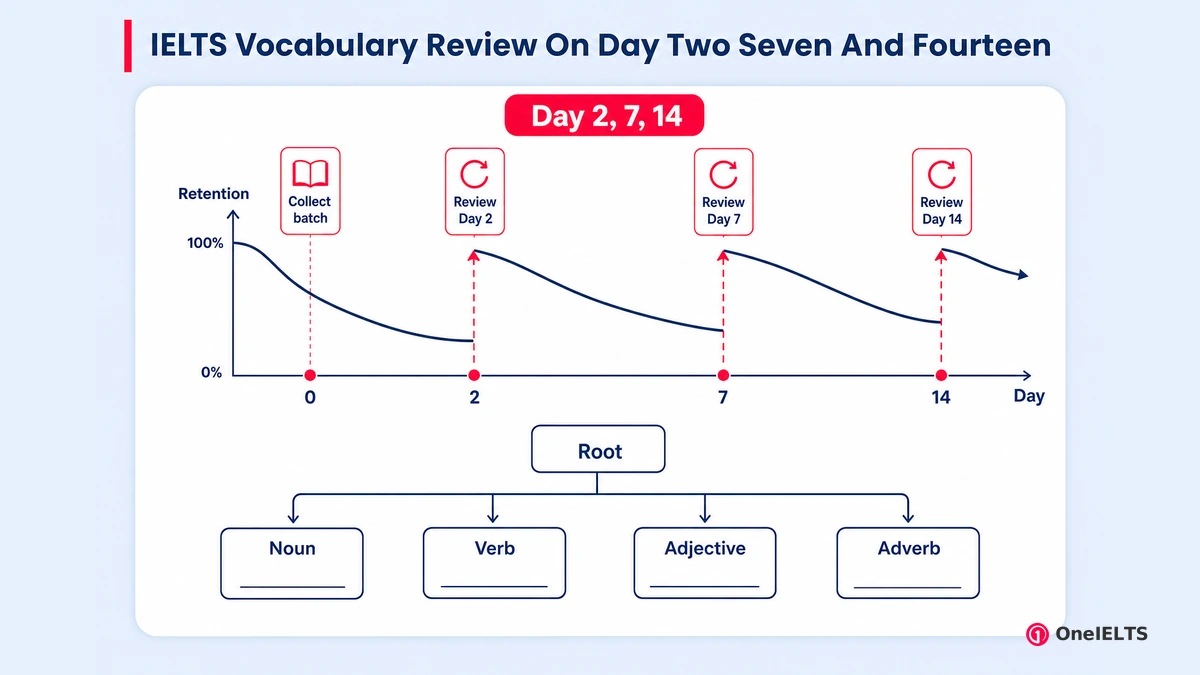
Learn in themed batches, store the collocation rather than the word, write each item into a sentence you would actually use, and come back to the batch three times across two weeks. Collecting words without a review schedule is why most vocabulary work disappears before test day.
Six steps make a themed batch stick.
- Pick one theme for the week from the ten above and close every other list. A finished theme beats four half-finished ones.
- Collect ten to fifteen items, and write each as a pair wherever a natural partner exists rather than as a single word.
- Write each item into one sentence of your own about a real Task 2 question, because a word you have never written is a word you cannot produce.
- Build the word family for the three most useful roots, taking noun, verb, adjective and adverb, and the theme triples for almost no extra effort.
- Review the batch on day two, day seven and day fourteen. Three short reviews beat one long one.
- Run a production test rather than a recognition one: cover the list and write the theme’s ten items from memory.
Two published study claims are worth naming and only one is worth taking. One guide sets a daily target of at least ten new words. Google’s AI Overview advises grouping word lists by theme rather than in random alphabetical order.
Take the second and leave the first. A daily word target is the volume trap this page opened with, and it measures collection rather than retrieval practice.
Step 5 is where this routine departs from the search results. Across the ten guides captured here, spaced review is never mentioned and word families are never mentioned.
Should You Download an IELTS Vocabulary PDF or Build Your Own List?
Download one to see the shape of the themes, then build your own. A list you wrote is a list you can retrieve, and a list you downloaded is a list you can only recognise.
The demand for a file is measured. Three of the eight related-search suggestions on this query ask for a downloadable file or a book. A raw PDF ranks above most real pages, a document-sharing upload ranks in the top ten, and so does a flashcard deck.
The delivery is where it breaks down. The two highest-authority pages on this search promise 500-plus words in their headlines and serve no word list at all in their page source. Each runs to roughly five thousand characters of text and a bare run of topic names. The downloadable word list files that do deliver sit far lower down.
A personal vocabulary log carries five things a downloaded file cannot.
- Only the items you did not already know, so reviewing it is never wasted time.
- The collocation rather than the bare word, because you wrote down the pair you actually met.
- Your own example sentence, which is the thing you will reproduce under pressure.
- A theme label, so a gap shows up as a whole weak theme rather than as scattered missing words.
- A review date, which no downloaded file has ever carried.
Retrieval strength is what the difference amounts to. A downloaded list is a checklist for finding holes in your themes, not a syllabus to memorise.
Which Vocabulary Lists Should You Learn for Each IELTS Task?
General themed vocabulary carries you a long way and then stops. Past that point each task needs its own task-specific lexis, and those word sets live on their own pages.
One list cannot serve every task, because a chart, an essay, a letter and a conversation ask for different language. The routes below say what each set contains and who needs it.
- Task 1 data description language covers increase, decline, plateau and fluctuate, with the noun and adjective forms that vary a sentence, at IELTS Task 1 vocabulary.
- Map and location language covers compass directions and the construction verbs a before-and-after map needs, at IELTS map vocabulary.
- Task 2 essay register covers the opinion, concession and consequence phrases an argument runs on, at IELTS Writing Task 2.
- Letter formula language covers the opening, request and closing patterns the General Training letter is graded on, at IELTS letter writing.
- Speaking topic language covers the everyday collocations and functional phrases that sound natural aloud, at IELTS speaking vocabulary.
- Synonyms cover the substitution sets, learned in context because register decides whether a swap helps, at IELTS synonyms.
- Linking words cover the cohesive devices that join sentences, marked under a different criterion, at linking words for IELTS.
Each signpost route above is a page rather than a lesson here. General vocabulary stops paying at the point where the task itself has a vocabulary of its own, and no number attaches to that point.
How Do You Practise IELTS Vocabulary?
Practise vocabulary inside real answers, not on the list. A word counts as learned when it comes out of you in a timed answer to a question you had not seen.
The routine that follows is a vocabulary retrieval drill dressed as ordinary writing practice. Five steps, one theme at a time.
- Take one theme you have just built and answer a Task 2 question on it with the list closed.
- Underline every place you repeated a word or reached for a vague one, and only then open the list.
- Rewrite the same paragraph once, replacing three of those places, and stop at three.
- Read the two versions aloud. If the replacement sounds forced, the register is wrong and the plain word wins.
- Repeat on a Task 1 chart from the same week, because data language is a separate set and does not transfer.
Step 4 is the unusual instruction and it needs its reason. That register check is the fastest available test of the descriptor’s style-and-collocation condition, and it costs nothing but the time it takes to read a paragraph twice.
Self-marking works here in a way it rarely does elsewhere, because you are checking your own retrieval rather than guessing a band.
The prompt practice for steps 1 and 5 needs real questions rather than loose PDF worksheets, and IELTS Writing practice supplies them. Practising needs a free OneIELTS account. The grid is browsable when you are logged out, and opening a set is what requires signing in.
How Do You Build an IELTS Writing Task 1 Vocabulary List?
Build it from the chart in front of you rather than from a general list, because Task 1 language is a closed word set and the same dozen structures cover every chart type.
A Task 1 sentence needs three slots filled. What changed, then the rate of change, then the time reference. Filling those three chart sentence slots is the whole job, and everything else in the sentence is grammar rather than vocabulary.
This set is worth learning before any other, because it has the highest coverage of anything in the exam for its size. Every chart, table, graph and diagram question reuses the same handful of structures. The data description language itself is on the IELTS Task 1 vocabulary page.
Which Vocabulary Do You Need for IELTS Speaking?
Everyday natural speech for familiar topics, plus a small set of functional phrases. The academic word lists candidates usually chase are the wrong material, because the examiner is listening for whether the words sound spoken.
One contrast makes the point and this page is entitled to make only this one. The same theme needs different words in Speaking and in Writing. An everyday collocation such as prices shot up belongs in conversation, while a steep rise belongs in an essay and sounds odd out loud.
Spoken register is a different target from written range. The functional phrases, the idioms and the topic collocations for speech sit on the IELTS speaking vocabulary page.
How Do You Remember IELTS Vocabulary Words?
By retrieving them, not by rereading them. Cover the list and write the theme from memory on day two, day seven and day fourteen.
One distinction makes retrieval practice work. Rereading a list feels like learning because the words look familiar, and familiarity is recognition. That recognition illusion is the trap, since the test asks you to produce, and production memory is trained only by being made to produce.
One implementation needs no app at all. Keep a theme page for each subject, the item written on the left and your own example sentence folded over on the right, so the fold does the covering for you. Run it on the spaced review dates already set out above rather than whenever you happen to open the notebook.
Where Can You Find IELTS Vocabulary Band 9 Word Lists?
There is no band 9 word list, because no word carries a band. Four of the eight related searches on this query ask for one, covering band 7, band 8, band 9 and a band 9 PDF. Every band claim of that kind misreads the descriptors, which attach the score to how a word is used.
What separates a band 9 answer is precision over rarity, across themes rather than within one. The closest usable artefact is a substitution set learned in context, where you meet the alternative inside a sentence rather than beside the original on a card.
The failure mode this search invites is worth one warning. A rare word from a band 9 list, dropped into the wrong register, produces the register mismatch described above and scores below the ordinary word it replaced. Context learning is the fix, and the sets themselves are on the IELTS synonyms page.
Where Can You Practise IELTS Vocabulary in Writing Task Answers?
On real Task 1 and Task 2 prompts, one theme at a time, with the word list closed while you write and open only while you revise.
Closed-list writing beats a worksheet for this specific purpose. A gap-fill tells you whether you recognise a word. An answer to a prompt tells you whether you can produce it, and only the second is what Writing and Speaking are marked on.
One review instruction turns prompt practice into production feedback. After each answer, tag every weak word with its theme, and the theme tally tells you which theme to rebuild next. Run that revision pass on IELTS Writing practice prompts. Practising needs a free OneIELTS account.
A practice link carries the question type but not the exam type, so a reader working in General Training mode will see General sets on the same link.
Written by Jamil Ahmed, reviewed 14 August 2026.
Last verified: 14 August 2026
Practice for the Real IELTS Exam
Apply what you’ve learned with free, exam-style practice:
- Take a free IELTS mock test — all four skills, real exam timing, AI band scoring
- Sit a Writing section mock — Task 1 and Task 2 in one timed hour with a band estimate
- Practise by question type — self-paced Writing sets with model answers