Consistent number style tells the examiner you control written English, and it keeps every figure in a Task 2 essay unambiguous. IELTS publishes no rule that forces words or digits, so consistency and accuracy are what get assessed. On the computer-delivered test, the on-screen word counter treats a figure written in digits as one word. Most essays need only two or three numbers, because Task 2 asks for an argument.
This page covers digits versus spelled-out numbers, commas in large numbers (lakh and crore included), the percent sign and other symbols, currency, measurements, dates, time, word counting, the four IELTS sections and Task 1. General counting rules sit on the OneIELTS word-count guide, and trend vocabulary on the Task 1 vocabulary page.
How Should You Write Numbers in IELTS Writing Task 2?
Write numbers consistently and unambiguously. IELTS sets no words-or-digits rule for Task 2. Examiners judge accuracy and control under Lexical Resource and Grammatical Range and Accuracy, so “fourty” is a spelling error and “5 reasons… six factors” looks careless.
Numbers appear rarely in an argument essay, mostly as rounded figures: “over half of young adults” or “a 10% rise”. Task 2 asks for an opinion, so two or three numbers do the job; Task 1 is the data-heavy task.
Three house conventions apply. Spell out one to ten, use digits from 11 upward and for exact figures, and never start a sentence with a digit.
Invented statistics earn no extra credit. An unsupported figure such as “73.4% of people” can weaken Task Response, while “roughly a third” reads as credible.
Should You Write Numbers as Words or Digits in an IELTS Essay?
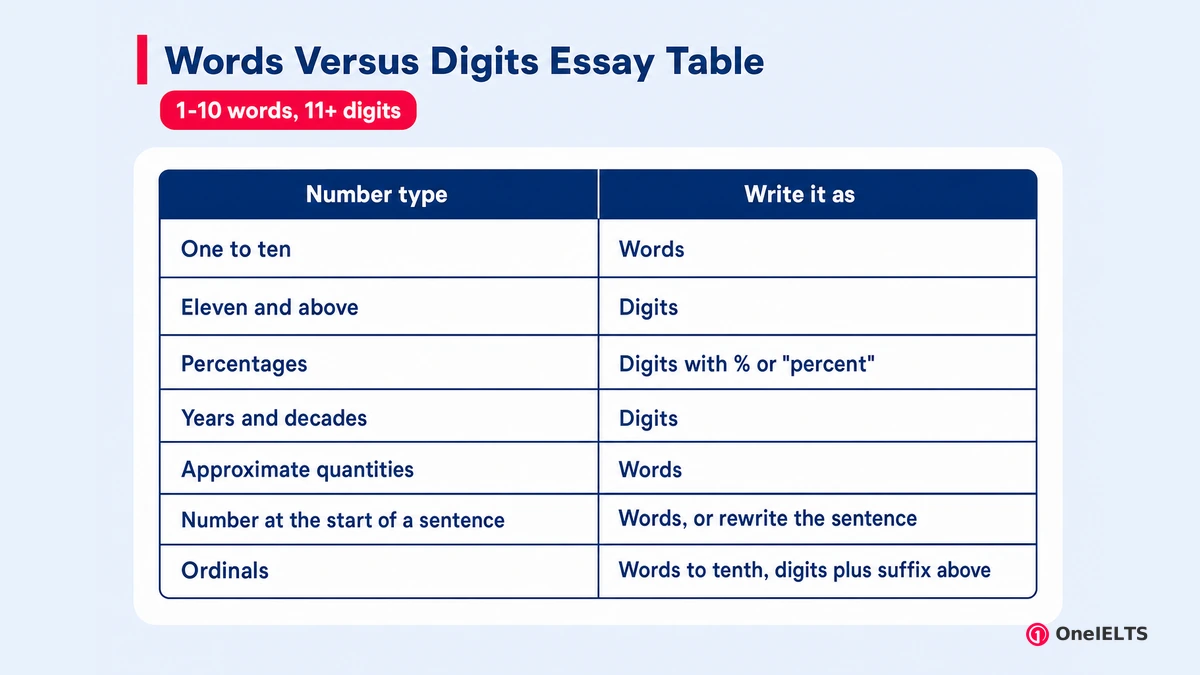
Both words and digits are accepted. Spell out one to ten and round approximations (“two decades”, “a few hundred”); use digits for 11 and above, percentages, years and exact figures. Whichever you choose, keep it the same throughout the essay.
Cardinal numbers (one, 40) and ordinal numbers (first, 21st) follow the same split, and seven everyday cases each have a default form in this table.
| Number type | Write it as | Essay example |
|---|---|---|
| One to ten | Words | Governments face two problems when they fund public transport. |
| Eleven and above | Digits | Around 40 countries now tax sugary drinks in some form. |
| Percentages | Digits with % or “percent” | Roughly 30% of graduates work outside their field of study. |
| Years and decades | Digits | Since 2020, remote work has become normal for office staff. |
| Approximate quantities | Words | A few hundred students may share a single small library. |
| Number at the start of a sentence | Words, or rewrite the sentence | Twenty percent of young adults now live with their parents. |
| Ordinals | Words to tenth, digits plus suffix above | The first reason is cost, and the second is convenience. |
teamielts tells readers to write the digits, not words. That advice sits on a Task 1 page, where figures are the data; in a Task 2 essay, spelled-out small numbers read more naturally, so each tip holds in its own task.
Spelling accuracy is the hidden risk of words. Forty, ninety, hundred, thousand, eighth and twelfth are the forms most often misspelled, and hyphenated numbers such as twenty-one need their hyphen. A misspelled number word costs Lexical Resource; a digit can’t be misspelled.
Sentence-initial numbers need a rewrite. Open with “Twenty percent of…” or move the figure inward (“In 2020, …”) rather than starting with “20% of…”.
Should You Use Commas in Larger Numbers in IELTS Writing?
In essay prose, group digits in threes with a comma (10,000; 2,500,000) or switch to words for round values (“2.5 million”). The no-comma advice some guides give applies to unambiguous answer-sheet entries, not to essay sentences.
International English places a thousand separator every three digits from the right and keeps the full stop for the decimal point. Our punctuation rules for IELTS Writing cover comma placement elsewhere.
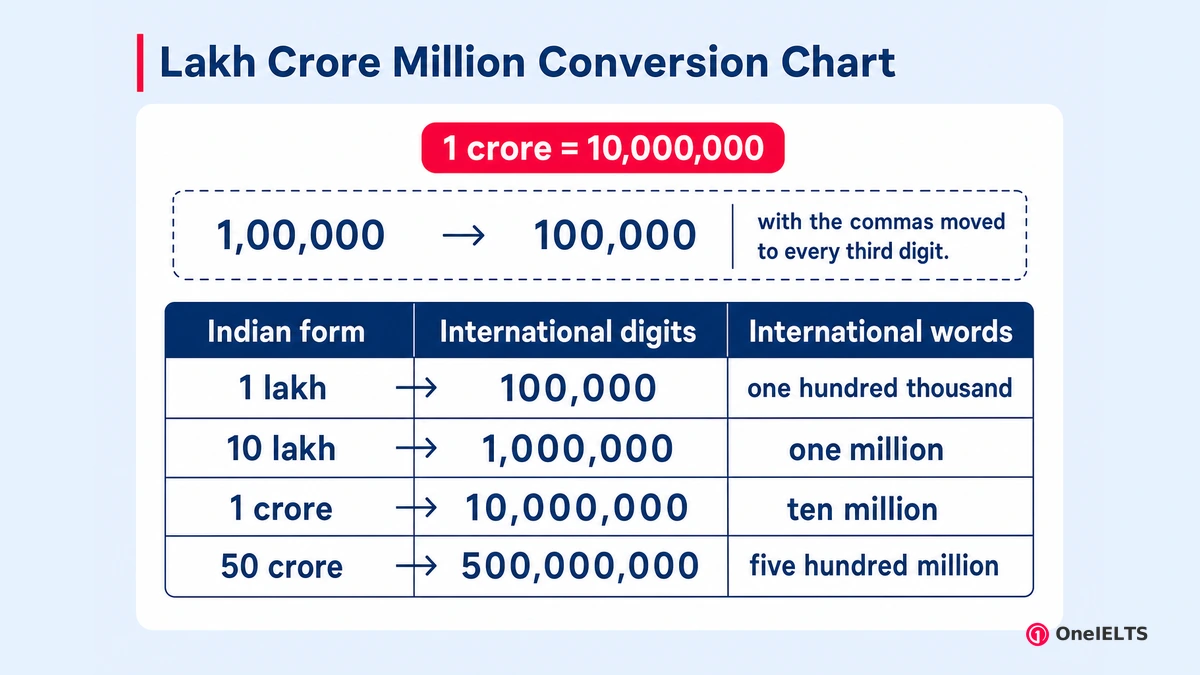
The Indian numbering system traps test takers in India. “1,00,000”, “5 lakh” and “2 crore” read naturally at home, but examiners abroad may not read lakh, crore or 2-2-3 grouping. Convert them: one lakh is 100,000, ten lakh is 1,000,000 (one million), and one crore is 10,000,000 (ten million).
Four common Indian forms convert like this.
| Indian form | International digits | International words |
|---|---|---|
| 1 lakh | 100,000 | one hundred thousand |
| 10 lakh | 1,000,000 | one million |
| 1 crore | 10,000,000 | ten million |
| 50 crore | 500,000,000 | five hundred million |
Million and billion take no plural -s after a number: “3 million people”, never “3 millions people”.
When Can You Use Symbols and Abbreviations in IELTS Writing?
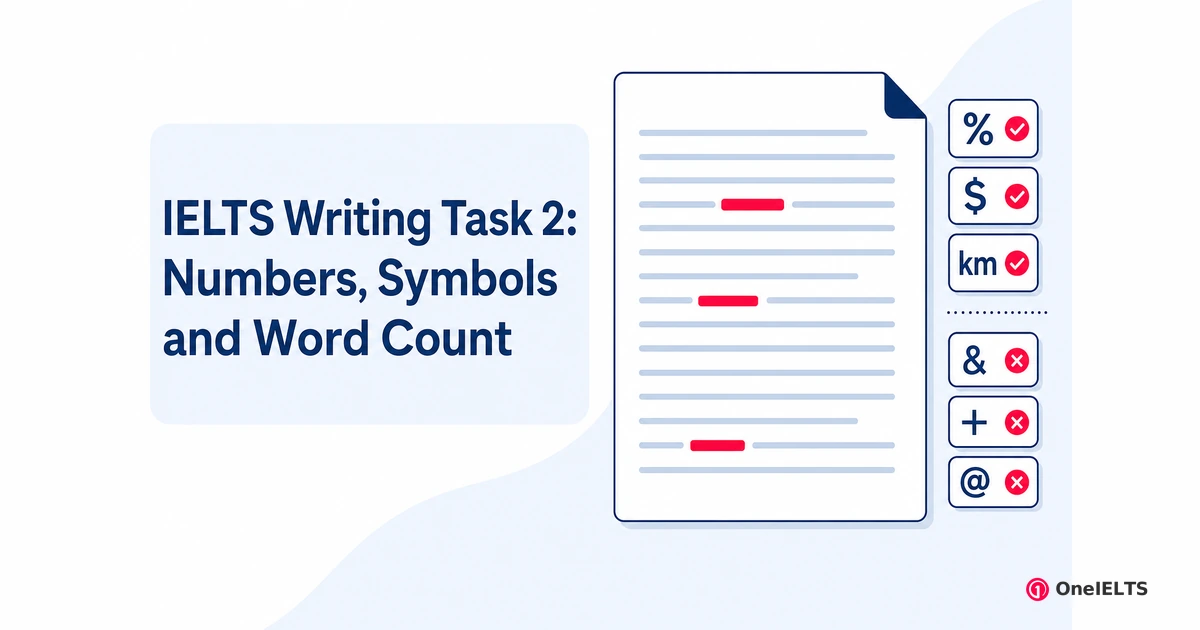
Use a symbol only when it’s the standard written form attached to a figure (%, $, °C, km). Keep informal symbols (&, +, =, @, arrows) and texting abbreviations out of a Task 2 essay, because the formal register of an argument doesn’t stretch to note-taking shorthand.
Seven symbols and abbreviations turn up in practice essays, and each one gets a verdict for Task 2 here.
- Percent sign (%): accept after a digit, as in 25%, and write percent in words after a spelled-out number.
- Currency symbols ($, £, €, ₹): accept before an exact figure such as $500, without adding the currency word afterward.
- Unit abbreviations (km, kg, °C): accept after a digit with one space, as in 5 km; spell units out elsewhere.
- Ampersand (&): avoid in essay prose and write “and” in full, unless it’s part of an official name.
- Plus and equals signs: avoid in essay prose, since + and = belong in notes and sums, not arguments.
- Latin abbreviations (e.g., i.e., etc.): use sparingly, because “for example” and “that is” read better in formal prose.
- Texting shortcuts (u, govt, w/): avoid completely, since examiners read them as informal writing and weak vocabulary control.
Both “25%” and “25 percent” are correct. American English spells percent as one word, while British English often uses per cent; pick one and keep it. “Etc.” at the end of a list signals vagueness in an argument essay, so name the items instead.
How Should You Write Currency in IELTS Writing?
Put the currency symbol before the figure and never repeat the unit: “$500”, not “$500 dollars”. For a currency your reader may not know, write the figure followed by the name, as in “500 rupees”.
Use the symbol plus digits for exact sums and words for round or general amounts (“millions of dollars”). US dollars and pounds sterling both take their symbol ($20, £20). For India, the ₹ symbol and “rupees” are both clear, while “Rs.” and “INR” read as invoice shorthand in an essay. Decimal amounts keep the point ($4.99), and a loose figure reads better in words (“under five dollars”). The unit takes no plural after a symbol.
How Do You Write Measurements in IELTS Writing?
Write a digit plus the standard abbreviation (5 km, 30 °C, 2 kg), and spell the unit in full when no number is attached (“measured in kilometers”).
Metric units are the international standard. Leave one space between the number and the unit, and unit abbreviations never take a plural -s: “10 kg”, not “10 kgs”. Kilometers and kilograms follow American spelling on this page. The British Council confirms British spelling (kilometre) is accepted equally, so spelling consistency is what counts. Degrees Celsius and distances mostly appear in environment, health or transport topics, so one or two measurements cover an essay.
How Do You Write Dates in an IELTS Task 2 Essay?
In essay prose, write years as digits (“in 2020”), decades without an apostrophe (“the 1990s”), and centuries in words or with a suffix (“the twenty-first century” or “the 21st century”). Full dates take the form “March 5, 2026” or “5 March 2026”, never “05/03/26”.
Numeric dates are ambiguous: 05/03 means 5 March in India and the UK but May 3 in the US. American month-day order and British day-month order both work once the month is a word. Skip “1990’s” and the clipped “90s” in formal prose. Dated evidence (“since the 2008 financial crisis”) provides support for an argument, but most Task 2 prompts are timeless.
How Can You Write Time Accurately in IELTS Writing?
Use “9:30 a.m.” or “half past nine” in prose. Avoid the 24-hour clock (“21:30”) unless the task itself uses it, and don’t combine forms such as “9 o’clock a.m.”.
Clock times take a.m. and p.m. or o’clock, while durations are usually spelled out: “two hours”, “a ten-minute walk”.
Compound adjectives with numbers take a hyphen and a singular noun, so write “a two-hour commute”, not “a two-hours commute”. That slip shows up often in Task 2 essays about work and transport. Clock times matter more in General Training Task 1 letters, where you arrange a meeting, than in Task 2.
How Do Numbers and Symbols Count Toward the IELTS Writing Word Count?
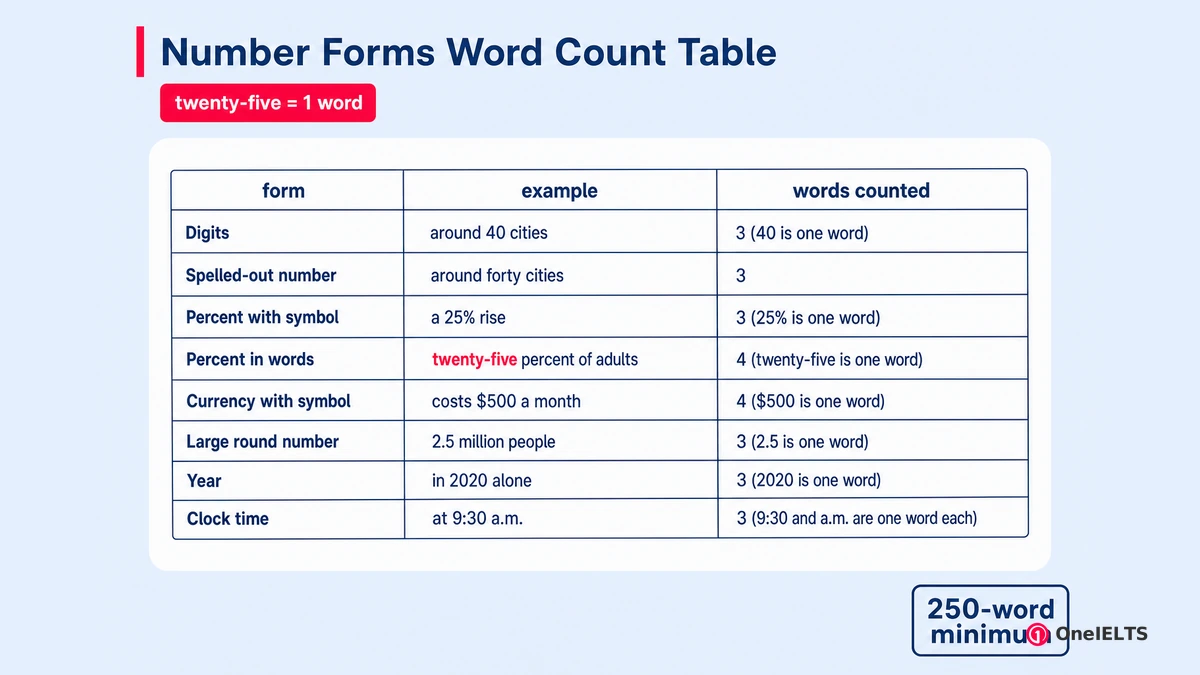
IELTS publishes no counting rule for numbers, but the word counter in the official computer-delivered practice test treats a figure in digits as one word, including a symbol attached to it (25%, $500). The same number spelled out counts as the words you write: “twenty-five percent” is two words, because the British Council counts a hyphenated word once. The Task 2 minimum is 250 words.
Eight common forms appear in the next table with the count the on-screen counter gives each one.
| Form | Example | Words counted |
|---|---|---|
| Digits | around 40 cities | 3 (40 is one word) |
| Spelled-out number | around forty cities | 3 |
| Percent with symbol | a 25% rise | 3 (25% is one word) |
| Percent in words | twenty-five percent of adults | 4 (twenty-five is one word) |
| Currency with symbol | costs $500 a month | 4 ($500 is one word) |
| Large round number | 2.5 million people | 3 (2.5 is one word) |
| Year | in 2020 alone | 3 (2020 is one word) |
| Clock time | at 9:30 a.m. | 3 (9:30 and a.m. are one word each) |
IELTS publishes general word-count guidance but no symbol-by-symbol rule. ielts.org sets the 250-word minimum and warns that a short answer may not give enough evidence to award higher bands, and IDP adds that every word counts equally. Hyphenated words follow the British Council rule above.
Spelling out numbers to pad an essay isn’t a strategy. Examiners assess quality, and the real word count penalty hits an essay under 250 words through Task Response. Spelled-out numbers add a word or two at most.
The general rules on contractions, hyphens, the question prompt and titles live in our guide on how to count words in IELTS Writing. Check a full essay’s count and score in OneIELTS writing practice.
How Do Numbers Differ Across IELTS Listening, Reading, Speaking and Writing?
Listening and Reading answers are marked on the answer sheet, where digits are safest and the word limit decides what fits. Speaking numbers are heard, not written. Writing is the only section where number style is judged as part of your prose.
A Listening instruction such as ONE WORD AND/OR A NUMBER lets you add one figure to your words, and similar-sounding numbers like thirteen and thirty are a classic trap. Each section’s own guide covers its full answer-sheet rules, so the comparison stays at one line apiece.
| Section | How numbers appear | What to watch |
|---|---|---|
| Listening section | Spoken figures you write on the answer sheet | Write digits, respect the word limit, and separate thirteen from thirty. |
| Reading section | Figures you copy from the passage | Copy digits exactly as printed and keep within the word limit. |
| Speaking | Numbers you say aloud | Stress the right syllable so fifteen and fifty sound clearly different. |
| Writing | Numbers inside your own sentences | Keep one style throughout and spell every number word correctly. |
How Do You Write Numbers in IELTS Writing Task 1?
Academic Task 1 uses far more figures, so digits are the default for data (45%, 3.2 million, 1990). Approximation is expected (“just over a quarter”), and the overview summarizes trends rather than listing every number.
Number use changes in three ways between the tasks. You select key figures, you use approximation language when a value sits between gridlines, and you compare values. Copying every value from the chart is a Task Achievement weakness, because examiners look for key features and an overview.
A data report that picks its strongest figures and ranks them reads better than one that recites the whole chart. The questions that follow cover vocabulary, pie chart figures, dates and the 150-word count.
Which Words Describe Numbers in an IELTS Writing Task 1 Report?
The words that describe numbers in Task 1 are approximation words (roughly, just under), proportion words (a third, the majority) and change words (doubled, fell by half). Approximation words soften a reading (“roughly 40%”), and examiners expect them. Proportion words and fractions turn a percentage into a share. The full trend vocabulary is in our IELTS Writing Task 1 vocabulary list.
How Do You Write Numbers and Symbols in a Task 1 Pie Chart?
The rules for a pie chart are to give percentages as digits with the % sign, pair them with fractions for variety (“25%, or a quarter”), and make the segments add up. Use “25 percent” for a figure, “a higher percentage of” for comparisons. Give the gap between two pie chart segments in percentage points: 30% to 45% is 15 points. Practice on IELTS Writing Task 1 pie chart samples.
How Do You Write Dates and Years in a Task 1 Graph?
The forms for dates in a graph are digits for years (“in 2010”), “from 2000 to 2020” or “between 2000 and 2020” for periods, and “over the period” for the whole span. Avoid “from 2000 until 2020” and “between 2000 to 2020”. Completed time periods take the past simple; projected data takes future forms. A line graph to 2030 needs both, as in these IELTS Writing Task 1 graph answers.
Do Numbers Count Toward the IELTS Writing Task 1 Word Count?
Yes, every number counts toward the 150-word Task 1 minimum on the same basis as in Task 2, and the on-screen word counter treats each figure written in digits as one word. ielts.org sets the 150-word minimum, and the per-form table above covers your Task 1 word count too. Full rules sit in the IELTS Writing word count guide.
Written by Jamil Ahmed, reviewed 7 October 2026.
Last verified: 7 October 2026
Practice for the Real IELTS Exam
Apply what you’ve learned with free, exam-style practice:
- Take a free IELTS mock test — all four skills, real exam timing, AI band scoring
- Sit a Writing section mock — Task 1 and Task 2 in one timed hour with a band estimate
- Practice by question type — self-paced Writing sets with model answers