IELTS map vocabulary is the words and fixed phrases you need to describe a place and how it changed: the structures on the map, where they sit, and what happened to them.
The map word set splits in two depending on which paper you are sitting. In Listening you have to recognise route language at speed. In a Writing Task 1 map you have to produce change language on paper, in the right passive form. The lists published for one do not serve the other.
A word list is not the deliverable either. A change verb you cannot put into the right tense and voice is a word you cannot use, and almost every sentence in a map report needs one.
This guide covers the Listening and Writing split, the change words, static maps, location words, infrastructure nouns, the grammar, sentence structures, common errors, learning the set and practice.
What Is Meant by IELTS Map Vocabulary?
IELTS map vocabulary is the set of words and fixed phrases used to name what is on a map, say where it sits, and describe what happened to it. Two versions of the same place is the usual frame.
Four groups make up the whole map word set. A feature noun for each thing on the map, a position word for where it sits, a change verb for what happened to it, and the grammar that carries the verb.
The size is worth stating, because no source on this topic states one. This is a closed vocabulary rather than an open one. Maps reuse the same few dozen structures and the same handful of change verbs, which is why it is worth finishing rather than sampling.
One thing separates it from every other Task 1 word set. It is the only one with no numbers in it. There is no increase, no decline and no peak, because the whole set is about objects and their positions.
Is Map Vocabulary the Same for Listening and Writing Task 1?
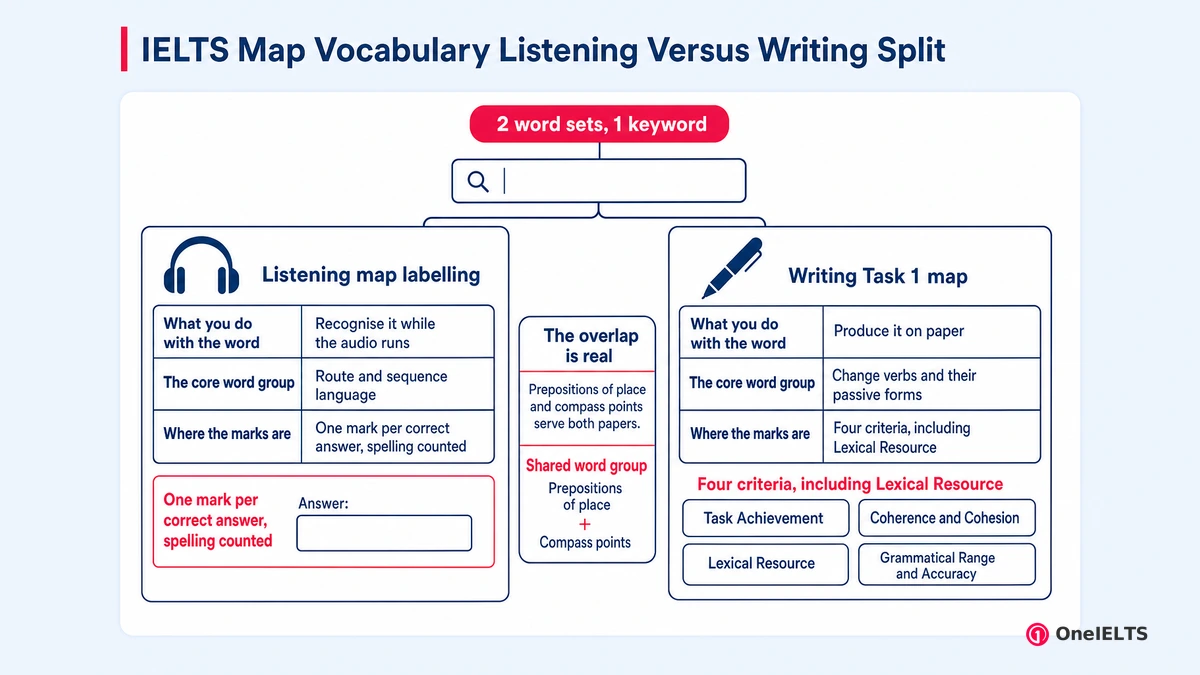
No. They overlap on where-things-are language and share almost nothing else. Listening map vocabulary is route language you recognise while an audio plays. Writing Task 1 map vocabulary is change language you produce, in the passive, in the right tense.
You may already be confused, and the search results are why. Search this term and the top result is a Listening page, while the next several are Writing pages, and Google’s own related searches offer both readings. Not one of the guides ranking on this term tells you which of the two you are reading.
| What the paper asks | Listening map labelling | Writing Task 1 map |
|---|---|---|
| What you do with the word | Recognise it while the audio runs | Produce it on paper |
| The core word group | Route and sequence language | Change verbs and their passive forms |
| Where the marks are | One mark per correct answer, spelling counted | Four criteria, including Lexical Resource |
Those cells come from the two published task formats. IELTS states that each correct Listening answer receives one mark and that you lose marks for incorrect spelling, and it assesses Writing on Task Achievement, Coherence and Cohesion, Lexical Resource, and Grammatical Range and Accuracy.
The overlap is real and worth naming so the split is not overstated. Prepositions of place and compass points serve both papers, and that shared preposition set is the only part of map language worth learning once for two exams.
So the recognition skill and the production skill need different preparation. If you are preparing for Writing Task 1, learn the change verbs and their passive forms first and treat route language as optional. The IELTS Listening map labelling page owns the other half.
Which Words Describe Changes Over Time on a Map?
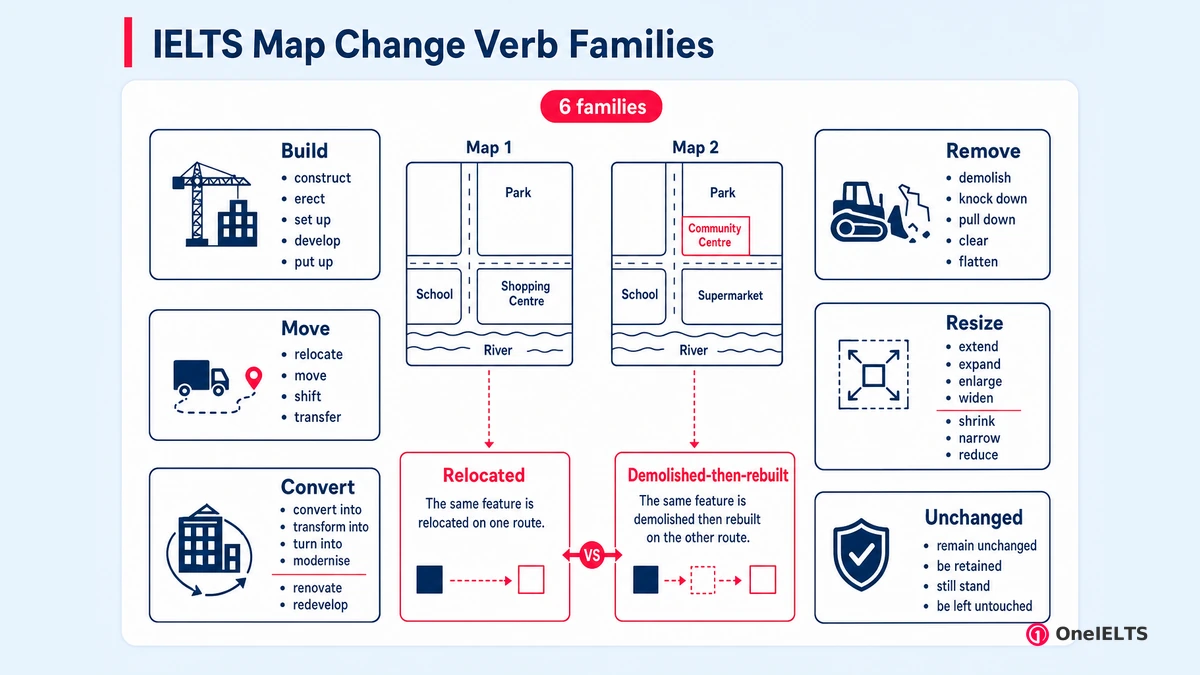
Six families of change verb cover everything a map can do: build, remove, move, resize, convert, and stay the same. Choosing the right family is itself part of the analysis.
- Build: construct, erect, set up, develop, put up. Something now stands where nothing did. The commonest change verb family and the easiest one to overuse.
- Remove: demolish, knock down, pull down, clear, flatten. Something has gone and nothing replaced it, which is a different claim from being replaced.
- Move: relocate, move, shift, transfer. A relocation puts the same feature in a new position, and choosing it tells the examiner you read both maps against each other.
- Resize: extend, expand, enlarge, widen, and in the other direction shrink, narrow, reduce. The feature is still there and its footprint change is what you are reporting.
- Convert: convert into, transform into, turn into, modernise, renovate, redevelop. A conversion keeps the building and changes its purpose or its condition.
- Unchanged: remain unchanged, be retained, still stand, be left untouched. A retained feature is the family candidates forget, and the one that turns a list of changes into a description of a place.
A thinner layer sits on top of those six. The adverbs that qualify a change, such as considerably, significantly, slightly and entirely, and the adjectives that describe the result, such as modern, spacious, built-up and landscaped.
Here is the point that turns the list into technique. The verb is the analysis. Relocated and demolished-then-rebuilt describe the same pixels and make different claims, and only one of them can be true of any given pair of maps.
Which Vocabulary Works for a Static Map With No Time Change?
None of the change verbs. A static map has no before, so the whole set above is unusable, and the report runs on position language, present simple description and words for what a place is for.
Exactly one page in the search results gives static maps their own vocabulary heading, and readers search for the question shape by name. That is why it gets a section here rather than a footnote.
- Position verbs in the present simple: is located, lies, stands, sits, occupies, borders, overlooks.
- Extent and proportion words: occupies most of, takes up the western half, runs the length of, dominates.
- Purpose nouns: a residential area, a commercial zone, recreational space, an industrial estate.
- Access language: is reached by, is served by, is connected to, runs alongside.
- Comparison language between two sites, when the prompt gives you two: closer to, further from, better served by.
One rule holds hard here, and it is an accuracy issue rather than a style one. Do not use a change verb on a map with no earlier state. Writing that something has been relocated when nothing has moved is a false statement about the prompt.
The method for these questions, including how to divide the map and what the overview says, belongs to the IELTS Task 1 map page. This section owns the words.
Which Vocabulary Covers Direction and Location on a Map?
Three small sets: the eight compass points, the prepositions of place, and the verbs that put something somewhere. Together they run to about thirty items, and they are the only part of map vocabulary that serves both Writing and Listening.
- Compass points: north, south, east, west and the four intermediate forms. A compass point is used as in the north-east, on the western side, in the south-western corner.
- Prepositions and prepositional phrases: opposite, adjacent to, across from, beside, between, alongside, next to, within, on the edge of, in the centre of.
- Position verbs: is located, is situated, lies, stands, sits, borders, overlooks, runs through, crosses.
One sentence stops this becoming a list-learning exercise. The three sets combine into a single location frame, made of a position verb plus a preposition of place plus a reference point. Build that frame once and you can locate anything on any map.
Whether to use compass points at all, and which paragraph they belong in, is decided on the IELTS Task 1 map page rather than here. This is also the set a Listening candidate should read, and the only part of this page that is.
Which Nouns Describe Infrastructure and Land Use?
Four groups of noun cover almost every feature a Task 1 map prints. Learning them by group means you can scan any map systematically instead of hunting for words while the clock runs.
- Built structures: housing estate, apartment block, retirement home, primary school, shopping centre, car park, industrial estate, factory, warehouse.
- Transport and access: main road, ring road, footpath, railway line, roundabout, bridge, bus route, pedestrian area. A transport feature is usually the first thing to change on a town map.
- Land use: residential area, commercial zone, agricultural land, farmland, green space, recreation ground, playing field, allotments. Naming the land use zone is often worth more than naming the buildings in it.
- Natural features: river, stream, coastline, woodland, forest, hill, lake, pond, marsh. A natural feature that survives the change is the easiest unchanged thing to report.
One instruction beats every word list on the internet. Use the map key wording the prompt supplies, because it is free, it is correct, and it is what the examiner expects to see on the page.
One register point, because candidates get it wrong in the other direction. These are neutral nouns rather than academic ones, and nobody scores higher for writing edifice instead of building.
What Grammar Do You Need for IELTS Map Vocabulary?
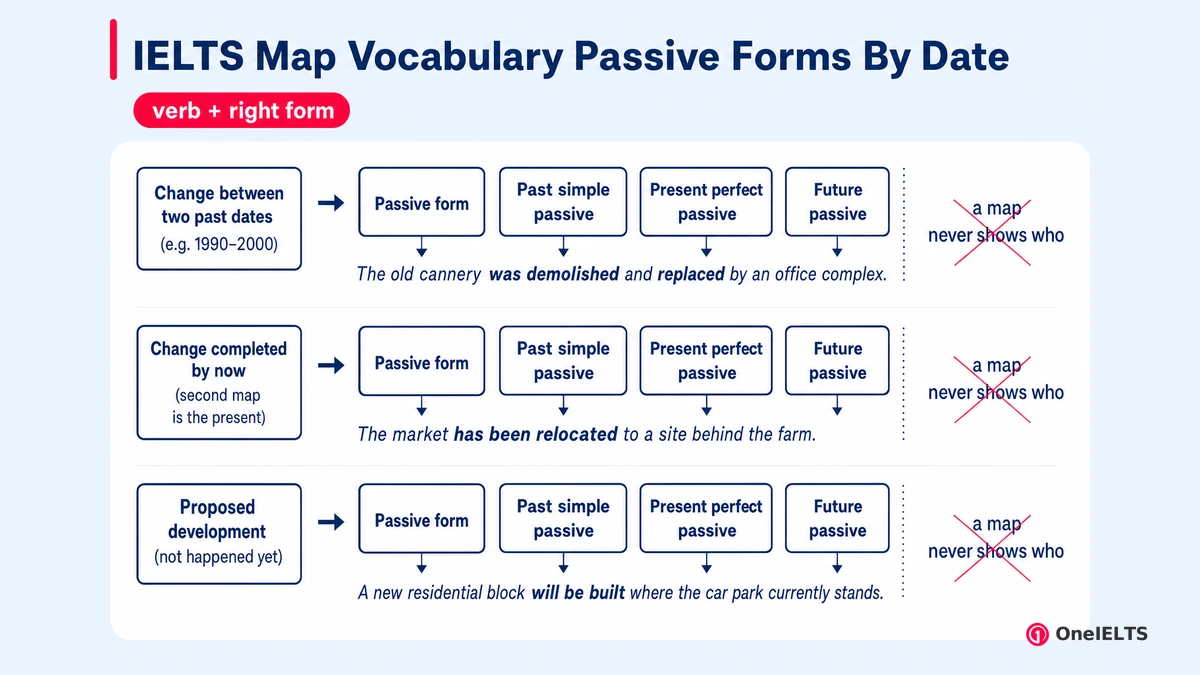
The passive, in three tenses. Almost every change on a map happened to something rather than by someone, so the change verbs above only become usable once you can put them into the right form.
The gap is measurable. Across the guides captured for this page, the word passive appears in only two, and in one of those it is three labels with no rule attached. The page carrying the longest change-verb list writes every item of it in the passive and never names the passive at all.
- Past simple passive, for a change completed between two past dates. The old cannery was demolished and replaced by an office complex.
- Present perfect passive, for a change completed by now, when the second map is the present. The market has been relocated to a site behind the farm.
- Future passive and other future forms, for a proposed development that has not happened. A new residential block will be built where the car park currently stands.
Two structures carry detail cheaply and both are worth stealing. The with-clause adds a consequence without needing a second sentence, as in the market was relocated, with a footpath leading to it. And used to names a state that is no longer true, which is the shortest way to report something that has gone.
The agentless passive is not a stylistic preference here. A map never shows who did the work, so naming an agent invents information the prompt does not contain.
This grammar is separately marked under Grammatical Range and Accuracy, so the forms above earn marks in their own right rather than only carrying the words. Whether a passive form arrives automatically or does not arrive at all is what a timed IELTS Writing mock tells you.
The dates on the maps choose the tense and it holds for the whole report. Neither system belongs here. The IELTS Task 1 tenses page teaches one, and the IELTS Writing passive voice page teaches the other.
How Do You Describe Maps Using IELTS Map Vocabulary?
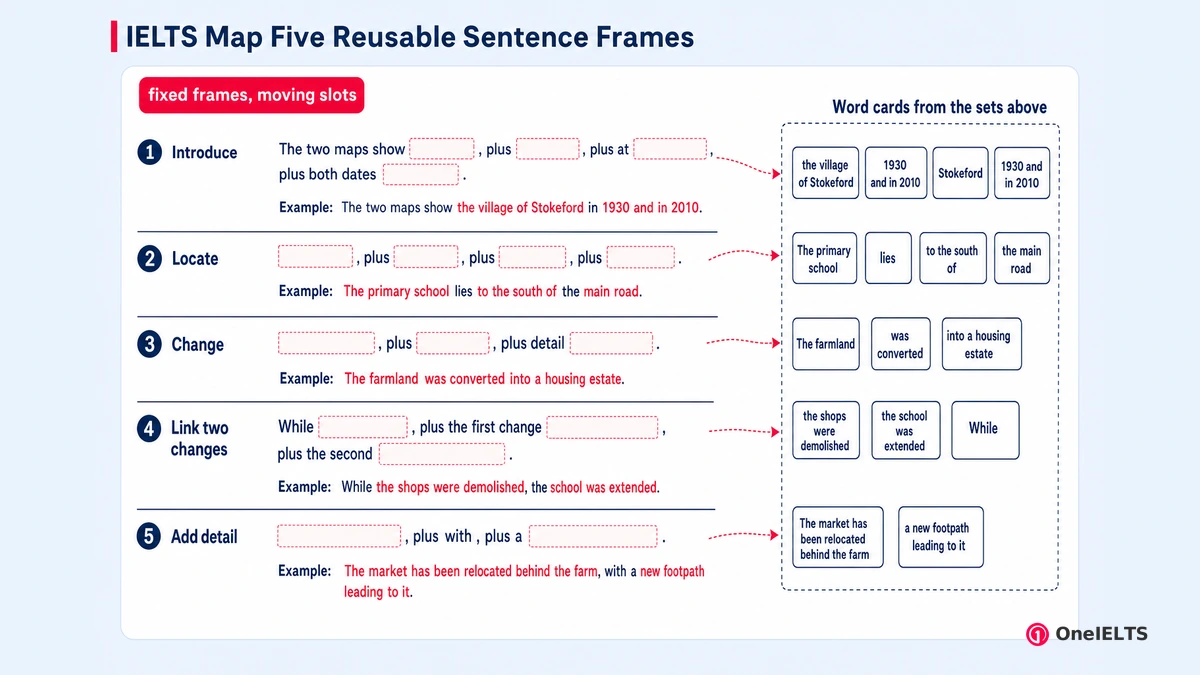
With five reusable sentence frames rather than with a word list. A frame has slots you fill from the sets above, and five of them will carry an entire map report.
Only one guide in this whole search treats sentence structures as the thing being taught, and it is the one whose title says so. Everywhere else the reader is handed a list and left to build the sentence unaided.
- Introduce: the two maps show, plus the place, plus at, plus both dates. The two maps show the village of Stokeford in 1930 and in 2010.
- The locating sentence: feature, plus position verb, plus preposition, plus reference point. The primary school lies to the south of the main road.
- The change sentence: feature, plus passive verb, plus detail with no agent. The farmland was converted into a housing estate.
- A linked change: while, plus the first change, plus the second. While the shops were demolished, the school was extended.
- Add detail: main clause, plus with, plus a noun phrase. The market has been relocated behind the farm, with a new footpath leading to it.
Slot filling is what turns frames from a crutch into a technique. The frames stay fixed and the slots change, so practice means filling slots on new maps rather than memorising finished sentences that will not fit the next prompt.
One warning against the opposite failure. A report in which all five frames appear in the same order every time reads as memorised, so vary which frame opens each body paragraph.
Which Typical Errors Should You Avoid With Map Vocabulary?
Five errors, and the first is the opposite of what most vocabulary advice tells you to do. Do not paraphrase the words the map’s key gives you.
Exactly one guide in this search addresses whether to reword the map’s own labels, and it says most words in the key do not need to be paraphrased. The worked limits are what make it usable. A town is not a city and a road is not a street, so swapping either changes what the map says. Housing area and residential area do legitimately mean the same thing.
- Paraphrasing the key. Swapping a labelled word for a near-synonym changes the claim. Fix: reuse the key wording and paraphrase the task sentence instead.
- Using a change verb on a map with no earlier state. Fix: check the caption for two dates before you write anything at all in the passive.
- Choosing the wrong change family. Demolished-then-rebuilt and relocated describe different events. Fix: look for the same feature elsewhere on the second map first.
- Reaching for a rarer word than the map deserves. A register mismatch costs more than it earns, so neutral nouns are fine and a wrong rare word scores below a right plain one.
- Listing features instead of describing a place. Fix: name at least one thing that stayed exactly as it was.
One more shows up only under timing. Verb repetition, meaning the same change verb four times in one report, is what happens when the clock is running. Two synonyms per family from the list above is enough to avoid it, and a false paraphrase is not the cure.
How Can You Enhance Your IELTS Map Vocabulary for Task 1?
Learn it by family and by form together, with the verb and its passive on one card, and test yourself by writing sentences about real maps rather than by rereading the list.
Rereading a list fails on this set for a specific reason. Recognition comes back long before production does, and this vocabulary is only ever tested in production.
- Take one change family a day, which covers the whole set in six days. Write each verb with its past participle, because the participle is the form you will need.
- For each family, write two sentences about a real map: one in the past simple passive and one in the present perfect passive.
- Build one page of feature nouns from three real maps rather than from a list, so real-map sourcing gives you the words that actually appear.
- Review the whole set on day two, day seven and day fourteen, because three short retrievals beat one long session.
- Run a retrieval test on production rather than recognition. Cover the page and write six change sentences about a map you have not seen.
The honest size statement is worth having, since no source on this topic gives one. About forty change verbs, thirty feature nouns and twenty location items. Set completion is a week of work rather than a term of it, which makes this the smallest high-yield set in Task 1.
The general review method is not a map topic, and the IELTS vocabulary page explains the spaced-review system in full.
How Do You Practise IELTS Map Vocabulary?
Practise on real map prompts with the word page closed, then open it only to revise. A word you can produce without looking is the only kind that survives twenty minutes under exam conditions.
- Open a map prompt and, before writing anything, list the five changes you can see using one verb each from five different families.
- Do some closed-page writing: six sentences about that map with this page shut. Then open it and mark every verb you could not retrieve.
- Rewrite the same six sentences in the passive, choosing the tense from the caption dates rather than from habit. That passive rewrite is where the gaps show.
- Repeat on a static map with no dates. Every change verb should now be unusable, and reaching for one means you have found a real gap.
- Take a weekly prompt and repeat until the six families arrive without looking anything up.
Step four is the unusual instruction and it earns its reason. The fastest way to prove you have understood the two map types is to try the wrong set on purpose and notice that nothing fits. That static-map check takes five minutes and it settles the question permanently.
A retrieval gap found in step two is worth more than an hour of rereading, because it names the exact verb that will fail you. The prompts for steps one and four come from IELTS Task 1 map practice, filtered to map questions only. Practising needs a free OneIELTS account.
How Do You Describe a Map in IELTS?
In four paragraphs: introduction, overview, and two body paragraphs split by area or by feature. The vocabulary on this page fills the sentences rather than deciding the report structure.
One point belongs here and only one. The word set does not tell you which changes to select or how to group them, so feature selection and the paragraph split sit outside vocabulary altogether. Two candidates with identical vocabulary can score two bands apart on selection alone, which is the whole of vocabulary versus method.
The four-paragraph report and every decision inside it belong to the IELTS Task 1 map page.
Which Vocabulary Is Used in Map Questions in IELTS?
It depends which paper you are sitting. Map questions appear in both Listening and Writing Task 1, and the two need different word sets that overlap only on position language.
One test settles it in a second. If you have to write the word, you need the change set. If you have to hear it and tick a box, you need the route set. That position overlap between them is real but small.
Listening needs route and sequence language, and it needs spelling accuracy on top, because a word you recognised still loses the mark if it reaches the answer sheet misspelled. Paper-specific vocabulary is the rule rather than the exception here.
Map labelling is a navigation skill rather than a vocabulary one, and the IELTS Listening map labelling page teaches it.
How Can You Use Map Labelling Vocabulary for Writing Task 1 Effectively?
Take only the position language across and leave the route language behind. Prepositions of place and compass points transfer cleanly, while turn left, go past and at the end of never appear in a written report.
The crossover is worth making for one reason. The transferable set is the one part of map language you learn once and use in two papers, which makes cross-paper learning worth the effort on these thirty items and on nothing else.
One transfer does not work, and it is a viewpoint difference rather than a word problem. A Listening set trains you to follow directions from a speaker’s position on the ground, while a written report describes a place from above. The same preposition does a different job in each.
How word sets are built and reviewed belongs to the IELTS vocabulary page.
Where Can You Find IELTS Map Vocabulary Practice?
On map prompts rather than on word lists. The only useful test of this vocabulary is whether it arrives while you are writing about an unseen map.
Filtering matters here more than on most types. An unfiltered search returns Listening map exercises alongside Writing prompts, and drilling the wrong one is precisely the mistake this page opened with. A filtered prompt set removes that risk because the question-type filter runs before you open anything.
That makes it a production test rather than a reading exercise. IELTS Writing Task 1 map practice opens only this type. Practising needs a free OneIELTS account. One thing to know: a practice link carries the question type but not the exam type, so check the exam type if you have been working in General Training mode.
Written by Jamil Ahmed, reviewed 14 August 2026.
Last verified: 14 August 2026
Practice for the Real IELTS Exam
Apply what you’ve learned with free, exam-style practice:
- Take a free IELTS mock test — all four skills, real exam timing, AI band scoring
- Sit a Writing section mock — Task 1 and Task 2 in one timed hour with a band estimate
- Practise by question type — self-paced Writing sets with model answers