In IELTS Writing Task 2, each phrase signals the job its sentence does: it states a position, adds a reason, gives an example, concedes a point or concludes. These 66 sentence frames, the key words and expressions searchers ask for, sit in 11 groups across the introduction, body paragraphs and conclusion.
Coherence and Cohesion and Lexical Resource reward frames that do a job, so each group lists its essay types and a band descriptors fix. Topic words sit on the Task 2 vocabulary page; connectors and introductions have their own guides.
The groups follow essay order.
- Introduction: restate the prompt.
- Opinion: state your position.
- Listing: add each new point.
- Reasons: explain why.
- Examples: prove the claim.
- Results: show the outcome.
- Highlighting: stress the strongest point.
- Contrasts: set facts side by side.
- Opposing views: answer the other side.
- Hedging: set claim strength.
- Conclusion: close the argument.
1. Introduction Phrases for Paraphrasing the Question
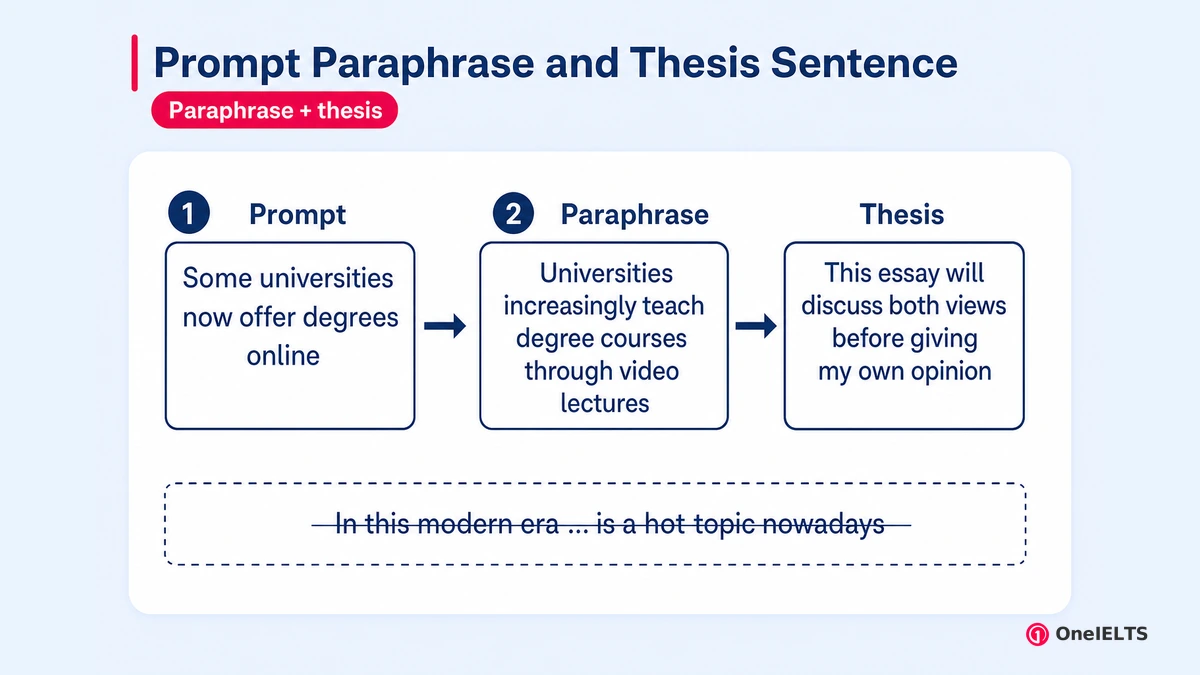
Introduction phrases restate the prompt in new words and set up your position within the first two sentences. Paraphrasing changes the prompt wording without changing its meaning. The paraphrase fills sentence one of the introduction, and a thesis statement or outline sentence follows it in sentence two.
Essay types: all five, from the opinion essay and the discussion essay to advantages and disadvantages, problem and solution, and two-part question prompts. Only the outline sentence changes by type.
Six openers handle both the paraphrase and the thesis, whatever the prompt asks.
- It is widely believed that working from home makes employees more productive, although many managers dispute this claim.
- In recent years, there has been growing debate about whether schools should replace printed textbooks with tablets.
- Some people argue that cities need more roads, while others feel that public transport is the better investment.
- The question of whether fast food should carry a health tax has become increasingly important for governments.
- This essay will discuss both views before giving my own opinion on whether university education should be free.
- I completely agree that governments should fund renewable energy, for two main reasons that the next paragraphs explain.
Compare two openings to a prompt about online degrees. The mechanical one reads “In this modern era, online learning is a hot topic nowadays”, a filler line that fits any prompt. The natural one reads “Universities increasingly teach degree courses through video lectures instead of lecture halls”, which swaps the key words and the grammar but keeps the meaning.
Copied wording earns nothing. The May 2023 Task 2 descriptors state that “Any copied rubric must be discounted”, so the introduction has to paraphrase the prompt, not copy it. The outline sentence also has to match the essay type: both views for a discussion essay, one clear position for an opinion essay. The full method sits on the Task 2 introduction page.
2. Phrases for Giving Your Opinion
Your view needs one clear position, stated in the introduction and kept identical through to the conclusion, and opinion phrases are how you state it. A reader who meets “I firmly believe” in paragraph one and a softer, opposite view in paragraph three no longer knows where you stand. Task Response marks that down.
These frames go in the thesis sentence, in the topic sentence of each supporting body paragraph, and in the restated position at the end.
Essay types: every agree or disagree essay and every two-part question essay needs one. A discussion essay needs one when the prompt adds “give your own opinion”, and an advantages and disadvantages essay needs one when it asks whether advantages outweigh disadvantages.
Each of these six frames gives a view in formal register, at a slightly different strength.
- From my point of view, online learning suits adult students better than children, who need a classroom routine.
- I am inclined to believe that a four-day working week would raise productivity in most office jobs.
- It seems to me that banning cars from city centers punishes residents more than it reduces pollution.
- I would argue that governments should spend more on preventive health care than on building new hospitals.
- I firmly believe that university education should remain free, because talent is spread evenly across income groups.
- In my view, social media has done more to divide public opinion than to inform it.
The mechanical version repeats one frame: “I think” opens the thesis, the first body paragraph and the conclusion. The natural version moves from “I would argue that” in the introduction to “I firmly believe that” once the evidence is in, then closes with “On balance”. Band 7 Task Response asks for “a clear and developed position”, so the position stays fixed while the frame changes.
Task 2 is an argument essay, so first person is acceptable in opinion sentences. Match the frame to the argument. “I am inclined to believe” suits a cautious claim, while “I firmly believe” needs strong support in the paragraph that follows.
3. Phrases for Listing and Adding Information
A bare “Moreover” only says that something follows. Listing and adding phrases introduce each new supporting point as a full sentence frame, so the reader knows a fresh idea has started and how it relates to the last one. They open the topic sentence of each body paragraph and bring in the second or third idea inside a paragraph.
Essay types: all five types use them, with the heaviest use in opinion and two-part question essays, where two or three reasons support one position.
Each frame opens a new point and tells the reader it builds on the previous one.
- The first reason why remote work appeals to parents is that it removes the daily commute entirely.
- Another key factor is that online courses let students in rural areas reach teachers they could never meet.
- A further point worth considering is the cost of maintaining tablets once schools have bought them.
- Not only does cycling cut traffic, but it also lowers the rate of heart disease in cities.
- In addition to cheaper fares, free buses also reduce the number of cars entering the city center.
- Equally important is the fact that older workers bring experience that younger colleagues cannot gain from training.
The mechanical paragraph opens three sentences in a row with “Firstly”, “Moreover” and “Furthermore”. The natural one uses a single frame, “The first reason why.” After that, reference words such as this, such and these hold the next ideas together, as in “This saving matters most to young families.”
The band 6 Coherence and Cohesion descriptor names the problem. It says cohesion “may be faulty or mechanical due to misuse, overuse or omission”, wording confirmed against the May 2023 public version on 7 October 2026. Stacked adders are the most visible kind of over-use.
Single-word cohesive devices such as moreover, furthermore and in addition belong on the Task 2 connectors page, so this list keeps to frames.
4. Phrases for Giving Reasons and Causes
“Cities are getting crowded” is a statement; “This is largely because rural jobs are disappearing” makes it an argument. Reason and cause phrases explain why a claim is true, and the frame belongs in the second sentence of a body paragraph, straight after the topic sentence.
Essay types: a problem and solution essay uses them for the causes of the problem, an opinion essay for the reasons behind the position, and a discussion essay for the reasons behind each view.
These six frames move a paragraph from what happens to why it happens.
- The main reason for this is that housing in large cities now costs more than most young workers earn.
- This is largely because rural areas offer fewer jobs for graduates than they did twenty years ago.
- One factor behind this is the rising cost of private tuition, which pushes families toward online courses.
- This can be attributed to the growth of delivery apps, which make fast food available at any hour.
- Owing to the fact that most people now work at screens, back problems have become common among office staff.
- A key cause of traffic congestion is the lack of reliable public transport in fast-growing suburbs.
The mechanical paragraph leans on “because” three times: people move to cities because of jobs, because of schools and because of hospitals. The natural version uses one cause frame plus a precise noun phrase: “This can be attributed to the concentration of skilled jobs.” The noun phrase raises Lexical Resource; the frame only carries it.
Each frame takes its own grammar. “Because” and “The main reason for this is that” need a full clause with a subject and a verb. “Attributed to” and “One factor behind this is” take a noun phrase instead.
Every cause you name is supporting evidence for the topic sentence. That chain of cause and effect is what teachers call argument development, and what Task Response describes as main ideas that are “extended and supported”.
5. Phrases for Giving Examples
Example phrases attach one specific, believable illustration to a general claim, so the reader sees the point working in the real world. Without one, a body paragraph stays abstract. The example goes in the third or fourth sentence of a body paragraph, after the reason it illustrates.
Essay types: all five types need them, since every body paragraph needs a specific example to extend and support its idea under Task Response.
Six openers bring in an example without every one starting the same way.
- A case in point is Singapore, where road pricing has kept city-center traffic moving for decades.
- To illustrate this, many Indian schools now set homework through apps that parents can check every evening.
- For instance, a nurse who trains abroad often returns home with skills her local hospital lacks.
- This is clearly seen in the way young people now get most of their news from short videos.
- A good example of this is a family that saves on rent by moving to a smaller town.
- Take online banking, for example, which lets rural customers pay bills without traveling to a branch.
The mechanical version invents data: “According to research, 87% of students prefer online classes.” The natural version stays general but believable: “In many Indian cities, students now attend coaching classes online after school.”
Examiners can’t check invented statistics, and a made-up figure adds nothing the band descriptors reward. An example has to be specific, but it doesn’t have to be a real study. A personal experience or a national example works just as well, so leave invented percentages out.
6. Phrases for Results and Consequences
The reason explains why something happens, and the consequence shows what it changes. Result phrases show what follows from a cause or a policy, completing the cause-and-effect chain of a body paragraph. They sit at the end of the paragraph, after the example, where the closing line works as a paragraph conclusion.
Essay types: an advantages and disadvantages essay uses them for the effect of each advantage. A problem and solution essay uses them for the effect of a solution, and an opinion essay for the outcome of its position.
Every frame here links an action to its outcome in a single move.
- As a result, many young couples now delay buying a home until their late thirties.
- This leads to longer working hours, which leave parents with less time to help children with homework.
- Consequently, small shops in town centers lose customers to online retailers that deliver within a day.
- This means that students who cannot afford private tutors fall further behind each school year.
- The outcome of this is that hospitals spend more on treating diseases that better diets could have prevented.
- This, in turn, raises the cost of public health care for every taxpayer in the country.
The mechanical chain repeats one word: “Fuel prices rise, so transport costs rise, so food prices rise.” The natural version carries the two-step consequence with one frame: “Rising fuel prices push up transport costs. This, in turn, raises the price of food.”
Here “this” refers back to the whole previous sentence. That is reference and substitution, the device band 7 Coherence and Cohesion credits when it is “used flexibly”.
7. Phrases for Highlighting and Stressing Key Points
Emphasis tells the reader where to look, and highlighting phrases mark the single strongest point in a paragraph so the examiner sees which reason carries the argument. Use one in the topic sentence of your strongest body paragraph, or in the sentence that sums up a paragraph’s main idea.
Essay types: opinion and two-part question essays use them most. A discussion essay uses one when you weigh one view as the strongest argument.
Each of the six frames tells the reader which idea matters most.
- It is particularly important to note that cheaper flights have brought far more tourists to small coastal towns.
- What matters most is whether a job offers proper training, more than the size of the starting salary.
- Above all, clean drinking water saves more lives than any new hospital a government could build.
- This is especially true of elderly people, who often lack the digital skills that online services assume.
- It should be stressed that recycling alone cannot solve plastic pollution without cutting how much plastic is made.
- The most significant point is that children who read daily build vocabulary faster than those who mostly watch videos.
The mechanical paragraph calls every point “very important”: cost, safety and time all get the same label. The natural paragraph highlights only safety with “Above all,” and states the other points plainly.
Emphasis works by contrast. Use a highlighting phrase once or twice per essay, never in every paragraph.
8. Phrases for Concessions and Contrasts
Two facts side by side, or a minor point admitted inside your own argument: contrast and concession phrases handle both moves in a single sentence. A contrast compares; a concession grants a detail without giving up the position. They work inside a body paragraph and at the turn between the two body paragraphs of a discussion essay.
Essay types: discussion essays use them to contrast the two views, and advantages and disadvantages essays use them to set benefits against drawbacks.
Contrast frames come in two kinds, and this set mixes both.
- On the other hand, cars that give rural families freedom also slow down city streets for everyone else.
- In contrast, students in online courses can replay a lecture as many times as they need.
- Whereas older workers value job security, younger employees often change jobs every two or three years.
- Unlike printed books, e-readers let students in remote villages carry a whole library on one device.
- Although fast food is cheap, its long-term cost appears in rising rates of diabetes and heart disease.
- Compared with trains, short-haul flights produce far more carbon dioxide for each passenger they carry.
Two errors recur. “But” opens a sentence and reads as informal, and “On the other hand” appears with no first hand set up before it. The natural fix puts “Whereas” inside one sentence: “Whereas cities offer more jobs, villages offer cheaper housing.”
Punctuation follows the frame. “Whereas” and “Although” start a subordinate clause, and a comma closes it before the main clause. “In contrast” and “On the other hand” take a comma after them.
This group contrasts facts or concedes a detail. The next group goes further: it reports the other side’s argument and answers it.
9. Phrases for Acknowledging Opposing Views
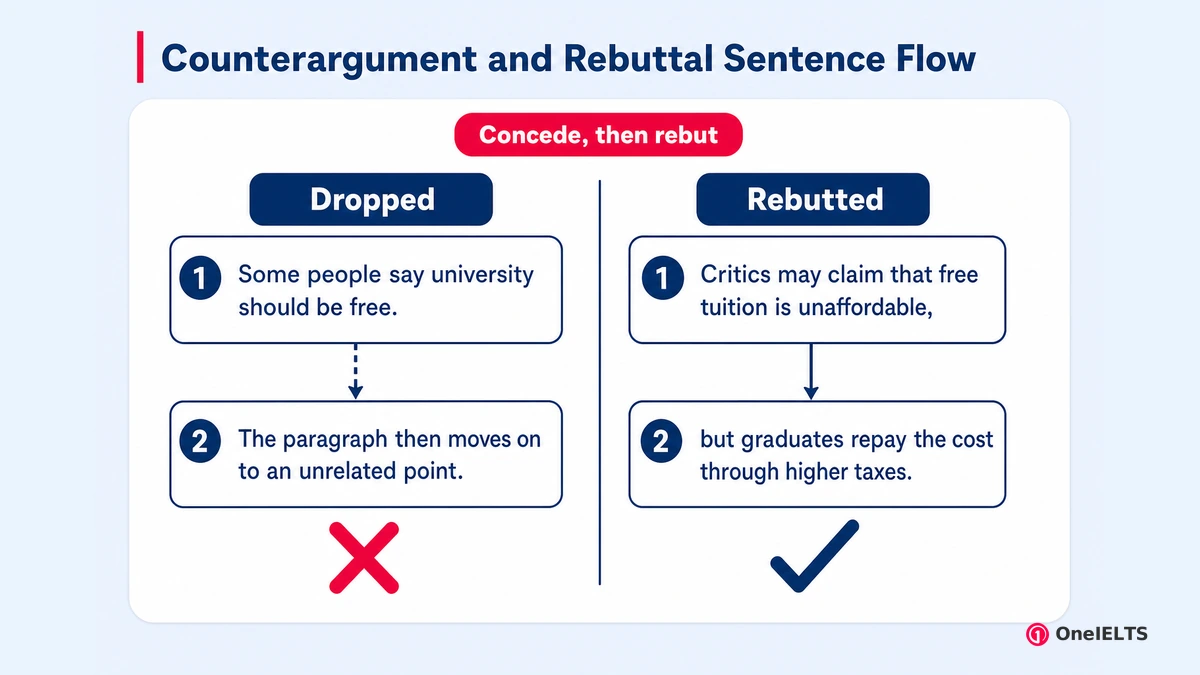
The counterargument frames report the other side fairly, then answer it, which shows the examiner a fully developed position. Band 9 Task Response describes “a clear and fully developed position”, and a rebutted opposing view is one of the plainest ways to show it. In an opinion essay they open the counterargument paragraph; in a discussion essay they can frame the whole first body paragraph.
Essay types: discussion essays always use them. Opinion essays use them when you partly agree, and problem and solution essays use them when a proposed solution has critics.
Each frame reports the other side, then turns it back toward your position.
- It is often argued that zoos protect wildlife; however, many zoo animals belong to species that face no threat.
- While it is true that online study is flexible, I contend that it cannot replace classroom discussion.
- Opponents of this view maintain that free public transport would cost taxpayers too much to run.
- Admittedly, a sugar tax raises food prices, yet it pushes manufacturers to put less sugar in drinks.
- Critics may claim that working from home isolates staff, but regular team days solve most of that problem.
- Although this view has some merit, banning homework would leave weaker students without extra practice.
The weak version states the other side and drops it: “Some people say university should be free.” The paragraph then moves on, so the reader can’t tell whether you agree. The strong version answers in the next sentence: “Critics may claim that free tuition is unaffordable, but graduates repay the cost through higher taxes.”
An unanswered opposing view weakens Task Response. The rebuttal has to follow the frame directly, or the paragraph quietly changes your position.
10. Phrases for Hedging and Expressing Certainty
“All young people are addicted to phones” claims more than any essay can prove. Hedging and certainty phrases set the strength of a claim, and band 7 Task Response warns of “a tendency to over-generalise”, so hedging is the direct fix. Use them on any claim about the future, a cause or a group of people, which means most body paragraphs and the predicted-outcome sentence of a problem and solution essay.
Essay types: problem and solution essays use them to predict what a solution will achieve, while advantages and disadvantages essays and opinion essays use them to weigh each claim.
The first three frames soften a claim, and the last three make it firmer.
- It is likely that electric cars will outsell petrol cars in most European countries within two decades.
- This may lead to a shortage of skilled workers if fewer young people choose vocational training.
- There is a strong possibility that remote work will empty some city-center offices for good.
- Arguably, free school meals do more for children’s exam results than smaller class sizes do.
- It is undeniable that smartphones have changed how teenagers spend their free time, as screen-time surveys show.
- To a large extent, a country’s health depends on what its people eat rather than on its hospitals.
The hedged version reads “Many young people are likely to spend more time on phones than on exercise,” and it claims only what an essay can support. Modal verbs such as may and might do the softening, along with adverbs like arguably. Band 7 Lexical Resource asks for “an awareness of style and collocation”, and precise claim strength is part of that style.
Certainty frames need proof. “It is undeniable that” requires evidence in the same paragraph, or the examiner reads it as one more over-generalization.
11. Phrases for Concluding Your Essay
One frame, a restated position and a short summary of reasons: conclusion phrases signal the end and restate your view in new words without adding a new idea. The frame opens the final paragraph, and the restated position and a one-line summary of reasons follow it.
Essay types: all five types end this way. Opinion and two-part question essays restate the thesis from the introduction, and discussion essays restate the writer’s own view.
These six closers run from the plainest to the most formal.
- In conclusion, I believe governments should fund public transport before building new roads into cities.
- All things considered, the benefits of studying abroad outweigh the cost for most students who can afford it.
- Taking everything into account, working from home suits parents better than it suits young graduates.
- To sum up, cheaper housing and better transport would both reduce pressure on overcrowded cities.
- On balance, I believe that printed books still have a place in schools alongside digital devices.
- Overall, it is clear that tourism brings small towns more income than it costs them in damage.
The mechanical conclusion paragraph copies the introduction word for word, so the examiner reads the same two sentences twice. The natural one is a paraphrase: “governments should fund renewable energy” becomes “public money is best spent on clean power”.
A new idea in the conclusion is a Task Response weakness, so keep to the restated position and the summary of reasons. A conclusion needs only one closing frame, and stacking “In conclusion, to sum up” is a common error. The conclusion tips page shows how to build the final paragraph.
How Do You Use Task 2 Phrases Without Sounding Memorized?
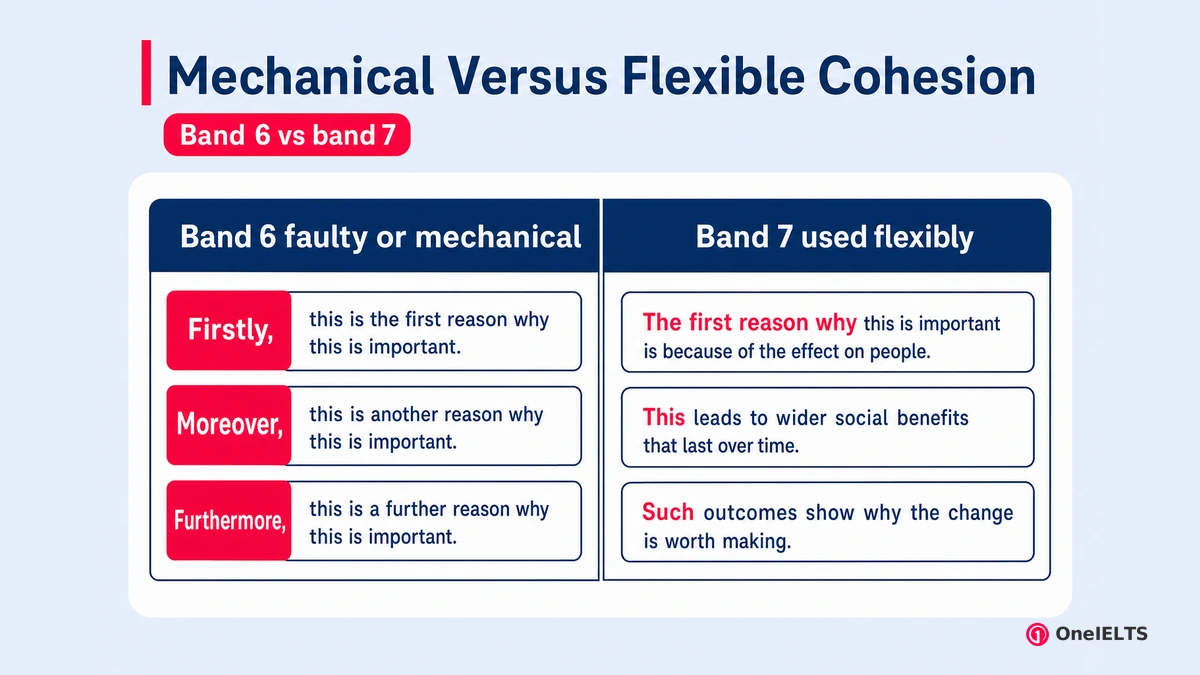
Choose each phrase for the job the sentence does, use it once, and build the sentence around your own idea. Examiners mark down cohesion that is “faulty or mechanical” (band 6) and reward cohesive devices used “flexibly” (band 7).
The May 2023 public band descriptors spell this out. At band 6, Coherence and Cohesion says cohesion “may be faulty or mechanical due to misuse, overuse or omission”. At band 7, “a range of cohesive devices including reference and substitution is used flexibly but with some inaccuracies or some over/under use”. Lexical Resource at band 7 adds that “an awareness of style and collocation is evident”.
The grid also treats memorized language as a weakness. Band 4 Lexical Resource lists “memorised phrases” and “formulaic language” among inappropriate lexical chunks. Band 0 applies only where there is “proof that a candidate’s answer has been totally memorised”. Wording checked on 7 October 2026 against the ielts.org PDF.
A quick self-check works on any practice essay: underline every frame you used. If more than half your sentences open with one, the essay reads as assembled from a list.
Six habits keep the frames working for your argument instead of against it.
- Pick the phrase for the sentence’s function. Decide if the sentence adds, explains, illustrates or concedes first.
- Use each phrase once per essay. A frame repeated in two paragraphs reads as a template, not a choice.
- Build the frame around your own idea. Your argument and most vocabulary marks sit in the words after it.
- Let reference words carry cohesion. Words such as this, these and such link sentences without stacking another connector.
- Keep a formal register throughout. Leave out contractions and chatty openers such as “to be honest” in Task 2.
- Match the phrases to the essay type. Discussion essays need counterargument frames; problem and solution essays need cause frames.
Which Phrases Suit Each IELTS Writing Task 2 Essay Type?
The phrase groups each Task 2 essay type needs are set by what its prompt asks the writer to do. The table gives the core groups, by number, for the opinion essay, discussion essay, advantages and disadvantages essay, problem and solution essay and two-part question.
Read across a row to see which groups each paragraph draws on.
| Essay type | Introduction | Body paragraphs | Conclusion |
|---|---|---|---|
| Opinion (agree or disagree) | 1 paraphrase, 2 opinion | 3 adding, 4 reasons, 5 examples, 7 highlighting, optional 9 counterargument | 11 concluding, 2 opinion |
| Discussion (discuss both views) | 1 paraphrase | 8 contrasts, 9 opposing views, 4 reasons, 5 examples | 11 concluding, 2 opinion |
| Advantages and disadvantages | 1 paraphrase | 3 adding, 6 results, 8 contrasts, 5 examples | 11 concluding |
| Problem and solution | 1 paraphrase | 4 causes, 6 results, 5 examples, 10 hedging | 11 concluding |
| Two-part question | 1 paraphrase | 3 adding, 4 reasons, 5 examples, 7 highlighting | 11 concluding |
The “Essay types” line in each section above also names occasional uses, such as hedging in an opinion essay. To recognize which type a prompt is, use the guide to IELTS essay types.
How Are Linking Words Different From Task 2 Phrases?
Linking words are single connectors such as however or therefore, while Task 2 phrases are sentence frames that carry a whole function. A frame usually contains a linking word plus the structure around it, as in “This can be attributed to”. Both count as cohesive devices, but learning frames cuts the over-use of bare connectors. The full list by function is on the IELTS Writing Task 2 connectors page.
Can You Use Idioms in IELTS Writing Task 2?
No, in most cases idioms are too informal for a Task 2 essay, and the band descriptors reward precise, appropriate vocabulary rather than colorful expressions. The band 8 grid credits “idiomatic items when appropriate”, so fixed academic expressions like “a double-edged sword” or “in the long run” can work. Conversational idioms like “a piece of cake” can’t. IELTS Speaking accepts that informal register. See quotes and idioms in IELTS Writing Task 2 for more.
Which Phrases Help a Task 2 Essay Reach Band 9?
The phrases that help at band 9 are the ones used so precisely and naturally that the examiner does not notice them as phrases. No list of phrases guarantees a band. Band 9 Lexical Resource reads “Full flexibility and precise use are widely evident”, with spelling and word-formation slips “extremely rare”. The full grid is on the IELTS Writing band descriptors page.
Four habits separate band 9 scripts from scripts that simply contain more phrases.
- Precise hedging of claims. Each claim carries exactly the strength its evidence supports, no stronger and no weaker.
- Concession answered by rebuttal. Every opposing view the essay admits gets an answer in the very next sentence.
- Reference and substitution instead of connectors. Words like this and such link ideas where weaker scripts add another connector.
- Topic-specific collocations inside frames. The frame stays plain, while the words inside it, like “curb emissions”, carry precision.
How Do You Write a Good IELTS Writing Task 2 Introduction?
A good Task 2 introduction paraphrases the question and states your position in two or three sentences, without a memorized template. The introduction paragraph uses three moves, each drawing on a group from this page.
- Paraphrase the prompt (group 1). Restate the question with new key words and new grammar, keeping its meaning exact.
- State your position (group 2). Give your answer in one clear thesis statement that the conclusion later restates.
- Outline the main points (group 1). Name the two ideas your body paragraphs develop, in the order they appear.
The step-by-step method is in the IELTS Writing Task 2 essay introduction guide.
Written by Jamil Ahmed, reviewed 7 October 2026.
Last verified: 7 October 2026
Practice for the Real IELTS Exam
Apply what you’ve learned with free, exam-style practice:
- Take a free IELTS mock test — all four skills, real exam timing, AI band scoring
- Sit a Writing section mock — Task 1 and Task 2 in one timed hour with a band estimate
- Practice by question type — self-paced Writing sets with model answers