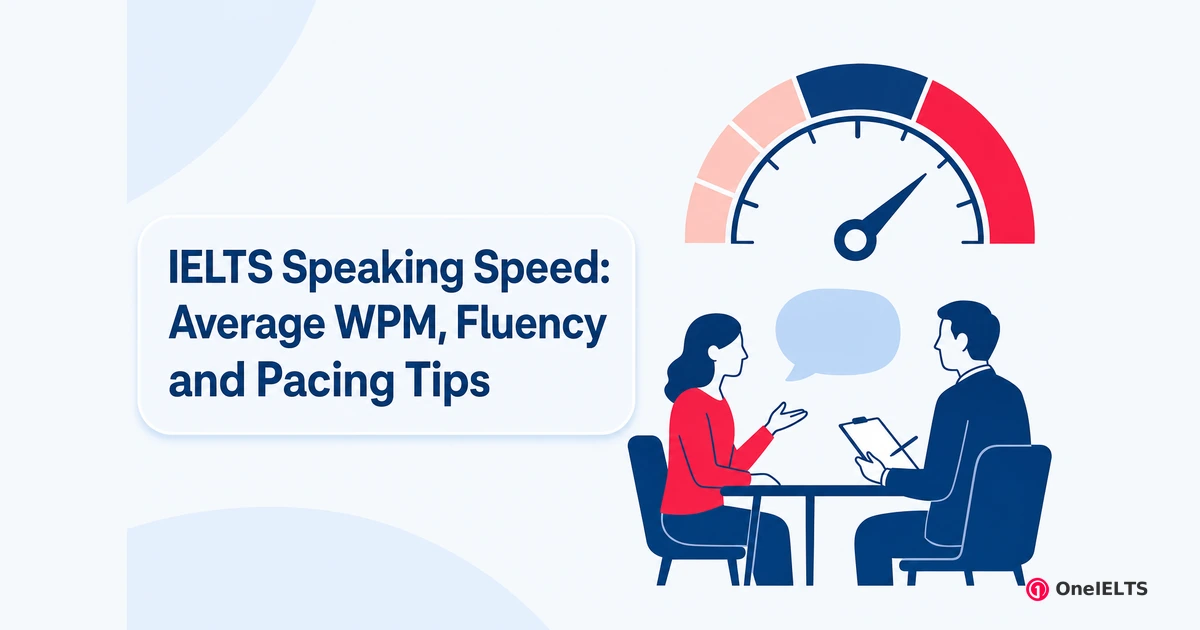
Your IELTS speaking speed, counted in words per minute (WPM), shapes how easily the examiner follows you and how fluent you sound. Average conversation runs at about 120-150 WPM, and IELTS sets no official words-per-minute target, because the examiner marks Fluency and Coherence rather than a speed number. At that pace, a two-minute long turn in Part 2 comes to roughly 240-300 words.
This page covers average WPM, speed by activity, a good pace for the IELTS Speaking test, why pace matters and what the descriptors say. It then turns to rushing and stalling, the factors behind your rate, measuring and improving it, and pacing each part. Pronunciation, linking words and test timings have their own guides.
What Is the Average Speaking Speed in Words per Minute?
Speaking speed, also called speaking rate or speech rate, is the number of words a speaker produces per minute of talk, pauses included. The average for English conversational speech is about 120-150 words per minute. Careful, slower speech sits near 100-120 WPM, and quick speech runs above 170 WPM.
WPM is an average across a stretch of talk. A fluent speaker slows down and speeds up inside one answer, and the figure smooths that out. Speech researchers prefer syllables per minute as the normal speech-rate measure, because long words take longer to say than short ones. Per second, the average speaking speed works out to roughly 2-2.5 words.
How Do Average Speaking Speeds Differ by Activity?
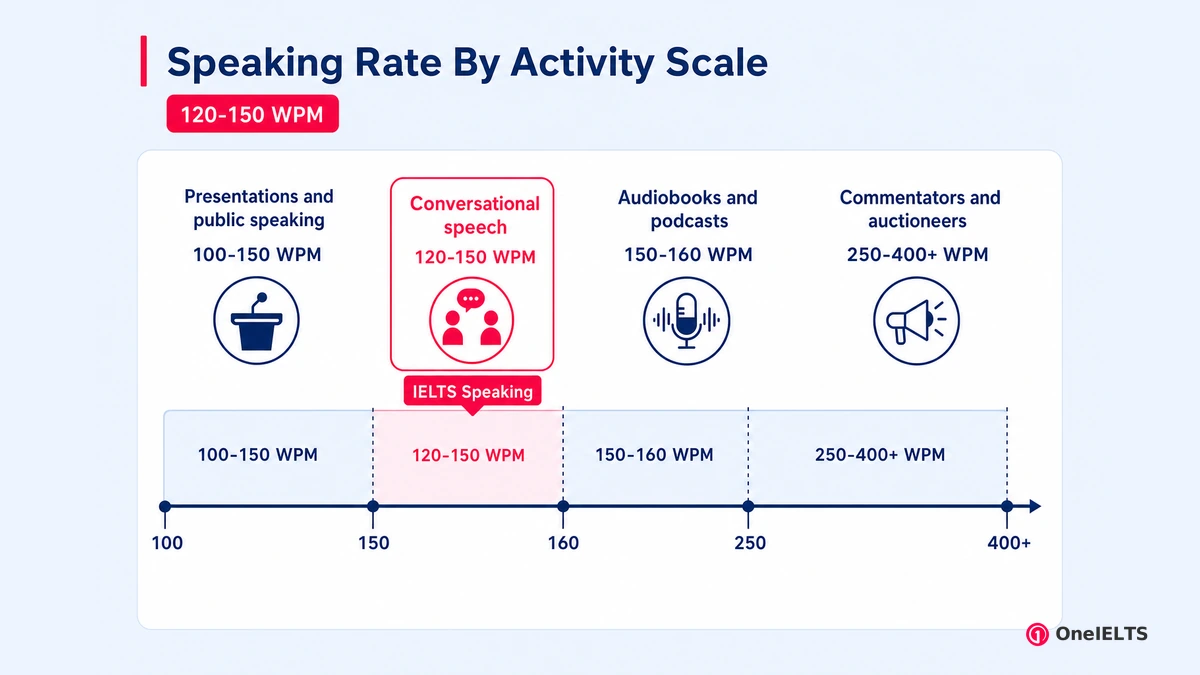
Conversation runs at about 120-150 WPM, presentations at 100-150 WPM, audiobooks and podcasts at 150-160 WPM, and commentators or auctioneers at 250-400+ WPM. The IELTS Speaking test is a face-to-face interview with an examiner, so the conversational row is your reference point. That holds even in Part 2, which feels like a short talk. Here’s where an IELTS answer sits among four everyday speaking situations.
| Activity | Typical WPM | Why speakers use this pace | Closest IELTS situation |
|---|---|---|---|
| Conversational speech | 120-150 WPM | Two people trade turns and need time to listen and reply. | All three parts, because every part is a live exchange with an examiner. |
| Presentations and public speaking | 100-150 WPM, often 130-140 | Speakers slow down so a large room can absorb each point. | Part 2 feels similar, but you’re still talking to one listener. |
| Audiobooks and podcasts | 150-160 WPM | Narrators read a polished script, so no time goes on finding words. | None directly; it’s closer to reading aloud than to unscripted answers. |
| Commentators and auctioneers | 250-400+ WPM | Fast action or rapid bidding demands a stream of short, quick phrases. | None; this pace would cost clarity and Pronunciation marks in IELTS. |
What Speaking Speed Is Good for the IELTS Speaking Test?
A good speaking speed for IELTS is a natural pace of roughly 120-150 words per minute, fast enough to sound fluent and slow enough for every word to stay clear. IELTS publishes no required WPM.
Good means you keep going without long pauses or slurred sounds. A candidate at 115 WPM who never stalls can score higher on fluency than one at 170 WPM who keeps restarting sentences. Nervous candidates who rush can treat the 130-160 WPM normal pace from speech-coaching guides as an upper target. Pace that slows for a key point and quickens for a familiar detail sounds more natural than one fixed rate.
IELTS marks four assessment criteria: Fluency and Coherence, Lexical Resource, Grammatical Range and Accuracy, and Pronunciation. Each is worth 25%, and none of them is a speed score.
Why Is Speaking Speed Important in the IELTS Speaking Test?
Pace matters because the examiner hears your answer once, live, and marks how easy it is to follow. That’s true in a test center and on the video call used for IELTS Online. Speed has no criterion of its own, so it works through three of the four. Five routes carry your pace into your band score.
- Listener effort: the examiner follows a steady pace without asking you to repeat, so each idea lands the first time.
- Fluency and Coherence: long pauses and slow, word-by-word speech pull this criterion down faster than any other pace problem.
- Pronunciation: rushing blurs word endings, word stress and intonation, the features covered in IELTS Speaking pronunciation.
- Time use: Part 1 and Part 3 each run 4-5 minutes under the Speaking test duration rules, and pace decides how fully each answer develops.
- Thinking time: a controlled pace leaves room to choose words, which protects Lexical Resource and your grammar score.
How Do the IELTS Fluency and Coherence Descriptors Treat Speaking Speed?
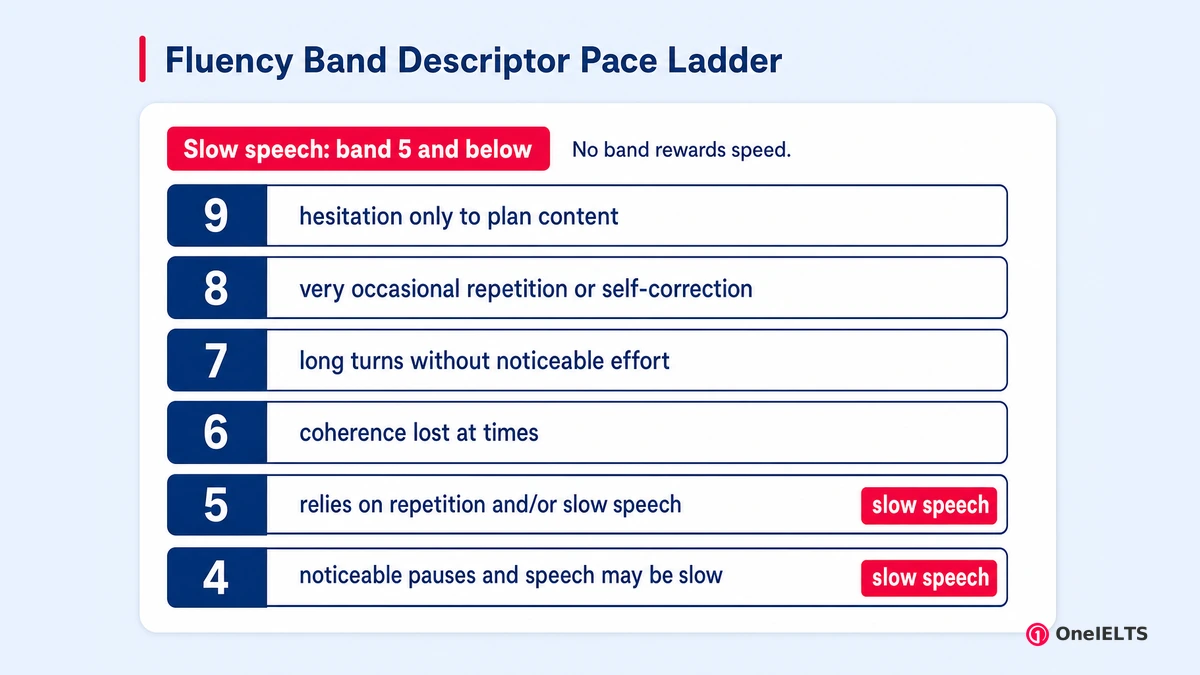
The public version of the Speaking band descriptors never sets a speed. It describes hesitation, repetition and self-correction, and it names slow speech only at band 5 and below. Speaking faster earns nothing on its own, while speaking too slowly can cap your score. Hesitation used to plan an idea counts differently from hesitation used to search for a word, and that distinction separates bands 7 to 9.
Each row paraphrases one band’s Fluency and Coherence line from the ielts.org grid, checked on 7 October 2026.
| Band | What the descriptor says about flow | What it means for your pace |
|---|---|---|
| Band 9 | Fluent, with any hesitation used only to prepare the content of the next utterance. | Pausing to plan an idea is fine; pausing to find a word isn’t. |
| Band 8 | Fluent, with only very occasional repetition or self-correction; most hesitation is content related. | A natural pace with rare restarts, where occasional word-search pauses still fit. |
| Band 7 | Keeps going and readily produces long turns without noticeable effort, with some hesitation or repetition. | Your pace holds steady across long answers, with no effortful stretches the examiner notices. |
| Band 6 | Willing to produce long turns, but coherence may be lost at times through hesitation, repetition or self-correction. | You talk at length, yet stalls or restarts sometimes break the thread of the answer. |
| Band 5 | Usually keeps going, but relies on repetition and self-correction, and/or on slow speech. | This is the first band where slow speech itself appears as a weakness. |
| Band 4 | Can’t keep going without noticeable pauses; speech may be slow, with frequent repetition. | Word-by-word pace with long gaps places an answer here, whatever the vocabulary. |
What Happens If Your Speaking Speed Is Too Fast or Too Slow?
Speaking too slowly, below about 100-110 WPM with long pauses, reads as limited fluency, while speaking too fast, above about 170-180 WPM, costs clarity and leaves no time to choose words. Test nerves push most candidates into rushing. Both extremes appear among the common IELTS Speaking mistakes examiners hear. The effects split into two too-slow results and three too-fast ones.
- Too slow: long pauses and fillers such as “um” and “you know” sound to the examiner like searching for language.
- Too slow: answers stay short and under-developed when the 4-5 minutes of Part 1 or Part 3 run out.
- Too fast: swallowed word endings and flat intonation cost Pronunciation marks, even when your vocabulary is strong.
- Too fast: grammar slips and self-corrections multiply at speed, and each restart pulls your fluency rating down.
- Too fast: a Part 2 talk runs out of ideas well before two minutes, leaving a silence the examiner hears.
What Factors Affect Your Speaking Speed?
Speaking speed is personal, and it shifts with the speaker, the topic and the setting, so measure your own rate rather than copying a number. An Indian English speaker’s syllable-timed rhythm can sound faster to an examiner than stress-timed rhythm, even at the same WPM. The fix there is stress and pausing, and speed can stay where it is. Six factors are easy to spot in your own recordings.
- Nerves and test pressure: adrenaline speeds most candidates up in the first minute, before they settle into the exchange.
- Familiarity with the topic: topic familiarity lets you talk freely, while an unfamiliar topic slows you to a halting pace.
- Vocabulary range in that topic: missing words force mid-sentence stops, so a thin topic vocabulary lowers your rate sharply.
- First-language rhythm and habits: your mother tongue sets your default sentence length, pausing points and syllable timing.
- Complexity of the idea being explained: abstract or multi-step ideas need planning time, which naturally drags the pace down.
- The listener’s reactions and questions: an examiner’s nod keeps you moving, while a follow-up question resets your rhythm.
How Do You Test and Calculate Your Speaking Speed?
Record a one- or two-minute answer, count the words in a transcript, and divide by the minutes spoken. For example, 260 words in 2 minutes is 130 WPM. Five steps give you a reliable figure in about ten minutes.
- Pick an IELTS-style prompt, such as a Part 2 cue card from IELTS Speaking practice.
- Record yourself answering without a script, on your phone, for one or two minutes.
- Transcribe the recording by hand or with a speech-to-text app to get a transcript.
- Count the words with a word count tool and divide by the minutes you spoke.
- Repeat across Part 1, Part 2 and Part 3 prompts, then compare the three rates.
Skip the free online read-aloud test for this job. It measures reading speed, which usually runs faster than spontaneous speech, so measure an unscripted answer instead. A word processor’s word count on the transcript is enough, and you won’t need a calculator.
How Can You Improve Your Speaking Speed for IELTS?
Improving speed for IELTS usually means steadying it: speeding up the slow, pause-filled stretches and slowing down the rushed ones. Talking faster across the board rarely helps. Seven techniques fit into fifteen minutes of daily practice.
- Shadow native audio at 130-150 WPM: play a podcast clip and repeat it half a second behind; shadowing trains rhythm, sentence stress and a steady rate together.
- Time yourself on Part 2 cue cards: set a two-minute timer for every practice talk, so you learn exactly how much content fills the long turn.
- Build topic vocabulary to cut word-search pauses: learn ten words per common topic from IELTS Speaking vocabulary lists, so fewer stops interrupt your answers.
- Use linking phrases to bridge ideas: phrases such as “on top of that” carry you from one point to the next; see IELTS Speaking linking words.
- Pause at sentence ends, not mid-phrase: a break between sentences sounds controlled, while a pause inside a phrase sounds like searching for a word.
- Read aloud daily to train breath and rhythm: five minutes of reading aloud builds breath control, so long sentences don’t leave you gasping halfway through.
- Review recordings for rushed or stalled stretches: mark each spot where your pace jumps or stalls, then re-record that answer until the rate evens out.
Which Speaking Speed Suits Each Part of the IELTS Speaking Test?
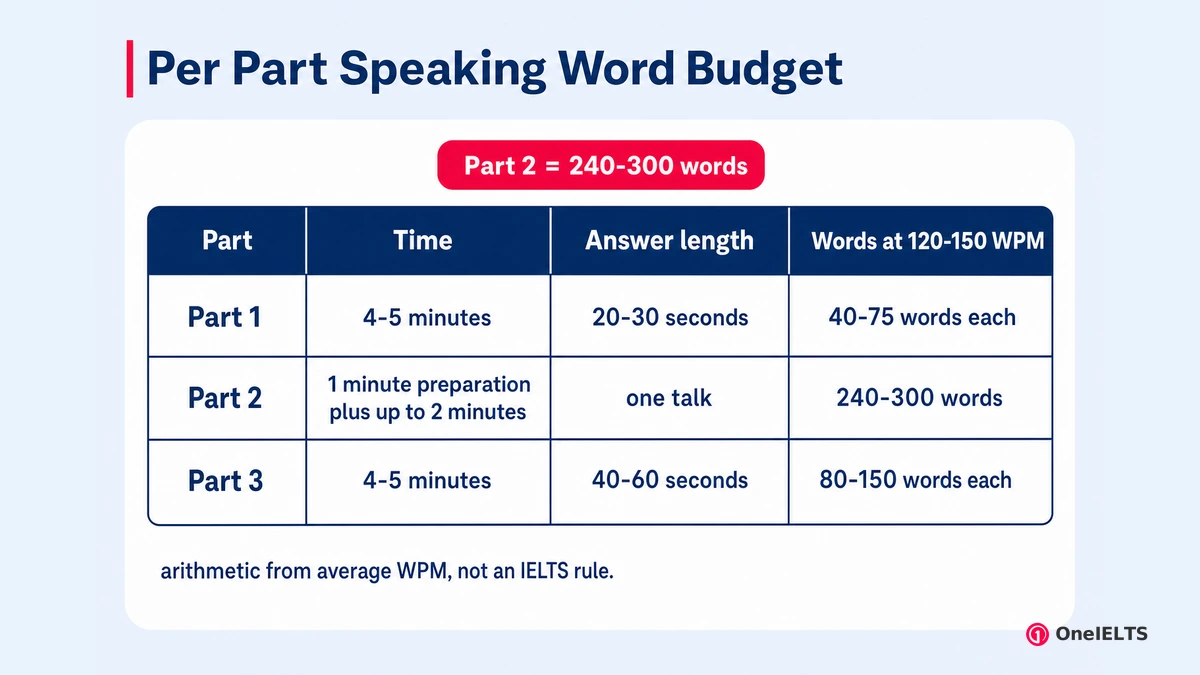
Keep the same natural 120-150 WPM in all three parts; what changes is the length of each answer. Part 1 wants short replies, Part 2 a sustained two-minute long turn, and Part 3 longer reasoned answers. Multiply each answer’s length by your rate and you get a rough word budget per part.
| Part | Time | Typical answer length | Approximate words at 120-150 WPM |
|---|---|---|---|
| Part 1 | 4-5 minutes | About 20-30 seconds per answer | Roughly 40-75 words each |
| Part 2 | 1 minute preparation, up to 2 minutes talking | One talk of up to 2 minutes | Roughly 240-300 words |
| Part 3 | 4-5 minutes | About 40-60 seconds per answer | Roughly 80-150 words each |
These word figures come from average-WPM arithmetic, and IELTS sets no word rule. The timings match ielts.org, checked on 7 October 2026: Part 1 and Part 3 last 4-5 minutes each, and the examiner stops your Part 2 talk at two minutes.
What Speaking Speed Works for IELTS Speaking Part 1 Answers?
The speed that works for Part 1 is your normal conversational pace, with answers of two to three sentences that reach the point quickly. Part 1 questions cover familiar topics such as home, work, studies and hobbies, so slowing to a careful 100 WPM makes you sound hesitant. Practice one rhythm for short answers: answer, reason, example, then stop. Sample questions sit in our IELTS Speaking Part 1 guide.
How Many Words Is a 2-Minute Speech in IELTS Speaking Part 2?
The words in a 2-minute Part 2 long turn come to about 240-300 at a natural 120-150 WPM. The examiner stops you at two minutes, so aim to fill the full time; the word count only tells you how much material to plan. Running out at 60-70 seconds is more common than overrunning.
Use the one-minute preparation to note three or four cue card points, each worth 30-40 seconds of talk. Practice with these IELTS Speaking Part 2 two-minute speech topics.
How Does Speaking Speed Change in IELTS Speaking Part 3?
The speaking speed in Part 3 often drops a little, because abstract discussion questions need more thinking time than Part 1. A short planning phrase such as “That’s an interesting question, and I’d say…” buys time without a silent pause. The examiner expects fuller, reasoned answers to abstract questions. Keep your pace steady with one structure: opinion, reason, example, contrast. More prompts sit in the IELTS Speaking Part 3 guide.
Is 180 Words per Minute Too Fast for IELTS Speaking?
Yes, 180 words per minute is usually too fast for IELTS Speaking, because it sits above the 170 WPM point where clarity starts to slip for most non-native speakers. The examiner doesn’t penalize speed itself in a fully clear candidate, but at 180 WPM most candidates lose the clarity the examiner scores.
The quick fix: make a practice recording with IELTS Speaking practice, count your WPM, and add a full pause at each sentence end.
Written by Rifah Binte Faruk, reviewed 7 October 2026.
Last verified: 7 October 2026
Practice for the Real IELTS Exam
Apply what you’ve learned with free, exam-style practice:
- Take a free IELTS mock test — all four skills, real exam timing, AI band scoring
- Sit a Speaking section mock — timed Parts 1–3 with voice recording and band feedback
- Practice all three parts — sample questions with feedback