The IELTS syllabus is the structure and content of the four test sections – Listening, Reading, Writing and Speaking. It is assessed over about 2 hours 45 minutes, with Reading and Writing differing between Academic and General Training. There is no set list of topics or subjects to memorise; you prepare the format and the skills, not a body of facts.
That makes the IELTS syllabus a fixed format rather than a content list. It runs a total duration 2h 45m, stays unchanged for 2026, and is built from four modules that test four test sections of English. This guide sets out what is in the syllabus and the exam pattern, the test types, and the four module syllabuses. It then covers the topics, the skills tested, the band score, CEFR mapping, how to study, the computer-or-paper choice, and the Academic vs General Training difference.
Last verified: 30 June 2026
What Is in the IELTS Syllabus?
The IELTS syllabus is made up of four sections – Listening, Reading, Writing and Speaking – with Reading and Writing differing between the Academic and General Training versions. Those four parts – in the order Listening Reading Writing Speaking – are the whole of what the syllabus contains, and the test measures nothing else.
The table below lines up each of the four sections against both versions and shows how long you get for each.
| Test Component | IELTS Academic | IELTS General Training | Time Allotted |
|---|---|---|---|
| IELTS Listening | 4 parts, 40 questions | 4 parts, 40 questions | 30 minutes |
| IELTS Reading | 3 passages, 40 questions | 3 sections, 40 questions | 60 minutes |
| IELTS Writing | Task 1: describe visual data; Task 2: essay | Task 1: write a letter; Task 2: essay | 60 minutes |
| IELTS Speaking | Part 1: interview; Part 2: cue card; Part 3: discussion | (same) | 11-14 minutes |
Those four test sections are everything the syllabus holds. There is no fifth paper, no grammar test sat on its own, and no separate vocabulary exam; the four modules together are the full content. The Time Allotted column is also the master record for each module’s length, and later sections do not restate these numbers.
The split between the versions is narrow. Only Reading and Writing differ between Academic vs General Training, while Listening and Speaking are shared modules taken in exactly the same form by every candidate. Academic Reading pulls from journals and Academic Writing sets a data-description task; General Training swaps in everyday texts and a letter. Everything else in the syllabus is common to both.
So when people ask what is in the IELTS syllabus, the honest answer is short. It is these four sections, the question types inside each, and the timing that frames them. The rest of this guide walks through each of the four sections in turn, but the composition never grows beyond what this table shows.
What Is the IELTS Exam Pattern?
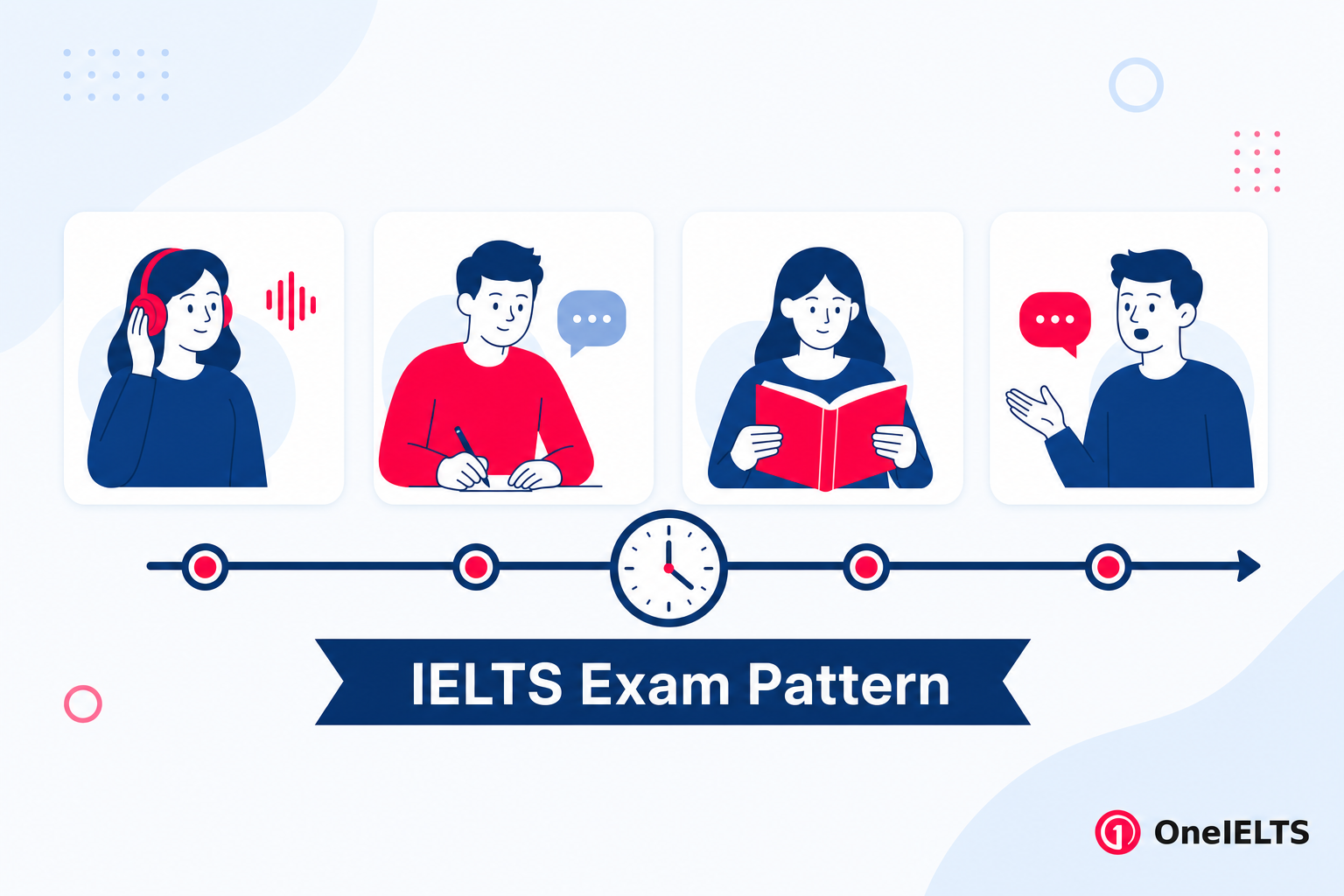
The IELTS exam pattern runs for about 2 hours 45 minutes in total, with Listening, Reading and Writing taken back-to-back in one sitting and Speaking scheduled separately. The pattern is the same for both versions; only the Reading and Writing content changes.
Listening, Reading and Writing run consecutively with no break between them. You move straight from one into the next, so the 2h 45m total is an unbroken block of concentration rather than three separate appointments. Speaking is held either on the same day or up to a week before or after, depending on your centre, and is the only part scheduled separately from the main sitting.
The marks mechanics differ by module, and the mini-table below shows how each is scored.
| Section | Time | How it is marked |
|---|---|---|
| Listening | 30 minutes | 40 questions, one mark per question |
| Reading | 60 minutes | 40 questions, one mark per question |
| Writing | 60 minutes | Criteria-marked by an examiner |
| Speaking | 11-14 minutes | Criteria-marked by an examiner |
Listening and Reading carry 40 questions each, and you earn one mark per question with no penalty for a wrong answer. Writing and Speaking work differently. They are criteria-marked by certified examiners against published rubrics, not counted right or wrong, so there is no question count to tot up in those two.
The pattern is identical whether you sit on computer or paper; only the delivery differs. The computer route removes the separate transfer window at the end of Listening, because you type answers straight in, while on paper you copy answers onto the sheet in that extra time. The order, the timing and the back-to-back block stay the same either way.
That unbroken block is more demanding than the raw timing suggests. Candidates who only ever practise one module at a time often fade in the third, because they never trained the stamina to hold focus across the whole sitting. A few full mocks run in one go is the only real fix.
What Are the Types of IELTS Exam?
IELTS comes in a small family of versions that share one core test but serve different goals, from university entry to UK visa rules. Knowing which one you need decides your Reading and Writing content.
The four main IELTS types are set out below, each with the purpose it serves.
- IELTS Academic measures whether your English is ready for university study or professional registration, using scholarly Reading texts and a data-description Writing task aimed at degree-level work.
- IELTS General Training suits migration and work, with everyday and workplace Reading and a letter-writing task instead of data description, mirroring the English you use in daily life.
- IELTS for UKVI is the same Academic or General Training test taken at a UK-government-approved centre, reported on a slightly different certificate for visa and immigration purposes.
- IELTS Life Skills is a speaking-and-listening-only test reported at CEFR levels A1, A2 or B1, used for specific UK family, partner and settlement visa routes rather than study.
Most candidates only ever sit Academic or General Training. The choice follows your destination, so check the receiving body’s requirement before you book. Sitting the wrong version means resitting.
What Is the IELTS Listening Syllabus?
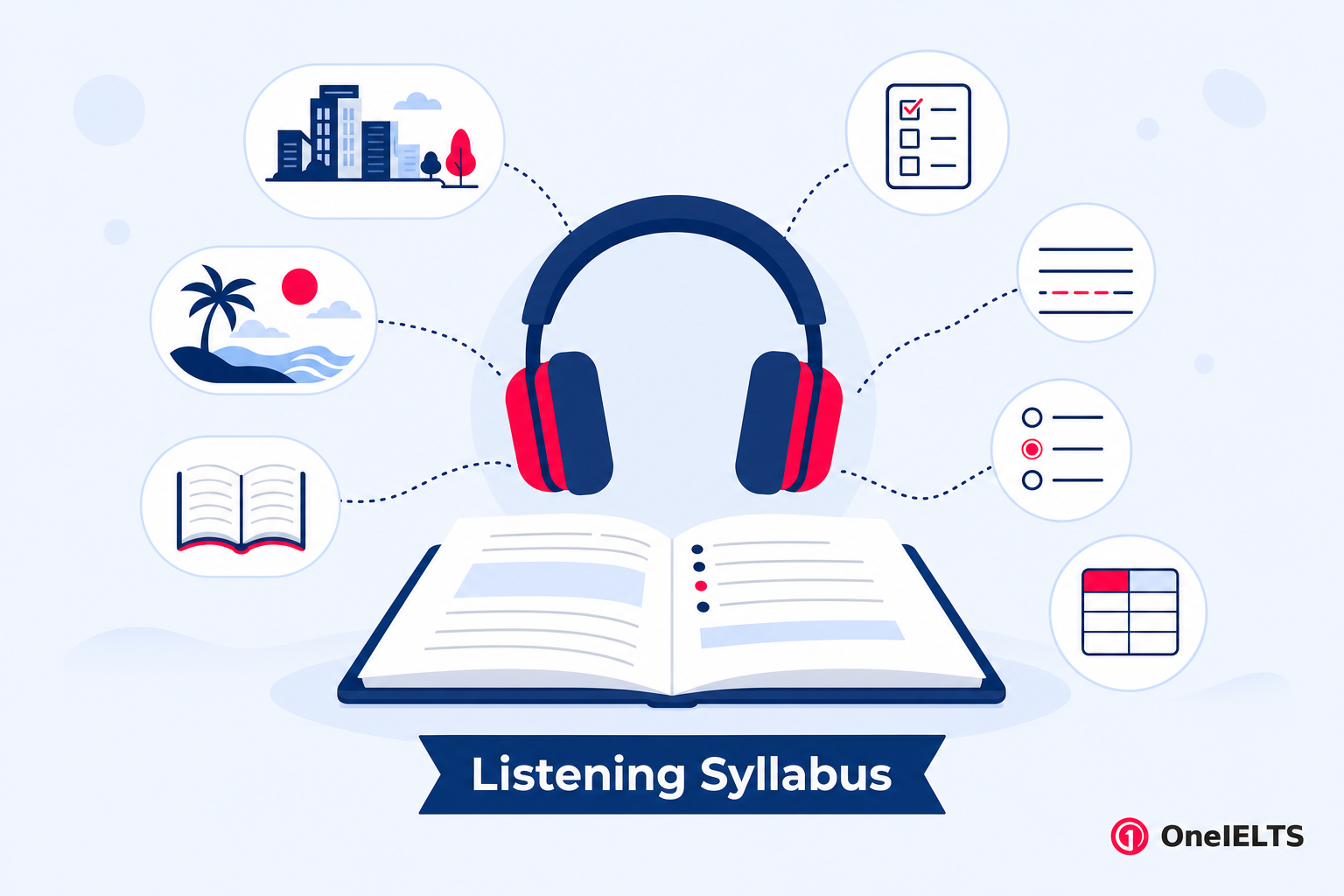
The Listening syllabus splits into four parts that climb from social settings to academic ones, summarised in the table below.
| Part | Setting | Question types |
|---|---|---|
| Part 1 | Everyday social conversation | Form and note completion |
| Part 2 | Social monologue | Map labelling, matching |
| Part 3 | Academic discussion | Multiple choice, matching |
| Part 4 | Academic lecture | Sentence and summary completion |
The four parts rise from social to academic as you go. Part 1 might be two people booking a community hall; Part 4 is a single speaker giving a university lecture with no visual support. The audio plays once only, so you cannot rewind, and you answer as you listen rather than after a replay.
You get 30 minutes for the recordings. On paper you then get 10 minutes transfer time to copy answers onto the sheet; on computer your answers are already in. Spelling and word limits are where candidates lose marks, because a correct word spelt wrong or a “two-word” answer given in three still scores zero.
Under the surface the question types expose four listening abilities. You use prediction from the question wording before the speaker even starts, and paraphrasing between what you hear and what is printed on the page. You also need recognising distractors when a speaker corrects an earlier figure, plus following connected speech where words run together at natural pace.
Each task type punishes a different slip. Form completion penalises a misspelt word or a wrong number. Map labelling fails if you mishear left for right or confuse two named locations. Multiple choice traps you when two options are both mentioned aloud and only one actually answers the question asked.
Part 1 and Part 4 reward different habits. Early on you are catching names, dates and prices, so accuracy with numbers and spelling carries the section. By Part 4 the speaker develops an argument across a long stretch, so you have to hold the thread and predict where the next answer falls. Treating all four parts as one undifferentiated skill is why many candidates plateau halfway up the band scale.
For the full breakdown of every task, see the IELTS Listening syllabus guide.
What Is the IELTS Reading Syllabus?
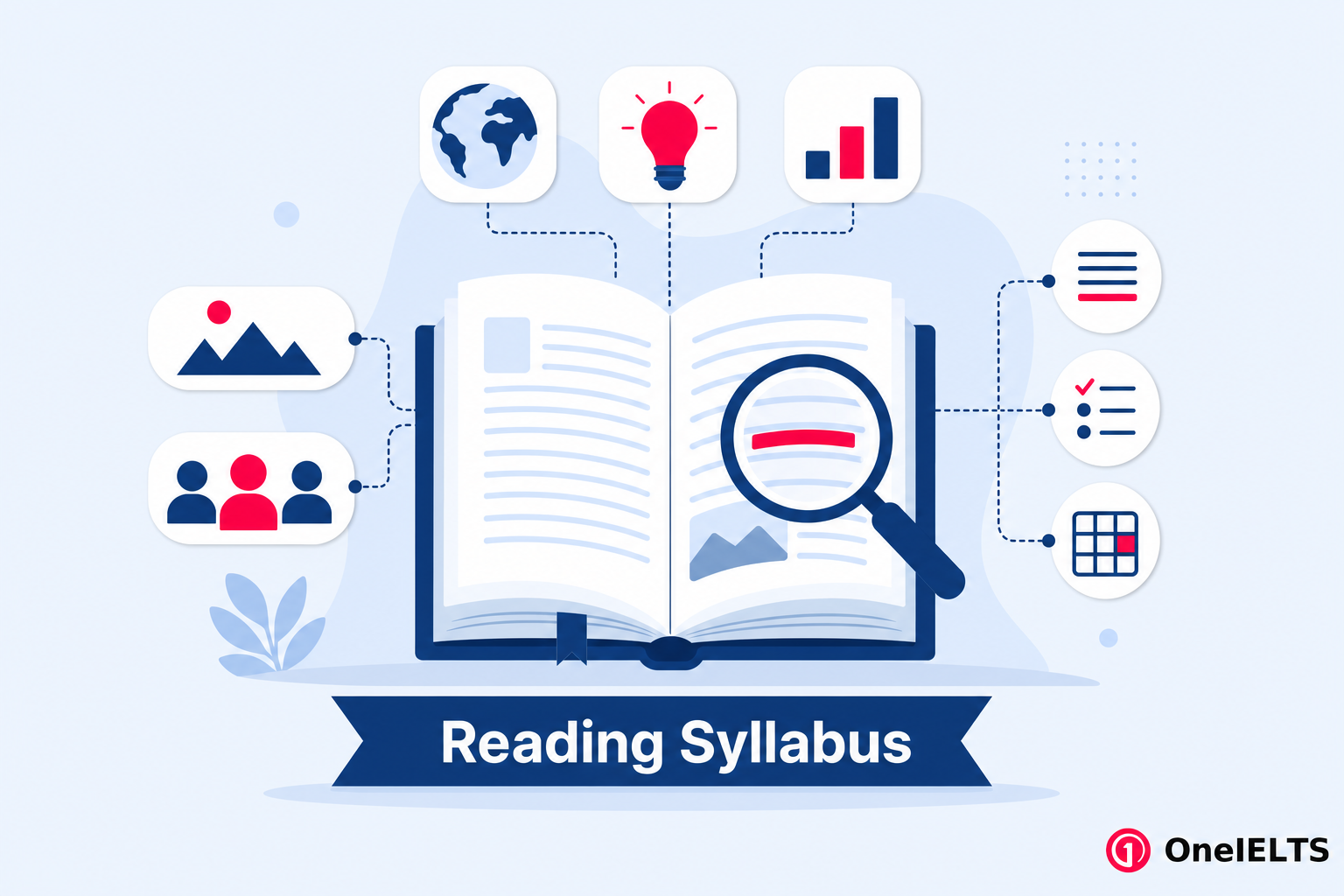
Reading runs the same length for both versions but draws on different text sources, compared in the table below.
| Aspect | Academic | General Training |
|---|---|---|
| Text sources | Journal and research articles | Notices, adverts, workplace texts, one long passage |
| Passages | 3 passages | 3 passages |
| Questions | 40 questions | 40 questions |
| Time | 60 minutes | 60 minutes |
Both versions share the same question types. You meet True False Not Given, matching headings, sentence completion and short-answer tasks across all three passages. The difference is the academic vs everyday texts split: Academic pulls from journals and research, while General Training uses signs, adverts, staff notices and one longer general-interest passage.
The questions are designed to test four reading sub-skills. You use skimming for a passage’s gist and scanning for one specific detail. You then need detailed reading of the lines around an answer, plus vocabulary judgement when a synonym hides the match. General Training rises in difficulty across the three passages, and there is no transfer time, so every answer must be on the sheet inside the hour.
The True False Not Given task is where candidates lose the most marks. The trap is the gap between False and Not Given: False means the passage contradicts the statement, while Not Given means it never addresses the point at all. Picking False when the text is merely silent is the most common error in Reading, and it is rarely a vocabulary problem.
Matching headings is the second big drain. The headings are deliberately close in meaning, so the task tests whether you can tell a paragraph’s main idea from a supporting detail. Reading the first and last sentence of each paragraph and ignoring the rest is the habit that breaks this task; the main idea often sits in the middle.
Pacing across three passages decides the band as much as comprehension does. Spending 25 minutes on the first passage leaves too little for the last, where the hardest questions and densest text sit. Aim for roughly 20 minutes each, mark anything you are unsure of, and move on rather than stalling on a single stubborn answer.
What Is the IELTS Writing Syllabus?
The Writing syllabus sets Task 1 and Task 2 for every candidate, with only Task 1 changing by version, as the table shows.
| Task | Academic | General Training | Words / Time |
|---|---|---|---|
| Task 1 | Describe a chart, graph or process | Write a letter | 150 words / 20 minutes |
| Task 2 | Essay | Essay | 250 words / 40 minutes |
The Academic Task 1 asks you to describe a visual – a bar chart, a line graph, a table, a process diagram or a map – in your own words. The General Training Task 1 is a letter, which may be formal, semi-formal or informal depending on who you write to. This chart or process vs letter split is the only place Writing differs by version.
You write the same essay both versions face in Task 2. You respond to an opinion or argument prompt and build a position across four or five paragraphs. The 150 words and 250 words are minimums, not targets, and writing under them costs you marks before the examiner even weighs your ideas.
Examiners mark both tasks on the abilities the rubric names. They judge task response and coherence and cohesion in how you order and link ideas. They also weigh lexical resource in your vocabulary and grammatical range in your sentence control. The essay is Task 2 weighted double, so spend about 20 minutes on Task 1 and 40 on Task 2.
The single most common way to lose half a band is drifting off the prompt in Task 2. A prompt asking whether you agree wants a clear position held to the end, not a balanced survey that never commits. Likewise an Academic Task 1 wants the key trends selected and compared, not every data point listed. Strong grammar cannot rescue an answer that quietly answered a different question, which is why reading the prompt twice before writing is worth the thirty seconds it costs.
What Is the IELTS Speaking Syllabus?
The Speaking module is a face-to-face examiner interview that runs 11-14 minutes and stays identical for Academic and General Training. It tests how you handle spoken English across three rising levels of demand.
The three parts and what each one tests are set out here.
- Part 1 – introduction and familiar topics. The examiner asks 4-5 minutes of questions about home, work, studies and interests, easing you in and checking you can give clear, natural answers about everyday life.
- Part 2 – the cue card. You get a topic card with 1 minute preparation, then speak for up to 2 minutes on it, followed by one or two short follow-up questions that round off the long turn.
- Part 3 – discussion. The examiner asks 4-5 minutes of more abstract topics linked to the Part 2 theme, pushing you to explain, compare and justify opinions rather than just describe.
Across all three parts the examiner scores the same four abilities. These are fluency in how smoothly you keep talking and lexical resource in the words you reach for. They also include pronunciation in how clearly you are understood and grammatical range in the structures you control. There is no fixed question count, because Speaking measures how you talk, not how many answers you tick.
Each criterion carries equal weight, so a fluent speaker with a narrow vocabulary scores no higher than a precise speaker who hesitates. Part 2 is where range shows most, because two minutes of unbroken speech exposes whether you can develop a point or only start one. Candidates often rehearse Part 1 answers and then freeze in Part 3, where the abstract questions cannot be memorised in advance and a pre-learned speech is obvious to the examiner.
The interview is also a conversation, not a recital. Padding with memorised phrases, speaking too fast to sound fluent, or giving one-word answers in Part 1 all cost marks. The examiner is listening for natural development of ideas, so a short pause to think reads better than a rehearsed block that does not fit the question.
What Topics and Question Types Appear in the IELTS Syllabus?
IELTS has no fixed topic list. Instead, each module reuses a fixed family of question types that repeat across versions, so you drill the formats rather than memorise subjects.
The table below maps the common topic themes and question-type families across the four modules.
| Module | Common topic themes | Question-type families |
|---|---|---|
| Listening | Everyday and study settings | Multiple choice, form and note completion, matching, map labelling |
| Reading | Academic or workplace texts | True/False/Not Given, matching headings, sentence completion |
| Writing | Chart or process, or a letter, plus an essay | Data description or letter, opinion or argument essay |
| Speaking | Familiar and abstract themes | Short answers, cue-card monologue, discussion |
The common topic themes are predictable in kind, not in detail. Listening leans on travel, study and daily admin. Reading covers science, history and social trends in Academic, and signs and workplace notices in General Training. Speaking moves from your own life to broad social questions about education, technology and the environment.
This is why preparation works the way it does. You cannot guess the exact passage or cue card, but you can master every question type that will frame it. Once a matching-headings task or a Task 1 chart feels automatic, the unfamiliar topic in front of you is the only new thing to process on the day. For a deeper task-by-task list, see the IELTS Listening question types guide.
What English Skills Does the IELTS Syllabus Test?
The syllabus tests cognitive sub-skills, not memorised content, and each one maps to specific modules. This is the real reason there is no topic list to revise.
The core sub-skills the test measures are mapped to their modules below.
- Skimming and scanning (Reading) – reading fast for gist, then hunting a passage for one specific detail or number without reading every word.
- Gist and detail listening (Listening) – catching the gist while also pinning down an exact word, name or figure as the audio plays once.
- Paraphrase recognition (Listening and Reading) – spotting that a reworded answer matches the question, since IELTS rarely repeats the prompt’s exact words.
- Coherence and cohesion (Writing) – organising ideas into logical paragraphs and linking them so a reader follows your argument without effort.
- Lexical range (Writing and Speaking) – choosing precise, varied vocabulary instead of repeating a handful of common words.
- Fluency and pronunciation (Speaking) – speaking with fluency at a natural pace while staying clear enough to be understood throughout.
These skills transfer across topics, which is exactly why the test rewards practice over cramming. Strengthen the sub-skill and you cope with whatever subject appears on the day, whether the Reading passage is about glaciers or the cue card asks about a memorable journey. It also explains why a strong reader in their own language still has to train scanning under time pressure: the skill is familiar, but doing it against a 60-minute clock is not.
How Is the IELTS Band Score Calculated From the Syllabus?
Each module is scored on the nine-band scale from 0 to 9. You get a band per module, and the rounded overall band averages the four. The British Council, IDP and Cambridge all use the same scale, so a band means the same thing wherever you sit.
Listening and Reading work from a raw mark out of 40. Each correct answer earns one mark, and a fixed conversion turns your raw total into a band. Writing and Speaking are marked by certified examiners against published criteria rather than counted right or wrong.
Half-band rounding applies to the overall score. An average ending in .25 rounds up to the next half-band, and one ending in .75 rounds up to the next whole band. So a 6.5, 7.0, 7.0, 7.0 set averages 6.875 and rounds to 7.0.
IELTS has no pass mark. There is no pass-or-fail result; you receive a band and each institution or visa route sets its own cut-off. A 6.5 clears one university and falls short at another. Because institutions set cut-offs, “good enough” depends entirely on your goal. Confirm the band your destination demands against the IELTS band score scale before you set a target.
How Does the IELTS Syllabus Map to CEFR Levels?
The CEFR levels A1 A2 B1 B2 C1 C2 describe a six-level scale of language ability used widely across Europe and beyond. IELTS bands map roughly onto them, so a band can be read as a CEFR level when a requirement is written that way.
The rough band mapping runs from low to high. Bands around 4.0-5.0 sit at B1, 5.5-6.5 sit at B2, and 7.0-8.0 reach C1, so the jump from B2 and C1 is the one most university applicants care about. Bands of 8.5-9.0 land at C2, while IELTS Life Skills is reported directly at A1, A2 or B1 rather than as a numeric band.
The mapping matters because some universities and visa routes state their requirement in CEFR levels, not bands. A course asking for B2 is asking for roughly a 5.5-6.5 overall. Knowing the link lets you read a CEFR requirement and set the right band target. For the full conversion, see the IELTS vs CEFR comparison.
Has the IELTS Syllabus Changed for 2026?
No – the IELTS syllabus, modules and question types are unchanged for 2026 and the same as previous years. The content, the four modules and the band scale stay the same year on year, so older study material still describes the test you will sit.
That stable format helps candidates. A practice book or mock from a couple of years ago still matches today’s test, and skills you built earlier still apply. You are not chasing a moving target.
The one thing shifting is delivery, not content. With paper-based phased out at many centres, computer testing is taking over while the syllabus itself does not move. Reflect this when you plan: the questions and skills are identical, but the way you sit the test is increasingly on a computer. Paper-based IELTS is being withdrawn from mid-2026, with the exact phase-out dates staggered by market and a “Writing on Paper” option remaining in some markets, so check your local centre before booking.
How Should You Study the IELTS Syllabus?
Learn the format first, choose Academic or General Training, then work module by module with timed practice. A plan built around the syllabus beats scattered revision, because you target the question types rather than guessing topics.
The steps that cover the syllabus efficiently are listed here.
- Learn the format and question types first so you recognise every task on sight and never waste exam time decoding what a question wants.
- Diagnose your weakest module early with one full mock, since the band you lose most often is the one worth the most focused hours.
- Rotate timed practice across all four modules each week so Listening, Reading, Writing and Speaking all reach your target band together.
- Spend more time on the version-specific parts – Academic Task 1 or General Training letters and reading – because the shared modules need less re-learning.
- Sit full timed mocks under exam conditions in the final weeks to build pacing and stamina across the back-to-back block.
- Download a current, dated syllabus PDF from an official or reputable source and use it as your checklist of question types and timings.
Build a structured IELTS study plan around these steps so each module gets the hours it actually needs.
Can You Take the IELTS Syllabus on Computer or Paper?
Yes – the same syllabus and bands apply whether you sit IELTS on computer or paper. Only the delivery differs. The questions, the modules, the timing and the nine-band scale stay identical across both, so your preparation does not change with the format.
Computer-delivered IELTS is now the default at most centres. You answer on-screen modules for Listening, Reading and Writing, then sit an in-person Speaking interview with a certified examiner. The computer route removes the transfer window in Listening and delivers faster results – often within days rather than the longer paper turnaround.
The screen gives you useful tools. You get a live word count in Writing, a highlighter for marking text, and copy and paste to move sentences while you draft. Paper-based IELTS is being phased out at many centres, so this guide reflects the paper phased out shift without pushing paper as the route to choose. Paper-based IELTS is being withdrawn from mid-2026, with the dates staggered by market, though a “Writing on Paper” option remains in some markets. For the full delivery comparison, see the computer-based IELTS guide.
Does IELTS Have Set Subjects or Topics to Memorise?
No – IELTS has no traditional academic subjects like maths or science; it tests the four English skills through a fixed format, so you revise question types and timing, not facts. With no set subjects and no facts to memorise, there is nothing to learn by heart the way you would for a content exam.
Because there is no subject list, you cannot memorise answers in advance. What you can do is rehearse the recurring question types across the four modules until each feels automatic, so the unfamiliar passage in front of you is the only thing you have to read fresh.
The topics in passages and prompts vary widely by design. Listening drops you into travel, study and admin scenes; Reading ranges across science, history and workplace notices; Speaking moves from your own life to broad social questions. That spread exists precisely so no fixed body of knowledge is required – only the English to handle whatever appears. See how the modules fit together on the IELTS format page.
How Does the IELTS Syllabus Differ for Academic and General Training?
The two versions share most of the test and split in just two modules. Listening and Speaking are identical for both, and only Reading and Writing change. That single fact decides almost everything about which version you prepare for and how you study.
The concrete differences are set out here, then the three sections below go deeper into each path.
- Identical Listening and Speaking – both versions sit the same four recordings and the same three-part interview, scored the same way.
- Academic vs everyday reading – Academic uses scholarly journal and research texts, while General Training uses everyday and workplace texts such as notices and adverts.
- Data task vs letter – Academic sets a data-description Writing Task 1 on a chart or process, while General Training sets a letter; the Task 2 essay is the same for both.
- Study vs migration – Academic targets university study and professional registration, while General Training targets migration and work.
What Is the IELTS Academic Syllabus?
The Academic syllabus keeps the shared Listening and Speaking but adds journal-style passages and a data description Task 1. It is built for university entry and professional registration, where you must cope with the dense, formal English of degree-level study.
The Reading draws on research articles and academic journals, so the journal-style passages run well above everyday text in vocabulary and sentence length. The data description Task 1 hands you a visual to report: a bar chart, a line graph, a table, a process diagram or a map. You select the key trends and describe them accurately in 150 words.
If you are heading to a university or a professional body, this is the version to study. Confirm the exact requirement on the IELTS Academic page before you book.
What Is the IELTS General Training Syllabus?
The General Training syllabus uses the same Listening and Speaking as Academic, but everyday workplace texts in Reading and a letter writing Task 1. It suits migration and work applicants rather than university study, so the English reflects daily and working life.
The Reading material is the kind you meet outside a classroom: notices, adverts, timetables and staff handbooks, plus a longer general-interest article. The letter writing Task 1 asks for a formal, semi-formal or informal letter – complaining to a landlord, asking a manager for time off, or writing to a friend.
If your goal is a work visa or permanent residence, General Training is your version. Check the receiving body’s requirement on the IELTS General Training page first.
Which IELTS Syllabus Should You Follow?
Follow the version your destination accepts – Academic for study and most professional registration, General Training for migration and work. The decision is not about which version feels easier; it is about which result your receiving body will accept.
Which version you need is set by your goal, not your preference. Check before booking, because sitting the wrong version means paying and resitting. A university almost always wants Academic, while an immigration route usually names General Training, but the only safe source is the body’s own published rule.
The good news is that Listening and Speaking preparation transfers either way, so only your Reading and Writing practice changes with the choice. Compare the two paths in detail on the IELTS Academic vs General Training guide before you decide.
Practice for the Real IELTS Exam
Apply what you’ve learned with free, exam-style practice:
- Take a full IELTS mock test
- Practice by section: Listening, Reading, Writing, Speaking
- Structure your essays with IELTS Writing templates