The fastest way to lift your IELTS band is to diagnose your weakest skill first, then drill it – sequence beats raw effort, because your overall band is an average of four scores. These ten IELTS tips run in the order you should work through them, from learning the format through timed practice to staying calm on test day. The numbered preparation tips are set out here, with section-wise advice afterwards.
- Know the test format
- Take a diagnostic mock
- Build a study plan
- Read and listen to English daily
- Practise timed sections
- Learn the band descriptors
- Expand topic vocabulary
- Record and review your speaking
- Master skimming and scanning
- Stay calm on test day
1. Know the IELTS Test Format
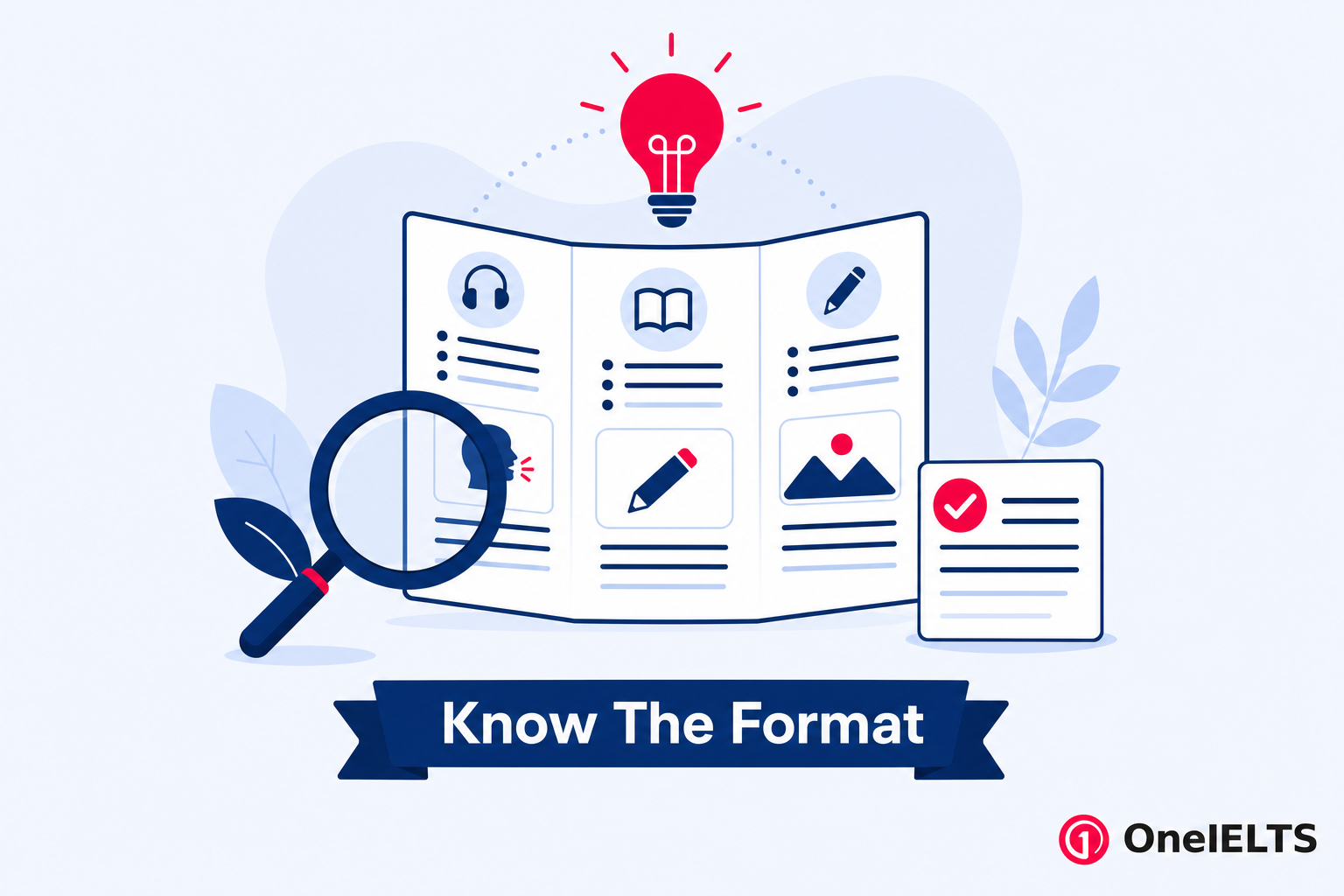
Knowing the format before you study stops the test from surprising you on the day. IELTS has four sections – Listening, Reading, Writing and Speaking – each on a fixed timing you should rehearse until it feels automatic. Once you know the timing and the question types, you spend test time answering rather than decoding instructions. Sit one full test early so you map the four sections end to end before any other habit.
2. Take a Diagnostic Mock Test
A first timed mock gives you a baseline score and shows your weakest skill in one sitting. Sit a full paper under exam conditions, mark it honestly, and write down the band you hit in each of the four skills. That baseline tells you which skill is dragging your average down, so you drill the right thing instead of revising what you already do well. Run the timed mock before you build your study plan, not after.
3. Build a Realistic Study Plan
Build your study plan around the band gap between your diagnostic score and your target, anchored to your test date. Count the weeks you have, then set a weekly schedule that gives the most hours to your weakest skill and keeps the others ticking over. A plan tied to a real test date forces steady work and stops last-minute cramming. Block fixed study slots into your week so the schedule survives a busy day.
4. Immerse in English Daily
Daily contact with English builds the fluency that timed practice alone cannot. Read English news for fifteen minutes, play podcasts on your commute, and do some daily speaking – even narrating your day out loud counts. This habit feeds Reading and Listening directly and trains your ear for the accents the test uses. Pick material on topics the test favours, such as education, environment and technology, so the input doubles as topic revision.
5. Practise Under Timed Conditions
Timed practice builds the speed and stamina the real test demands across nearly three hours. Untimed practice teaches accuracy, but only working against the clock trains the time management a live section under exam pressure demands. Set a timer for every section you practise, and finish even when it hurts, because stamina is what fails candidates in the final Reading passage. Add one full-length timed run a week as your test date nears.
6. Study the Band Descriptors
The band descriptors tell you exactly what examiners reward, so you study them to write and speak for the score you want. Read the public Writing and Speaking descriptors and mark the gap between band 7 vs 8 on each criterion. Knowing that examiners reward range, accuracy and coherence lets you aim your practice at the examiner criteria instead of guessing. Mark one of your own answers against the descriptors to see where you actually sit.
7. Expand Topic Vocabulary
Strong topic vocabulary lifts your lexical resource score in both Writing and Speaking. Learn words by theme – health, education, environment – and store them as collocations rather than single words, because examiners reward natural word partnerships. Keep a running list of the phrases that fit common essay prompts, and use each new collocation in a sentence the same day. Recycle the words across practice answers until they surface without effort.
8. Record and Review Your Speaking
Record speaking answers on your phone, then play them back to catch the fluency and pronunciation issues you cannot hear while talking. A phone recording exposes the fillers, the flat intonation and the mispronounced words a live answer hides. Listen back against the Speaking descriptors and note one fluency fix and one pronunciation fix per recording. Re-record the same question until both improve, because progress you can hear keeps you practising.
9. Master Skimming and Scanning
Skimming and scanning are the two reading techniques that save you the most time in the Reading test. You skim a passage for its gist, then scan for the keywords that match each question, instead of reading every line in order. These techniques convert the hardest constraint in Reading – the clock – into a manageable one. Practise locating the keywords from a question in under twenty seconds, because that speed is what clears the third passage.
10. Stay Calm on Test Day
A steady test-day routine cuts the avoidable errors that nerves cause. Sleep well, arrive early, and time each section the way you rehearsed so the clock holds no surprises. To manage nerves, breathe slowly before Listening starts and read each instruction once rather than racing it. Candidates most often lose marks here not from weak English but from careless transfer errors and misread instructions, so slow down in the final two minutes of each section to avoid careless errors.
What Are the Section-Wise IELTS Tips?
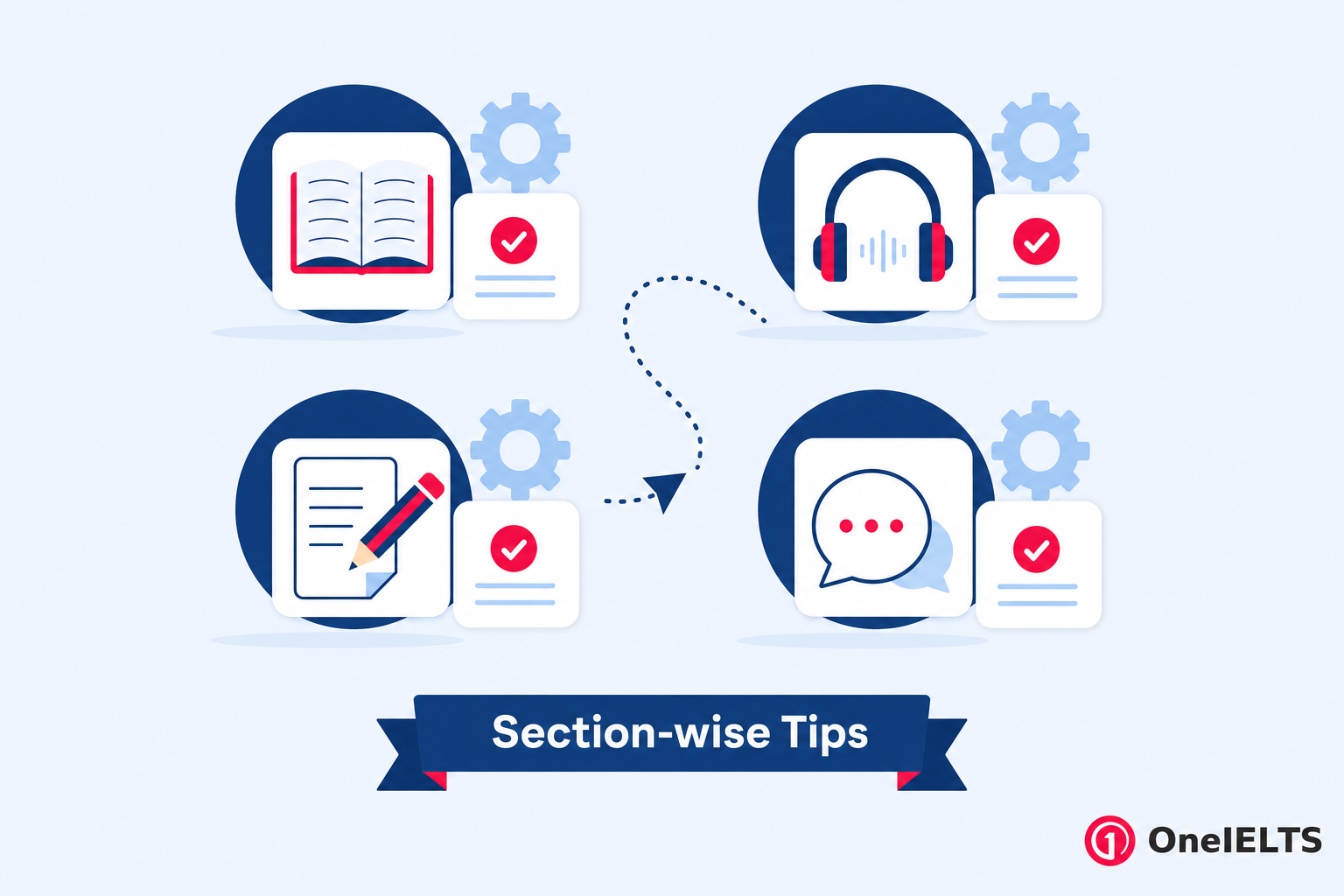
Each of the four skills rewards a different habit, so the per-section advice below targets the specific move that lifts that section’s score. Master one technique per skill rather than spreading your effort thin. The four section-specific tips that matter most are set out here.
- Listening read-ahead. Use the gaps between recordings to read ahead to the next questions, so you know what to listen for and catch the answer the moment it is spoken.
- Reading skim-scan. Skim each passage for its overall meaning first, then scan for keywords that match each question, which protects you from running out of time on the final text.
- Writing plan first. Spend five minutes to plan first before you write Task 2, mapping your two main points, because a planned essay scores higher on coherence than a longer unplanned one.
- Speaking extend answers. Extend answers in Part 1 with a reason or example rather than stopping at a single line, because the examiner needs enough speech to score your range and fluency.
How Many Days Do You Need to Prepare for IELTS?
It depends on your band gap, but most candidates need a few weeks to a few months of focused work, a span of weeks to months set by your target. A half-band gap might take three to four weeks; a one-to-two band gap usually needs two to three months of daily practice. Sit a diagnostic mock first, because that score sets the realistic timeline. Map those weeks against your test date in our IELTS study plan guide.
Which IELTS Tip Improves Your Score the Most?
Targeting your weakest skill gives the biggest overall gain, because the band is an average of four scores and your lowest one drags the mean down hardest. Lifting a 5.5 to 6.5 in your weakest skill is the single biggest gain available – more than polishing a skill you already pass. Pair that focus with band-descriptor study to raise the weak skill against the criteria examiners mark. See how each half-band is calculated in our IELTS band score guide.
Practice for the Real IELTS Exam
Apply what you’ve learned with free, exam-style practice:
- Take a full IELTS mock test
- Practice by section: Listening, Reading, Writing, Speaking
- Structure your essays with IELTS Writing templates