Sitting the IELTS exam means working through four sections — Listening, Reading, Writing and Speaking — in a single block of about 2 hours 45 minutes, then reporting one set of band scores. That structure is the IELTS exam format: four skills tested separately, each marked on the same 0–9 band scale, with Academic vs General sharing two sections and differing on the other two. One quirk shapes your planning: the first three sections run back-to-back, but the Speaking interview can fall up to 7 days before or after, so “test day” is really two appointments. This guide walks through the four sections, the timing, the question types, how scoring works, and where Academic and General Training diverge.
What Are the Sections of the IELTS Exam Format?
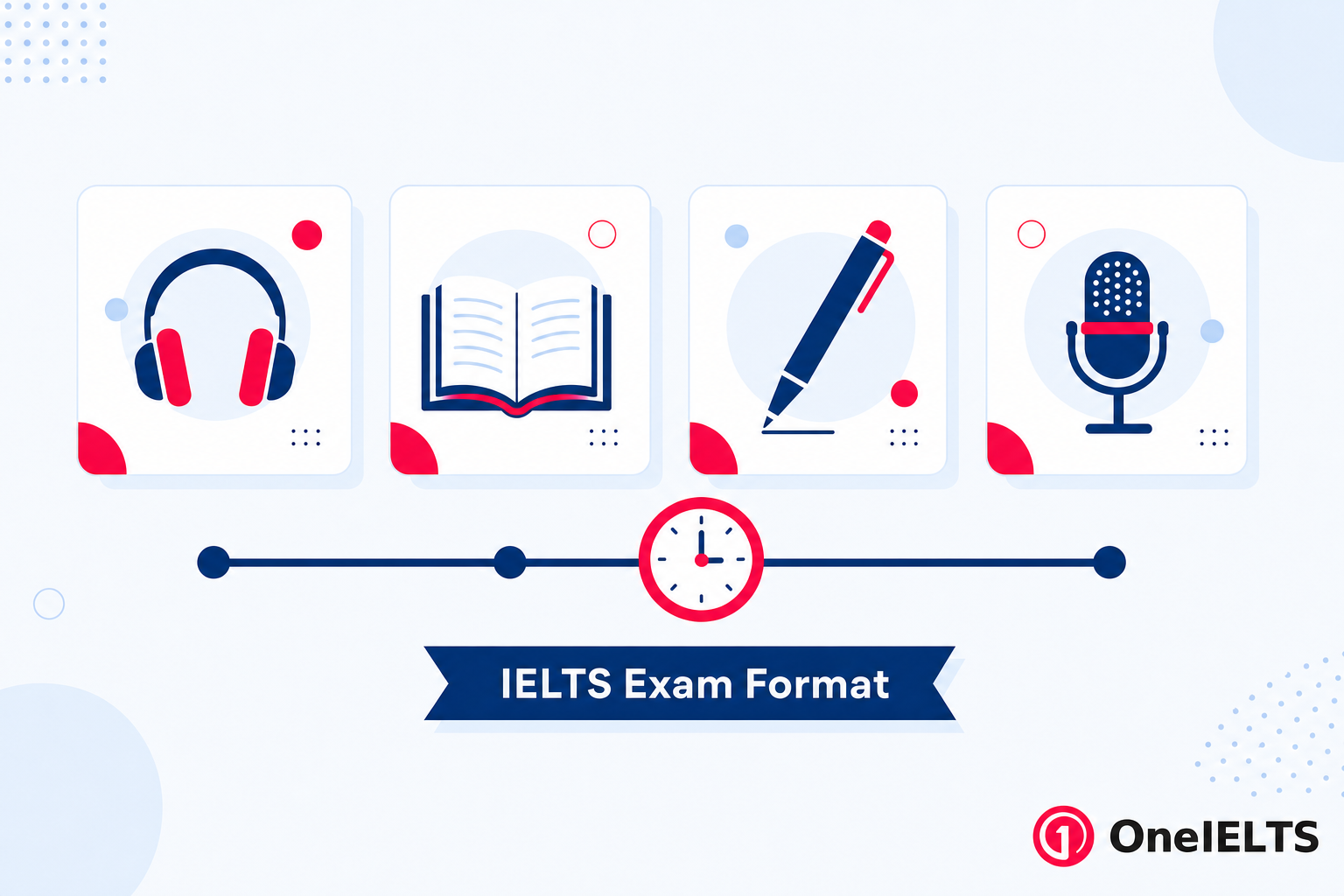
IELTS has four sections — Listening, Reading, Writing and Speaking, taken in one ~2h45m sitting, with Speaking up to 7 days before or after. The British Council, IDP and Cambridge English run all four to a fixed length, so you can rehearse the exact timing. Each skill carries its own question count and clock, set out here with the minutes you get for each.
- Listening — 40 questions, 30 minutes. You hear four recordings once and answer as they play, then transfer your responses.
- Reading — 40 questions, 60 minutes. Three passages with no extra transfer time, so you write answers straight onto the sheet.
- Writing — 2 tasks, 60 minutes. A shorter Task 1 and a longer essay, with the timing split roughly 20 and 40 minutes.
- Speaking — 3 parts, 11–14 minutes. A face-to-face interview with an examiner, covering an introduction, a long turn, and a discussion.
What Question Types Are in the IELTS Format?
The IELTS format reuses a small set of question types across the four sections, so once you know the formats you meet few surprises on test day. Listening and Reading lean on objective formats marked right or wrong; Writing and Speaking ask you to produce language an examiner judges. The recurring question types are set out below.
- Multiple choice. You pick the correct option from a list, common in both Listening and Reading.
- Matching. You link items — headings to paragraphs, or speakers to opinions — across Listening and Reading.
- Map labelling. A Listening task where you mark places or directions on a plan or diagram.
- Essay task. Writing Task 2 asks for a 250-word argument or discussion essay on a given prompt.
- Describe a graph. Academic Writing Task 1 asks you to summarise a chart, table or process in 150 words.
How Is the IELTS Test Format Scored?
Each of the four sections is scored on the 0-9 scale, and your overall band is the average of the four, rounded to the nearest half-band. So Listening 6.5, Reading 6.5, Writing 6.0 and Speaking 7.0 average 6.5 overall. The band score reports proficiency, not a pass mark, which is why institutions set their own minimums. Listening and Reading convert a raw mark out of 40 into a band using a fixed table.
Writing and Speaking work differently. Trained examiners mark them against published band descriptors, scoring four criteria per skill — for Writing, task response, coherence, lexical resource and grammatical range. Half-band rounding then applies, so a 6.25 average rounds up to 6.5 while a 6.125 rounds to 6.0.
How Does the Academic Format Differ From General Training?
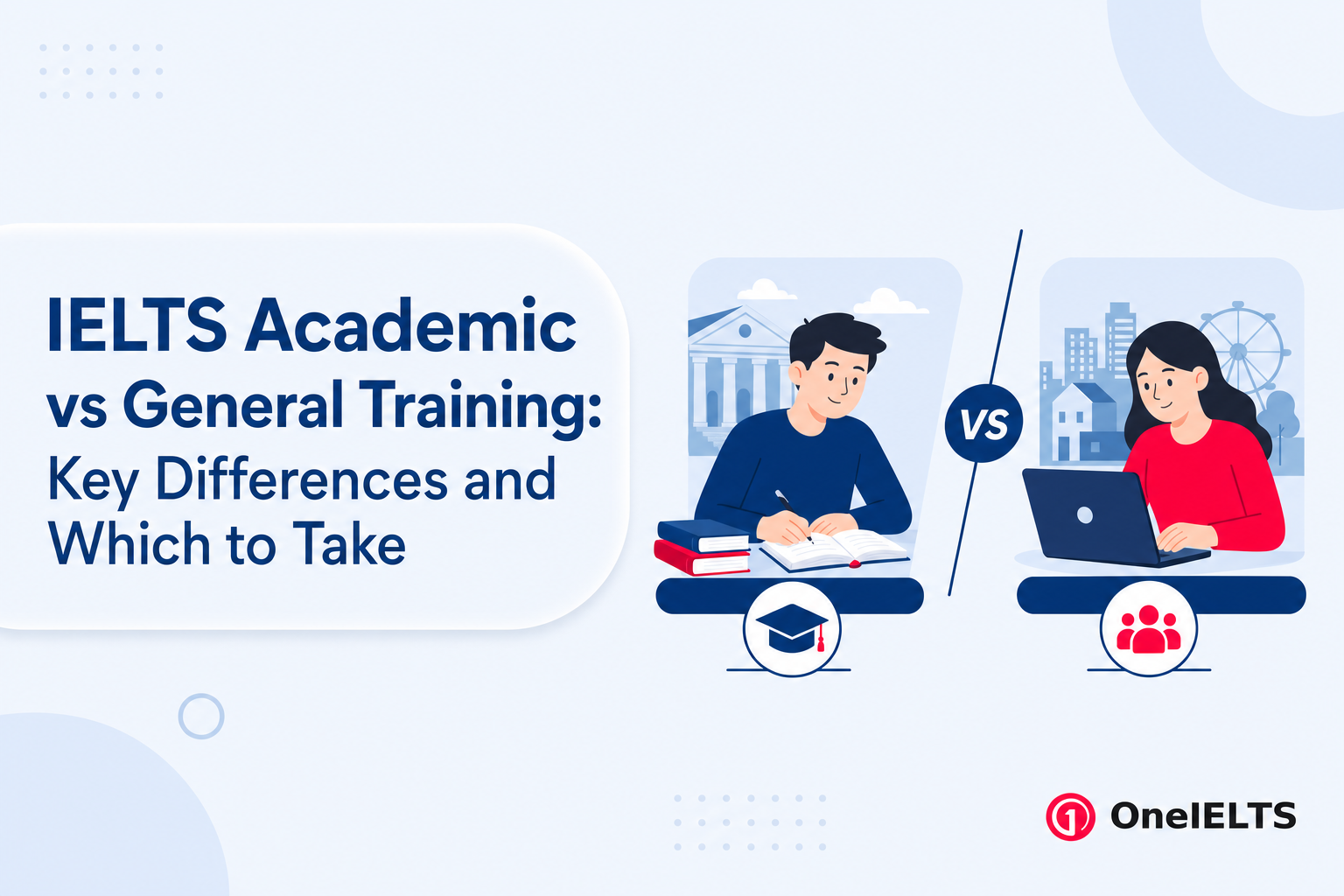
Listening and Speaking are identical across both versions; only Reading and Writing differ between Academic and General Training. Academic suits university entry, while General Training suits work and migration routes, and the split shows up in the texts you read and the first thing you write. The section-by-section comparison is set out in the table.
| Section | Academic | General Training |
|---|---|---|
| Listening | Same four recordings, 40 questions, 30 minutes | Same four recordings, 40 questions, 30 minutes |
| Reading | Three academic passages from journals and books | Workplace notices, adverts and a longer general text |
| Writing | Task 1 asks you to describe a graph, chart or process | Task 1 asks you to write a letter for a given situation |
| Speaking | Same three-part interview, 11–14 minutes | Same three-part interview, 11–14 minutes |
The Reading difference sits in the source material, and the Writing Task 1 difference decides whether you describe data or write a letter.
How Long Is the IELTS Exam Format?
The IELTS exam takes about 2 hours 45 minutes for Listening, Reading and Writing, plus a separate Speaking test of 11–14 minutes. Those first three sections run consecutively with no break, which sets the test duration you sit in one go.
Keep the Speaking separate appointment in mind: it can be scheduled on a different day, either up to 7 days before or after the other three. So plan for two slots, and check which date your test centre assigns when you book.
Why Is Knowing the IELTS Format Important for Your Score?
Knowing the format lifts your band because you spend test day applying skills rather than decoding instructions, and that saved attention converts directly into marks. Candidates most often lose half a band in Reading by mismanaging the 60 minutes — there is no transfer time, so a slow start in passage one cuts into passage three. The main reasons format knowledge raises your score are set out here.
- Format familiarity removes surprise, so you recognise each task type the moment it appears and start answering sooner.
- Time management improves when you know each section’s clock, letting you pace 40 Reading questions across the hour.
- Question strategy sharpens, because you can match a tactic — skimming, keyword scanning — to each known question type.
- Band improvement follows, since saved time and fewer mistakes on familiar tasks push your average up half a band or more.
Is the IELTS Format the Same for Computer and Paper?
Yes, the format and scoring are identical on computer and paper — the same four sections, question counts, timing and 0–9 bands apply either way, an identical format on both. Only the input method and results speed differ: the computer delivered test asks you to type and click, while the paper based test uses a pen and answer sheet. Computer results arrive in 3–5 days against about 13 for paper, a gap that matters near a deadline; our IELTS on computer guide covers this in full. Note that paper based IELTS is being phased out at many centres through 2026, so check availability before you book.
Written by Jamil Ahmed, reviewed 30 June 2026. Last verified: 30 June 2026
Practice for the Real IELTS Exam
Apply what you’ve learned with free, exam-style practice:
- Take a full IELTS mock test
- Practice by section: Listening, Reading, Writing, Speaking
- Structure your essays with IELTS Writing templates