The right IELTS study plan is the one that closes your band gap, not the one that fits a calendar. Start with a diagnostic mock to fix your baseline. Then measure the distance to your target band and pick the schedule that matches it. A small gap needs roughly a month, a moderate gap two months, and a weak base three months.
This guide covers how long a plan should be. It then lays out a 1-week, 1-month, 2-month and 3-month schedule day by day, and finishes with how to personalise the weekly schedule to your own weak skill, daily time and test date.
Last verified: 30 June 2026
How Long Should Your IELTS Study Plan Be?
Your plan length depends on the gap between your diagnostic score and your target band, not on a fixed number of weeks. A learner sitting at 6.5 who needs 7.0 has a different job from one sitting at 5.0 who needs the same 7.0, so the timeline has to stretch to fit the work.
Take a full diagnostic mock before you commit to anything. The score it gives you is the baseline that sets everything else, and most candidates underestimate the gap until they see a real result under timed conditions.
As a rule of thumb, a half-band gap or less calls for about one month of focused work. A one-band gap is a moderate climb that suits two months. A gap of more than one band, or a shaky foundation in grammar and reading speed, needs the full three months so the early weeks can rebuild the base.
What Does a 1-Week IELTS Study Plan Look Like?
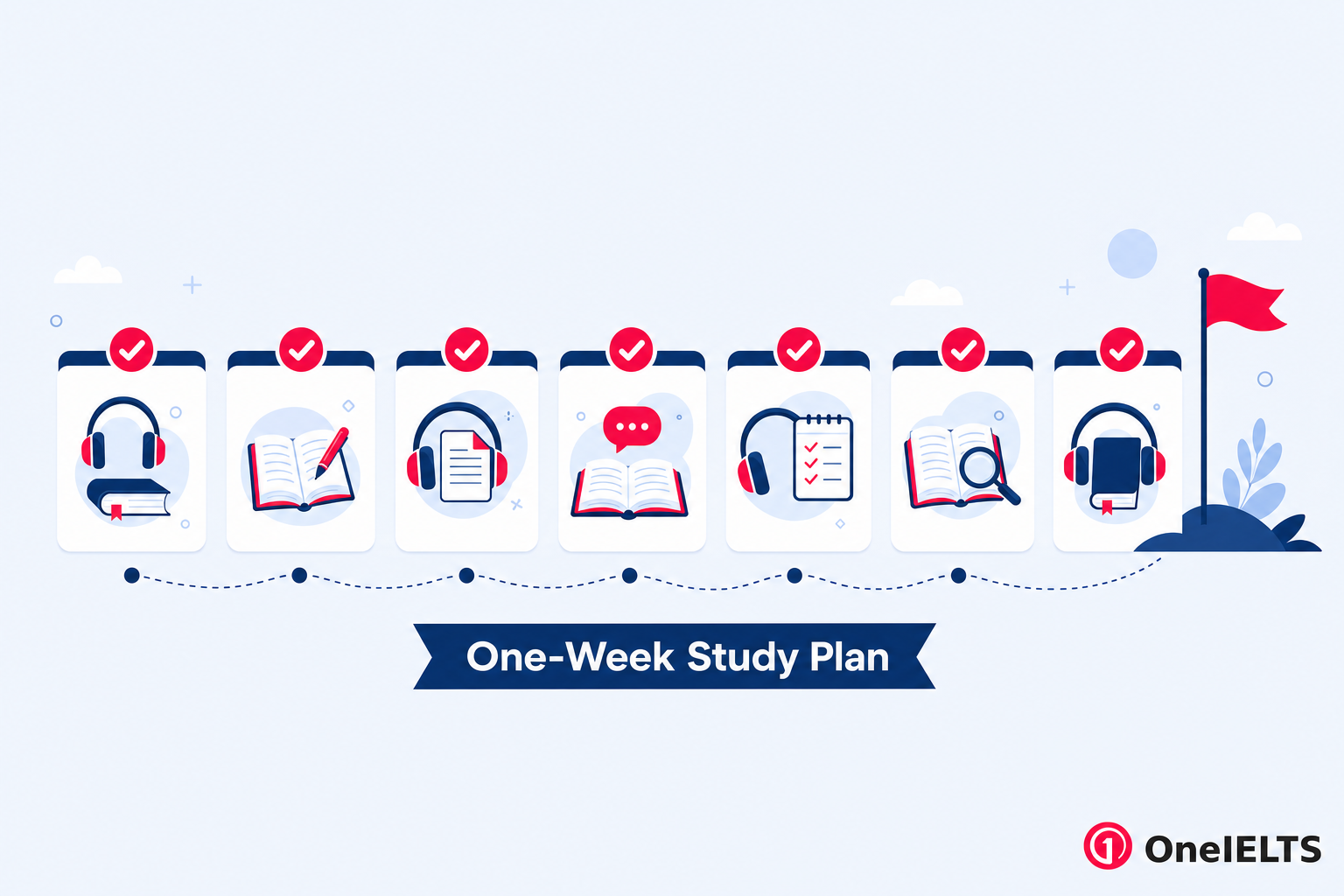
A one-week plan compresses the essentials into seven days and works best when you are already near your target band and need sharpening, not rebuilding. The 7-day breakdown below assigns one skill per day after an opening baseline mock.
| Day | Focus | Tasks |
|---|---|---|
| Day 1 | Know the test + baseline | Learn the format of all four sections; sit a baseline mock to find your weakest area. |
| Day 2 | Listening | Drill section types, practise note completion, and review every wrong answer. |
| Day 3 | Reading | Time three passages, practise skimming and scanning, and log unknown vocabulary. |
| Day 4 | Writing | Write one Task 1 and one Task 2 under time; check structure, task response, and cohesion. |
| Day 5 | Speaking | Record Parts 1, 2 and 3; work on fluency, range, and answering the actual question. |
| Day 6 | Full mock | Sit a complete timed mock across all four skills in one sitting. |
| Day 7 | Review weak areas | Re-attempt your two weakest sections and fix the recurring errors from the mock. |
This near-target band schedule suits a candidate who has sat IELTS before or scores within half a band of the goal; it is too tight to lift a genuinely weak skill from scratch.
What Does a 1-Month IELTS Study Plan Look Like?
The one-month plan runs week by week and is intensive: it cycles through all four skills and builds in two full mocks so you can measure progress mid-way and again at the end. Here is how the four weeks split out, with the daily tasks for each.
| Week | Focus | Daily tasks |
|---|---|---|
| Week 1 | Listening + Reading foundations | Two hours daily; one Listening set and one Reading passage, timed, with full error review. |
| Week 2 | Writing + Speaking foundations | One Task 1 or Task 2 daily; record one Speaking part; study band descriptors for both. |
| Week 3 | Mixed practice + first full mock | Rotate all four skills; sit a complete mock mid-week and analyse every section. |
| Week 4 | Test technique + second full mock | Drill timing and weak sections; sit a final full mock two days before the test. |
What Does a 2-Month IELTS Study Plan Look Like?
The two-month plan spans eight weeks and splits cleanly into a skill-building half and a test-practice half, with weekly mocks layered in once the foundations are solid. The week-by-week structure is laid out below.
| Week | Focus | Daily tasks |
|---|---|---|
| Week 1 | Listening skill building | Daily section drills; learn question types and accent patterns; review all errors. |
| Week 2 | Reading skill building | Build skimming, scanning, and time control across all three passage types. |
| Week 3 | Writing skill building | Study descriptors; write Task 1 and Task 2 on alternate days with feedback. |
| Week 4 | Speaking skill building | Daily recordings of all three parts; expand topic vocabulary and fluency. |
| Week 5 | Mixed practice + weekly mock | Rotate all four skills daily; sit one full mock and analyse it fully. |
| Week 6 | Test practice + weekly mock | Drill under exam timing; sit a weekly mock and target the weakest section. |
| Week 7 | Test practice + weekly mock | Refine technique on writing and speaking; sit another full timed mock. |
| Week 8 | Final review + weekly mock | Light targeted review; sit a final mock three days before the exam. |
What Does a 3-Month IELTS Study Plan Look Like?
The plan that spans three months moves month by month from foundation to fluency to exam simulation, giving a weak base enough runway to rebuild before any test pressure starts. Each month’s focus and goals appear in the table below.
| Month | Focus | Goals |
|---|---|---|
| Month 1 | Foundation | Fix grammar, core vocabulary, and reading speed; learn the format of all four sections. |
| Month 2 | Fluency | Build active output in Writing and Speaking; practise each skill in timed sets weekly. |
| Month 3 | Exam simulation | Sit full mocks under real conditions; refine timing and clear the last recurring errors. |
How Do You Personalise Your IELTS Study Plan?
Personalising your IELTS study plan means adjusting the schedule to your own band gap, weak skill, and time before the test rather than copying a template. Two candidates with the same target band rarely need the same plan, because their starting points and daily hours differ. The factors that should reshape your weekly schedule are listed here, with how each one changes the work.
- Your diagnostic band. The score from your first mock sets the gap to your target band and decides whether you need a one-, two-, or three-month timeline.
- Your weakest skill. Whichever of Listening, Reading, Writing, or Speaking scored lowest earns the most practice days, so the plan front-loads it early.
- Daily time available. Two free hours a day supports an intensive month; one hour means stretching the same content across more weeks to keep quality high.
- Test date. A fixed test date works backwards into your timeline, so the final mock lands two or three days before you sit the real exam.
- Academic vs General Training. Your module changes the Writing Task 1 and Reading content you drill, so the practice materials must match the version you booked.
- Access to a tutor or mocks. A tutor or AI-evaluated mocks add feedback you cannot give yourself, which speeds up Writing and Speaking gains the most.
Can You Prepare for IELTS in Two Weeks?
Yes, a two-week plan is possible if you are already close to your target band and need to sharpen rather than build. A fortnight gives enough room for revision and technique, fixing recurring errors, and getting comfortable with timing under pressure. Being close to target is the condition that makes it work. It is too short to lift a weak skill from scratch, so treat it as a polishing window after broader IELTS preparation, not a substitute for it.
How Many Hours a Day Should You Study for IELTS?
Most candidates study two to three hours a day, scaled to how much time their timeline leaves. A one-month plan leans toward the upper end, while a three-month plan can sit at the lower end and still cover everything. Focused study beats long study: one hour spent analysing why you missed an answer beats three hours of untracked practice, because quality and review move your band more than raw hours.
Which Resources Fit an IELTS Study Plan?
Pair your plan with official Cambridge materials and timed mocks so your practice mirrors the real exam. The Cambridge IELTS books supply authentic past papers, and timed mocks train your pacing for each section. Add section drills for your weakest area. Use AI evaluation on your Writing and Speaking mocks for feedback that turns repeated practice into band gains, and build these into a structured IELTS preparation routine.
Practice for the Real IELTS Exam
Apply what you’ve learned with free, exam-style practice:
- Take a full IELTS mock test
- Practice by section: Listening, Reading, Writing, Speaking
- Structure your essays with IELTS Writing templates