All three IELTS partners publish a passive voice page. Not one of them connects the passive form to the marking, and only two pages in eight warn that overusing it is a problem. Google’s own summary of this search leads with exactly that warning.
The voice decision is made sentence by sentence, and it turns on one question: does the doer matter? Doer omission is the point of the construction, not a side effect of it.
This page covers the form and the past participle, all twelve tenses the exam board drills, when to use it, and overuse. Then the verbs that refuse it, Task 1 process description, natural processes, Task 2, your own opinion, Speaking, and how to practise.
What Is the Passive Voice?
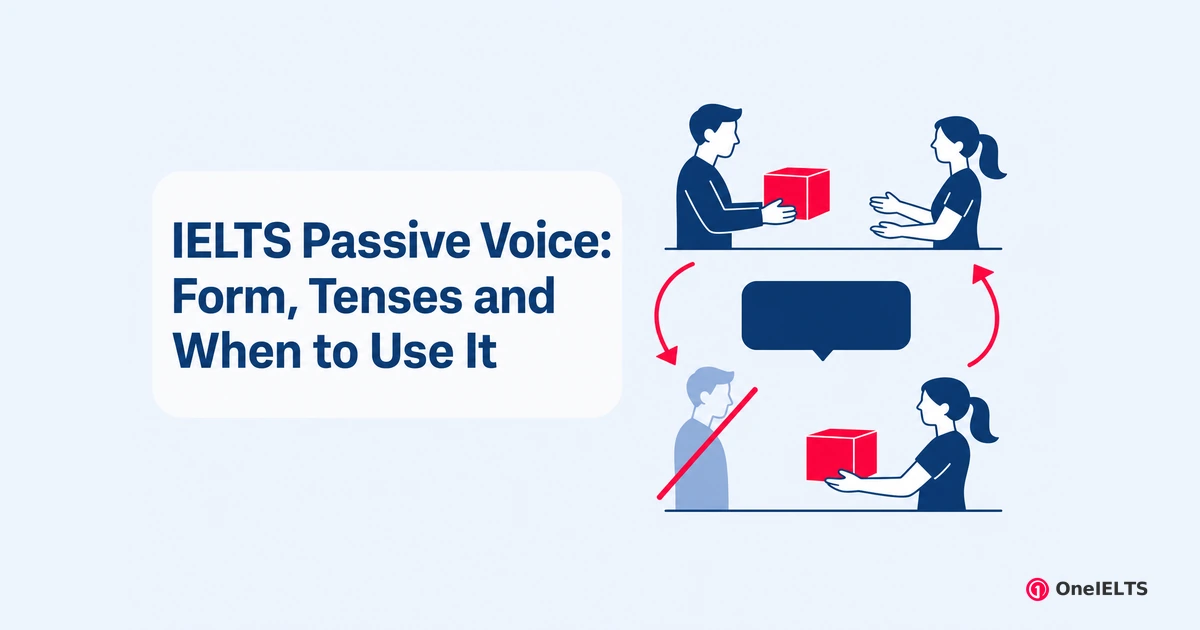
The passive voice puts the thing having something done to it first, and the person doing it second or nowhere. That moved object is the whole construction, and everything else follows from it.
The exam board grounds it on emphasis. The passive is used when we want to emphasise the action and the object of a sentence rather than the subject, which is an emphasis shift rather than a change of meaning.
One pair shows what moved. Active: the council built the library in 1998. Passive: the library was built in 1998. The library has come forward, and the demoted doer has gone entirely.
The board also corrects the commonest misconception about it, unusually crisply. These are not tenses, they are voices. Voice not tense is the distinction, so the tense is unchanged by the switch and only the be part carries it.
Knowing the passive matters for receptive understanding too, not only for producing Writing. Reading passages and Listening scripts use it constantly, and a sentence you cannot unpack is a question you cannot answer.
How Do You Form the Passive Voice?
Take the object, put it first, add the right form of be, and change the verb to its past participle. The tense stays exactly where it was. IELTS Buddy gives the only procedural version in eight pages, in three steps.
- Move the object and make it the subject of the new sentence, which is the object fronting step everything else depends on.
- Add by before the old subject only if you are keeping it, and delete both if you are not.
- Add be in the same tense as the original, so the retained tense sits in the auxiliary, then change the main verb to its past participle.
The exam board gives the one-line formula alongside that procedure: a form of the verb be plus the past participle, used only with verbs that take an object.
One mistake sits second on the AI Overview’s list and appears on no captured page at all. Forgetting the be. Every passive verb needs an auxiliary be, are, was, were, been or being, and a past participle standing on its own is not a passive. A missing auxiliary is a grammar error rather than a stylistic choice.
Coverage is uneven here. The British Council’s page uses the string past participle exactly once and gives no tense table, so a reader landing there gets the concept and not the mechanics.
How Do You Keep the Tense When You Change the Voice?
The tense lives in the be, not in the main verb. Change be to whatever tense the active sentence was in, and the retained tense takes care of itself because the participle never moves.
The exam board puts it as an instruction: to change the tense of the sentence you change the be part.
Two pairs make the tense carrier visible. The present pair: the council maintains the park, and the park is maintained. The past pair: the council maintained the park, and the park was maintained. One word changed in each, and the unchanged participle sat still both times.
That single fact stops the commonest rewrite error, which is switching a whole sentence into the past because was feels passive. Which tense a Task 1 answer needs is settled on the IELTS Writing Task 1 tenses page.
Which Tenses Can the Passive Voice Take?
All of them, plus the infinitive and the -ing form. The exam board drills twelve forms on a single sentence where most pages publish eight, and the table below follows that single sentence drill so you see only the be part changing.
| Form | Passive pattern | Example |
|---|---|---|
| Present simple | is / are + participle | The park is maintained. |
| Present continuous | is / are being + participle | The park is being maintained. |
| Past simple | was / were + participle | The park was maintained. |
| Past continuous | was / were being + participle | The park was being maintained. |
| Present perfect | has / have been + participle | The park has been maintained. |
| Past perfect | had been + participle | The park had been maintained. |
| Going to | is / are going to be + participle | The park is going to be maintained. |
| Will | will be + participle | The park will be maintained. |
| Infinitive | to be + participle | The park needs to be maintained. |
| -ing form | being + participle | The park dislikes being maintained badly. |
| Used to | used to be + participle | The park used to be maintained. |
| Modal passive | should / must / can be + participle | The park should be maintained. |
| Perfect infinitive | to have been + participle | The park seems to have been maintained. |
| Perfect -ing form | having been + participle | Having been maintained, the park reopened. |
The spread across the sources is the justification for printing all of them. The exam board drills twelve forms, IELTS Buddy gives thirteen plus the passive infinitive and passive gerund nobody else covers, IDP and EduBenchmark give eight, and the British Council gives none.
One of those rows earns its place more than the others. The modal passive, should be plus the participle, is the form a Task 2 solution paragraph actually runs on.
When Should You Use the Passive Voice?
Four situations, and one of them is a whole task. Use the passive when the doer is unknown, obvious, irrelevant or general, and avoid it whenever the doer is the point of the sentence.
| Situation | Voice | Why |
|---|---|---|
| The doer is unknown | Passive | Nobody can name who did it, so fronting the receiver is the only honest option. |
| The doer is obvious | Passive | Naming an obvious doer adds words and no information. |
| The action matters more than the doer | Passive | Emphasis on receiver is exactly what the construction is for. |
| People in general | Passive | A general subject avoids the vague they and people. |
| Describing a man-made process | Passive | The stages are the content and the operator is not. |
| Presenting data and trends | Mixed | A passive can front a figure, but trend verbs refuse the construction. |
| Formal or impersonal reporting | Passive | Reporting frames carry a view without attributing it to one named person. |
| Stating your own opinion | Active | The prompt asked what you think, so the sentence needs you in it. |
| Describing your own experience | Active | An experience with no experiencer in it reads as evasion. |
| Emphasising who did something | Active | Fronting the receiver buries the one fact the sentence exists to deliver. |
The avoid half of that table comes from the only structured negative guidance in eight pages. EduBenchmark publishes a when-to-avoid list with three items: stating clear arguments and opinions in a Task 2 essay, describing personal experiences in Speaking, and placing emphasis on the doer.
The use half is close to unanimous. The captured pages publish three, four, four, four, five and five reasons between them, and three of those recur everywhere: an unknown doer, an irrelevant doer, and emphasis on the receiver.
What none of them supplies is a way to choose in the moment. That is what the next two sections are for, and it is why every avoid situation above names the thing you would be hiding.
When Is the Doer Unknown or Unimportant?
Most of the time in a process or a data description, which is why by plus the doer usually gets deleted rather than written.
One page in eight makes default omission the rule and attaches a consequence to it. Do not include by unless you are asked to, because in a conversion exercise adding it will be marked wrong. That is stricter than the exam board, which allows a kept doer in a prepositional phrase whenever the doer is important.
Every by phrase you drop is words back for the content the task is actually marking, and word saving of that kind compounds across a 250-word essay. Concision is its own skill and the concise writing for IELTS page covers it.
One vocabulary note worth having. The standard term for the doer, the agent term, returns zero on six of eight captured pages, so a reader searching it finds almost nothing.
Can You Overuse the Passive Voice?
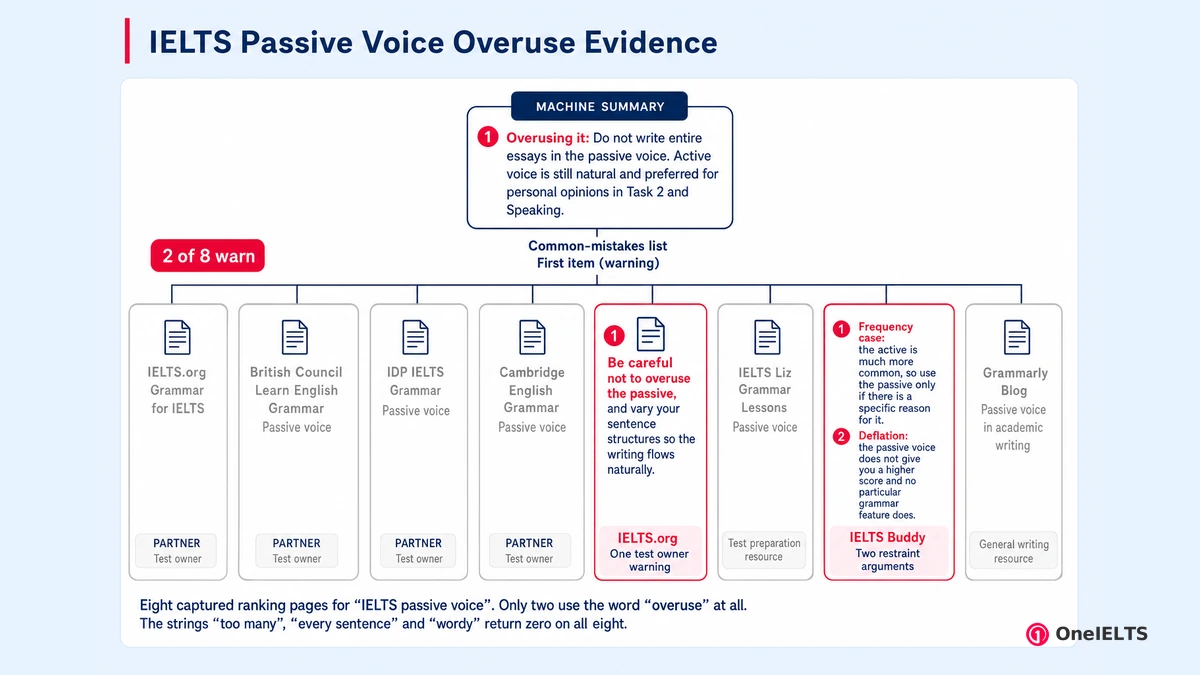
Yes, and it is the commonest way this grammar point backfires. You would not know that from the pages that rank for it.
One test owner states the warning. Be careful not to overuse the passive, and vary your sentence structures so the writing flows naturally. That is the whole of the published caution, and natural flow is the reason it gives.
Now the measurement. Only two of the eight captured pages use the word overuse at all. The strings too many, every sentence and wordy return zero on all eight. The exam board’s own page never warns.
The comparison is uncomfortable and the reader can check it. Google’s AI Overview on this exact search publishes a common-mistakes list, and its first item reads “Overusing it: Do not write entire essays in the passive voice. Active voice is still natural and preferred for personal opinions in Task 2 and Speaking.” The machine has a mistakes section and the exam board does not.
Two restraint arguments are published, and together they beat a bare warning. IELTS Buddy makes the frequency case: the active is much more common, so use the passive only if there is a specific reason for it. IELTS Liz supplies the deflation, that the passive voice does not give you a higher score and no particular grammar feature does. There is no bonus attached to the construction.
She goes further on her Task 1 tenses page, and it is the strongest published statement against forcing it.
“There are candidates who have been told by some teachers that they will get a high score if they use the passive voice. This is not true. No tense is more valuable than another.”
She concedes the narrow case in the same breath, noting that a diagram or a map is often a combination of passive and active voice. What she rules out is forcing it into a bar chart, line graph, table or pie chart, where it will probably result in an error.
So the rule is a sentence-by-sentence choice. A paragraph in which every sentence is passive has stopped choosing, and if you cannot say which of the four situations a passive sentence is in, write it active. Voice balance is only visible across a whole marked answer, which is why a timed Writing mock test shows it and a single rewritten sentence never will.
Which Passive Voice Mistakes Cost Marks?
Three mistakes, and they are the three the machine summary names while the ranking pages name none.
Overusing it comes first, for the reasons above. A missing auxiliary comes second, where the participle stands alone with no form of be in front of it. An intransitive attempt comes third, where a verb with no object gets forced into a construction that needs one.
The measurement is stark. The words mistake, error, common mistakes and incorrect return zero on all four test-owner pages in the capture. There is no errors section on any of them.
A fourth belongs on the list and it is this page’s own rather than anyone else’s: a retained doer, where by plus the doer stays in a sentence you made passive precisely to remove them. The wider error set belongs to the IELTS writing mistakes page.
Which Verbs Cannot Take the Passive Voice?
Any verb with no object. Happen, occur, arrive, die, rise and fall take no object, and the stative verbs like belong and cost refuse the construction too. If nothing receives the action, there is nothing to move to the front.
The test owner supplies the worked pair: he died, not he was died. Its stative verb example is the only one in eight pages: this bag belongs to me, not this bag is belonged to me.
The board also states the rule from the cleaner direction. The passive is used only with transitive verbs, the ones that take an object, so the transitive test is the one to run. It never uses the word intransitive, which means a reader searching that term will not find the board’s own coverage of it.
One consequence follows that no captured page draws. The verbs a trend description runs on, rise, fall, increase, decrease, fluctuate and remain, are intransitive in their trend sense. Every one of them is an impossible passive. A candidate reaching for the passive to sound formal in a line-graph answer is reaching for a trend verb construction that does not exist.
Coverage here is thin, with four of eight pages addressing it at all, and two of the four published by the same company.
How Do You Use the Passive in Writing Task 1?
Use it throughout a man-made process description and sparingly everywhere else. Never on the trend verbs, which cannot take it at all.
IELTS Buddy makes the strongest published case. The time you will really be in trouble if you do not know the passive is when you have to describe a man-made process in Academic Task 1, where you use it throughout. Its reason is the useful part: in a process we are not interested in who does the activity, we are interested in the activity itself. That makes the activity as subject the default shape of every stage sentence.
EduBenchmark supplies the tense in a clause. A process description runs on the present simple passive throughout.
Three places in Task 1 use it differently.
- The process description, where the passive is the default and an active sentence is the one worth checking twice.
- The data description, where a fronted figure can carry emphasis in a passive, though the trend verbs themselves refuse the construction.
- The General Training complaint letter, where a passive carries the fault without naming who is at fault, which is a use only the test owner names.
One worked line shows the shape. The clay is mixed with water, then the mixture is pressed into moulds and left to dry for two days. Stage verbs, sequence words and chart vocabulary belong to the Task 1 children rather than here.
Should You Use the Passive for Natural Processes?
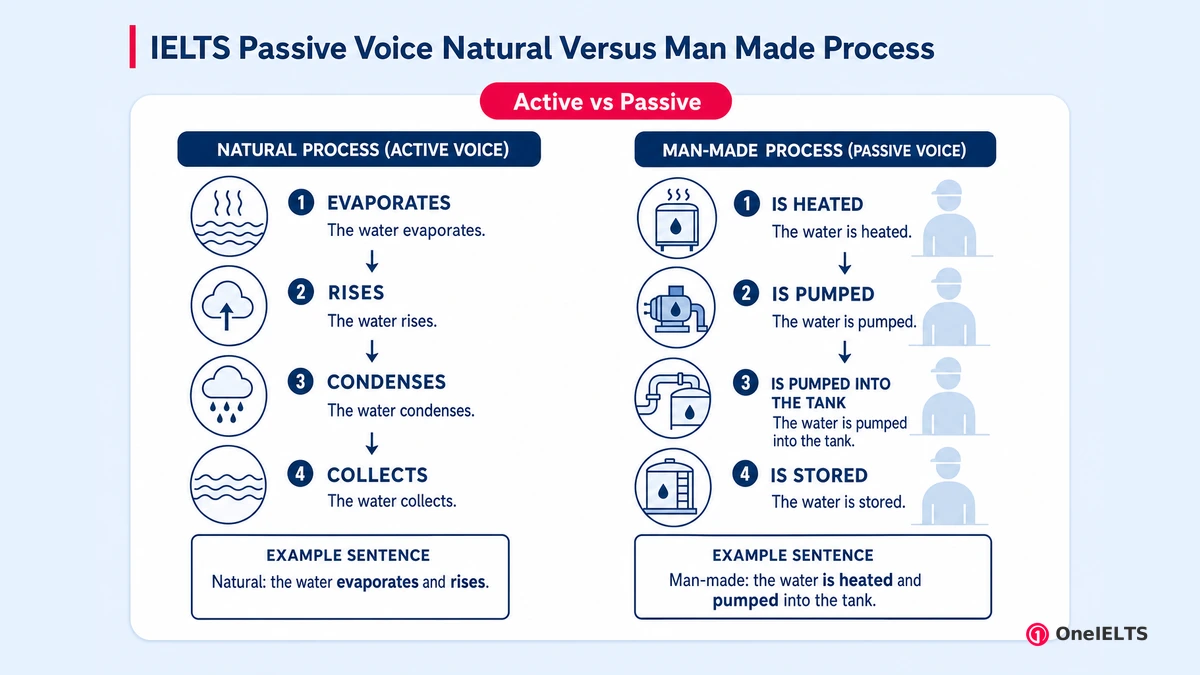
No. Natural processes take the active voice, and man-made ones take the passive. Half the advice you will read about processes is wrong for half the diagrams.
Two sources state it. The exam board writes that when we describe a process we use the passive to show the process matters more than who did it. In the same breath it adds that this is not the same for natural processes, where you use active. IELTS Buddy states the rule independently.
Neither of them explains it, so here is the reason. A man-made process has a hidden agent you are deliberately removing, and the passive does that cleanly. A natural process has no agent to hide. The water evaporates, the caterpillar becomes a pupa, and a passive there is an invented doer standing where nobody stands.
The pair makes it obvious. Natural: the water evaporates and rises. Man-made: the water is heated and pumped into the tank. The verb is doing different work in each.
A third corroboration sits on the same search result. A paid course structures its process module as Natural Processes and Industrial Processes, as two separate lessons.
The consequence is worth stating plainly. Every other page tells the reader to use the passive for processes with no qualification at all. That unqualified advice is wrong for the water cycle, the life cycle and every other natural diagram Task 1 sets.
How Do You Use the Passive in Writing Task 2?
Use it to report what other people think and to state generalisations. Keep it out of the sentences where your own position is supposed to be.
The exam board gives the structure, and it is the only page in eight that does. The impersonal it with a reporting verb: it is argued that governments should spend more on public transport, or it is considered impolite to talk with your mouth full in many cultures.
The AI Overview names what that buys you. An objective, formal tone in place of vague words like people or they.
Three jobs cover almost every legitimate Task 2 passive.
- Reporting a common view before you disagree with it, which sets up the debate without you appearing to hold both positions.
- Stating a generalisation without claiming to have counted, where an active sentence would need a subject you cannot supply.
- Carrying a modal solution in the passive, as in should be introduced or must be regulated.
There is one sentence it must not go anywhere near, and the next section is about that sentence: the one stating your own view. Essay structure and the essay types are covered elsewhere.
Which Passive Voice Structures Sound Academic?
Three: it is argued that, it is considered, and the modal passive. Everything past those three starts costing clarity rather than adding to it.
Each belongs in a different paragraph. It is argued that renewable subsidies distort the market belongs where you set up the debate, as does it is considered acceptable in many countries. Those two are reporting frames and their paragraph placement is the body paragraph that handles the other side.
The modal passive belongs where you propose. Public transport should be subsidised in every major city is a recommendation, and it reads as one.
One caveat from the capture is worth carrying. EduBenchmark lists “it is believed by me” as a sentence to avoid, and it is right, because a bolted-on doer inside an impersonal frame is the worst of both constructions. The handoff from here is the IELTS Writing Task 2 introduction page, which owns how the opening is built.
Should You Use the Passive to Give Your Opinion?
No. It is believed that is not your opinion. It belongs to unspecified people, and on a prompt asking for your view, using it instead of stating your position costs you marks.
IELTS Liz gives the ruling. The passive it is thought does not refer to you, it refers to other people. If you use it is believed, that belief is not yours, and the examiner gives you a lower score because you did not give your opinion.
The other side belongs on the record because it is the exam board’s. The ielts.org page offers “It is argued that governments should spend more on public transport” as a model impersonal structure for IELTS. Nobody on this search result joins the two.
Both are right about different sentences, and that is the resolution. The impersonal frame carries a reported view held by others, which is exactly what you need when you set up a debate or acknowledge the opposing side. It is wrong in one sentence only: the one where the prompt demand was what you think. That sentence needs a subject that is you.
The practical test takes a second. Read the sentence back and ask who believes it. If the answer comes out as people in general when the prompt asked for your view, rewrite it with a stated position.
IELTS Liz calls using it for your own opinion a big mistake in Task 2, and that is her judgement rather than a published rule. Belief ownership is the thing being marked, and how to state a position belongs to the introduction page.
Should You Use the Passive in IELTS Speaking?
Rarely, and never for your own experience. One or two uses, well placed, do show range, and the British Council is the only source that shows you where.
The capture holds three positions and the source disagreement is open. The exam board says you probably will not need it in Speaking. IDP says it is more common in writing than in speaking. EduBenchmark lists two Speaking uses under avoid, namely expressing clear arguments and opinions, and describing personal experience.
Against those three, the British Council gives Speaking its own section with five worked examples, and says including some passive might help demonstrate your grammatical range.
The resolution is a division of labour. The passive belongs in the Speaking answers that describe things, and stays out of the ones that describe you. A building was restored, a law was introduced, a festival is held every year. Never a good time was had by me.
One model shows the shape. The tower was restored in the 1990s and is now open to visitors, which is a descriptive answer with no experiencer in it because none is needed.
The inversion is a real observation rather than a joke. The fullest Speaking guidance on this search result sits on the page with no tense table, and the page that drills twelve tenses is the one saying you will not need it.
Does the Passive Voice Raise Your Band Score?
Not on its own. It is one structure inside Grammatical Range and Accuracy, and range only counts when the sentences carrying it are accurate.
IELTS Liz supplies the only direct answer on the search result, and it is a deflation. The passive voice does not give you a higher score, and no particular tense or grammar feature does, because each one counts only in so far as it shows a broader range. There is no bonus in the construction itself.
One criterion mention exists in the whole capture. The British Council says including some passive might help demonstrate your grammatical range, and that range and accuracy is a quality examiners look for in academic tasks.
Then the measured absence, which justifies saying any of this. Grammatical range returns zero on seven of the eight captured pages, band descriptor returns zero on all eight, and 25% returns zero on all eight. That includes all four test-owner pages. The handoff for the four criteria is the IELTS Writing pillar.
How Do You Practise the Passive Voice?
Practise converting both ways. Turn active into passive to learn the form, then turn your own passives back into active to find the ones that were never doing a job. Five steps make a two-way conversion session.
- Open a man-made process diagram and write the whole description. Do not think about voice while you write, and simply describe the stages in order.
- Underline every verb and mark each one A or P. The man-made default is P, so any A you wrote is worth a second look.
- Now open a natural process and repeat the verb marking. The natural default is A, and every P you wrote there is probably wrong.
- Take a Task 2 paragraph you have already written and convert every passive back to active. Keep only the ones that got worse in the active.
- Check the survivors against the four situations. If a sentence does not fit one of them, it stays active from now on.
Step 4 is the unusual instruction and it earns its place. Converting back is the only way to find an unjustified passive, because a sentence that was never doing a job looks fine while you are writing forward. That is the mechanism behind the whole overuse problem.
Drilling material is scarce. Only one captured page offers an active-to-passive quiz with answers, against three live related searches asking for exercises.
Steps 1 and 3 need diagrams. IELTS Writing Task 1 process diagram practice is filtered to process diagrams, so every set you open is the task this grammar exists for. Practising needs a free OneIELTS account.
Written by Jamil Ahmed, reviewed 14 August 2026.
Last verified: 14 August 2026
Practice for the Real IELTS Exam
Apply what you’ve learned with free, exam-style practice:
- Take a free IELTS mock test — all four skills, real exam timing, AI band scoring
- Sit a Writing section mock — Task 1 and Task 2 in one timed hour with a band estimate
- Practise by question type — self-paced Writing sets with model answers