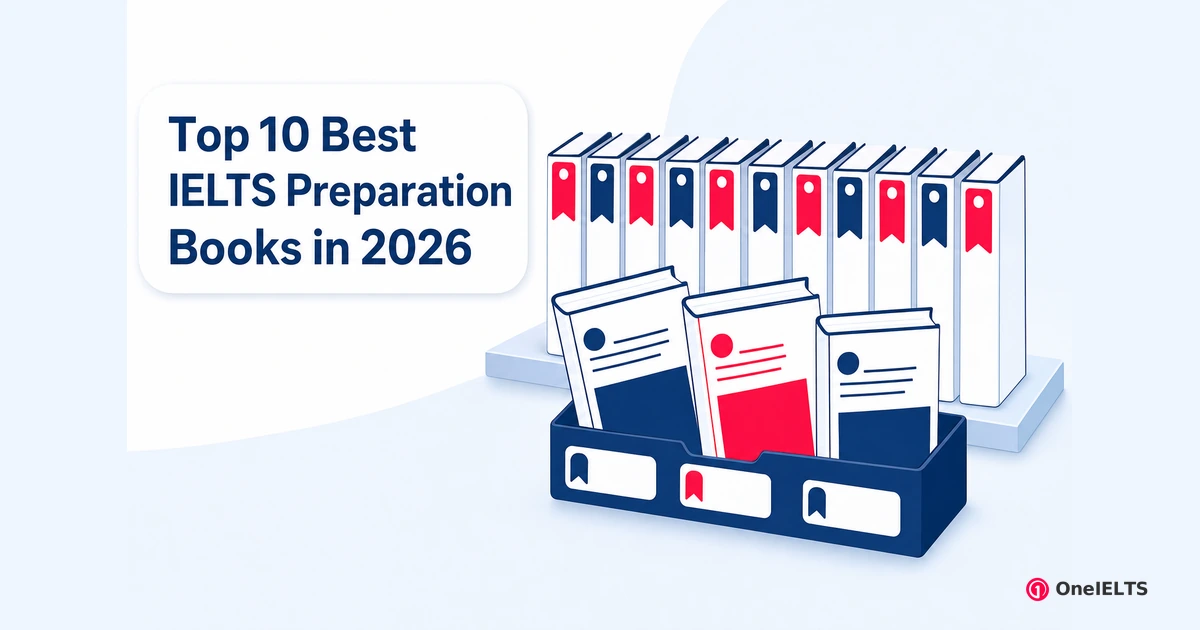
For most candidates, The Official Cambridge Guide to IELTS plus the latest Cambridge IELTS volume is the strongest starting pair. These books supply the format, drills and official practice tests for self-study. No title serves IELTS Academic, IELTS General Training and on-screen practice equally, so each gets a role label. Then: choosing, using, PDFs, self-study.
Ten books by role, 2026 editions.
- The Official Cambridge Guide to IELTS: Cambridge University Press & Assessment guide.
- Cambridge IELTS Practice Tests: retired papers plus answer key.
- Official IELTS Practice Materials: partner samples with audio recordings.
- IELTS Trainer 2: coached tests, then unguided ones.
- Barron’s Superpack and Premium: independent strategy, extra tests.
- Target Band 7: Simone Braverman’s shortcuts for Academic.
- Cambridge IELTS vocabulary books: topic words graded by band.
- IELTS Grammar for Bands 6.5 and Above: accuracy work.
- Collins Get Ready for IELTS Writing: Writing from band 4.
- Makkar IELTS Books: Indian cue-card sets for Speaking topics.
Which IELTS Book Is Best for Preparation?
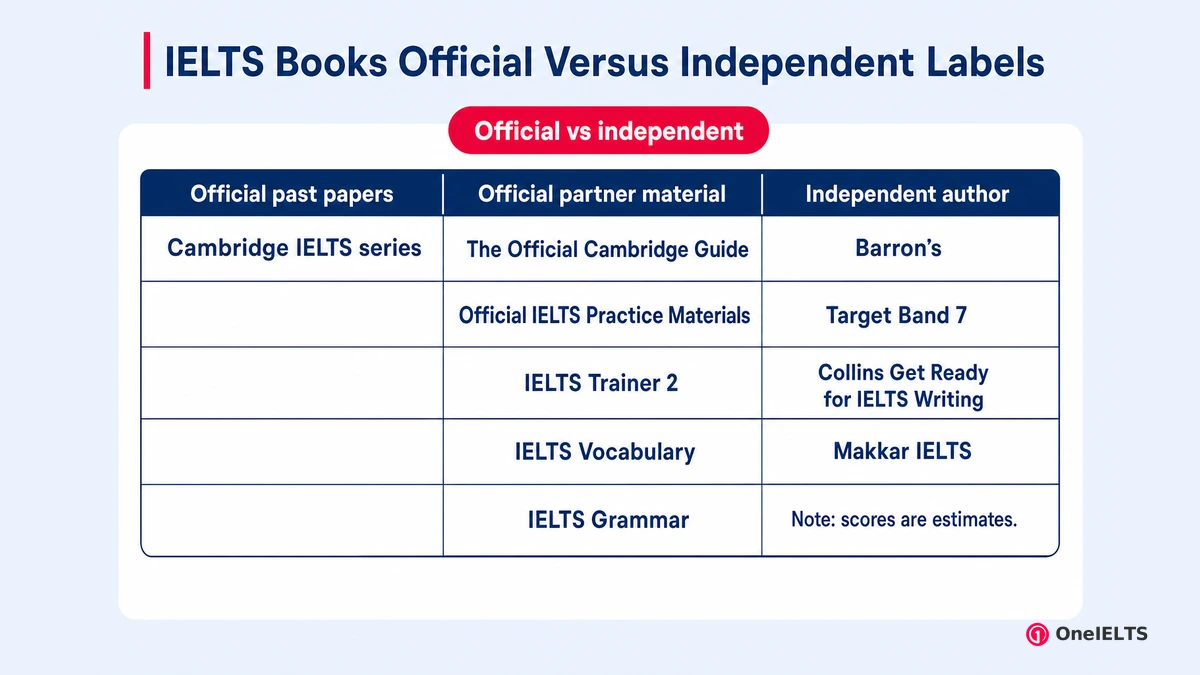
The Official Cambridge Guide to IELTS is the best single starting book for IELTS preparation. The test’s own publisher wrote it, it covers Academic and General Training, and it includes full official practice tests. Pair it with the latest Cambridge IELTS practice-test volume for real past-paper practice.
The AI Overview for this search also names the Official Cambridge Guide to IELTS the best overall preparation book, and IDP’s quick comparison leads with it too. What neither tells you is who wrote each book’s tests. The Cambridge IELTS series reprints official past papers, partner titles carry official sample material, and an independent author writes the rest from scratch. Editions and volume numbers below were checked on publisher pages on 7 October 2026.
Each row labels a book by where its tests come from, then by module, skill and starting band.
| Book | Publisher or author | Official or independent | Module | Main skill focus | Best for |
|---|---|---|---|---|---|
| The Official Cambridge Guide to IELTS | Cambridge University Press & Assessment | Official partner material | Both | All four skills | First book, any band |
| Cambridge IELTS series | Cambridge University Press & Assessment | Official past papers | Separate Academic and GT editions | Full timed tests | Band 6 and above |
| Official IELTS Practice Materials | Cambridge Assessment English | Official partner material | Both | Sample tests, examiner comments | Extra official samples |
| IELTS Trainer 2 | Cambridge University Press & Assessment | Official partner material | Separate Academic and GT editions | Guided then unguided tests | Band 5 to 6 |
| Barron’s IELTS Superpack and IELTS Premium | Lin Lougheed, Barron’s | Independent author | Both | Strategy plus extra tests | Self-studiers wanting explanation |
| Target Band 7 | Simone Braverman | Independent author | Academic | Shortcuts and time management | Band 6 aiming for 7 |
| IELTS Vocabulary Books by Cambridge | Pauline Cullen, Cambridge | Official partner material | Both | Lexical Resource | Writing and Speaking vocabulary |
| IELTS Grammar for Bands 6.5 and Above | Diana Hopkins, Pauline Cullen | Official partner material | Both | Grammatical Range and Accuracy | Writing stuck at 6 |
| Collins Get Ready for IELTS Writing | Collins | Independent author | Both | Writing Task 1 and 2 | Band 4 starters |
| Makkar IELTS Books | Dr. Kiranpreet Kaur Makkar | Independent author | Both | Speaking cue cards | Speaking topic preparation |
1. The Official Cambridge Guide to IELTS
Cambridge University Press & Assessment publishes The Official Cambridge Guide to IELTS, and its job in a study set is teaching the format before you test yourself. The current Student’s Book with Answers, dated 22 May 2025 on the Cambridge shop, holds eight official IELTS practice tests and a Cambridge One activation code for the digital content.
It covers Academic and General Training in one volume and teaches all four skills, which is why the AI Overview calls it the best overall choice. It suits first-time candidates and self-studiers who want one book that explains all the question types. Its limit is volume. Eight practice tests teach the format, but they aren’t enough timed practice on their own.
The guide earns its first-place slot on five counts.
- Every question type explained. Each Listening, Reading, Writing and Speaking task gets its own strategy walk-through.
- One book, both modules. Academic and General Training material sit side by side, so nobody buys twice.
- Full official tests. Eight complete practice tests come with answers, so the guide doubles as early mock material.
- Written by the test’s publisher. Cambridge co-owns IELTS, so the question styles match what appears on test day.
- Model answers included. Writing and Speaking sections carry model answers you can compare your own work against.
2. Cambridge IELTS Academic and General Training Practice Tests
This series is your supply of real exam papers, published by Cambridge University Press & Assessment as numbered volumes. Each volume holds four authentic past papers with an answer key and audio, in separate Academic and General Training editions, and the AI Overview calls the set essential for real test practice.
Cambridge IELTS 1-20 fill most shelves already. The newest, IELTS 21 Practice Tests Academic with Digital Pack, came out on 16 July 2026 with downloadable audio, Speaking videos and sample Writing responses. Use recent volumes for current task styles and older ones as extra timed practice. These books test you; they don’t teach, so pair them with a guide or skill book. Build timed listening practice around the audio, not the transcript.
Five features make the series the backbone of any book set.
- Authentic retired test papers. Every volume prints four real past IELTS papers, so your scores track the live test.
- Separate Academic and General Training editions. Reading and Writing differ by module, so buy the edition matching your test.
- Answer keys and listening transcripts. Each answer key comes with listening transcripts, so you can trace every missed answer.
- Sample Writing with examiner comments. Sample Writing answers carry examiner comments explaining the band each script earned on test day.
- Many volumes for practice. Twenty-one numbered volumes give you far more timed practice than any single book can hold.
3. Official IELTS Practice Materials
Official IELTS Practice Materials gives you extra official sample tests after the Cambridge series runs out. Cambridge Assessment English, on behalf of the IELTS partners, produced Volume 1 and Volume 2, each with practice tests for all four skills in both modules.
Each volume adds sample answers with examiner comments on Writing and Speaking, plus a DVD with a Listening test and recordings of three students taking the Speaking test. The DVD format shows its age. I couldn’t confirm current stock in India from the publisher, so check availability with your bookseller before ordering.
Four kinds of official material justify a place on the shelf.
- Official sample tests. Both volumes carry official sample tests for Listening, Reading, Writing and Speaking, written by the test makers.
- Examiner comments on Writing. Sample Writing answers come with examiner comments, so you see why a script scored its band.
- Speaking test samples. Recorded Speaking tests show three real candidates, so you hear what each band sounds like aloud.
- Material for both modules. Academic and General Training Reading and Writing both appear, so General Training candidates aren’t left out.
4. IELTS Trainer 2
IELTS Trainer 2 coaches you inside the tests rather than after them. Cambridge University Press & Assessment publishes it with six practice tests, and it comes in separate Academic and General Training editions; the Academic one dates from June 2019.
The first two tests are guided practice tests, with step-by-step guidance, tips and Training exercises built into each part. The final four are plain full tests with full answers, explanations and model Writing answers. A guided test teaches while you work; a plain test only scores you, so Trainer 2 suits candidates who want coaching rather than an answer key alone.
These four features set the Trainer apart from a plain test book.
- Guided practice tests first. The first two tests embed step-by-step tips, so you learn the method while answering real-style questions.
- Full tests with full answers. Four unguided tests follow, each with full answers and explanations for checking your reasoning.
- Exam-style Listening audio. Downloadable audio recreates the Listening test, so your ear practice matches test-day speed and accents.
- Academic and General Training editions. Each module has its own edition, so the Reading and Writing tasks match your test.
5. Barron’s IELTS Superpack and IELTS Premium
Barron’s gives you the most strategy explanation of any book here, from an independent publisher. Lin Lougheed writes both titles for Barron’s Educational Series. IELTS Premium, Seventh Edition, holds six practice tests (four Academic, two General Training) with online audio. The Superpack, Fifth Edition, bundles Barron’s IELTS, IELTS Practice Exams and IELTS Essential Words.
Independent means the author writes the tests rather than reprinting retired papers, so treat your Barron’s scores as estimates. The AI Overview calls Barron’s great for self-study, and it suits learners who want every strategy spelled out before they attempt a question.
Four strengths make Barron’s worth a place beside the official books.
- Detailed question-type strategies. Every question type gets a step-by-step strategy with worked examples before any practice begins.
- Additional practice tests. The Superpack adds 18 practice tests across its books, far more than any official title offers.
- Online audio support. Listening exercises and model tests run on online audio, with scripts for checking what you missed.
- Bundled skill books. The Superpack adds a vocabulary book, IELTS Essential Words, to the strategy and test volumes.
6. Target Band 7 by Simone Braverman
Target Band 7 is a strategy book for candidates near band 6 who need a 7 in IELTS Academic. Simone Braverman, who runs IELTS-Blog.com, wrote it as an independent author, and it focuses on shortcuts, time management and common traps rather than full tests.
It suits Academic candidates already around 6 who are aiming for band 7. Its limit is practice volume: it carries few full tests, so pair it with the Cambridge series for timed papers.
The book concentrates on four areas where band 6 candidates leak marks.
- Time-saving strategies. Each question type gets a shortcut that cuts time without lowering accuracy, especially in Reading.
- Traps that cost marks. Braverman lists the common traps, such as spelling and word-limit errors, that quietly drop a band.
- Writing structures for both tasks. Ready structures for Task 1 and Task 2 help you organise answers under time pressure.
- Focused on IELTS Academic. The book targets the Academic module, so General Training candidates get less from its Reading advice.
7. IELTS Vocabulary Books by Cambridge
Cambridge’s IELTS vocabulary books raise your Lexical Resource score in Writing and Speaking. Pauline Cullen wrote the self-study series, organized by topic and graded by level, formerly titled Cambridge Vocabulary for IELTS. It builds the vocabulary examiners reward.
IDP lists the level-graded IELTS Vocabulary Up to Band 6.0, and the AI Overview names Vocabulary for IELTS by Cambridge; both point to the same series. Cambridge sells two levels: Up to Band 6.0 and For Bands 6.5 and above. Pick the first, if you’re below 6.
Five features suit this series to self-study.
- Topic vocabulary units. Each unit groups topic vocabulary, such as health or the environment, around a likely IELTS theme.
- Collocations and word forms. Exercises drill collocations and word forms, the two areas where band 6 vocabulary usually slips.
- Exercises with an answer key. Every exercise has an answer key, so you can check your work without a teacher.
- Audio for pronunciation. Downloadable audio models pronunciation and feeds the listening passages that present each word in context.
- Targets Lexical Resource directly. Units and exam tips aim at the Lexical Resource criterion examiners mark in Writing and Speaking.
8. IELTS Grammar for Bands 6.5 and Above
IELTS Grammar for Bands 6.5 and Above fixes the grammar errors that hold Writing and Speaking at band 6. Cambridge published it in March 2021, written by Diana Hopkins and Pauline Cullen, as the new title of Cambridge Grammar for IELTS.
It teaches grammar through IELTS-style tasks, starts with an entry test, and comes with downloadable audio and a full answer key with model Writing answers. Grammar maps onto Grammatical Range and Accuracy, one of four Writing criteria. The book suits candidates whose Writing is stuck at 6 because of errors, not ideas, and who need band 6.5 or higher.
The book’s focus falls on four areas.
- Grammar through IELTS tasks. Each point is taught through real IELTS-style Reading, Writing and Listening tasks, not abstract drills.
- Common errors at band 6. Units target the grammar errors that most often keep a script below band 7.
- Complex sentence structures. Practice builds complex sentences you can control, the range examiners look for above band 6.
- Exercises with an answer key. A full answer key and model Writing answers let you correct every exercise yourself.
9. Collins Get Ready for IELTS Writing
Collins Get Ready for IELTS Writing builds Writing Task 1 and Writing Task 2 skills from a pre-intermediate start. Fiona Aish and Jo Tomlinson wrote it for HarperCollins, aimed at candidates around band 4, and it covers only Writing.
It runs twelve graded units, four review units and one complete Writing practice test. The next step up is Writing for IELTS by Anneli Williams, part of the Collins English for IELTS skills series for bands 5 to 6+. Sister Get Ready titles cover Listening, Reading and Speaking.
These four features suit a lower-level Writing candidate.
- Step-by-step units for both tasks. Twelve graded units build Task 1 and Task 2 skills, starting from sentence-level basics.
- Model answers. A full set of model answers shows what a finished response looks like at each stage.
- Language for graphs and arguments. Units teach language for describing graphs in Task 1 and arguing in Task 2.
- Self-study answer key. A complete answer key lets you check every exercise alone, which suits candidates without a teacher.
10. Makkar IELTS Books
Makkar IELTS books prepare you for current Speaking topics, not for full tests. Dr. Kiranpreet Kaur Makkar, who runs an IELTS institute in Phagwara, Punjab, writes them; a list crediting Dr. Gurpreet Makkar is citing the wrong name. The Speaking cue cards appear for each four-month cycle, and the latest is Sept-Dec 2026.
The books cover Speaking Part 2 and Part 3 topics, plus Writing samples and General Training letters, and they’re widely used by candidates in India. They aren’t official tests. Read the sample answers for ideas, then speak in your own words, because examiners mark memorized answers down.
Four uses explain the series’ popularity.
- Current Speaking cue-card topics. Each cycle’s book collects the cue-card topics reported for Speaking Part 2 that period.
- Sample answers for Parts 2 and 3. Sample answers show how to extend a topic; copy the structure, never the script.
- Writing sample essays. Separate Makkar books carry sample essays and General Training letters for Writing practice between tests.
- Popular with candidates in India. Makkar cue-card sets circulate widely among Indian candidates, so classmates often share topics.
How Do You Choose the Right IELTS Book for Your Level?
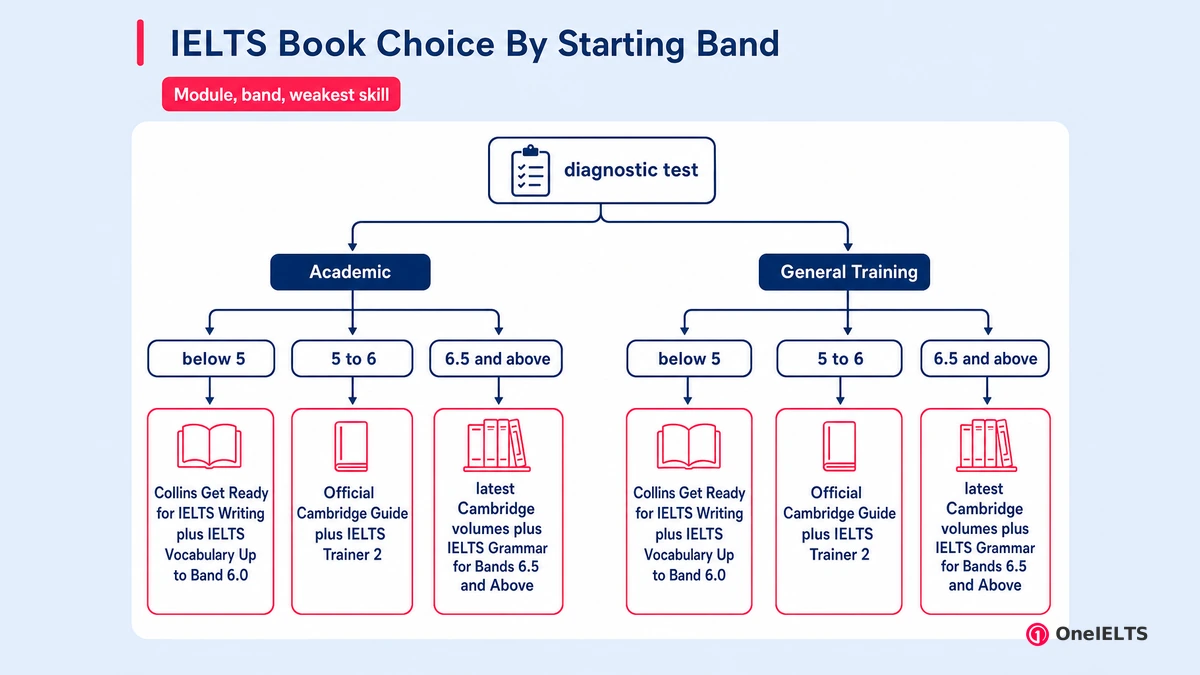
Choose by three things in order: your module (Academic or General Training), your current band, and your weakest skill. Beginners start with a guide and a skill book; candidates at band 6 or above need official practice tests most.
Your starting band comes from a diagnostic test, a full timed mock taken before you buy anything, which also shows your weakest skill. IELTS General Training candidates must buy General Training editions of the Cambridge series, because Reading and Writing differ from IELTS Academic.
The table matches five starting points to a two-or-three-book set.
| Starting point | Recommended book set | Why |
|---|---|---|
| Beginner or below band 5 | Collins Get Ready for IELTS Writing, IELTS Vocabulary Up to Band 6.0 | Builds the language base first, because full tests only confirm a low score at this stage. |
| Band 5 to 6 | Official Cambridge Guide, IELTS Trainer 2 | The guide teaches every question type and Trainer 2 coaches you through the first two tests. |
| Band 6.5 and above | Latest Cambridge IELTS volumes, IELTS Grammar for Bands 6.5 and Above | Timed official papers and accuracy work close the last half-band gap. |
| IELTS General Training candidates | Official Cambridge Guide, Cambridge IELTS General Training editions | General Training Reading and Writing differ, so Academic editions train the wrong tasks. |
| Weak in one module only | One skill book for that module, plus one Cambridge volume | Fixing the weakest skill lifts the overall band faster than broad revision does. |
How Should You Use IELTS Books Effectively?
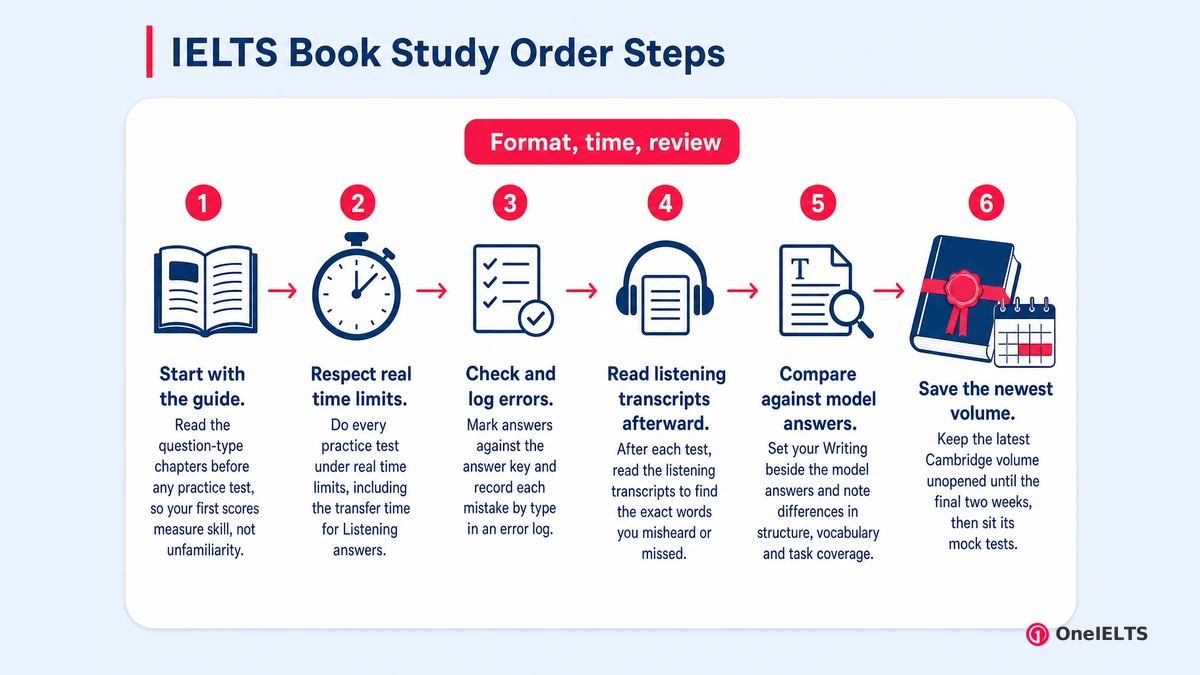
Work through any IELTS book in three passes: learn the format, practice under time limits, then review every error. This section covers using the books themselves; the wider schedule follows in the self-study section.
Candidates most often run out of fresh Cambridge papers in the final fortnight, because they spent the newest volume in week one. The order below prevents that.
- Start with the guide. Read the question-type chapters before any practice test, so your first scores measure skill, not unfamiliarity.
- Respect real time limits. Do every practice test under real time limits, including the transfer time for Listening answers.
- Check and log errors. Mark answers against the answer key and record each mistake by type in an error log.
- Read listening transcripts afterward. After each test, read the listening transcripts to find the exact words you misheard or missed.
- Compare against model answers. Set your Writing beside the model answers and note differences in structure, vocabulary and task coverage.
- Save the newest volume. Keep the latest Cambridge volume unopened until the final two weeks, then sit its mock tests.
Can You Download IELTS Preparation Books as a PDF?
Yes, but only the free official samples; full commercial books such as the Cambridge IELTS series are copyrighted, and ‘free PDF’ copies online are unauthorized. Copyright covers every numbered volume. The legal free route is the official sample tests the IELTS partners post on ielts.org and their own sites, plus sample pages publishers release. Pirated files often lack the audio files, carry outdated editions, or hide malware.
How Can You Self-Study IELTS With Books?
Self-study with books works when you add a fixed study schedule, timed practice and outside feedback on Writing and Speaking. Books can’t score your Writing or Speaking, so you need model-answer comparison, a study partner, or an AI or teacher review.
Five parts make a self-study system that books alone can’t supply.
- Diagnostic test first. Take one full mock test before studying to find your starting band and weakest skill.
- Weekly study schedule. Build each week around one guide and one test volume, with fixed days for each skill.
- Timed full mock tests. Sit one timed full mock test every week during the last month before your exam.
- Writing feedback and Speaking practice. Get feedback on Writing and record Speaking practice, because no book can mark either skill.
- Error log review. Reread your error log before each new test, so the same mistake doesn’t cost marks twice.
Can You Get 7.5 in IELTS in One Month?
Yes, it is possible only if you already score around 7 and use the month for timed practice, not for learning English from the start. Your starting level decides it, since a gain of more than half a band in four weeks is uncommon.
A realistic four-week plan spends weeks one and two on two timed papers a week plus error review, week three on your weakest skill, and week four on full mocks. Map it with an IELTS study plan before you buy anything for band 7.5.
How Can You Get 8.5 in IELTS?
The skills needed for an 8.5 are near-flawless Listening and Reading accuracy plus Writing and Speaking at band 8, which books support but cannot certify on their own. At band 8.5, Listening and Reading accuracy means almost no missed answers across a full paper.
Two books from this list matter most here: the latest Cambridge volumes for timed papers and IELTS Grammar for Bands 6.5 and Above for advanced grammar. Writing and Speaking still need examiner-level feedback. Compare your scripts with the descriptors for IELTS band 8.
Can You Prepare for IELTS Online for Free?
Yes, free official sample tests and free online mock tests can replace part of the book practice, especially for the computer-delivered format. The IELTS partners publish official sample tests for Academic and General Training on ielts.org.
A free mock test adds full-length, timed online practice on screen, the closest match to computer-delivered IELTS. Books stay useful for structured skill teaching that free material rarely sequences.
Do Paper-Based Books Still Prepare You for Computer-Delivered IELTS?
Yes, the content and question types are the same on paper and on computer, but book practice should be paired with on-screen timed practice before test day. IELTS says the paper-based test ends from mid-2026, and IDP India confirms that IELTS on paper won’t be available from mid-2026 (checked on 7 October 2026).
Books can’t simulate typing your essays, reading long passages on screen, or the on-screen word counter, so typing speed needs separate on-screen practice. Selected centres offer Writing on Paper inside computer-delivered IELTS. Compare both modes in IELTS paper vs computer.
Written by Fahimur Rahman, reviewed 7 October 2026.
Last verified: 7 October 2026
Practice for the Real IELTS Exam
Apply what you’ve learned with free, exam-style practice:
- Take a free IELTS mock test — all four skills, real exam timing, AI band scoring
- Start with the free mock test — one full test, no payment needed
- Practice skill by skill — Listening, Reading, Writing and Speaking sets