You improve your English vocabulary through consistent input, active retention and regular use: meet a word, record it, review it with spaced repetition, then use it until passive vocabulary becomes active vocabulary. IELTS scores that payoff under Lexical Resource, mapped at the end. This page teaches methods; word lists sit on IELTS writing vocabulary. Causes, mistakes, a routine, timelines and books frame nine ways.
- Read extensively and actively, slightly above your level.
- Keep a vocabulary journal with example sentences.
- Learn words in context, not in isolation, as collocations.
- Learn root words, prefixes and suffixes to decode words.
- Use a dictionary and thesaurus, checking every synonym.
- Use flashcards and vocabulary apps for spaced review.
- Play word games as a short daily top-up.
- Listen to movies and podcasts for natural speech.
- Use new words in daily communication within days.
What Is the Best Way to Improve Vocabulary?
The best way to improve vocabulary is to read widely every day and then actively use the new words you meet. Write each one down with an example sentence, review it on a schedule, and use it in your own speaking and writing within a few days.
Reading alone grows passive vocabulary, the words you recognize. Only word retrieval, pulling a word out of memory to say or write it, builds active vocabulary.
So the method has three stages. Consistent input comes from ways 1 and 8. Active retention comes from ways 2, 6 and 7. Regular use comes from way 9.
What Causes Poor Vocabulary?
A poor vocabulary usually comes from too little reading, passive exposure without review, and never using new words, not from a lack of ability. Fixing it pays off quickly, because a strong vocabulary makes reading faster, writing more precise and speaking more confident.
Each of the five causes below is a habit you can change this week.
- Little or no regular reading: without a daily reading habit, you meet too few new words to grow.
- Meeting words once and never reviewing them: a word seen once usually fades before you can use it.
- Relying on translation instead of English definitions: translation gives a rough match but hides how the English word is used.
- Using the same safe words in speech and writing: repeating “good” and “big” keeps word choice flat.
- Never noticing how words combine with other words: missing partners like “strong coffee” leads to unnatural phrasing.
1. Read Extensively and Actively
Extensive reading gives you more new words than any other habit, because it puts unfamiliar words in natural sentences again and again. Choose texts a little above your reading level and spread them across varied topics, because variety raises the number of unfamiliar words you meet. Learners on Reddit, cited in Google’s AI Overview, agree that regular reading of challenging books builds a richer mental lexicon than occasional reading.
The five habits start easy and get more demanding as you go.
- Read 20 minutes a day on topics you already like: interest keeps you reading long enough to meet repeated words.
- Mix fiction, news, essays and opinion articles: each genre carries its own vocabulary, from dialogue to formal argument.
- Choose texts where about one word in fifty is new: that ratio lets you follow the meaning without stopping constantly.
- Underline unknown words and keep reading before checking them: context often explains the word by the end of the paragraph.
- Re-read one short article a week to see the same words again: a second meeting fixes what the first missed.
2. Keep a Vocabulary Journal
Writing a word down with its meaning and an example sentence makes it far more likely to come back than a word you only looked up. A vocabulary journal, or a simple vocab notebook, holds that record in one place. The AI Overview pairs the journal with spaced repetition and short practice paragraphs, and that review side is way 6.
Fill in the five fields in this order each time you add a word.
- The word and its part of speech: write “decline (verb)” so you know how the word behaves in a sentence.
- A short meaning in English, not a translation: a brief English definition trains you to think in English.
- The sentence where you found it: copying the original line keeps the real context attached to the word.
- Its common partners, such as “make a decision”: these word partners stop you pairing it with the wrong verb.
- Your own example sentence: writing about your own life makes the word easier to recall later.
3. Learn Words in Context, Not in Isolation
Words travel in groups. Learning the phrase, such as “heavy traffic” or “take responsibility”, teaches meaning, grammar and natural use at once, which a single word on a list can’t. While reading, notice synonyms, antonyms and formal versus informal equivalents. Context clues help too, since signal words such as “unlike”, “such as” and “that is” often reveal the meaning.
Each habit below keeps something extra attached to the word you learn.
- Learn collocations, the words a word usually goes with: “heavy rain” sounds natural, while “strong rain” doesn’t.
- Note the preposition a word takes: “interested in” and “responsible for” are fixed pairs, so learn them together.
- Learn word families such as decide, decision, decisive: one entry covers a verb, a noun and an adjective.
- Record whether a word is formal or informal: “purchase” suits a formal letter, while “buy” suits a chat with friends.
- Learn chunks and set phrases as one unit: “on the other hand” is easier to recall whole than word by word.
- Guess an unknown word from context clues before checking it: then confirm your guess in a dictionary.
4. Learn Root Words, Prefixes and Suffixes
A small set of Latin and Greek root words and common affixes unlocks hundreds of words, so one part you learn pays off many times. Suffixes also guide word formation. Knowing them helps you pick economy, economic or economical correctly, and that choice is a frequent error in written English.
The word parts fall into groups by what they change in a word.
- Prefixes that change meaning: un-, re-, mis-, over-: “misread” and “overcook” show how a prefix shifts a base word.
- Suffixes that change word class: -tion, -ment, -ive, -ly: “inform” becomes “information”, “informative” and “informatively” with each new ending.
- Common roots: “dict” (say), “port” (carry), “spect” (look): they explain predict, export and inspect at a glance.
- Number prefixes: uni-, bi-, tri-: these turn unicycle, bilingual and triangle into easy guesses for one, two and three.
- Building a word family from one root: from “spect” you get inspect, respect, spectator and perspective.
5. Use a Dictionary and Thesaurus
Two tools do different jobs here. A learner’s dictionary shows meaning, pronunciation, example sentences and collocations. A thesaurus shows alternatives, but only the dictionary tells you whether an alternative fits your sentence. Online tools such as Vocabulary.com, named in the AI Overview, let you look words up while you read.
Use the thesaurus to search and the dictionary to check, as these five habits show.
- Use an English-English learner’s dictionary, such as Cambridge or Oxford Learner’s: both define words in simple English.
- Read the example sentences, not only the definition: examples show grammar and partners that a definition skips.
- Check the collocation and register labels: labels such as “formal” or “informal” tell you where a word belongs.
- Use a thesaurus to find options, then check each one in the dictionary: synonyms are rarely exact swaps.
- Note synonyms and antonyms in your journal: pairs like “rise” and “fall” are easier to recall together.
6. Use Flashcards and Vocabulary Apps
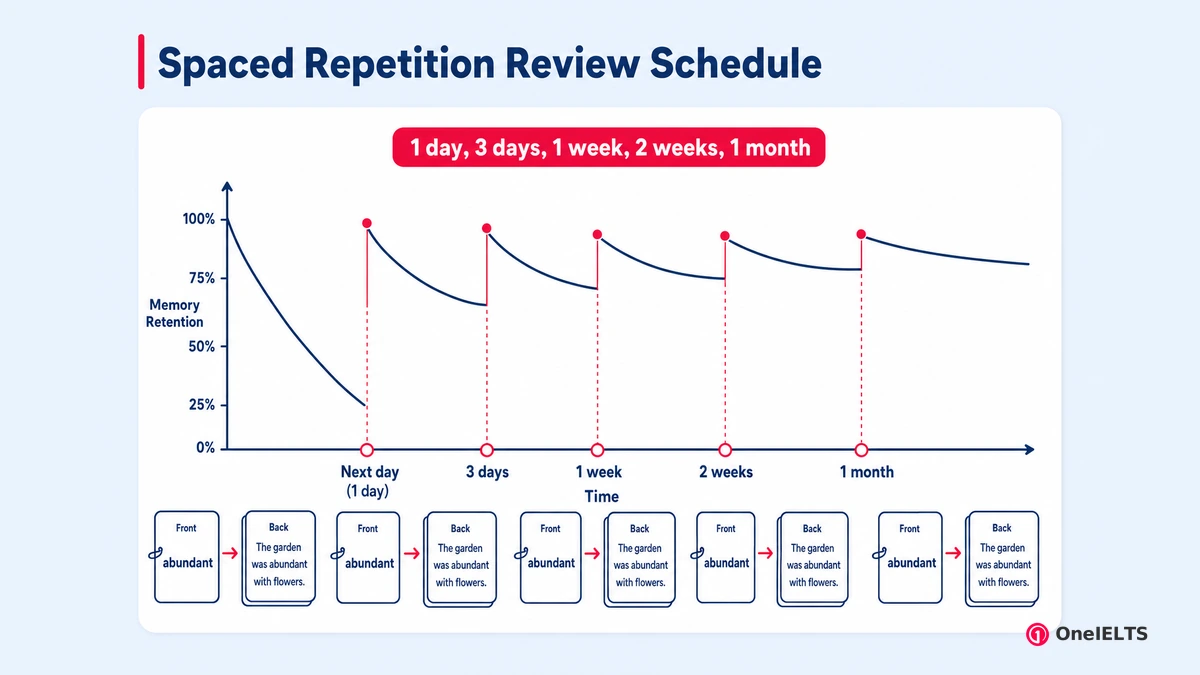
Memory fades along a predictable forgetting curve. Reviewing a word just before you’d forget it moves it from short-term to long-term memory with the least effort, and spaced repetition times each review to that point. A card should test recall, so you say or write the word rather than only recognize it.
Here’s the spaced repetition schedule, step by step.
- Put the word on the front and your own example sentence on the back: this tests use as well as meaning.
- Review new cards the next day: the first review comes soonest, because a new word fades fastest.
- Then review after about 3 days, a week, two weeks and a month: each gap grows as the word sticks.
- Move a card back to the start when you get it wrong: a missed word restarts its schedule.
- Let an app such as Anki, Quizlet or Vocabulary.com schedule the reviews: it tracks due cards for you.
Pick an app that shows words in sentences and schedules reviews. One that only flashes single words trains recognition and little else, and flashcards built from your own journal beat a ready-made deck.
7. Play Word Games to Improve Vocabulary
Word games add repetition without boredom and test recall in a few minutes, so they work best as a 10-minute daily top-up rather than the main method. Pick games that make you produce words, not only spot them. Describing games also train paraphrase, the skill of explaining a word you can’t recall, which matters later in IELTS Speaking.
Each game pairs with the skill it builds.
- Crosswords for meaning and spelling: crosswords make you match a clue to a word and spell it exactly.
- Wordle for letter patterns: the daily puzzle trains you to see common letter patterns in English words.
- Scrabble or Boggle for word building: both reward finding words from given letters, which stretches spelling and word knowledge.
- Word association chains with a friend: each player adds a related word, building links between words in memory.
- Taboo-style games, describing a word without saying it: you explain “umbrella” without saying “rain”, which trains paraphrase.
8. Improve Your Vocabulary by Listening to Movies and Podcasts
Audio and video show how words sound and which ones native speakers actually use in everyday speech, something reading alone can’t teach. You also absorb natural pronunciation and tone. Listen closely: pause and replay the line where a new word appears, then say it aloud.
The sources run from the most support to the least.
- Movies and TV shows with English subtitles: subtitles link the sound of each word to its spelling on screen.
- The same show again without subtitles: a second viewing tests whether you now catch the words by ear.
- Learner podcasts such as BBC Learning English: short episodes explain phrases slowly, with transcripts you can check afterward.
- Talks and interviews on topics you know: familiar content lets you focus on the words rather than the ideas.
- Writing down one useful phrase from each session: one phrase in your journal turns watching into learning.
9. Use New Words in Daily Communication
You own a word only when you can produce it. Using it in your own sentences turns passive recognition into active use, and it builds speaking skills at the same time. The AI Overview advises writing short paragraphs that include new words on purpose, which is the first step here.
The steps move from private practice to real communication.
- Write a short daily paragraph using three new words: daily writing makes you choose the right form and partner.
- Keep a journal entry in English: writing about your day uses everyday words you’ll need in conversation.
- Use one new word in a message or email: a real reader gives the word a real purpose.
- Bring a new word into a conversation on purpose: saying it aloud once makes the next use easier.
- Ask a partner or teacher whether you used it correctly: feedback catches wrong collocations before they become habits.
What Are the Common Mistakes That Slow Vocabulary Growth?
The mistakes that slow vocabulary growth are learning words without context, never reviewing them, never using them, and chasing rare “impressive” words instead of useful ones. The lists of “10 powerful words” and “20 tricky words” in search results are a starting point at most. Words picked up by rote memorization, without partners or context, are rarely used correctly.
Each mistake comes with the numbered way that fixes it.
- Memorizing long word lists with no example sentences: words without context don’t stick, so learn them as phrases (way 3).
- Looking a word up once and never reviewing it: one look rarely lasts, so schedule a review with flashcards (way 6).
- Swapping in thesaurus synonyms without checking fit: most synonyms differ in register or partners, so check the dictionary (way 5).
- Learning rare words you will never use: spend your time on useful words you’ll say and write this week (way 9).
- Only reading or listening, never speaking or writing: recognition without use leaves words passive, so produce them daily (way 9).
What Does a Daily Vocabulary Practice Routine Look Like?
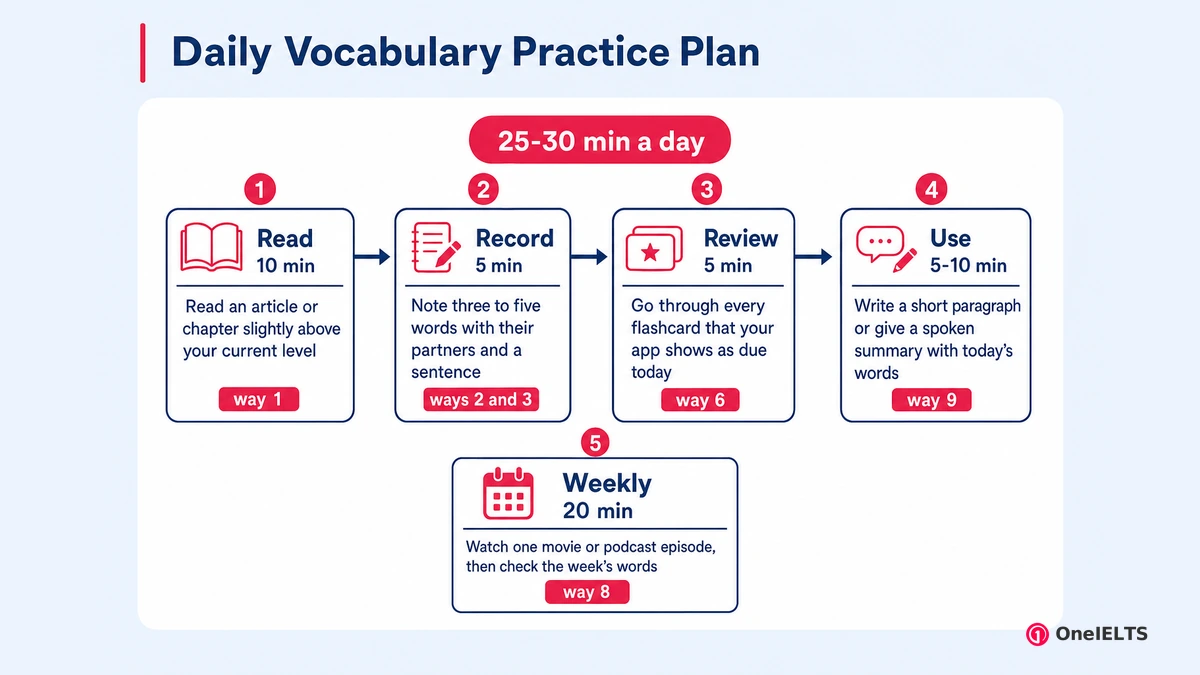
A daily routine of about 25 to 30 minutes is enough: read, record, review and use, in that order. This practice schedule fits all four steps into one sitting of study time, plus a weekly review on the weekend.
| Step | Time | What to do | Way it uses |
|---|---|---|---|
| Read | 10 minutes | Read an article or chapter slightly above your current level | Way 1 |
| Record | 5 minutes | Note three to five words with their partners and a sentence | Ways 2 and 3 |
| Review | 5 minutes | Go through every flashcard that your app shows as due today | Way 6 |
| Use | 5-10 minutes | Write a short paragraph or give a spoken summary with today’s words | Way 9 |
| Weekly | 20 minutes | Watch one movie or podcast episode, then check the week’s words | Way 8 |
As an optional extra, choose one word of the day from today’s reading, never a random rare one. If you searched for a printable PDF version, save or print this table.
How Long Does It Take to Improve Vocabulary?
Most learners notice a difference within four to eight weeks of daily practice. At a steady learning rate of five to ten new words a day, 300 practice days add roughly 1,500 to 3,000 words a year, if you review and use them. That range is plain arithmetic from the daily rate, not a research figure.
The count matters less than the number of words you can use. Learners at lower levels see faster early gains, because high-frequency words come first and appear everywhere. For adult learners, closing the gap between recognizing a word and using it takes longest. Track your progress with a monthly check: can you use last month’s words in a sentence without looking?
Which Books Help Improve English Vocabulary?
Two kinds of books help: vocabulary workbooks that teach words with exercises, and graded or easy novels that let you meet those words in stories. The six picks below cover four workbooks and two kinds of novels.
| Book | Type | Level | Best for |
|---|---|---|---|
| Word Power Made Easy by Norman Lewis | Workbook | Intermediate to advanced | Building words from Greek and Latin roots, with daily exercises |
| English Vocabulary in Use (Cambridge) | Workbook series | Elementary to advanced, one book per level | Topic vocabulary taught in short two-page units with practice |
| English Collocations in Use (Cambridge) | Workbook | Intermediate and advanced | Learning which English words naturally go together in phrases |
| 1100 Words You Need to Know | Workbook | Upper intermediate | A weekly set of new words with short reviews |
| Oxford Bookworms or Penguin Readers | Graded readers | Beginner to intermediate, by stage | Easy novels for beginners written within a controlled word count |
| Animal Farm or The Old Man and the Sea | Short classic novels | Intermediate | Plain-language classics short enough to read straight through |
Work through a workbook at one unit a week, and copy each unit’s new words into your journal (way 2).
How Do You Improve Vocabulary for the IELTS Lexical Resource Criterion?
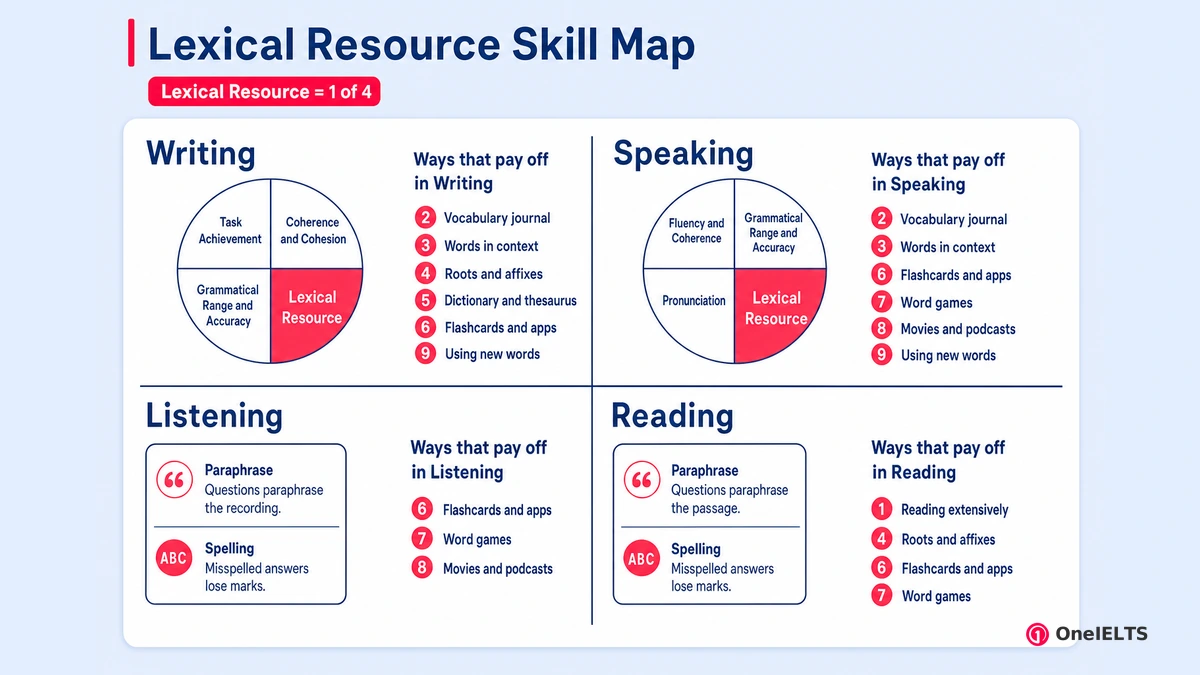
You improve it by using the methods above on IELTS topics and checking word choice against the criterion. In IELTS Writing and IELTS Speaking, examiners mark vocabulary under Lexical Resource, one of four equally weighted criteria, so it’s about a quarter of each band. Listening and Reading have no vocabulary criterion. Their questions paraphrase the recording or passage, though, and misspelled answers lose marks, so vocabulary decides marks there too.
The table maps each of the nine ways to the skill where it pays off.
| Way (number) | IELTS skill | What changes in the test |
|---|---|---|
| Reading extensively (1) | Reading | Faster recognition of paraphrased answers in the passage |
| Vocabulary journal (2) | Writing and Speaking | A wider range of less common words, used accurately |
| Words in context (3) | Writing and Speaking | Natural collocation, which the band 7 descriptor names |
| Roots and affixes (4) | Writing, Reading | Correct word forms and better guesses at unknown words |
| Dictionary and thesaurus (5) | Writing | Precise word choice; unchecked thesaurus swaps cost marks |
| Flashcards and apps (6) | All four skills | Faster recall of the right word under time pressure |
| Word games (7) | Listening and Reading; Speaking | Accurate spelling in answers; paraphrase when a word won’t come |
| Movies and podcasts (8) | Listening and Speaking | Recognizing words in natural speech at normal speed |
| Using new words (9) | Writing and Speaking | Active vocabulary that holds up under test conditions |
General advice backfires in the test. The Writing band descriptors (updated May 2023) ask at band 7 for “some ability to use less common and/or idiomatic items” and say “an awareness of style and collocation is evident”. At band 6 they warn that a risk-taker shows “a wider range of vocabulary used but higher degrees of inaccuracy or inappropriacy”.
So rare words in the wrong register and memorized phrases that miss the question are marked down, however impressive they look. In practice, an essay that swaps “big” for “colossal” usually loses more on precision than it gains from less common lexical items. Checked on 7 October 2026.
Which Vocabulary Do You Need for IELTS Writing?
The vocabulary IELTS Writing rewards is topic vocabulary for Task 2 essays, describing-trends language for Academic Task 1, and accurate collocations in both, which means range used precisely, not rare words. Task 2 asks for at least 250 words, so that range has to hold across a full essay. Topic word lists, collocations and exercises live on our IELTS Writing vocabulary guide, so this page doesn’t repeat them.
How Can You Improve English Vocabulary and Speaking Skills for IELTS Speaking?
The fastest way is to learn topic words for common Part 1, 2 and 3 themes as spoken phrases and say them aloud in timed answers, so they come out without hesitation. In IELTS Speaking, Lexical Resource also credits paraphrasing when you don’t know a word. Talking around it keeps you fluent, and the band 6 descriptor asks you to be “generally able to paraphrase successfully”. Our IELTS Speaking vocabulary page lists the topic words and phrases.
Do Synonyms Help Improve Vocabulary for IELTS Reading and Listening?
Yes, IELTS Reading and Listening questions rarely repeat the words of the passage or recording, so knowing synonyms is how you recognize that a question and the text say the same thing. In IELTS Listening, a question about “cost” often arrives in the recording as “price”, and each paraphrase tests whether you know both words. Our synonyms for IELTS page gives the common pairs.
Can an IELTS Mock Test Show How to Improve Your Vocabulary?
Yes, a full timed IELTS mock test shows where your vocabulary is holding you back. It shows whether learned words come back in Writing and Speaking answers and whether you spot paraphrases in Listening and Reading. Each skill’s band score then names your next way to focus on. Take an IELTS mock test under test conditions after a month of timed practice.
Written by Fahimur Rahman, reviewed 7 October 2026.
Last verified: 7 October 2026