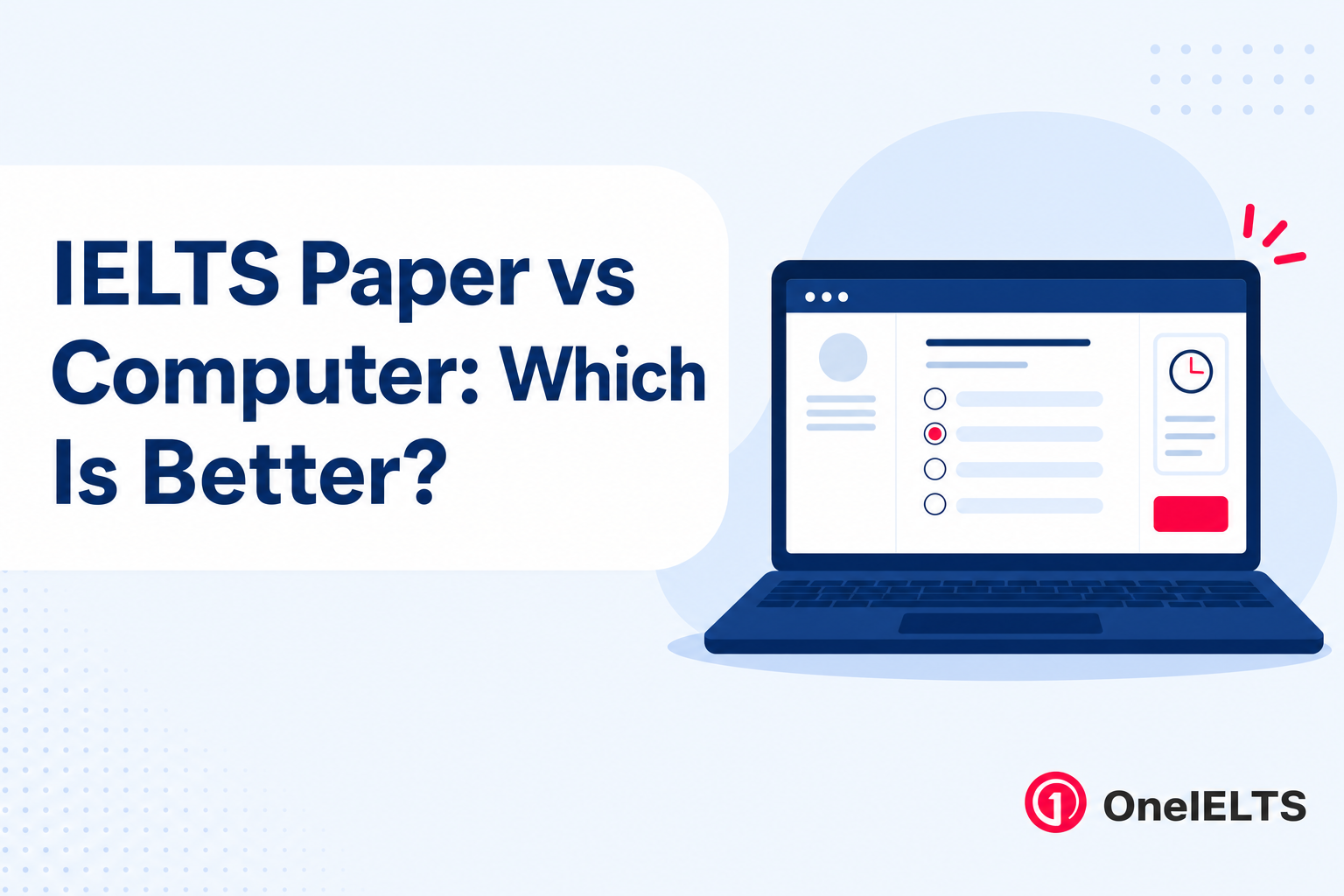
Choosing between the paper and computer IELTS comes down to one fact: the paper vs computer IELTS choice changes nothing about your score, because the content and identical scoring are the same on both. So you decide on results speed, test dates, and whether typing vs writing feels faster for you.
This guide defines both formats, sets out the key differences, weighs which is easier, lists the computer test’s drawbacks, and gives a verdict on which format suits which candidate.
Last verified: 30 June 2026
What Is the Computer-Based IELTS?
The computer-based IELTS is the same test taken on screen at an official test centre, where you read questions and enter answers using a keyboard and mouse instead of a pen. You sit Listening, Reading, and Writing at a workstation, and the Speaking test stays a face-to-face interview with an examiner.
Computer-delivered IELTS gives you faster results, usually within a few days, and more dates each month, often several sessions a day at busy centres.
What Is the Paper-Based IELTS?
The paper-based IELTS is the same test taken with pen and paper in an exam hall, where you write your answers by hand on printed question and answer sheets. You can annotate the Reading passages directly, underline key words, and jot notes in the margins as you go.
Many candidates prefer paper for its familiarity, since it mirrors the handwritten exams they took at school. Note that paper-based delivery is being phased out from mid-2026, so computer-delivered IELTS is becoming the standard way to sit the test.
How Do Paper and Computer IELTS Differ?
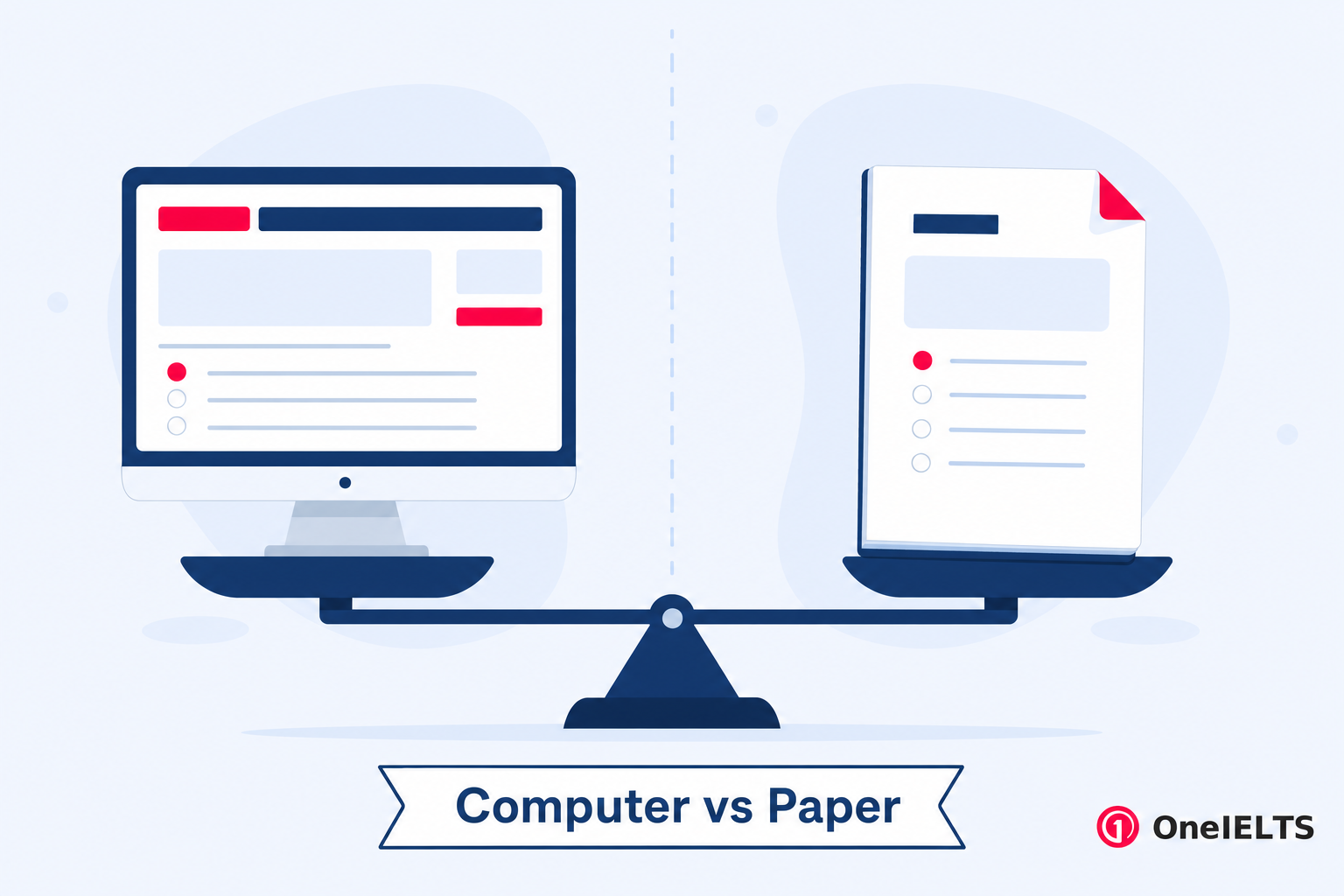
They differ only in medium, results speed, and test-date availability, since the questions, content, and identical scoring stay the same across both formats. The practical contrasts in results time, test dates, input method, and writing edits are set out in the table below.
| Aspect | Paper | Computer |
|---|---|---|
| Results time | About 13 days | 3-5 days |
| Test dates | Fewer fixed dates each month | Many dates, often several daily |
| Input method | Handwriting with pen | Typing on a keyboard |
| Writing edits | Cross out and rewrite by hand | Cut, paste, and edit on screen |
| Content & scoring | Identical content, same band scale | Identical content, same band scale |
Which Is Easier, Paper or Computer IELTS?
Neither is easier, because the questions and scoring are identical, so “easier” depends only on whether you read and type faster on screen or handwrite more comfortably.
The computer test gives you on-screen tools, an automatic word count in Writing, and highlighting in Reading that you tap to mark key phrases. Because the identical questions appear in both formats, your handwriting comfort or your typing speed is the only real variable. If your typing outpaces your writing, screen suits you; if not, paper does.
What Are the Pros and Cons of Each IELTS Format?
Both formats use identical questions and scoring, so the trade-off is comfort and speed, not difficulty. The pros and cons of each are set out below.
What Are the Pros and Cons of the Paper-Based IELTS?
Paper suits candidates who think better with a pen: you can annotate the Reading passages, underline key words, and it mirrors the handwritten exams from school. The trade-offs are slower results of about 13 days, fewer dates each month, edits made by crossing out on the page, and a phase-out from mid-2026.
What Are the Pros and Cons of the Computer-Based IELTS?
Computer returns results in 3-5 days, offers far more dates, and adds on-screen tools — an automatic word count in Writing and tap-to-highlight in Reading. The trade-offs are screen fatigue across a long session, lost time for slow typists, limited rough paper, and on-screen annotation that takes practice.
Which Should You Choose, Paper or Computer IELTS?
For most candidates the answer is now computer-delivered IELTS, because it returns results faster, offers far more dates, and is replacing paper from mid-2026. Your typing speed, results urgency, date availability, and personal comfort decide the rest. The match between candidate type and best format is mapped below.
- Need results fast. Choose computer if results urgency drives a tight application deadline, since scores arrive in days rather than two weeks.
- Want the soonest sitting. Choose computer when date availability matters, as centres run many more sessions than paper allows.
- Type faster than you write. Choose computer if your typing speed beats your handwriting, especially in the two Writing tasks.
- Prefer pen on paper. Choose paper while it lasts if handwriting comfort and marking the page outweigh speed for you.
Is the Computer IELTS Results Faster?
Yes, computer-delivered results arrive in 3-5 days versus about 13 days for paper, a gap that decides the format for anyone racing a deadline. That results speed matters when an application deadline for a university offer or visa closes within two weeks of your test date, since the slower paper turnaround can miss the cut-off entirely. You can confirm the current timeline and book a session on our computer-delivered IELTS page.
Is Scoring the Same for Paper and Computer IELTS?
Yes, the identical band scale and marking apply to both paper and computer IELTS, so your result means exactly the same whichever format you sit. That equal recognition means universities and immigration authorities accept either format on the same terms, and you sit the Speaking same way in both: a face-to-face interview marked against identical criteria. You can see how the nine-band scale works on our IELTS band score guide.
Practice for the Real IELTS Exam
Apply what you’ve learned with free, exam-style practice:
- Take a full IELTS mock test
- Practice by section: Listening, Reading, Writing, Speaking
- Structure your essays with IELTS Writing templates