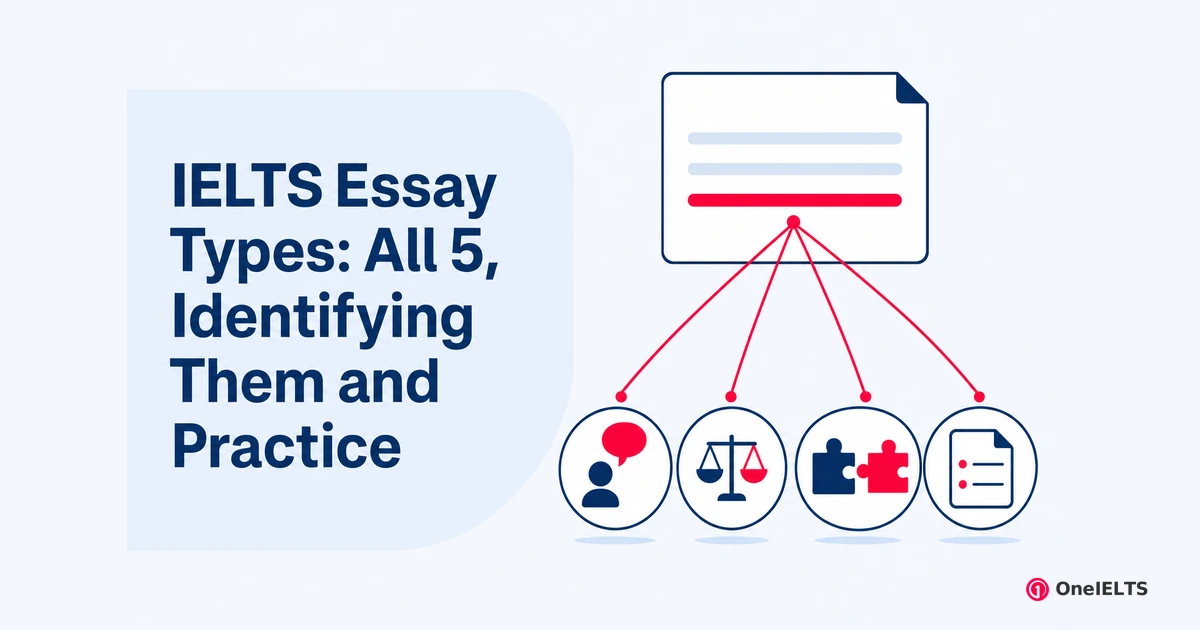
The AI summary above these results says five. The British Council says five. IDP publishes four pages on this question type and states no number on any of them, listing three, three, three and seven. The count is disputed, and the exam will never tell you which essay type you have been given.
This guide defines the grouping, works through the count, and sets the boards’ rival lists side by side. Then the five one at a time: opinion, discussion, advantages and disadvantages, problem and solution, two-part questions. It closes on reading the instruction wording, which type appears most often, how a type taxonomy error costs you against the task requirement, and practice.
What Are the Types of Essay in IELTS Writing Task 2?
An essay type is a grouping of Task 2 prompts by what the instruction asks you to do. State a view, discuss two views, weigh two sides, explain a problem and fix it, or answer two questions.
It is a teaching convention rather than an exam category, and one source in eleven says so. IELTS Liz writes that teachers sometimes divide essays into categories based on how they teach, so IELTS and teachers give essays different names and categorise them differently. No unofficial category comes with a board stamp on it.
She also states the operational consequence, and again she is alone in eleven pages. IELTS will not tell you which type of essay you are given, so self identification from the instruction is part of the task.
That leaves the instruction grouping worth precisely one thing. It is a shortcut for deciding what your answer has to contain, and the answer requirement is the only reason to learn a label at all.
How Many IELTS Essay Types Are There?
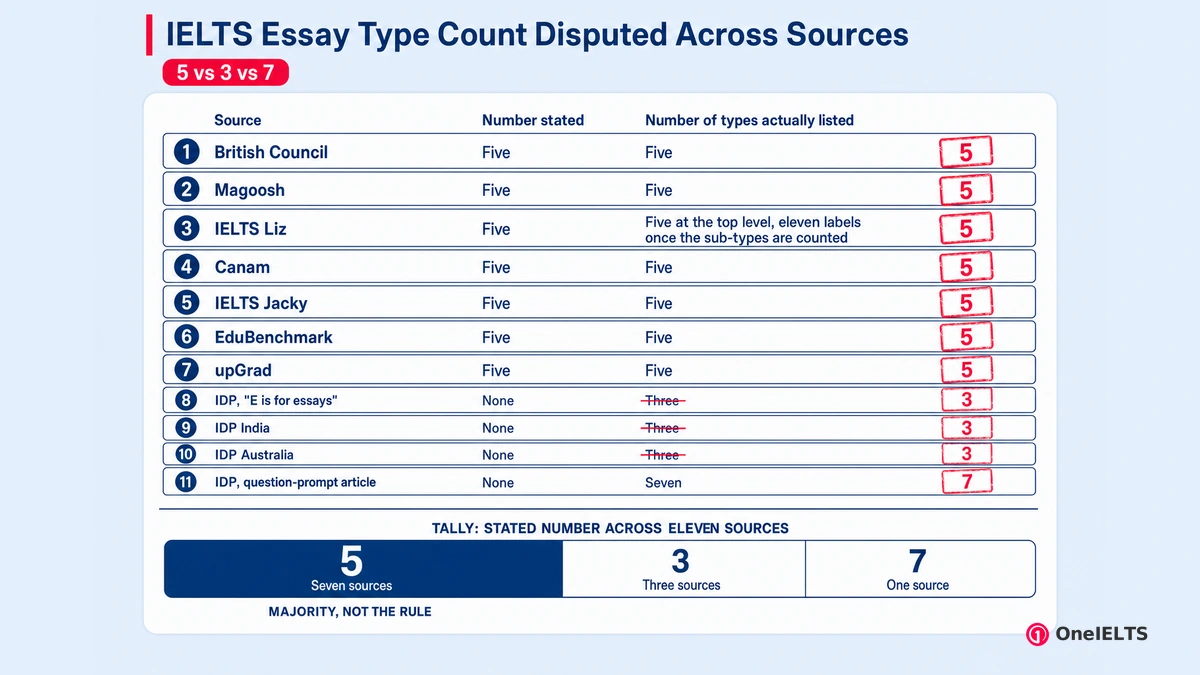
Most sources say five, and the number is genuinely disputed. Eleven captured pages give answers of three, five and seven, and the two exam boards do not agree with each other.
The demand is arguing too. Google’s own People-also-ask block on this search asks “What are the 5 types of IELTS essay?” and “What are the 4 types of essays?” in the same box.
The top People-also-search-for chip reads “7 types of essay in IELTS”, and that chip is an indexed search term in its own right. The AI Overview one line above all of it says five.
The table sets each source’s stated number against its listed number, meaning the types it goes on to name.
| Source | Number stated | Number of types actually listed |
|---|---|---|
| British Council | Five | Five |
| Magoosh | Five | Five |
| IELTS Liz | Five | Five at the top level, eleven labels once the sub-types are counted |
| Canam | Five | Five |
| IELTS Jacky | Five | Five |
| EduBenchmark | Five | Five |
| upGrad | Five | Five |
| IDP, “E is for essays” | None | Three |
| IDP India | None | Three |
| IDP Australia | None | Three |
| IDP, question-prompt article | None | Seven |
Two conclusions come out of that source spread and no more. Seven of eleven state five, so five is the working answer and the rest of this page uses it.
The second conclusion is the disputed count itself. All four IDP pages decline to state a number, three of them list three types and the fourth tabulates seven, so five is a convention rather than a rule. Magoosh adds one line worth carrying: both papers use the same set.
Are the Essay Types the Same in Academic and General Training?
Yes. The same set of instructions appears in both papers, and no page in the capture publishes a different list for General Training.
Magoosh states it explicitly, and it is the only page in eleven that answers the question at all. Both versions use the same five question types for Task 2. That makes it a captured claim rather than a board rule, and it is offered here as exactly that.
The paper difference sits elsewhere. What changes between Academic and General Training is Task 1, not Task 2. The handoff for the two papers is the IELTS Writing pillar.
Which Essay Types Do the Test Owners Name?
They name different sets, and one of them tells you not to use the sets at all.
The British Council names five: opinion, discussion, problem and solution, advantages and disadvantages, and the two-part question, each with a worked excerpt. The AI Overview on this very search points readers to the British Council blog for official guidance, and the guidance it points to is indeed the five.
IDP is where the board taxonomy breaks. Four IDP pages were captured. The global prepare page, the India blog and the Australia article each list three types: opinion, discussion and two-part questions. None of those three names an advantages and disadvantages type or a problem and solution type at all, and both are folded into a cause-plus-something table inside the two-part section.
The fourth IDP page tabulates seven types, adding multi-part, multi-part-and-opinion and positive or negative. Not one of the four states a number.
That fourth page also carries the sentence that reframes this whole topic, and nobody on the search quotes it. Rather than trying to match your answer to an essay-type category such as advantages and disadvantages or causes and solutions, learn to interpret what the question is asking so you answer it relevantly. A test owner is telling candidates that category matching is the wrong tool, on the same domain that runs three taxonomy pages.
Instruction interpretation is what it offers instead, and the practical reading is short. Use the five as a checklist for what your answer must contain, then drop the label and answer the instruction in front of you.
One grounding gap is worth recording. The string “ielts.org” returns zero on ten of the eleven captured pages, and the single hit is a sample question rather than a type list.
What Is an IELTS Opinion Essay?
An opinion essay gives you a statement and asks for your position on it. Your answer takes one side and holds it from the introduction to the conclusion.
The trigger wording is short and it comes in two forms: “To what extent do you agree or disagree?” and the blunter “Do you agree or disagree?”. Two IDP pages record the aliases, so a reader who met another name recognises it. These are the agree-or-disagree essay and the argumentative essay.
What the answer must contain fits in one line. A stated position, reasons that support it, and no drift into a balanced survey of both sides.
Position drift has a name on this search and Magoosh supplies it. Sitting on the fence means writing that there are advantages and disadvantages without taking a clear position, and examiners want to see your opinion. Fence sitting is the failure this type produces, and it costs Task Response rather than grammar.
How Do You Open an Opinion Essay?
Paraphrase the statement, then state your position in the same paragraph. The position sentence is what makes the opening an opinion opening rather than a generic one.
An opinion opening needs two moves, and here is what the capture supplies about them. Five sources publish a sample opinion introduction and none of them states a rule about where the position goes. The guidance here is the shared pattern those samples follow, described as that and nothing firmer.
One thing to avoid comes from Magoosh: a memorised opener is recognisable and it costs marks. Write the paraphrased statement from the prompt in front of you. The handoff for hooks, background sentences and thesis wording is the IELTS Writing Task 2 introduction page.
What Is an IELTS Discussion Essay?
A discussion essay gives you two views in opposition and asks you to discuss both. Almost always it also asks for your own opinion, and both halves are marked together.
The trigger wording barely varies: “Discuss both views and give your own opinion.”
One genuine disagreement between sources sits on this type. IDP Australia writes that when you discuss both perspectives in your body paragraphs you should refrain from mentioning your personal viewpoint there. Set that against an instruction that demands your opinion and the resolution is simple. The body paragraphs carry the reported view of each side, and your own opinion goes where the prompt asks for it rather than being scattered through both.
The failure here is a half answer. Discussing only one view fails the first instruction, and discussing both without ever answering the second instruction fails the other.
Which Linking Words Does a Discussion Essay Need?
A contrast marker between the two views and a single clear opinion signal where your own view starts. That is a smaller set than most word lists suggest.
Being honest about the source: no page in eleven publishes a per-type linking set, so what follows is function not list. It is the job the type needs done rather than words anybody has published for it.
Two functions cover it. A contrast word moves the reader from the first view to the second, and one opinion phrase marks the sentence where you stop reporting. The handoff for the words themselves is the linking words for IELTS page.
What Is an Advantages and Disadvantages Essay?
This type asks you to weigh two sides of a trend, and it comes in two versions that need two different answers. The difference between them is one word.
Both trigger wordings appear in the capture: “What are the advantages and disadvantages of…?” and “Do the advantages outweigh the disadvantages?”
IELTS Liz is the only source that separates them, and the split is the useful content here. The first version asks you to present both sides. The second, the outweigh prompt, asks you to decide which side is bigger and say so. Answering an outweigh prompt with a balanced survey has not answered the question, however well the survey is written.
The measurement makes the point sharper. The string “outweigh” returns zero on five of the eleven captured pages, so a candidate can read half this search and never meet the word that decides which side wins.
The one failure follows from the one word difference. Presenting both sides on a prompt that asked which one wins reads as a complete essay and scores as an incomplete answer.
What Is a Problem and Solution Essay?
This type names an issue and asks what causes it, what it leads to, or what should be done about it. Which of those three it asks for changes what your body paragraphs must contain.
The trigger wordings are captured in two lengths: “What are the causes of these problems and suggest solutions?” and the shorter “What are the causes and solutions?”
Two sources cut the sub split differently and both are worth knowing. EduBenchmark names three question types: problem plus solutions, cause plus solutions, and solutions only. IELTS Liz names four under her Solution Essays heading: solution only, cause solution, problem solution and cause effect.
Those two lists are not the same, and the difference is exactly where a candidate writes the wrong essay. A cause request wants the reasons, an effect request wants the consequences, and a solution request wants neither unless it asks for them. A prompt asking only for solutions does not want a paragraph explaining the problem.
IELTS Jacky records the aliases: these are also called causes and solutions or problems and solutions essays.
The one failure is the wrong half. Spending half the essay describing a problem the prompt only asked you to solve leaves the actual instruction under-answered.
What Is a Two-Part Question Essay?
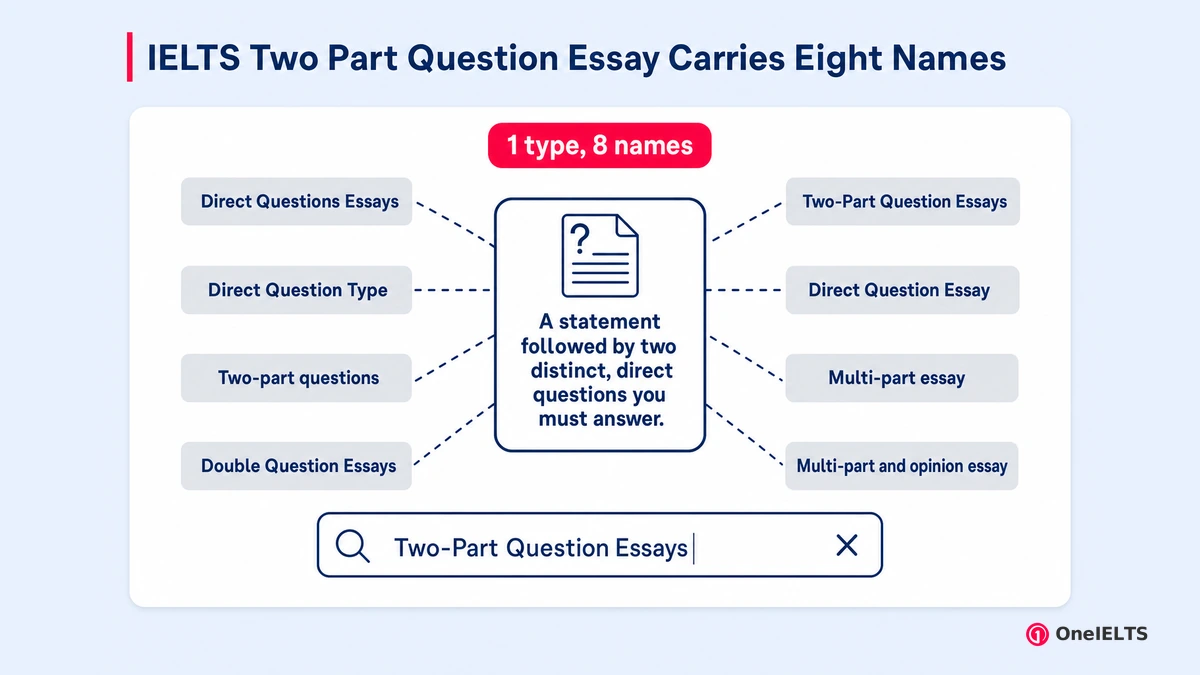
A two-part question gives you a statement and then asks two questions, separate and direct. Both answered at similar length is the requirement, and this is the type most likely to be half-answered.
The AI Overview describes the shape as a statement followed by two distinct, direct questions you must answer. IDP’s own worked example follows the same shape, pairing a why question with a question about effects.
The naming problem is this section’s real content, and it is fully measured. Across eleven pages this one type carries eight names. They are Direct Questions Essays, Direct Question Type, Two-part questions, Double Question Essays, Two-Part Question Essays, Direct Question Essay, Multi-part essay and Multi-part and opinion essay.
The counts turn that name variation into a search mismatch. The string “direct question” returns zero on six of eleven pages and “double question” returns zero on eight of eleven. A candidate searching one of those names will not reach the pages using another, which is why this type is the least reliably prepared of the five.
IDP’s two taxonomy pages add a sub-classification nobody else uses: cause plus opinion, cause plus effect, and cause plus solution.
The one failure is predictable, and it is a half answer. Answering the first question well and the second in a single sentence leaves half the instruction unaddressed.
How Do You Identify the Essay Type from the Question?
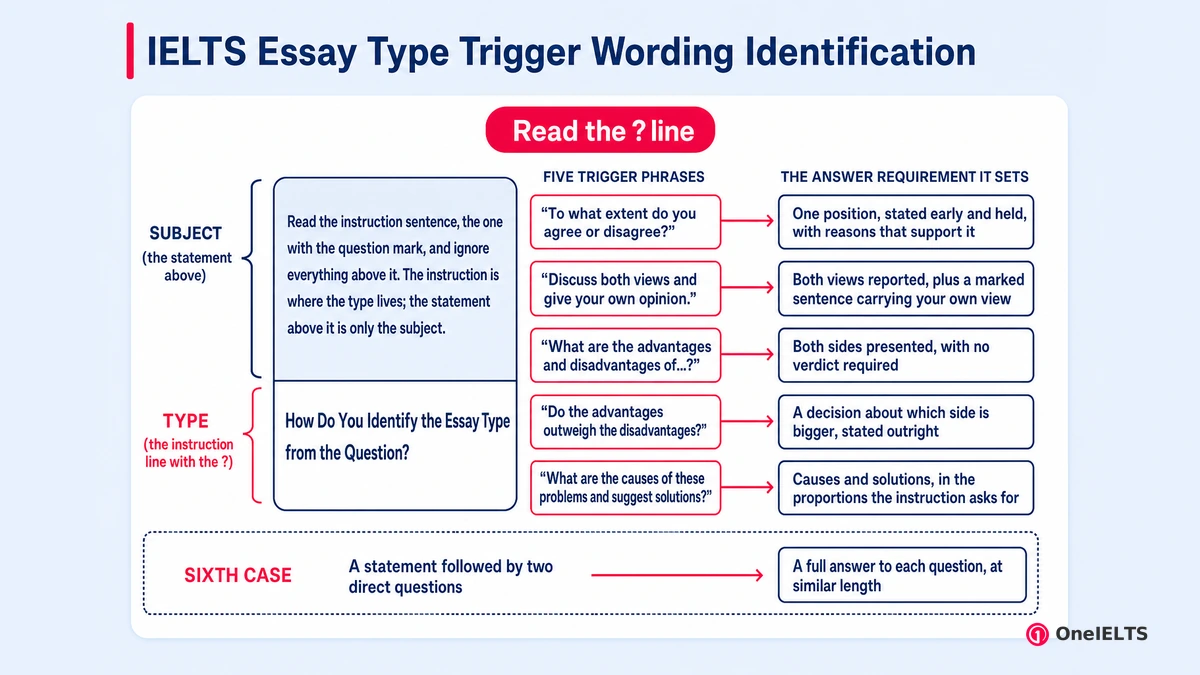
Read the instruction sentence, the one with the question mark, and ignore everything above it. The instruction is where the type lives; the statement above it is only the subject.
This section exists because almost nobody supplies it. The phrase “instruction words” appears on one of the eleven captured pages and appears once, “task words” appears on none, and only two pages publish a wording-to-type mapping at all.
Every trigger wording in the table is verbatim from the capture.
| What the instruction says | Type it signals | What your answer must contain |
|---|---|---|
| “To what extent do you agree or disagree?” | Opinion | One position, stated early and held, with reasons that support it |
| “Discuss both views and give your own opinion.” | Discussion | Both views reported, plus a marked sentence carrying your own view |
| “What are the advantages and disadvantages of…?” | Advantages and disadvantages | Both sides presented, with no verdict required |
| “Do the advantages outweigh the disadvantages?” | Outweigh | A decision about which side is bigger, stated outright |
| “What are the causes of these problems and suggest solutions?” | Problem and solution | Causes and solutions, in the proportions the instruction asks for |
| “Is this a positive or negative development?” | Positive or negative | A judgement, not a survey of both effects |
| A statement followed by two direct questions | Two-part question | A full answer to each question, at similar length |
IDP publishes the only board-level identification aid in the capture, and it is a question word list. Read the question words, meaning what extent, why, suggest, decide and evaluate, and answer relevantly.
The honest caveat belongs here too, and IELTS Jacky supplies it. Most questions fit one of these categories, but questions can be written in many ways and it can be hard to tell which type you have.
The fallback costs nothing. If you cannot name the type, write down what the instruction literally asks for and make sure your essay contains each item on that literal request. A fallback check like that is what stops a naming failure becoming a content failure.
EduBenchmark measures the error the section prevents. Incorrectly identifying the question is a common mistake among test takers.
Which Instruction Words Signal Each Essay Type?
Five short phrases carry almost all of it: agree or disagree, discuss both views, advantages and disadvantages, outweigh, and causes and solutions. Learn those five phrases and the sixth case is a statement followed by two question marks.
Every one of them is a verbatim instruction cue captured across the eleven pages rather than a paraphrase. Two of the five determine what your answer must do rather than merely what it is about, and those two are outweigh and the two-question shape.
One word changes an answer completely, and it is outweigh. That decisive word turns a presentation into a judgement. The handoff for structure and paragraphing is the IELTS Writing Task 2 hub.
Which Essay Type Appears Most Often?
Opinion, on the only three published estimates that exist. All three are unsourced, so read the ordering as a preparation hint rather than as a probability.
Three claims, each named so you can weigh it. Magoosh publishes figures in its scoring table, putting opinion at roughly 25 to 30 per cent and discussion at roughly 20 to 25 per cent. upGrad writes that opinion essays continue to appear more frequently than other types. Canam writes that opinion essays are the most common type in the exam.
Now the caveat, stated plainly. No board publishes a frequency. None of the three sources says where its figure comes from, and the two boards in this capture publish no frequency at all. Three agreeing guesses are still guesses, and no published estimate here rests on anything an examiner released.
The practical reading is short. Opinion and discussion between them are the safest start, because they cover most of what any unsourced figure claims. The two-part type is the one most worth a deliberate rehearsal, since it is the easiest to half-answer and the hardest to search for under a consistent name.
Which Topics Come With Each Essay Type?
Any of them. Task 2 uses the same five instructions across every subject, so the subject and the instruction vary independently and the same subject can arrive as any of the five.
That independent variation has a consequence for how you prepare. Preparing by type alone leaves you with shape without ideas, and preparing by subject alone leaves you with ideas without shape.
Separate preparation is the answer, since neither half substitutes for the other. The handoff for the subject side is the IELTS Writing Task 2 topics page.
Does the Essay Type Change How You Are Marked?
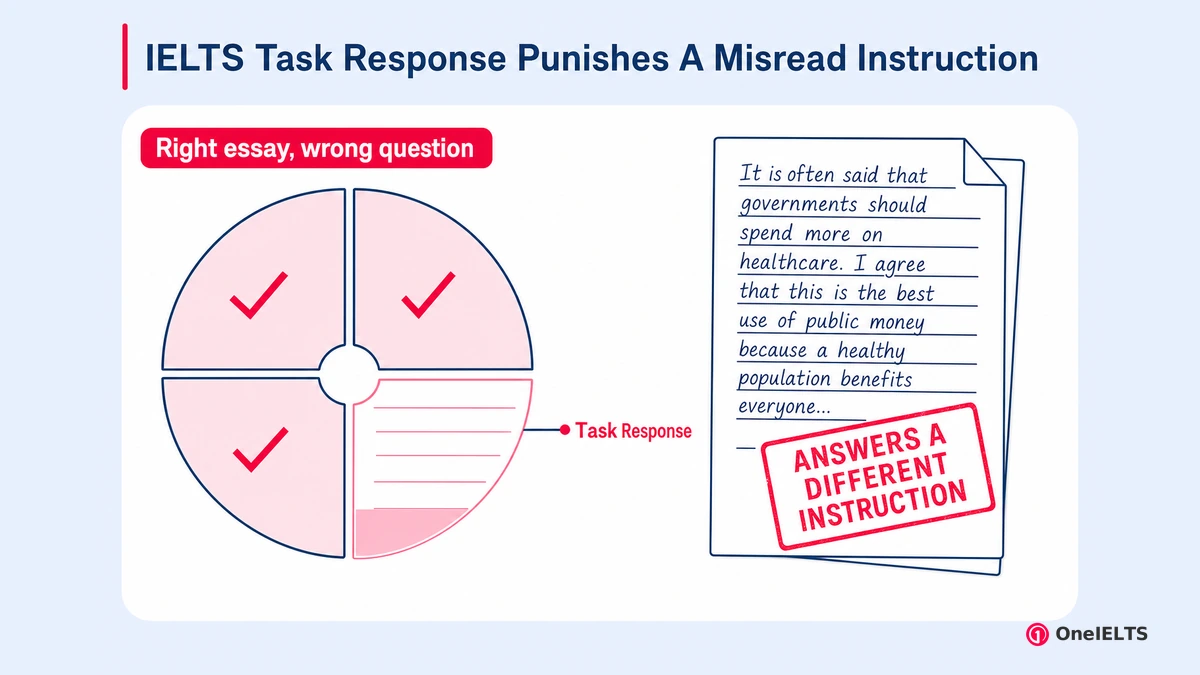
No. The four criteria are the same for every type, and one of them, Task Response, is where getting the type wrong costs you, because it measures whether you did what the instruction asked.
IDP states the mechanism. The examiner assesses how thoroughly you address the task in the Task Response criterion. Join that to this page’s subject and the instruction match is what carries the marks: a well-written essay that answers a different instruction loses in that criterion however good the language quality is.
Both IDP taxonomy pages corroborate it from the other direction. You may lose marks unnecessarily even if your grammar and vocabulary are good, because you did not understand what the task required. Neither of those pages says which type list to use, which is worth one dry sentence.
The criterion cost is discussed mostly by people who are not marking the papers. The string “task response” returns zero on both test-owner taxonomy pages and scores highest on a preparation site.
A type error is invisible until something scores it. A band estimate against the four criteria on a timed Writing mock test is what shows whether yours cost you.
How Do You Practise Each IELTS Essay Type?
Practise one type at a time with the filter on, then finish with a mixed set where the type is not announced, because the exam does not announce it either.
The routine runs on fifteen prompts rather than fifty, and the last two steps are the ones that matter.
- Choose one type and open three prompts of that type in a row. Write only the instruction sentence out by hand before you plan anything.
- Write one full essay from the set. Check it against the one thing the type demands, not against a template.
- Repeat with a second type until you have covered all five. Five types at three prompts each is fifteen prompts, not fifty.
- Now switch the filter off and open an unfiltered set. Name the type from the instruction BEFORE you read the rest of the prompt.
- If you cannot name it in ten seconds, write down what the instruction literally asks for instead. That list is what your essay has to contain.
Step 4 carries the point of the whole page. A filtered set teaches you the five answers and hides the one question the exam actually asks, which is which of the five this is. The unfiltered set is where the identification drill happens, and identification is the gap this page was written to fill. The habit it builds is instruction first, prompt second.
The prompts for step 4 come from the unfiltered IELTS Writing Task 2 practice hub, where the type is not labelled for you.
The filtered sets cover steps 1 to 3, one type each. Start with the opinion essay set. Then move to discussion.
Third comes advantages and disadvantages. Fourth is problem and solution.
The two-part set is filtered as double question essays. That label is one of the eight names this type carries, and the filter had to pick one of them.
Practising needs a free OneIELTS account. The grid is browsable when you are logged out, and opening a set is what requires signing in.
Written by Jamil Ahmed, reviewed 14 August 2026.
Last verified: 14 August 2026
Practice for the Real IELTS Exam
Apply what you’ve learned with free, exam-style practice:
- Take a free IELTS mock test — all four skills, real exam timing, AI band scoring
- Sit a Writing section mock — Task 1 and Task 2 in one timed hour with a band estimate
- Practise by question type — self-paced Writing sets with model answers