


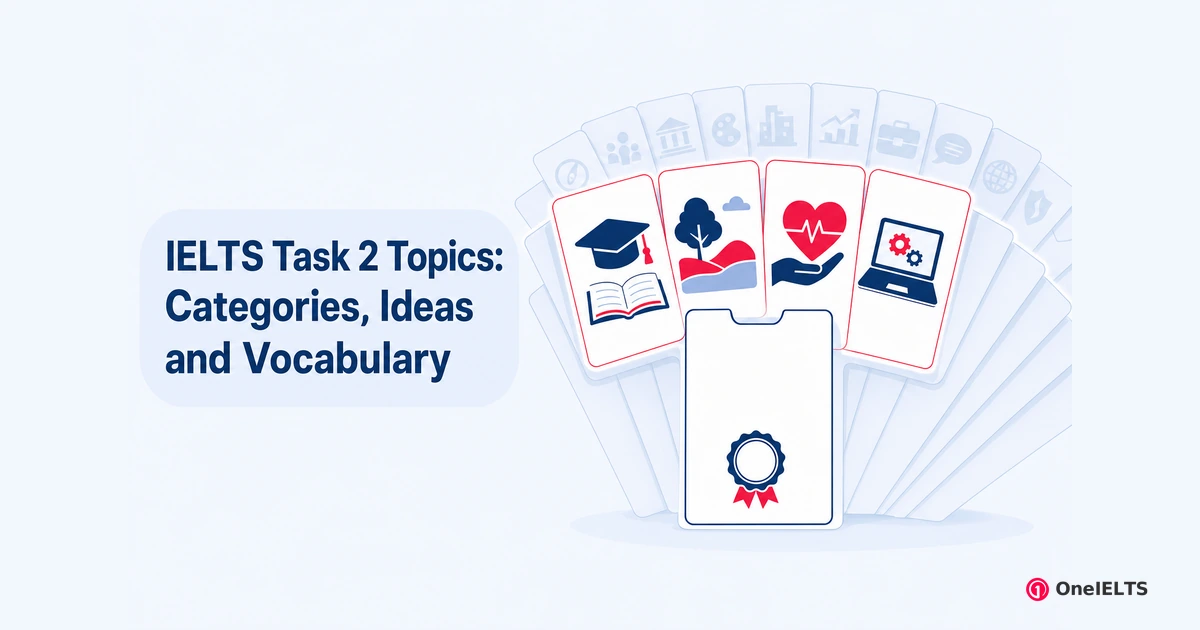
Twelve pages on this search publish a category list and they run from five items to twenty-two. Neither exam board publishes one at all. Four subjects appear in all twelve, namely education, environment, health and technology, and no other topic category is agreed.
This guide defines the object, counts the published lists, and names the four. Then what the official site actually publishes, the essay topic against question type confusion, where recent topics come from, how to generate ideas, and the vocabulary each subject needs. It closes on the two papers, whether topics repeat, the easiest topics to start with, topic scope, and practice.
What Are IELTS Writing Task 2 Topics?
A Task 2 topic is the subject matter a prompt is about, such as education, the environment or technology. It is not the same thing as the question you are asked about that subject.
The exam board describes the task and never names a subject. In Task 2 you are given a point of view, argument or problem which you need to discuss. That is the whole of the board wording on what arrives in front of you.
Two things are travelling together in every prompt. The subject matter is what the prompt is about, and the prompt wording is what it asks you to do with that subject. They vary independently, and the section further down works through why that matters.
One topic scope rule does come from ielts.org, and it is the sentence that makes a category list useful rather than decorative. If a prompt narrows a wide subject to one aspect, answer only that aspect. Answer relevance is graded: you will be penalised if what you write does not relate to the topic.
How Many Topic Categories Are There in IELTS Writing Task 2?
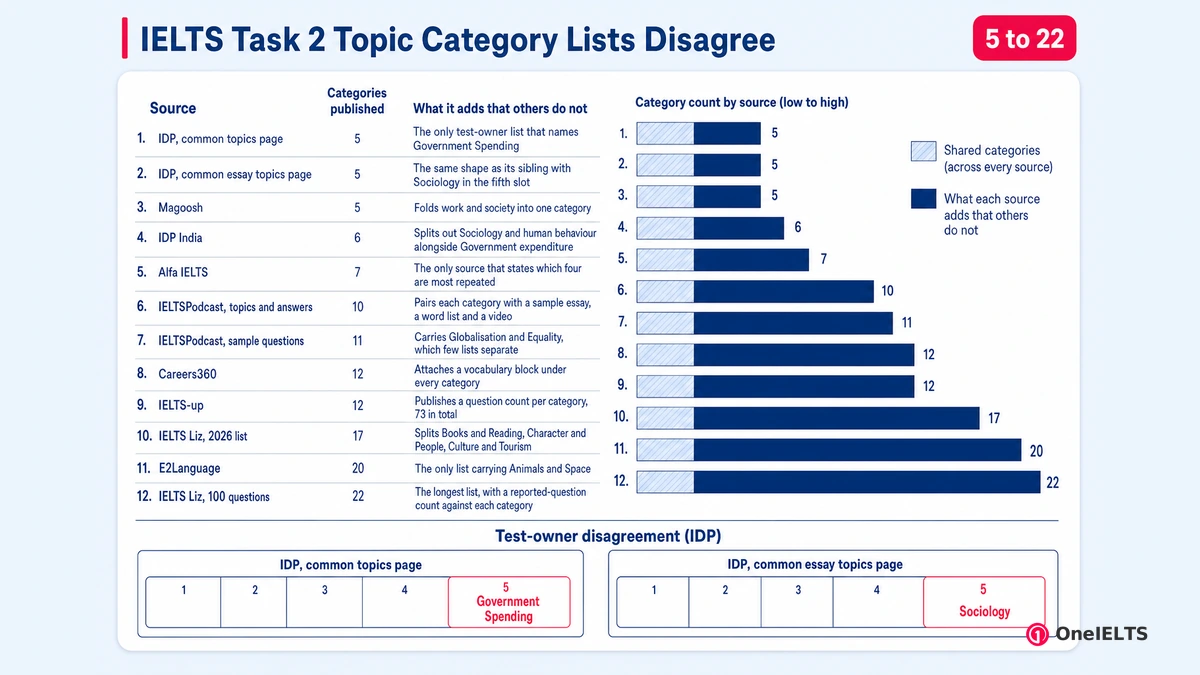
There is no agreed number. Twelve of the nineteen pages that rank for this query publish a category list, and those lists run from five items to twenty-two. The exam board publishes none, so every one of them is a third party’s guess.
The published count on each of the twelve, in order: 5, 5, 5, 6, 7, 10, 11, 12, 12, 17, 20 and 22. List length varies by a factor of 4.4, and that category spread goes unacknowledged on every one of them.
| Source | Categories published | What it adds that others do not |
|---|---|---|
| IDP, common topics page | 5 | The only test-owner list that names Government Spending |
| IDP, common essay topics page | 5 | The same shape as its sibling with Sociology in the fifth slot |
| Magoosh | 5 | Folds work and society into one category |
| IDP India | 6 | Splits out Sociology and human behaviour alongside Government expenditure |
| Alfa IELTS | 7 | The only source that states which four are most repeated |
| IELTSPodcast, topics and answers | 10 | Pairs each category with a sample essay, a word list and a video |
| IELTSPodcast, sample questions | 11 | Carries Globalisation and Equality, which few lists separate |
| Careers360 | 12 | Attaches a vocabulary block under every category |
| IELTS-up | 12 | Publishes a question count per category, 73 in total |
| IELTS Liz, 2026 list | 17 | Splits Books and Reading, Character and People, Culture and Tourism |
| E2Language | 20 | The only list carrying Animals and Space |
| IELTS Liz, 100 questions | 22 | The longest list, with a reported-question count against each category |
The source disagreement gets worse when one publisher argues with itself. IDP runs two topic pages in this cluster and its own two five-item lists differ in the fifth item. One names Government Spending, the other names Sociology.
The machines disagree the same way. Two AI Overviews captured on the same day on two sibling searches gave two different top-five sets. One names Work and omits Government; the other names Government and Crime and omits Work. Neither cites a test owner.
The disagreement sits at the edges rather than the centre, which is what makes the next section worth reading.
Which Essay Topics Are Most Common Across the Lists?
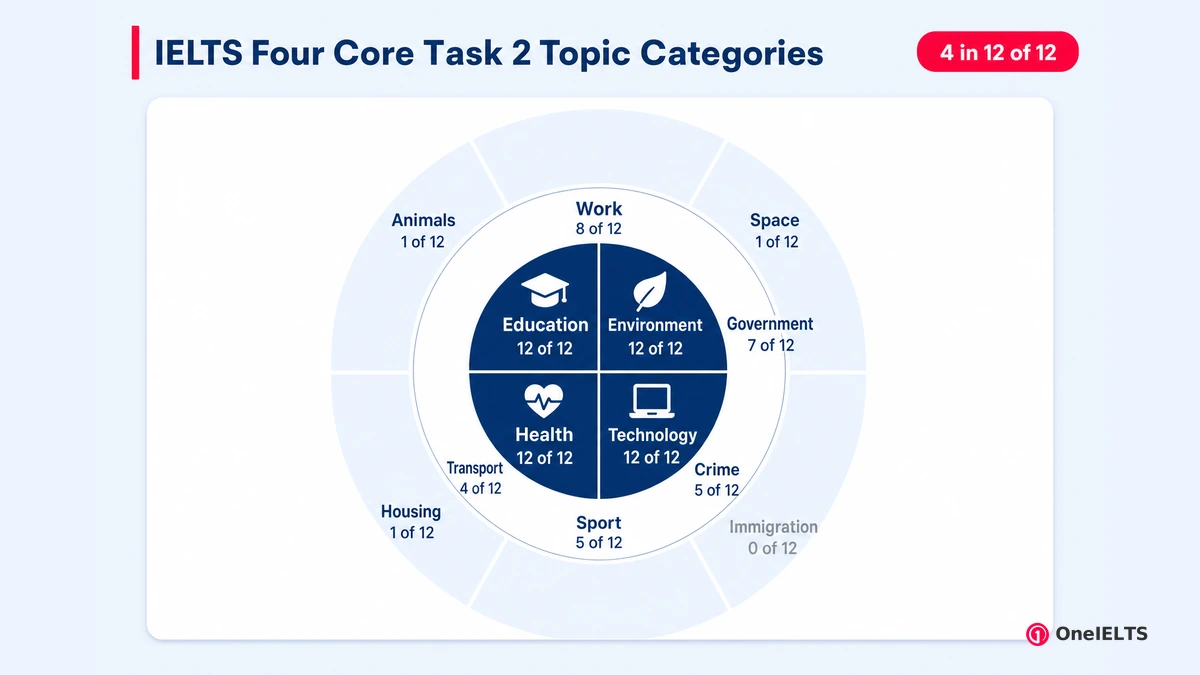
Four: education, environment, health and technology. They are the only categories appearing in all twelve published lists, so they are the only four worth preparing before anything else.
- Education. In every one of the twelve lists, and the AI Overview’s sub-themes for it are online versus traditional classrooms, free university access, and uniforms and discipline. Every candidate has sat in a classroom, which is why this is the cheapest category to prepare.
- Environment. Also in all twelve. Its captured sub-themes are climate change responsibility, economic growth against green policies, and single-use plastic bans, which is the one core subject where a weak answer usually fails on missing specifics.
- Health. In all twelve, and its sub-themes stay close to daily life: public healthcare funding, fast food taxes and sedentary lifestyles. The everyday version of the subject needs no data, which makes it easy to argue from experience.
- Technology. In all twelve, with sub-themes of artificial intelligence and automation in jobs, screen time effects on young people, and data privacy and security. The examples for this core category are already in the reader’s hand.
Everything past those four is a contested category, and the list overlap thins fast. Work or employment appears in eight of twelve, government in seven, crime in five, sport in five, transport in four, and globalisation, art, media, family and food in three each. Money appears in two.
The tail is the cheapest thing on this page to act on. Animals, space and housing appear on one list each, and immigration appears on none, so category frequency puts them below the preparation priority line.
One source corroborates the four, and one is all there is. Alfa IELTS writes that education, technology, environment and health are the most repeated IELTS Writing Task 2 topics. A single agency sentence is the entire published support for the strongest pattern on this search.
Does the Official IELTS Website List Any Task 2 Topics?
No. Neither exam board publishes a topic list, and that single fact explains every disagreement above.
Look at what each board publication actually contains. The ielts.org Academic Writing format page gives the marking, the two tasks, the skills tested and the word count, and names zero categories. The British Council’s Task 2 guide gives the five essay types with worked excerpts, and names zero categories either.
Then the measured absence, which is the strongest claim on this page. The line everyone attributes to the boards, that Task 2 topics are of general interest and require no specialist knowledge, appears on no page in the nineteen captured. “Topics of general interest” returns zero on all nineteen. “Specialist knowledge” returns zero on all nineteen.
That absence is measured in this capture rather than across everything either board has ever printed. Both boards’ own pages are inside the nineteen.
What ielts.org does publish is worth more than a list. Focus only on the narrow aspect a prompt names, because an answer that does not relate to the topic is penalised.
The practical consequence is one line. A category list is a preparation aid built by teachers from reported questions, so the rule is probability not syllabus.
How Do Essay Topics Differ from Essay Types?
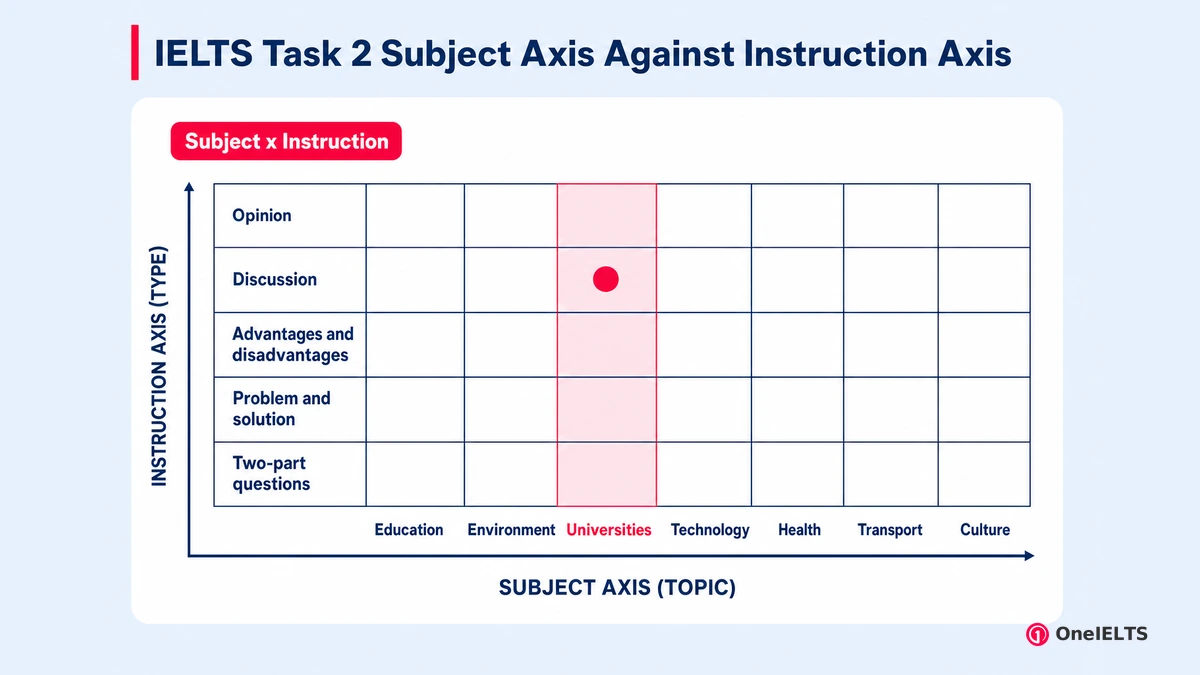
The topic is what the prompt is about; the question type is what you are asked to do with it. Education is a topic. Discuss both views is a question type. Every prompt carries one of each.
The subject axis and the instruction axis move separately, and one worked pair shows it. Free university access can arrive as a prompt asking whether you agree that tuition should be free, or as a prompt asking you to discuss both views on public funding for universities. The essay you write changes completely while the ideas you need stay the same.
That independent variation is exactly what this search keeps collapsing. writing9 ranks third on this query with a page that is a question type, opinion, published under a topics URL. My IELTS Classroom’s page is titled “100 IELTS Essay Topics” and every one of its nine sections is a question type. Engnovate filters 37,593 prompts by type and offers no subject taxonomy at all.
Three of the twenty-four live related-search chips ask for a topic list filtered by question type, so readers are making the same prompt pairing error the pages are.
The confusion costs something concrete, and the preparation split is the fix. A candidate who prepares by type learns essay shapes and arrives with no ideas. A candidate who prepares by topic arrives with ideas and no shape.
What Are the Five Types of IELTS Essay?
Five: opinion, discussion, advantages and disadvantages, problem and solution, and two-part questions. That is the type name set, and this section stops there.
One disagreement is worth knowing because you will meet it. The British Council’s own guide names five types, and an AI Overview captured on a sibling search named four, dropping two-part questions. The board count and the machine summary do not match.
Five types is the working answer. The handoff for what each one demands is the IELTS essay types page.
Where Can You Find Recent Task 2 Topics?
From reported questions, and you check the date on the page rather than the date in its title. On this search those two are frequently not the same.
Four kinds of source exist, and each one fails differently.
- Teacher-maintained reported archives, where a named author curates what students report. These carry the tightest wording and the smallest volume, and IELTS Liz’s own caveat is that questions have been recreated as accurately as possible.
- User-submitted month-by-month boards. IELTS Buddy states in its own opening that what is posted is just a selection, because the test now runs most days and no board could keep up with it.
- Candidate forums, where two separate r/IELTS threads and a Quora question rank organically on the sibling head, with six individual Reddit comments indexed as results in their own right.
- The Cambridge past paper books, which My IELTS Classroom names as by far the best resource for authentic IELTS essay topics. These are the only source in nineteen with a publisher behind the wording.
The dateline check is really an archive freshness check, and the recency is theatre in three measured cases. IELTSPodcast’s page title reads “Recent Exam Topics (2026)” and its newest dated archive block is January 2024. E2Language’s article dateline is June 2022. IELTS-up’s footer copyright reads 2015-2019, and it is still cited inside an AI Overview.
My IELTS Classroom gives the warning nobody else does. Many of the IELTS questions circulating online are worded incorrectly, which is why a forum thread or an archive is a topic signal rather than a practice prompt.
This page publishes no archive of its own, because a list of recent questions is stale within a month.
Are the Expected Topics for 2026 Worth Studying?
Read them, do not bank on them. A year label tells you which subjects were in circulation recently, which is genuinely useful, and it does not tell you what you will be given.
The prediction disclaimer comes from the pages selling the year. IDP writes that you can never predict the questions you will encounter. writing9 states that its questions are not predictions. IDP India calls the specific question uncertain. The same pages do both jobs at once.
One counter-observation makes the circulation signal worth something. IELTS Liz notes that IELTS nearly always bases its essay topics on current world issues, so news tracking is what a year list actually supports. The handoff for planning that reading is the IELTS writing tips page.
How Do You Generate Ideas for Any Task 2 Topic?
You do not learn topics. You build a small stock of transferable positions and examples per category, and four categories is enough to start.
The gap here is measured. The word “brainstorm” appears on one of the nineteen pages captured. The closest thing to a method anywhere on this search is a single line on a page last updated in 2019: remember some key ideas and vocabulary for each topic. This search sells inventories and withholds the method.
The routine takes one core category at a time.
- Take one core category and write the two positions a reasonable person could hold on it, in one sentence each, without looking anything up.
- Attach one concrete example to each position. A named policy, a familiar situation or a number you already know is enough for both.
- Write the one concession sentence that admits what the other position gets right, because every question type on this task can use it.
- Open a second prompt in the same category and reuse all four pieces. Change the wording, not the category stock you just built.
- Note anything you had to invent on the second prompt, because that is the hole in the category rather than a language problem.
Two techniques are actually published, and Alfa IELTS supplies both. A brainstorm step dumps everything you have on a subject, and a mind map branches outward from the subject name.
Aspect narrowing is where a good stock most often goes wrong. A prepared set of ideas about a wide subject still has to be cut down to the aspect the prompt names, and an answer that drifts back to the wider subject is penalised.
Which Brainstorm Method Suits a New Topic?
The one that produces two opposing positions fastest, because an unfamiliar subject is a problem of ideas rather than of language.
The two published methods differ in practice, and Alfa IELTS separates them. An idea dump puts everything on paper and sorts afterwards, which suits a subject you already know. A branching map starts from the subject name and forces you outward, which suits one you do not.
E2Language offers the only fallback on this search for a genuinely unfamiliar subject: if you are not familiar with a topic, look it up. That is a preparation instruction and not an exam-room one. The handoff for planning time inside the hour is the IELTS Writing Task 2 hub.
Which Vocabulary Does Each Topic Need?
A small functional set per category, not a long word list. Roughly fifteen to twenty words that let you name the actors, the mechanism and the consequence inside that subject.
Supply is thin and it is countable. The phrase “topic vocabulary” appears on two of the nineteen pages. Only two sources pair words to categories at all: Careers360, which puts a vocabulary block under each of its twelve categories, and Alfa IELTS, which publishes three vocabulary sections covering education, environment and health. Everyone else lists topics and stops.
Each core category needs the same three word functions rather than the same words.
- Education. Who acts is the institution, the teacher and the learner. The mechanism is funding, access and assessment. The outcome is attainment, and the subject register here is closer to policy than most candidates expect.
- Environment. Who acts is the government, the industry and the household. Cause language covers emission, consumption and waste. Consequence language covers the depletion, the damage and the recovery that follow from those.
- Health. Who acts is the state, the provider and the patient. The mechanism is funding, prevention and treatment. The outcome runs from life expectancy down to the everyday cost of a diet.
- Technology. Who acts is the platform, the employer and the user. The mechanism is automation, data collection and access. The consequence language covers displacement, privacy and dependence, in that subject’s own register.
A functional set beats a long list for one reason. A Task 2 essay has to name a cause and a consequence in the subject’s own wording, and a fifty-word alphabetical list supplies neither reliably under timing.
Where Can You Build Topic Vocabulary for Task 2?
Build it per category, from reading about that category, and keep it small enough to recall under timing.
IDP offers the reading input method. All of these subjects are commonly found in the news, so reading the news is a way to get a sense of how each one is discussed. Collocation pickup is what that gets you and a word list does not, because you see the words in the company they keep.
Careers360 supplies the one pairing model worth copying: category pairing rather than an alphabet, with the words attached to the subject they serve. Recall size is the constraint that keeps it honest. The handoff for building the words themselves is the IELTS vocabulary list page.
Are Task 2 Topics the Same in Academic and General Training?
The task is the same and the subject pool overlaps heavily, while General Training prompts sit closer to everyday life and Academic prompts lean towards abstract and societal framing.
Three sources provide support for the paper overlap. Magoosh publishes “Is Task 2 the same for Academic and General Training?” as its own FAQ heading. E2Language states that its twenty topics appear in the IELTS General and IELTS Academic exams. Alfa IELTS gives the comparison a section of its own.
The evidence limit is worth stating plainly. The capture supports an overlap claim and a framing difference. It does not support a per-category split between the two papers, and no page in nineteen publishes one.
One real difference is not a topic at all. The General Training paper pairs this essay with a letter rather than with a data description, so the paper pairing changes how the hour is spent.
Everyday framing and societal framing are the same subjects seen from different distances, which is what the next section works through.
Which Topics Appear in General Training Task 2?
The same core four, arriving in a more everyday register. The same subject is asked about in terms of families, workplaces, neighbourhoods and services rather than in terms of policy.
Being exact about what the capture supports: E2Language’s twenty-item list is written for both papers explicitly, and no page in nineteen publishes a General-Training-only category list. So the honest answer is a register shift on a shared pool rather than a separate pool.
One contrast shows the shift. Policy framing asks whether governments should fund public healthcare; household framing asks whether families should pay more for a healthier diet. The handoff for the two papers is the IELTS Writing pillar.
Are IELTS Essay Topics Repeated?
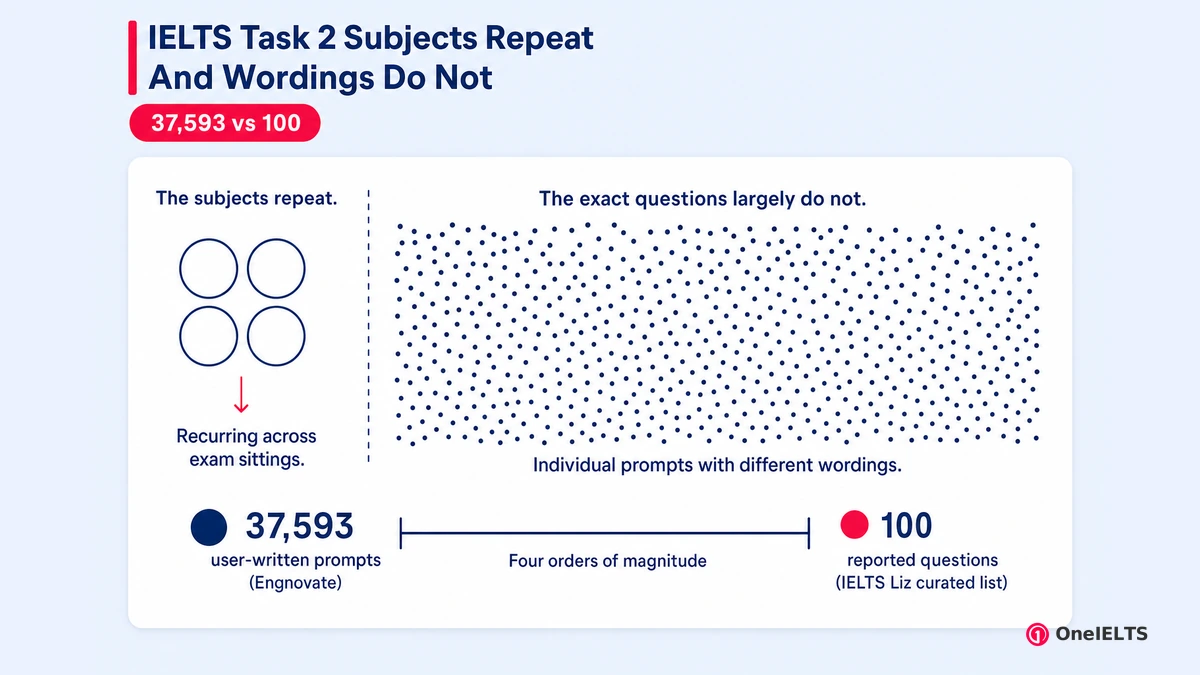
The subjects repeat and the exact questions largely do not. Most preparation goes wrong in the gap between those two statements.
Four sources make the subject recurrence claim. IDP India writes that essay topics tend to repeat across exams, just with a new twist. Alfa IELTS writes that many common topics are repeated in the test in different forms. IELTS-up writes that its questions are often used, though sometimes with a little variation. writing9 writes that its questions could be repeated from previous months and, in the same breath, that they are not predictions.
The arithmetic settles the wording variation. Engnovate lists 37,593 user-written prompts. IELTS Liz’s curated list carries 100 reported questions and IELTS-up’s carries 73. Four orders of magnitude sit between the largest prompt corpus and the largest curated list.
A subject recurs and a wording rarely does. Memorising a question is worthless and memorising a subject’s ideas is not, which is why four core categories are worth the preparation time and a twenty-two-item list is not.
Magoosh adds the warning that closes it. A memorised phrase is detectable, and openers of that kind cost marks rather than earning them.
If the exact wording cannot be predicted, the only preparation that transfers is writing a whole paper to time on a prompt you have never seen. That is what a full Writing mock test gives you.
Which Task 2 Topics Are Easiest for Beginners?
Education first, then health, then technology, then environment. The ordering basis is how much a candidate already knows without research, not how often each appears.
The section exists because the demand does and no page serves it. “For beginners” appears as a related search on two of the three live searches captured, and not one of the nineteen pages orders its categories by difficulty or uses the word in a heading.
- Education, first. Every candidate has been through a school system, so prior knowledge is already in place and the two positions on almost any education prompt can be argued from personal experience rather than from research.
- Health, second. The everyday version of the subject covers diet, exercise and cost, and none of those needs a statistic. Specific detail here comes from ordinary life rather than from a report you have to remember.
- Technology, third. The examples are in the reader’s hand, which makes the concrete half easy. The abstract half, meaning data and automation policy, takes a little reading before the positions feel solid.
- Environment, last. Its everyday framing is thin, and it is the one core subject where a weak answer usually fails on missing specifics rather than on language, so it rewards preparation more than instinct.
The capture offers one thin corroboration, named as one source. Careers360 calls education a simple essay topic and one of the most repeated. That is a single sentence from a single portal.
This ordering is a preparation sequence, not a difficulty ranking anybody has published. No exam board ranks its subjects, and the contested categories are left out of it because the capture does not support extending the order to them.
How Do You Practise IELTS Writing Task 2 Topics?
Practise by category, not by question. Take one of the four core subjects, write on two different prompts inside it, and check whether the same positions and examples carried across.
The routine below is a category drill, and its whole value sits in the second prompt.
- Pick one core category and write your two positions and two examples on paper before you open any prompt at all.
- Open a Task 2 prompt in that category and write the full essay to time, using the position stock you just wrote down.
- Open a second prompt in the SAME category and write again. Do not change your stock between the two.
- Compare the two essays. Anything you had to invent on the second attempt is a hole in the category, not a language problem.
- Only when a category survives two prompts, move to the next one. Four categories done properly beats twenty-two skimmed.
Step 4 is the transfer test and it needs its reason stated. Stock reuse across two different prompts in the same category is the only evidence that you prepared a subject rather than memorised an answer, which is the failure this whole page argues against.
The prompts for steps 2 and 3 come from IELTS Writing Task 2 practice, filtered to Task 2 so every set you open is an essay. Practising needs a free OneIELTS account. The grid is browsable when you are logged out, and opening a set is what requires signing in.
Written by Jamil Ahmed, reviewed 14 August 2026.
Last verified: 14 August 2026
Practice for the Real IELTS Exam
Apply what you’ve learned with free, exam-style practice:
- Take a free IELTS mock test — all four skills, real exam timing, AI band scoring
- Sit a Writing section mock — Task 1 and Task 2 in one timed hour with a band estimate
- Practise by question type — self-paced Writing sets with model answers