Map labelling questions hand you a park, campus, or floor plan and ask you to write the right place beside each letter as the speaker walks you through it. The trick is simple once you see it: this is a navigation task, not a vocabulary one. The recording narrates a route in real time, so you track directional language from a fixed orientation point rather than waiting to recognise place names. This guide covers what these questions are, how to approach them, the spatial vocabulary that decides the answers, why students lose marks, what a real map looks like, the best tips, and how to practise. You will also see how plan labelling and directions work inside Section 2.
What Are IELTS Listening Map Labelling Questions?
Map labelling asks you to label places on a map or plan as a speaker describes their location or a route, matching each gap to the spot the audio points to. The answers are usually given to you as a box of options or as letters printed on the map. So you slot names into positions rather than spelling new words.
This task appears in the Listening test, most often in Section 2, where one speaker gives a monologue such as a tour introduction. Because the speaker moves through space, you follow directions in sequence from one orientation point to the next. Plan labelling rewards candidates who keep pace with the route instead of guessing from prior knowledge.
How Do You Approach Map Labelling Questions?
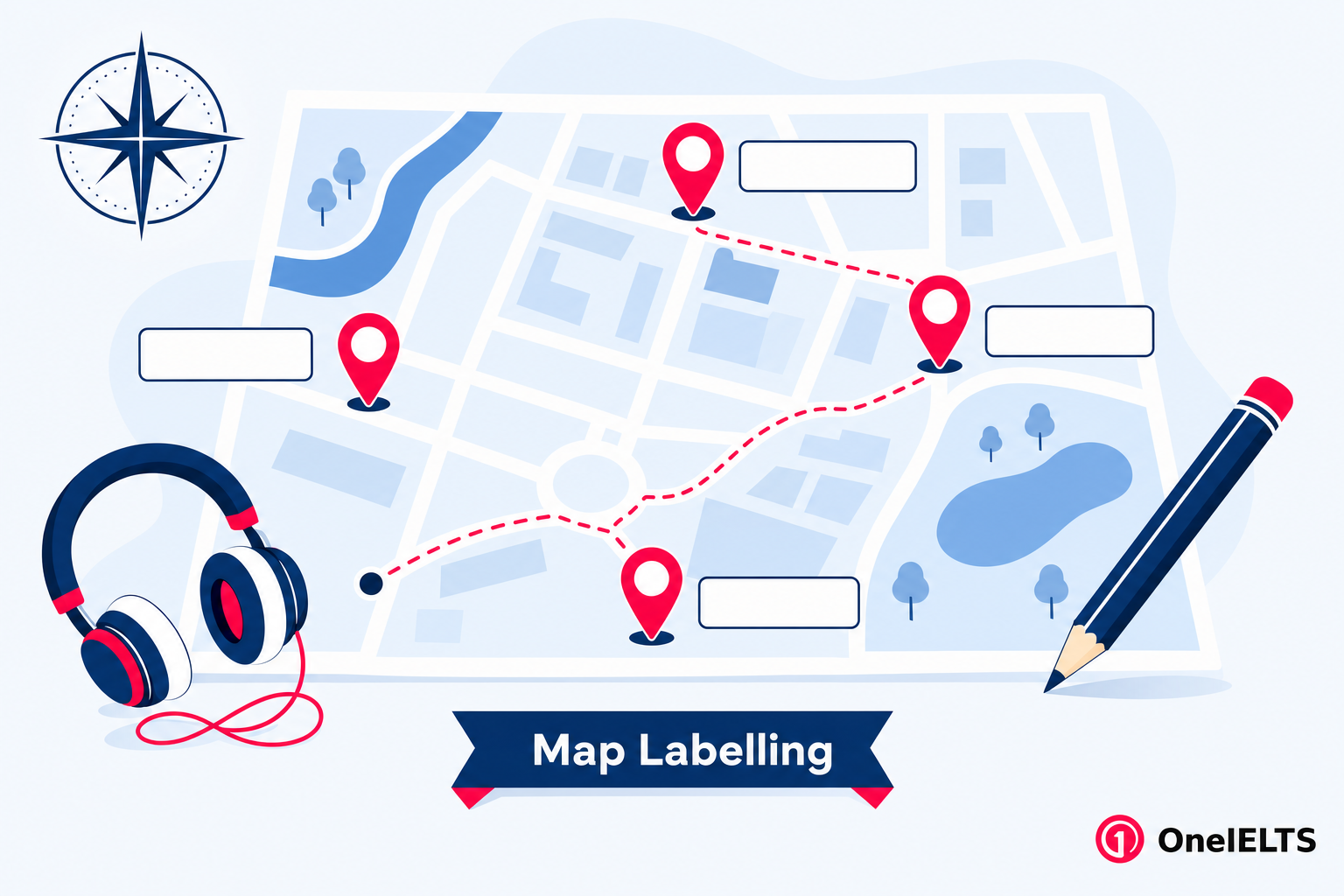
A reliable approach treats the map as a set of fixed reference points and the audio as a moving pointer, so you anchor yourself first and move only when the speaker does. Use the preparation seconds before the recording to read every label and find the compass. The four steps below turn that habit into a routine.
- Orient the map. Before the audio starts, find the compass or the entrance arrow so you know which way is north and where a visitor would stand to begin.
- Find the starting point. Listen for the fixed starting point the speaker names first, usually “we are standing at the main gate” or “you can see reception here,” and put your pen there.
- Follow directions. Track each instruction in order and follow directions step by step across the map, moving your pen one phrase at a time rather than scanning ahead to a likely answer.
- Label as you hear. Write each answer the moment it is described, because if you label as you hear it you stay locked to the route and never confuse two nearby locations.
What Directional Language Should You Know?
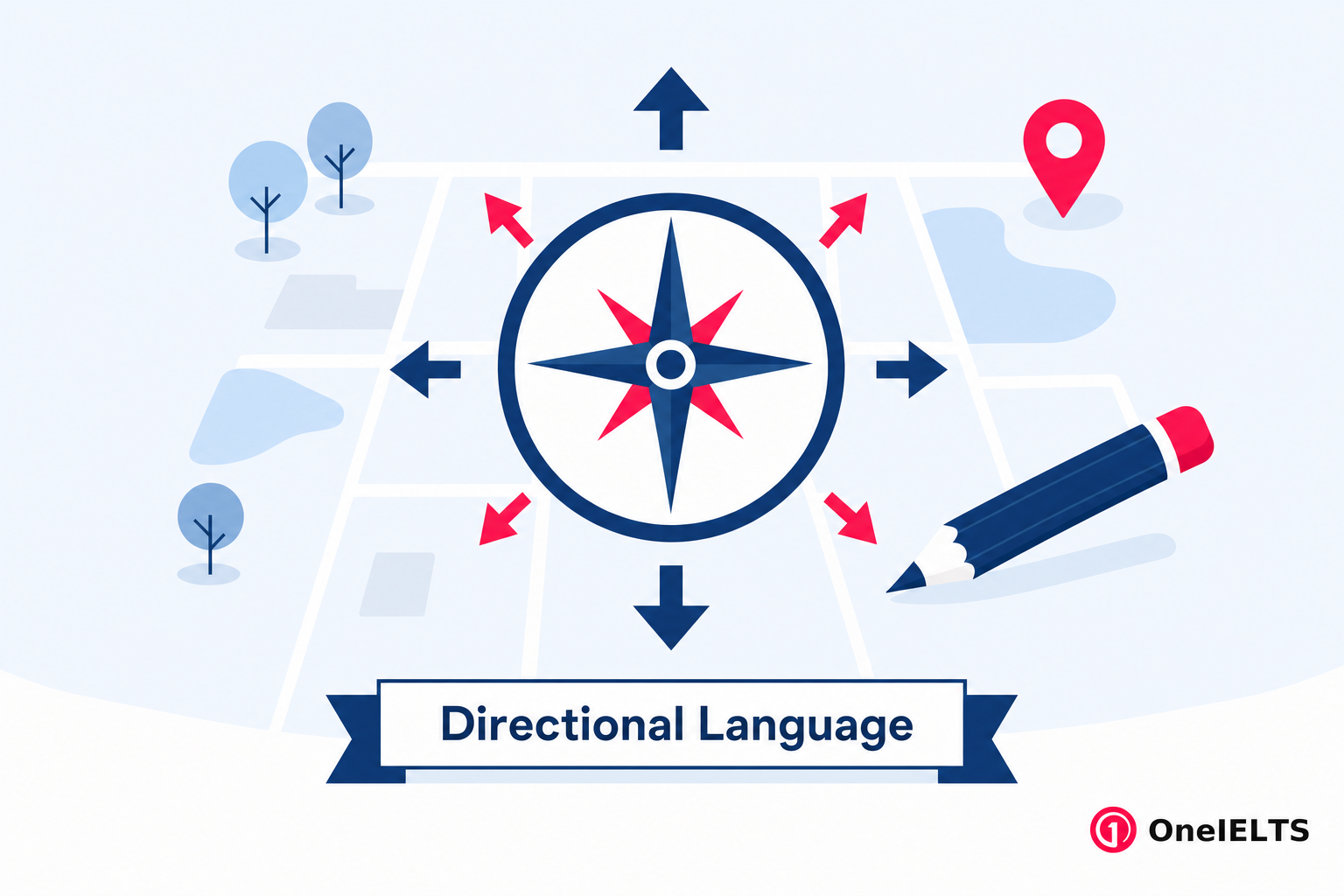
The spatial vocabulary is what actually decides these answers, because the speaker rarely names a building outright and instead positions it relative to something you have already found. Knowing these phrase families means you convert each instruction into a move on the page. The phrase groups that carry the most answers are listed here.
- Turn left right phrases. Commands such as turn left right at the junction change your facing, so a turn left right cue resets which direction “ahead” now points to.
- Opposite adjacent phrases. Words like opposite adjacent to, “across from,” and “next to” fix one place against another, so opposite adjacent language places the gap relative to a labelled landmark.
- Beyond at the end of phrases. Distance markers such as beyond at the end of the corridor tell you how far along a path the location sits before you mark it.
- North south phrases. Compass words like north south, “to the east,” and “on the western side” only help once the map is oriented, so check the north south arrow first.
Why Do Students Lose Marks on Map Questions?
Most marks are lost by losing orientation when the speaker changes direction, because one missed turn flips left and right for every instruction that follows. A single direction change you do not register means your pen now faces the wrong way. Candidates lose orientation in that moment and keep labelling positions that no longer match the route. That is how a candidate ends up falling behind: the audio moves on, the gaps pile up, and one slip costs three or four answers instead of one.
What Does a Map Labelling Question Look Like?
A typical Section 2 map or plan shows a park, a campus, or a single building with lettered locations such as A to H scattered across it and several gaps to fill. The Part 2 map or plan prints the streets, paths, or rooms, marks an entrance and a compass, and leaves blank boxes beside the features the speaker will name.
The audio gives a spoken route rather than a list, so the speaker walks you from the entrance past each lettered point in turn. You match each place to its letter in the order described. Working to label in order from the starting point keeps your answers aligned with the recording.
What Are the Best Tips for Map Labelling?
The best tactics all protect your orientation and keep your pen synced to the audio, so you spend the recording confirming positions rather than recovering from a lost one. These habits separate a clean set of answers from a scramble, and the most reliable ones are set out below.
- Mark the orientation point first. Put orientation first by circling the compass and the entrance before the audio begins, so every later instruction has a fixed reference to build from.
- Keep your pen on the current location. Resting your pen on location at the last confirmed point means you never lose your place, and your hand moves with the speaker through each new direction.
- Listen for prepositions of place. The prepositions of place such as “behind,” “between,” and “opposite” carry the answer, so treat each one as the signal to move your pen and mark a gap.
- Do not jump ahead. Stay on the location the speaker describes now, because guessing the next answer early is how candidates mislabel two points at once.
- Check spelling of labels. When you copy a place name from the options, match the spelling exactly, because a misspelt label loses the mark even when the position is right.
How Can You Practise These Questions With Real Audio?
Drill this question type with timed practice tests and replay every miss until the directional moves feel automatic rather than effortful. Timed practice under real conditions trains you to label at the speaker’s pace, and when you replay misses you hear exactly where your orientation slipped. Isolate the type before full tests by running several map sections back to back, so you build the navigation habit in one of our IELTS Listening practice tests.
How Do You Use the Compass and Map Orientation?
Check the compass and map orientation during the preparation time, before the audio starts. Fix which way is north so a phrase like “east of the library” matches the page, not your assumption. A misread orientation flips every direction that follows.
How Do You Track the Route as the Speaker Moves?
Keep your pencil on the marked starting point and follow the route as the speaker moves. Moving in real time keeps you oriented when several labels sound plausible at once. Lose the speaker’s path and the later answers unravel.
How Is IELTS Map Labelling Scored?
Each correctly placed label is worth one mark, with no penalty for a wrong guess, so fill every blank. Spelling matters only when you write a word rather than choose a letter, so copy any given labels exactly.
Last verified: 30 June 2026
Practice IELTS Listening
Put this into practice with real, exam-style questions: