


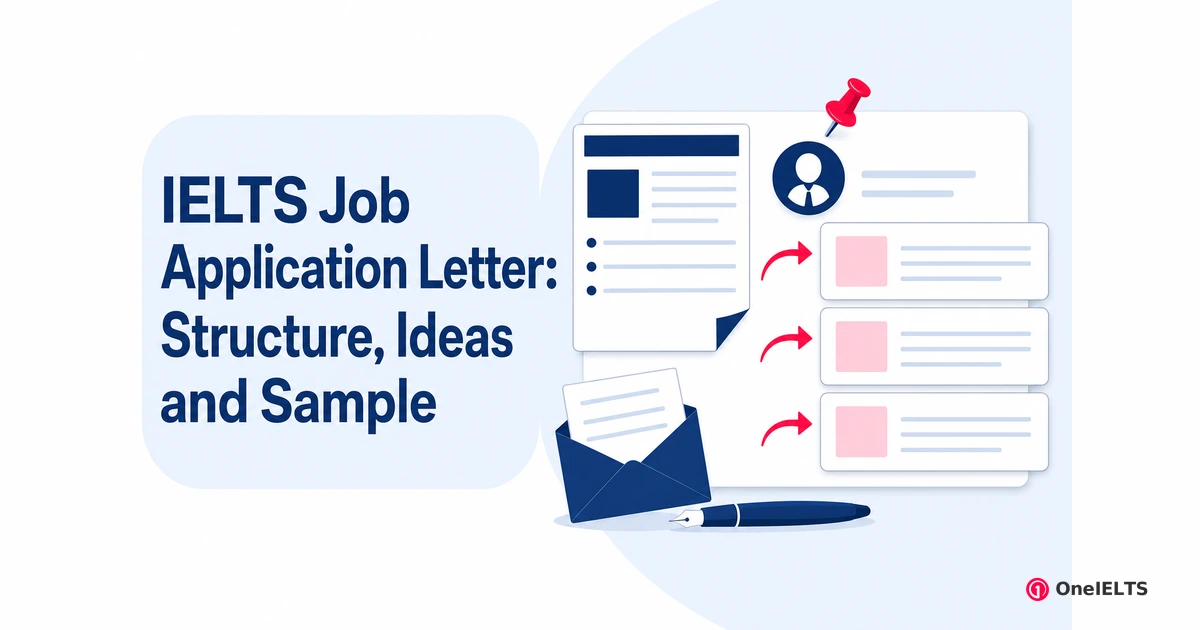
A job application letter is a General Training Task 1 prompt that gives you a job, a person to write to and three points to cover, and asks for at least 150 words. It is the most predictable letter in the exam, and no page says so.
Read enough real prompts and the bullet triad turns out to be the same three questions in a different order: who you are, what you can do, and what you want. Prepare a self-introduction paragraph, an experience paragraph and a what-I-want paragraph once, and the topic almost stops mattering.
The register question is settled here too. This letter takes a formal register, always, and every source that states one agrees.
This guide covers reading the situation, the register, the three bullet points, the structure, where the ideas come from, documents, the closing, a sample, the common topics and practice.
What Is an IELTS Job Application Letter?
An IELTS job application letter is a General Training Task 1 prompt in which you have seen a job advertised, or been told about one, and must write to apply for it in at least 150 words.
Two situations cover almost every version, and they change your opening sentence. Either you saw an advertised vacancy, or you had a personal recommendation from someone you met. Four of the seven real prompts collected for this page are advertisement prompts.
One thing separates this purpose from the other six. It is the only letter type where the reader decides something about you, so the bullet points ask about your own experience rather than about a situation happening around you.
The search results create one confusion worth clearing. Pages titled job application often carry a wider employment letter family: asking for a reference, declining an offer, requesting a role. Those are different tasks with different registers, and a job application prompt is specifically about applying.
Everything shared with the other purposes belongs to the IELTS letter writing page.
How Do You Find the Situation and Purpose of the Letter?
Read the prompt for four things before writing a word. Who is receiving it, how you heard about the job, which job it is, and what the three bullets are asking. Two minutes of prompt reading decides the whole letter.
- Who: are you given a named recipient, or told to open with Dear Sir or Madam? That single answer settles the salutation and the sign-off together.
- How you heard: an advertisement, a notice board, a conversation. The vacancy source is your opening sentence, and candidates leave it out.
- Which job: the exact job title, because naming it in the first line is what makes the purpose unmistakable to a reader.
- The three bullets: read them as questions about you, not as topics to be covered in the abstract.
The test owner is clear about what the opening does. Write a purpose sentence that plainly explains why you are writing, using I am writing to apply for, I am writing to express an interest in, or I am writing in response to.
Item two deserves the emphasis it never gets. Across the captured guides the where-you-saw-it move appears in every phrase bank and is named as a required element by nobody.
Should a Job Application Letter Be Formal or Informal?
Formal. Always. This is the one letter purpose where the register question has a single answer, and settling it in a line is the point of this section.
One source states it outright: job application letters are always formal in nature, so use formal expressions and a formal tone. The test owner gives two reasons that are better than the rule itself. You are usually told to open with Dear Sir or Madam, which is itself the salutation signal to write formally, and the purpose is a serious purpose because you are applying for a job.
Three things are what a formal register means here, and the parent page owns the rest. A contraction ban throughout, a formal opening address, and a formal sign-off with your full name underneath it.
One guide in the capture keeps semi-formal alive as a possible category for this type, and even it says the task usually appears as a formal letter. The exception is theoretical, and the full register argument sits on the IELTS letter writing guide.
How Do You Answer All the Bullet Points?
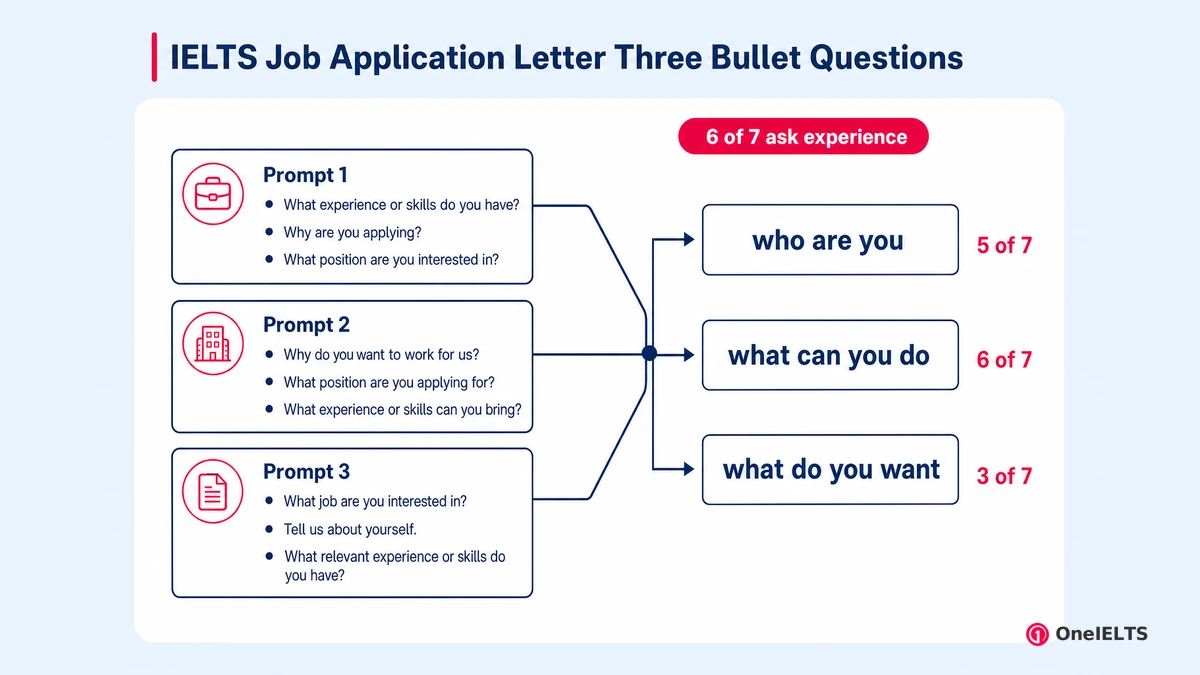
The bullet triad is almost always the same three questions in a different order: who you are, what you can do, and what you want. Recognise which is which and you are writing a letter you have already prepared.
The finding is a measurement rather than an opinion. Across the real application prompts collected for this page, six of seven ask for your experience or skills. Five ask who you are or why you are applying, and three ask what sort of job you want. Availability appears in one. The wording changes every time and the questions do not.
- Who are you: your current situation in one or two sentences, covering what you do now, how long you have done it, and any qualification that matters. Never a life story.
- What can you do: the paragraph that carries the marks. Two pieces of evidence, each with an example, meaning an experience and a result or a skill and where you used it. Adjectives alone are not evidence.
- What do you want: which position, full-time or part-time, and when you could start. This is where availability goes when a bullet asks for it.
One source publishes the only closed content list in the whole search result, and it sits on a page nobody will find it on. The position you are applying for, how you learned about it, and whether you want full-time or part-time work. Then your education and skills, the special qualities that fit you to the job, when you can attend an interview, and when you could join.
The cost of missing one is stated plainly in the captured set: fail to cover all three bullets clearly and you lose a band on Task Response. Note the label. IELTS calls that criterion Task Achievement on Task 1 and Task Response on Task 2, so the warning is right and the name is the guide’s slip.
The test owner removes one common anxiety in a line: you do not have to limit yourself to one paragraph per bullet point. The self-introduction and the evidence paragraph can each run to two if the bullets earn it.
What Is the Structure of a Job Application Letter?
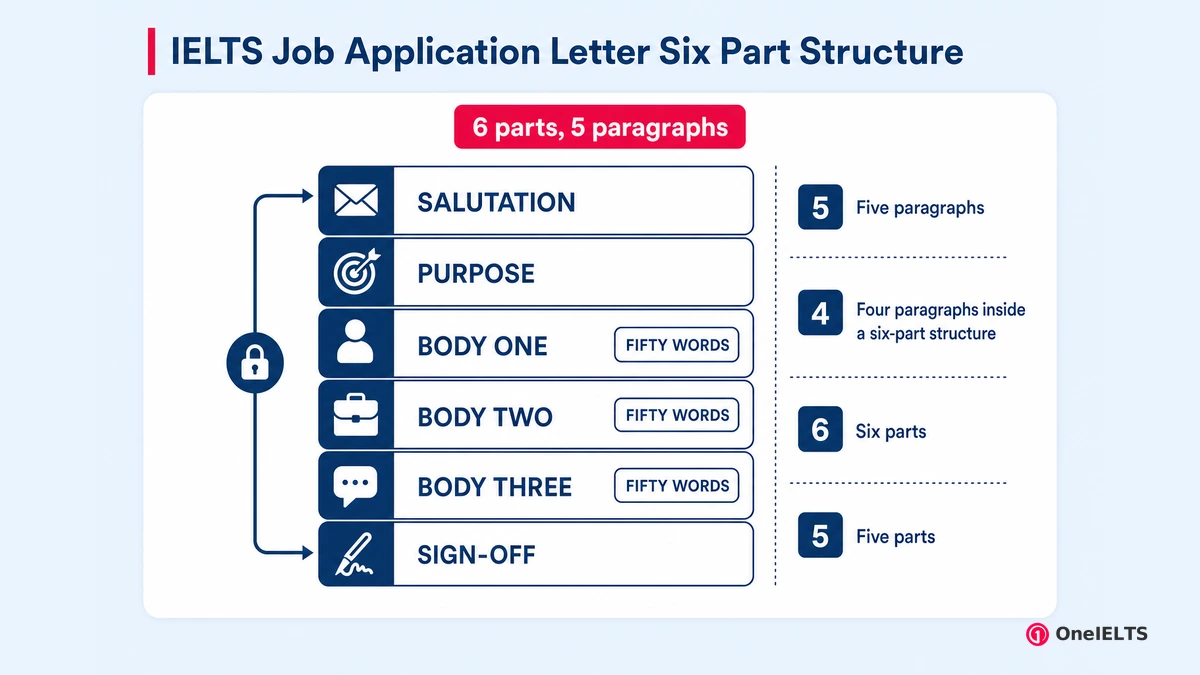
Six parts, five of which are paragraphs. The disagreement you will meet elsewhere about whether it is four, five or six is a counting difference rather than a real one.
Four sources on this search give four different numbers: five paragraphs, four paragraphs inside a six-part structure, six parts, and five parts. They describe the same letter. Some count the greeting and the sign-off as parts and some do not, which covers the whole of the argument.
- The salutation: Dear Sir or Madam, or Dear plus title and surname when the prompt gives you a name.
- The purpose paragraph: one sentence naming the job and how you heard about it, and never longer than that.
- Body one: who you are, at a body paragraph length of about fifty words.
- Body two: what you can do, with evidence. About fifty words again and the most important paragraph in the letter.
- Body three or the closing paragraph: what you want, and what you would like to happen next.
- The sign-off and your full name, with a sign-off match to whatever salutation you opened with.
The fifty-word guidance is guidance, not a rule, and it is what takes a 150-word letter to about 170 without padding. One paragraph per bullet is not a template to memorise either. The examiner should be able to find each bullet point without hunting for it, and a paragraph per bullet is the cheapest way to guarantee that.
The salutation and sign-off pair themselves, and the IELTS letter openings and closings page carries the full pairing.
How Do You Generate Ideas for an Application Letter?
Invent them, quickly, and make them fit together. You are not describing your real life. You are building a short, consistent back story that makes the three bullet points answerable.
The permission comes first, because a candidate without it writes three thin paragraphs. You may invent the recipient’s surname when you are not given one, and you should take a moment to build a logical background so your invented detail supports your points rather than sitting beside them.
The limit arrives in the same breath. One letter in the captured set was marked around band 6.5 partly because its details contradicted the prompt’s own premise, claiming a job title that made the request in the letter illogical. Logical consistency is the test: invent freely inside the prompt, never against it.
- Decide what you do now. One job and one length of service, because everything else hangs off this.
- Decide the one piece of evidence that fits the advertised job, whether an achievement, a responsibility or a qualification.
- Decide why you want this job specifically. Not the money, but a reason connected to the job in the prompt.
- Check the three against each other. If your current role makes the application illogical, change the role rather than the application.
One source gives a reassurance the others leave out. The ideas do not have to be the best ideas you can think of. Go with your first thoughts rather than hunting for better ones, because they only have to relate directly to the bullet points.
Evidence versus claim is where band 6 letters fail. An adjective is not evidence. Reliable and hard-working are claims, and five years in the same role is evidence.
Which Documents Can You Mention in an Application Letter?
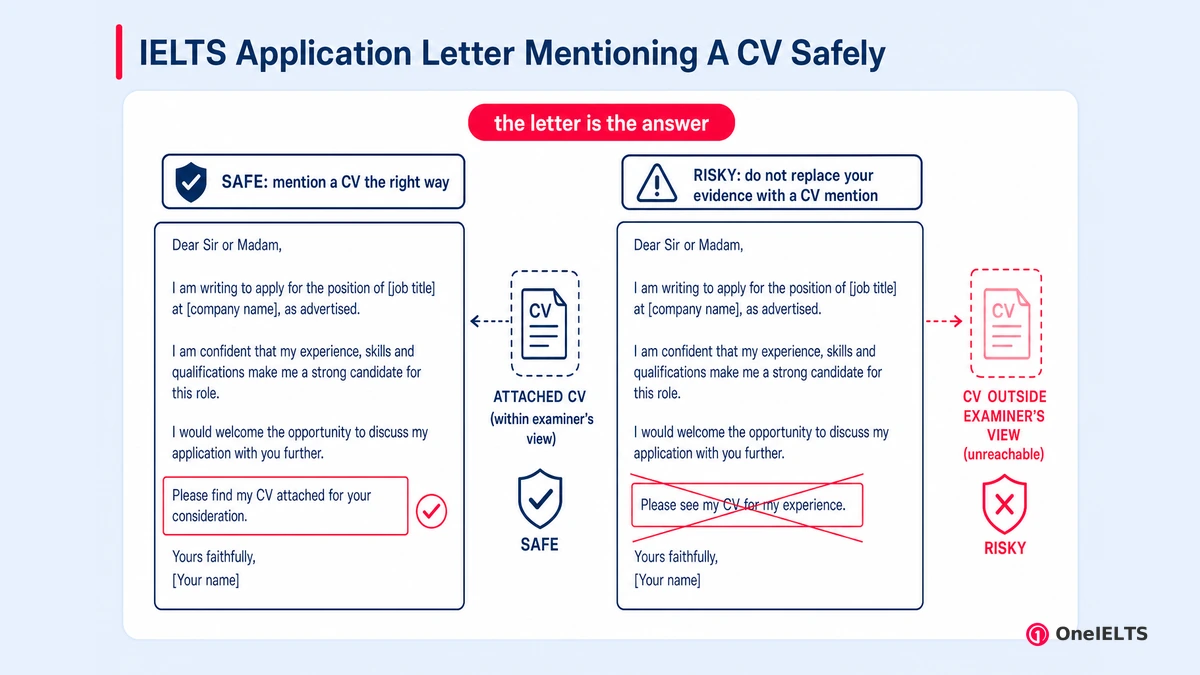
You may mention a CV or references as a closing formula, and the test owner’s own model does. Never use the mention as a substitute for describing your experience, because that is the bullet point carrying the marks.
The sources split cleanly and none of them states a rule. Six of the ten guides captured for this page have their model letter claim an attached CV, resume or references, and one of the six is the official test owner. Four others never mention a document at all.
- Safe: a single closing sentence offering further information or making a curriculum vitae mention. It reads as normal professional English and the test owner’s model uses it.
- Safe: offering to supply references if they are required, rather than claiming they are already attached to something.
- Risky: writing please see my CV for my experience instead of describing the experience. The examiner cannot see a CV, so that is an unanswered bullet.
- Unnecessary: listing what the attachment contains. It spends words on a document that nobody involved will ever read.
Here is the point that resolves it, and no source states it. Treat the letter as whole answer, start to finish. Everything the examiner will ever know about you sits inside those 150 words, so an enclosure formula can decorate the ending and can never carry content.
The rubric supports the reading. The task explicitly says you do not need to write any addresses, because the letter is a text rather than a document with enclosures attached to it.
How Do You Close a Job Application Letter?
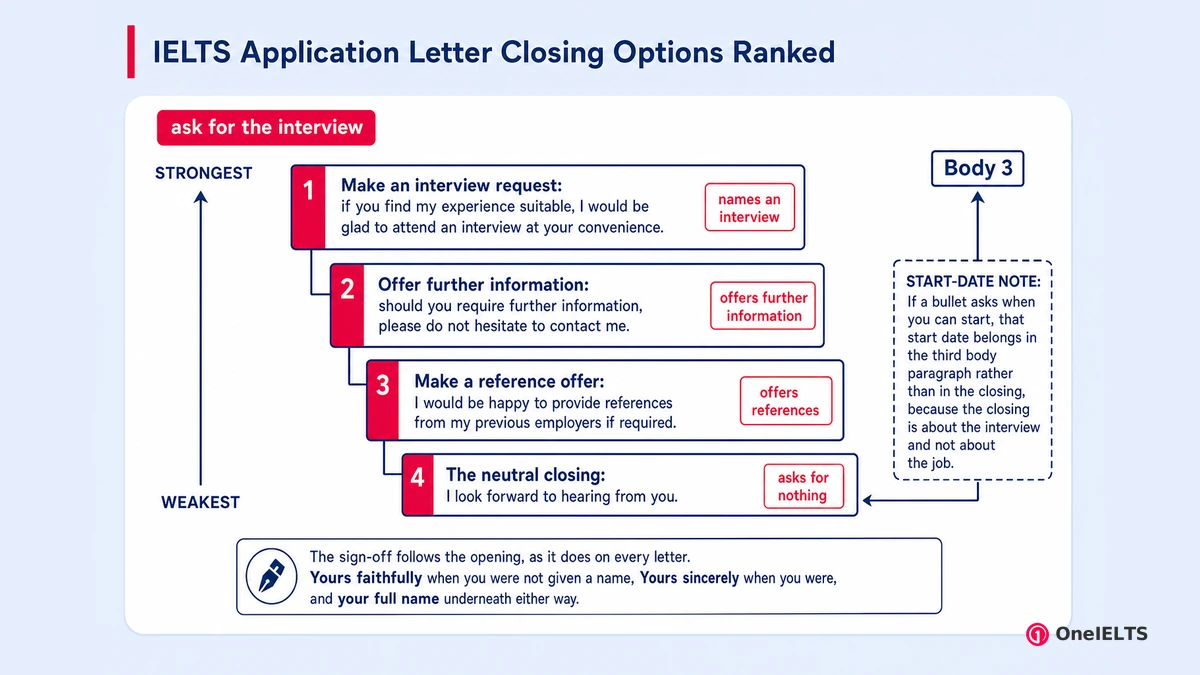
One sentence saying what you want to happen next, then the sign-off. On this letter type the next step is almost always an interview, and naming it turns a description into an application.
- Make an interview request: if you find my experience suitable, I would be glad to attend an interview at your convenience.
- Offer further information: should you require further information, please do not hesitate to contact me.
- Make a reference offer: I would be happy to provide references from my previous employers if required.
- The neutral closing: I look forward to hearing from you. Correct, common, and the weakest of the four.
Option one outranks option four for a reason no source states. An application is a request, and a request that names its outcome answers the task more completely than one that asks for nothing at all.
The sign-off follows the opening, as it does on every letter. Yours faithfully when you were not given a name, Yours sincerely when you were, and your full name underneath either way.
One thing goes in the wrong place constantly. If a bullet asks when you can start, that start date belongs in the third body paragraph rather than in the closing, because the closing is about the interview and not about the job.
What Does a Job Application Letter Sample Look Like?
About 170 to 180 words in six parts, formal throughout, with two pieces of concrete evidence in the middle paragraph. Read a model letter for those things and ignore its sentences.
The word target needs precise attribution. The published minimum is 150 words. Two independent guides in the captured set recommend aiming for about 170 to 180, one captured model runs to 182 words and another to 189, and a student letter marked around band 6.5 ran to 229. That last figure is the useful one, because the longest letter in the set is the weakest.
- Find the purpose sentence. It should sit in the first two lines and it should name the job outright.
- Find the evidence. Count the concrete facts in the middle paragraph, and fewer than two means the letter is claiming rather than showing.
- Check the contractions. On this letter type there should be none anywhere in it.
- Check the closing. Does it ask for anything, or does it only look forward to hearing from someone?
- Count the words, then compare that number against how much the letter actually manages to say.
Planning time gets four minutes inside the twenty-minute task in the guidance two captured guides give, and the test owner’s own page gives no timing at all.
Length discipline is a timing skill more than a writing one, and a timed IELTS Writing mock is where it shows up. Going long is not penalised in itself, and the cost is Task 2’s time, which the IELTS Writing Task 1 hub explains.
What Are the Common Job Application Letter Topics?
The jobs change and the situation does not. Almost every captured prompt is one of four situations, and once you can name the recurring situation the three bullets are predictable before you read them.
- You saw an advertised vacancy: a newspaper, a magazine, a website or a notice board. The commonest by far, and the one where you must say where you saw it.
- Someone made a personal suggestion: a person you met recommended you get in touch. Here the first bullet usually asks when and where you met them.
- A part-time role or weekend job: a hotel, a restaurant, a shop, a football club. Availability is far more likely to appear as a bullet on these.
- An internal or employment agency application: writing to an employment agency, or applying for a full-time post at the company you already work for part-time.
These are the situations behind the real prompts collected for this page, including a ten-prompt index published on one of the captured sites. The specific jobs recur too: waiter, hotel weekend work, museum shop, sales manager, night-class teacher, au pair, restaurant.
One boundary is worth keeping in view. Asking for a reference, declining an offer or requesting a role are different letters with different registers, even though guides file them under the same heading as this one.
How Do You Practise IELTS Job Application Letters?
Build the three paragraphs once, then practise fitting them to different prompts. On this task type the content is nearly fixed, so the skill being drilled is adaptation rather than invention.
- Write your three paragraphs once, untimed: who you are, one piece of evidence, and what you want. About fifty words each.
- Take five different application prompts and write only which reusable paragraph answers which bullet. Prompt matching takes five minutes in total.
- On two of them, rewrite the evidence paragraph so the evidence fits that particular job. Evidence adaptation is the only part that should change much.
- Write one full timed letter in twenty minutes, checking the clock as you finish the purpose sentence. It should read about minute five.
- Mark it yourself. Is every bullet answered, is there no contraction anywhere, and does the closing ask for something?
Step one is the unusual instruction and the opening finding is its reason. If the three questions behind the bullets are always the same, the paragraphs can be written before you ever see a prompt, which is not true of any other letter purpose.
The prompts for steps two and four come from IELTS Writing practice, where the OneIELTS sets live. One thing the link cannot do for you: it carries the question type but not the exam type, so switch Exam type to General in the left rail once the page opens. Practising needs a free OneIELTS account.
That exam type switch takes two seconds and it is the difference between drilling letters and drilling bar charts.
Which Greeting and Signoff Does an Application Letter Need?
Dear Sir or Madam with Yours faithfully when you are not given a name, and Dear plus title and surname with Yours sincerely when you are. On this letter type the first pairing is far more common.
The point that belongs here rather than on the parent page is about who decides. The prompt usually gives you a prescribed salutation, and when it does, that instruction has already fixed your paired sign-off. It is not two choices, it is one.
One source offers a middle option worth knowing. Kind regards is formal but friendly, and it suits a letter to someone you have actually met, such as the businessman who suggested you get in touch.
Sign with your full name rather than a first name, whatever the pairing. The IELTS letter writing page carries the full table for a name unknown and every other case.
Which Linking Words Does a Formal Letter Need?
Very few. A 170-word letter in six parts needs the connectors that move you between paragraphs and almost nothing else, because the structure is already doing the cohesion work.
Three groups earn their place. An addition connector for stacking two pieces of evidence, a contrast connector for the single concession an application sometimes needs, and a result connector for tying an achievement to the outcome it produced.
The point that belongs to this page is about tone. An application letter is marked partly on tone, and heavy formal connectors inside a short letter read as a stiff tone rather than as range. Short-letter cohesion runs on two or three of them, not ten.
The linking words for IELTS page lists the devices themselves.
How Do You Write a Complaint or Request Letter Instead?
Change the purpose sentence and the closing, and keep everything else. A complaint letter states what went wrong and what you want done. A request letter states what you want and why you deserve it.
The transfer is the reason this section exists. The six-part shape, the formal register and the one-paragraph-per-bullet rule are identical across the formal letter purposes, so the shared structure carries over untouched. What moves is the first sentence and the last one.
One register trap sits underneath the purpose swap. A complaint to a company is formal and a complaint to a neighbour is not. The employment family behaves the same way, since asking a former boss for a reference is semi-formal while applying to a stranger is formal.
The IELTS letter writing page carries the full list of purposes and the register test for each.
Where Can You Practise IELTS General Writing Task 1?
On General Training sets, which are letters, and you have to switch the exam type yourself because the link cannot carry it.
The constraint is worth stating precisely, since getting it wrong sends readers to the wrong sets. The link opens the practice hub, and the Exam type switch sits in the left rail. A General Training set is there and it is a letter. The question type filter is not module-aware, so the chart types listed beside it belong to Academic and are not letter filters.
It is worth the two clicks. A real set gives you the real bullet points in the exact form the exam uses them, which is the part a sample letter cannot teach you. The IELTS Writing practice hub holds them. Practising needs a free OneIELTS account.
Written by Jamil Ahmed, reviewed 14 August 2026.
Last verified: 14 August 2026
Practice for the Real IELTS Exam
Apply what you’ve learned with free, exam-style practice:
- Take a free IELTS mock test — all four skills, real exam timing, AI band scoring
- Sit a Writing section mock — Task 1 and Task 2 in one timed hour with a band estimate
- Practise by question type — self-paced Writing sets with model answers